
For many Americans, Social Security benefits serve as a foundational pillar of retirement security. However, a common misconception persists that these benefits are entirely tax-exempt. While Social Security was originally designed to be tax-free, legislative changes in 1983 and 1993 introduced a system where a portion of these benefits can be subject to federal income tax depending on your overall financial picture.
Navigating the intersection of retirement distributions and the Internal Revenue Service (IRS) requires a clear understanding of “combined income.” Calculating your tax liability is not merely a matter of looking at your benefit check; it involves a specific formula that integrates your various income streams. By mastering this calculation, retirees can better plan their cash flow, minimize tax drag, and ensure their golden years are financially sustainable.

Understanding Combined Income: The Core Metric
The first step in determining how much of your Social Security is taxable is calculating what the IRS calls your “combined income” (also frequently referred to as provisional income). This is a specialized metric used solely for the purpose of testing Social Security taxability. It is important to note that your combined income is not the same as your Adjusted Gross Income (AGI).
The Combined Income Formula
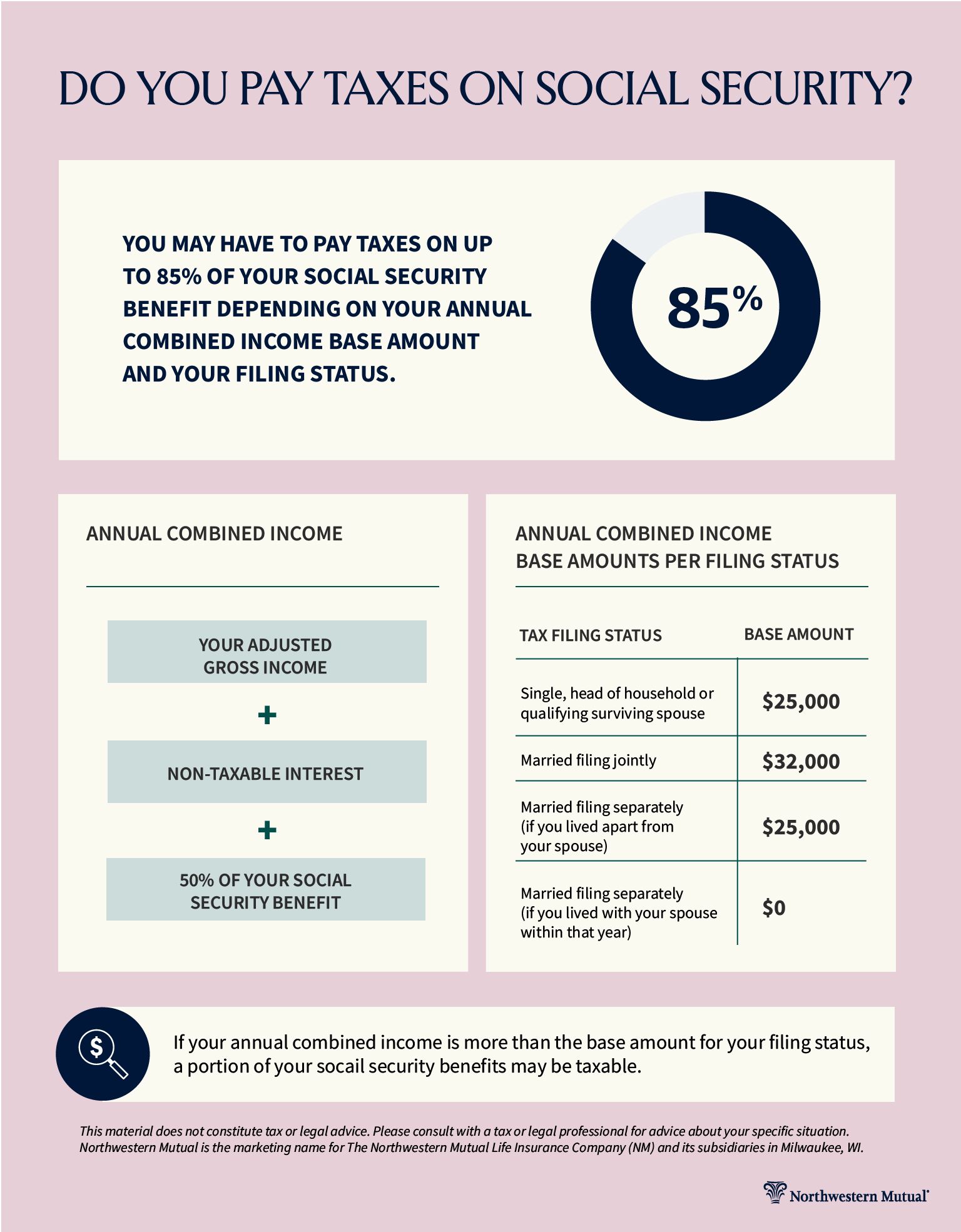
To find your combined income, you must add together three specific components:
-
Your Adjusted Gross Income (AGI) from your tax return (excluding Social Security benefits).
-
Any nontaxable interest you received (such as interest from municipal bonds).
-
Exactly one-half (50%) of your total Social Security benefits received during the year.
For example, if an individual has an AGI of $30,000, earns $1,000 in municipal bond interest, and receives $20,000 in Social Security benefits, their combined income would be $30,000 + $1,000 + $10,000 (half of the Social Security), totaling $41,000.
Why Nontaxable Interest is Included
A frequent point of confusion for investors is why “tax-free” municipal bond interest is included in this calculation. While municipal bond interest remains exempt from direct federal income tax, the IRS uses it as a “stealth” metric to determine the taxability of other income—in this case, Social Security. This means that while you aren’t paying tax on the bond interest, that interest could inadvertently push you into a higher bracket where more of your Social Security becomes taxable.
The Federal Income Tax Thresholds
Once you have determined your combined income, you must compare that figure against specific thresholds established by the IRS. These thresholds determine whether 0%, 50%, or up to 85% of your benefits are subject to income tax. It is a common myth that 85% of your benefits are taken as tax; rather, it is that 85% of the benefit amount is added to your taxable income and taxed at your ordinary marginal rate.
Thresholds for Individual Filers
If you file as an individual (Single, Head of Household, or Qualifying Surviving Spouse), the following brackets apply:
-
Below $25,000: Your Social Security benefits are generally not taxable.
-
Between $25,000 and $34,000: You may have to pay income tax on up to 50% of your benefits.
-
Above $34,000: Up to 85% of your benefits may be taxable.
Thresholds for Married Filing Jointly
If you are married and file a joint return, the thresholds are slightly higher to account for the dual-income potential:
-
Below $32,000: Your benefits are generally not taxable.
-
Between $32,000 and $44,000: You may have to pay income tax on up to 50% of your benefits.
-
Above $44,000: Up to 85% of your benefits may be taxable.
The Special Case of Married Filing Separately
The IRS discourages married couples from filing separately if they live together. If you are married, file a separate return, and lived with your spouse at any time during the tax year, your base amount is $0. This effectively means that 85% of your Social Security benefits will likely be taxable regardless of your other income.
A Practical Step-by-Step Calculation Walkthrough
To see how these thresholds work in a real-world scenario, let’s examine a hypothetical couple, the Millers, who are filing jointly.
The Millers’ Financial Data:
-
Pension Income: $25,000
-
IRA Distributions: $10,000
-
Tax-exempt Interest: $2,000
-
Total Social Security Benefits: $30,000
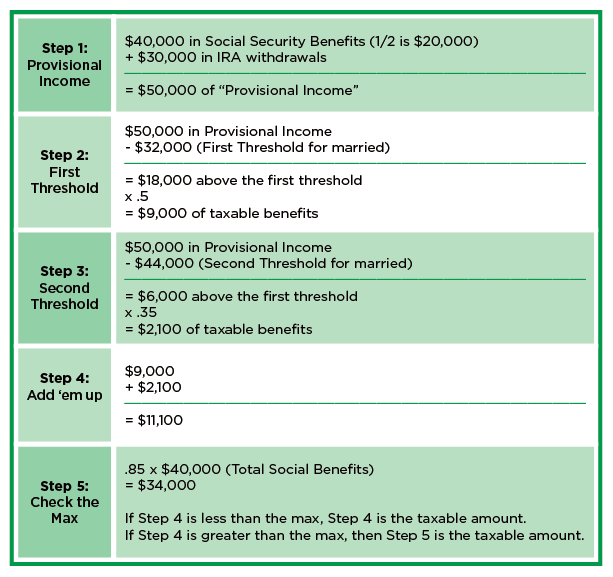
Step 1: Calculate Adjusted Gross Income (minus Social Security)
The Millers’ AGI consists of their pension and IRA distributions: $25,000 + $10,000 = $35,000.
Step 2: Apply the Combined Income Formula
Combined Income = AGI ($35,000) + Tax-exempt interest ($2,000) + 50% of Social Security ($15,000).
The Millers’ Combined Income is $52,000.
Step 3: Compare to Thresholds
Since $52,000 is greater than the $44,000 threshold for married couples, the Millers will fall into the 85% taxability bracket.
Step 4: Determine the Taxable Amount
The math for the actual taxable amount is a “lesser of” calculation. The IRS calculates several different figures and taxes the smallest one. Generally, for high-income earners like the Millers, the calculation results in 85% of their total benefit being added to their taxable income.
$30,000 (Total Benefit) x 0.85 = $25,500.
This $25,500 is then added to their other income on Form 1040 and taxed at their relevant marginal tax rate.
Strategic Tax Planning for Retirees
Understanding the “Social Security Tax Torpedo”—the phenomenon where an extra dollar of income can trigger taxes on Social Security benefits while also being taxed itself—is vital for effective tax planning. There are several strategies to mitigate this impact.
Utilizing Roth Accounts
Qualified distributions from a Roth IRA or Roth 401(k) are not included in your Adjusted Gross Income. Because they are omitted from AGI, they do not increase your “combined income.” Retirees who have built up significant Roth assets can draw from these accounts to meet spending needs without pushing their Social Security benefits into a higher taxability bracket.
Strategic Withdrawal Sequencing
The order in which you tap your accounts matters. Many advisors suggest a “bracket management” strategy where you withdraw just enough from traditional IRAs to stay below the Social Security tax thresholds, then switch to Roth accounts or taxable brokerage accounts (subject to lower capital gains rates) for the remainder of your needs.
Qualified Charitable Distributions (QCDs)
For those over age 70½, a QCD allows you to transfer up to $105,000 per year directly from a traditional IRA to a qualified charity. This distribution counts toward your Required Minimum Distribution (RMD) but is excluded from your AGI. By lowering your AGI, you effectively lower your combined income, which can reduce or eliminate the tax on your Social Security benefits.
Timing Social Security Benefits
The decision of when to claim Social Security also has tax implications. By delaying benefits until age 70, you increase your monthly check by roughly 8% per year after Full Retirement Age. While this results in a higher benefit, it also provides a window between retirement and age 70 to perform Roth conversions. These conversions can lower the future RMDs that might otherwise force your Social Security benefits to be taxed at the 85% level later in life.
State-Level Taxation and Reporting
While federal tax rules are uniform, state laws vary significantly. As of the current tax year, the majority of states do not tax Social Security benefits at all. This includes states with no income tax (like Florida, Texas, and Nevada) as well as many states that have income taxes but specifically exempt Social Security (like Illinois, Michigan, and Pennsylvania).
However, a handful of states still impose some level of tax on benefits, often using their own unique thresholds or mimicking the federal system with specific modifications. If you live in a state that taxes benefits, your effective tax rate on Social Security may be higher than you anticipated, making localized tax planning essential.
Filing the Paperwork: Form SSA-1099
Every January, the Social Security Administration sends out Form SSA-1099. This document details the total amount of benefits you received in the previous year. When filing your taxes, you will use the figures from this form to complete the Social Security Benefits Worksheet in the IRS instructions.
For those who find they consistently owe money at the end of the year due to Social Security taxation, the IRS allows for voluntary federal income tax withholding. You can file Form W-4V (Voluntary Withholding Request) with the Social Security Administration to have 7%, 10%, 12%, or 22% of your monthly benefit withheld for taxes. This can prevent a large, unexpected tax bill and potential underpayment penalties.
By taking a proactive approach to calculating and managing the tax on Social Security income, retirees can protect their purchasing power. Tax efficiency in retirement is not about avoiding obligations, but about understanding the rules well enough to ensure you are not paying more than is legally required, leaving more of your hard-earned benefits for your personal goals and legacy.
aViewFromTheCave is a participant in the Amazon Services LLC Associates Program, an affiliate advertising program designed to provide a means for sites to earn advertising fees by advertising and linking to Amazon.com. Amazon, the Amazon logo, AmazonSupply, and the AmazonSupply logo are trademarks of Amazon.com, Inc. or its affiliates. As an Amazon Associate we earn affiliate commissions from qualifying purchases.