
In the intricate world of finance, where numbers dictate decisions and percentages govern prosperity, few concepts are as fundamental yet frequently misunderstood as the “effective rate.” At first glance, it might appear to be just another piece of financial jargon, yet its implications are profound, shaping everything from the cost of your mortgage to the true return on your investments. The effective rate strips away the superficial layers of quoted percentages, revealing the true cost of borrowing or the genuine yield of an investment, taking into account the often-overlooked power of compounding. For anyone navigating personal finance, engaging in business transactions, or strategizing investments, a deep understanding of the effective rate isn’t just beneficial—it’s absolutely essential for making informed, intelligent financial choices.

This article delves into the core of what the effective rate represents, dissecting its mechanics, illustrating its various applications across different financial domains, and empowering you with the knowledge to leverage this concept for greater financial clarity and success. We will explore how it differs from nominal rates, why its calculation is crucial, and how recognizing it can protect you from hidden costs while maximizing your financial gains.
Unpacking the Concept: Nominal vs. Effective Rates
To truly grasp the significance of the effective rate, one must first understand the distinction between it and its more commonly advertised counterpart: the nominal rate. This divergence is where many individuals stumble, misinterpreting the actual financial implications of loans, savings, and investments.
The Illusion of the Nominal Rate
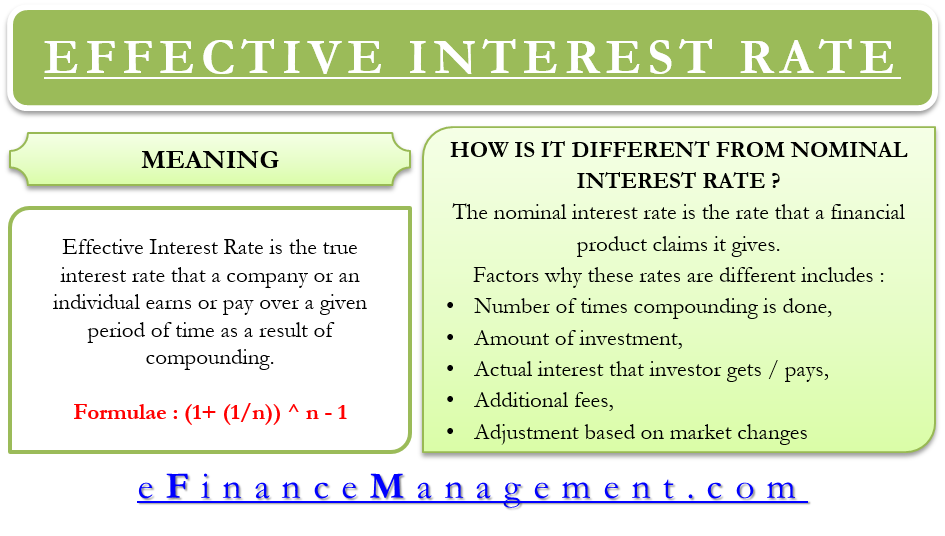
The nominal interest rate is the stated or advertised interest rate on a loan or investment over a specific period, typically an annual rate. For example, a bank might advertise a savings account with a “2% annual interest rate” or a loan with a “5% annual interest rate.” This rate seems straightforward, and on the surface, it gives you a quick idea of the cost or return. However, the nominal rate often fails to tell the full story because it does not account for the frequency with which interest is compounded within that period.
Think of the nominal rate as the headline—it’s attention-grabbing, but the devil is always in the details. Without considering how often interest is calculated and added to the principal, the nominal rate can be misleading, especially when comparing different financial products. Two loans with the same nominal annual rate can have vastly different true costs if one compounds monthly and the other annually.
Why Compounding Matters
Compounding is the engine that drives the difference between nominal and effective rates. It refers to the process where the interest earned on an investment or charged on a loan is added back to the principal, and then the next interest calculation is based on this new, larger principal amount. This means interest earns interest, or interest is charged on previously accrued interest.
The more frequently interest is compounded—daily, monthly, quarterly, semi-annually, rather than annually—the greater the impact on the total amount. For an investment, more frequent compounding means your money grows faster. For a loan, it means your debt accumulates more rapidly. The nominal rate, by itself, doesn’t capture this cumulative effect. It simply states the rate before factoring in the compounding frequency. This phenomenon is why the effective rate is almost always higher than the nominal rate for loans and investments that compound more frequently than once a year.
The True Cost or Return
The effective annual rate (EAR), also known as the effective interest rate (EIR) or annual equivalent rate (AER), is the actual annual rate of return or cost of borrowing, taking into account the effect of compounding over a given period. It’s the rate that allows for a true apples-to-apples comparison between different financial products, regardless of their nominal rates or compounding frequencies.
When you see an effective rate, you are looking at the real percentage cost you’re paying or the real percentage return you’re earning over a year. This distinction is critical for making sound financial decisions. Ignoring the effective rate can lead to underestimating the cost of debt or overestimating the returns on savings, ultimately impacting your financial health.
Effective Rates in Personal Finance
For individuals managing their own money, understanding the effective rate is not merely academic; it’s a practical skill that can save thousands of dollars and significantly boost wealth accumulation. It’s relevant across various personal finance products, from basic banking to complex credit instruments.
Loans and Mortgages: Understanding Your True Interest Cost
When you borrow money, whether for a car loan, a personal loan, or a mortgage, the advertised rate is often the nominal rate. However, loans typically compound interest more frequently than annually—monthly being the most common. This means the actual interest you pay over the year is higher than what the nominal rate suggests.
For example, a mortgage with a 4.5% nominal annual interest rate compounded monthly will have an effective annual rate slightly higher than 4.5%. While the difference might seem small percentage-wise, over the lifetime of a large loan like a mortgage, it translates into thousands or even tens of thousands of extra dollars paid. Savvy borrowers always inquire about the effective rate or calculate it themselves to understand the true cost of their debt and to compare competing offers accurately. A loan with a slightly lower nominal rate but much more frequent compounding might, in fact, be more expensive than one with a slightly higher nominal rate but less frequent compounding.
Savings Accounts and Investments: Maximizing Your Returns
On the flip side, for savings and investments, a higher effective rate is desirable. Banks advertise nominal rates for savings accounts, certificates of deposit (CDs), and money market accounts. If these accounts compound interest more frequently than annually (e.g., daily or monthly), the effective rate will be higher than the nominal rate, meaning your money grows faster.
Consider two savings accounts: Account A offers a 2% nominal annual rate compounded annually. Account B offers a 1.98% nominal annual rate compounded daily. Without knowing about effective rates, you might instinctively choose Account A. However, when you calculate the effective rate, Account B might yield a higher actual return due to daily compounding, illustrating the power of even slight differences in compounding frequency. For long-term investments, such as those in retirement accounts or brokerage portfolios, understanding the effective yield, which also accounts for dividends and capital gains, provides a more comprehensive picture of your actual investment performance.
Credit Cards: Avoiding Hidden Fees and Escalating Debt
Credit cards are perhaps one of the most insidious examples where understanding the effective rate is crucial. While credit card companies typically quote a nominal annual percentage rate (APR), the interest on credit cards is often compounded daily. This rapid compounding, combined with high nominal rates, means the effective rate can be substantially higher than the advertised APR, causing debt to spiral quickly if not managed proactively.
Furthermore, credit card agreements often include various fees (late payment fees, annual fees, balance transfer fees) that, while not directly part of the interest rate calculation, can effectively increase the overall cost of using the card. While these aren’t typically rolled into a standard effective interest rate calculation, being aware of the total cost of credit—including all fees and the effective interest rate—is paramount for consumers to avoid deep financial traps.
Effective Rates in Business and Investing
Beyond personal finance, the concept of the effective rate extends into the realm of business finance and investment analysis, playing a critical role in strategic decision-making and performance evaluation.
Corporate Finance: Cost of Capital and Project Evaluation
For businesses, calculating the effective cost of capital is fundamental. When a company issues debt (like bonds or loans) to finance operations or new projects, it needs to understand the true annual cost of that debt. This isn’t just about the stated coupon rate on a bond; it involves considering how interest payments are structured and compounded. The effective cost of debt feeds directly into the company’s weighted average cost of capital (WACC), a key metric used to discount future cash flows and evaluate the profitability of potential investments or projects.

Without an accurate effective cost of capital, businesses might misjudge the viability of projects, leading to suboptimal investment decisions. For instance, a project might seem profitable based on a nominal interest rate, but when the higher effective rate of borrowing is applied, it could turn out to be a losing proposition.
Investment Analysis: Comparing Returns Accurately
In the world of investing, comparing different investment vehicles requires a keen eye on their effective rates of return or yields. Whether evaluating bonds, preferred stocks, or complex derivatives, investors need to know the true annual return they can expect. For bonds, the “yield to maturity” is a form of effective rate, representing the total return an investor expects to receive if they hold the bond until it matures, taking into account the bond’s current market price, par value, coupon interest rate, and time to maturity.
Similarly, when comparing alternative investments or even different stock dividend policies, the effective annual return provides a standardized metric for comparison. It accounts for all cash flows (dividends, interest payments) and their reinvestment or compounding, giving investors a clear picture of an investment’s actual performance potential, rather than just its stated coupon or dividend rate. This prevents investors from chasing seemingly high nominal yields that, upon closer inspection, deliver lower effective returns due to less frequent compounding or other factors.
Effective Tax Rate: The Real Burden
Another crucial application in business finance is the “effective tax rate.” This is the actual percentage of their income that a company or individual pays in taxes, after accounting for all deductions, credits, and preferential rates. It differs significantly from the statutory tax rate (the official rate set by law).
For businesses, the effective tax rate is a vital indicator of tax efficiency and can vary significantly due to tax planning, R&D credits, depreciation schedules, and international tax treaties. A company’s effective tax rate gives analysts and investors a clearer picture of its actual tax burden than merely looking at the statutory rate, which might be much higher. Similarly, for individuals, understanding their effective tax rate provides a truer sense of their tax liability and helps in financial planning, especially when considering different income sources or deductions.
Calculating the Effective Rate
While the concept of the effective rate is straightforward, its calculation involves a simple yet powerful formula that translates nominal rates and compounding frequencies into a comparable annual figure.
The Universal Formula
The most common formula for the effective annual rate (EAR) is:
EAR = (1 + (Nominal Rate / Number of Compounding Periods per Year))^Number of Compounding Periods per Year – 1
Where:
-
Nominal Rate: The stated annual interest rate (as a decimal).
-
Number of Compounding Periods per Year (n): How many times interest is compounded within a year (e.g., 1 for annually, 2 for semi-annually, 4 for quarterly, 12 for monthly, 365 for daily).
Let’s break down how this works:
-
Nominal Rate / n: This gives you the interest rate per compounding period.
-
1 + (Nominal Rate / n): This adds the periodic interest rate to 1, representing the growth factor per period.
-
(…)^n: Raising this growth factor to the power of ‘n’ calculates the total growth over the entire year, taking into account all compounding periods.
-
– 1: Subtracting 1 converts this growth factor back into a percentage rate for the year.
Practical Examples and Scenarios
-
Example 1: Savings Account
-
Nominal Rate: 5% (0.05)
-
Compounding: Monthly (n=12)
-
EAR = (1 + (0.05 / 12))^12 – 1 = (1 + 0.00416667)^12 – 1 = (1.00416667)^12 – 1 = 1.05116 – 1 = 0.05116 or 5.116%
-
Here, a 5% nominal rate compounded monthly effectively yields 5.116% annually.
-
-
Example 2: Loan
-
Nominal Rate: 8% (0.08)
-
Compounding: Quarterly (n=4)
-
EAR = (1 + (0.08 / 4))^4 – 1 = (1 + 0.02)^4 – 1 = (1.02)^4 – 1 = 1.082432 – 1 = 0.082432 or 8.2432%
-
An 8% nominal rate compounded quarterly means you’re effectively paying 8.2432% annually.
-
Tools and Calculators
While the formula is straightforward, manual calculation can be tedious. Fortunately, numerous financial calculators (both physical and online) and spreadsheet software (like Excel with the EFFECT function) can quickly compute the effective annual rate. Learning to use these tools empowers you to instantly compare different financial products and make accurate financial assessments without needing to perform manual calculations.
The Importance of Knowing the Effective Rate
Understanding and utilizing the concept of the effective rate is more than just a financial nicety; it is a critical skill for navigating the complexities of modern finance and achieving your monetary goals.
Making Informed Financial Decisions
The primary benefit of knowing the effective rate is the ability to make truly informed financial decisions. Whether you are choosing between different loan offers, comparing investment opportunities, or evaluating the profitability of a business venture, the effective rate provides the objective truth. It cuts through misleading advertisements and allows for a direct, equitable comparison of options, ensuring you select the product or strategy that best aligns with your financial objectives. This clarity helps prevent costly mistakes and optimizes your financial outcomes.
Avoiding Pitfalls and Maximizing Opportunities
Without an understanding of the effective rate, individuals and businesses are vulnerable to common financial pitfalls. For borrowers, underestimating the true cost of debt due to frequent compounding can lead to over-indebtedness. For investors, overestimating returns based on nominal rates can result in disappointment and missed opportunities to invest in truly higher-yielding products.
Conversely, armed with this knowledge, you can actively seek out opportunities. You can identify savings accounts with superior effective rates even if their nominal rates appear similar, or negotiate loan terms with less frequent compounding to reduce overall interest paid. It empowers you to be a proactive participant in your financial journey, rather than a passive recipient of advertised rates.
Empowering Financial Literacy
Ultimately, comprehending the effective rate significantly enhances your overall financial literacy. It builds a deeper understanding of how money works—how it grows, how it costs, and how time and compounding frequency profoundly impact its value. This foundational knowledge is transferable to many other financial concepts, from understanding inflation’s erosion of purchasing power to calculating future value in retirement planning. By demystifying one of finance’s most crucial concepts, you gain confidence and capability to tackle more complex financial challenges and achieve long-term financial stability and growth.
In conclusion, the effective rate is far from an abstract financial concept; it is a practical tool essential for anyone looking to optimize their personal finances, evaluate business investments, or simply make smarter choices with their money. By distinguishing between nominal and effective rates and understanding the powerful role of compounding, you gain a critical advantage, transforming potential financial pitfalls into pathways for informed decision-making and genuine financial success.
aViewFromTheCave is a participant in the Amazon Services LLC Associates Program, an affiliate advertising program designed to provide a means for sites to earn advertising fees by advertising and linking to Amazon.com. Amazon, the Amazon logo, AmazonSupply, and the AmazonSupply logo are trademarks of Amazon.com, Inc. or its affiliates. As an Amazon Associate we earn affiliate commissions from qualifying purchases.