
In the vast realm of material science and engineering, fluids are often categorized by their response to applied forces. The common understanding, shaped by everyday observations of water or oil, often assumes a constant resistance to flow – a property known as viscosity. However, a fascinating and critically important class of substances defies this simple assumption: non-Newtonian fluids. Far from being mere scientific curiosities, these dynamic materials are foundational to a myriad of modern technologies, influencing everything from the protective gear we wear to the performance of advanced industrial machinery. Understanding non-Newtonian fluids is not just about abstract physics; it’s about unlocking innovations that drive progress across countless technological domains.

Beyond Simple Viscosity: Understanding Non-Newtonian Behavior
To truly grasp the essence of a non-Newtonian fluid, we must first appreciate its Newtonian counterpart and then delve into the characteristics that set these unique substances apart. Their peculiar behavior under stress is what makes them invaluable to technological advancements.
The Newtonian Baseline: Predictable Flow
Most people intuitively understand Newtonian fluids, even if they don’t know the term. These are fluids where viscosity – a measure of a fluid’s resistance to deformation by shear stress – remains constant regardless of the shear rate (the rate at which layers of the fluid move past each other). Think of water, air, or most light oils. If you stir water gently or vigorously, its “thickness” or resistance to flow doesn’t change. This predictable relationship, described by Isaac Newton’s law of viscosity, states that shear stress is directly proportional to shear rate, with viscosity being the constant of proportionality. This linear relationship simplifies engineering calculations and material handling for a vast array of applications.
The Dynamic Nature: Viscosity Under Stress
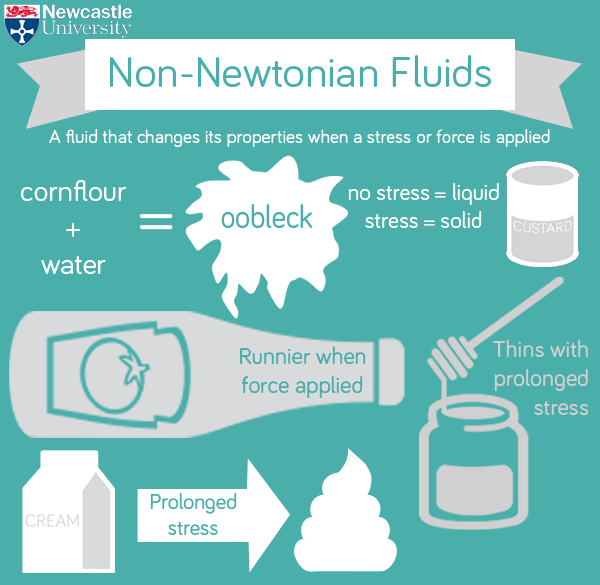
Non-Newtonian fluids, however, play by a different set of rules. Their viscosity is not constant; instead, it changes depending on the applied shear stress or shear rate. This means that how “thick” or “thin” a non-Newtonian fluid feels or behaves can drastically alter based on how quickly or forcefully it is stirred, poured, or otherwise manipulated. Imagine dipping your hand slowly into a vat of cornstarch and water (oobleck) – it feels like a liquid. Now try to punch it quickly, and it will resist like a solid. This dynamic response to force is the defining characteristic of non-Newtonian fluids and the key to their technological utility. Their ability to adapt their rheological properties makes them ideal for applications requiring intelligent, responsive materials.
Key Characteristics and Deviations
The deviations from Newtonian behavior are what define non-Newtonian fluids. These deviations manifest in several ways:
-
Shear-Dependent Viscosity: The most common characteristic, where viscosity changes with the shear rate. This can be either shear-thinning (viscosity decreases) or shear-thickening (viscosity increases).
-
Time-Dependent Viscosity: Some non-Newtonian fluids also exhibit a change in viscosity over time while subjected to constant shear, or after the shear is removed. This leads to phenomena like thixotropy and rheopexy.
-
Yield Stress: Certain non-Newtonian fluids, known as viscoplastic fluids, behave like solids until a certain amount of stress (the yield stress) is applied, after which they begin to flow like a liquid.
These diverse responses mean that designing systems to handle or utilize non-Newtonian fluids requires a deeper understanding of fluid mechanics and material science, often involving complex computational fluid dynamics (CFD) models to predict their behavior accurately.
Types of Non-Newtonian Fluids and Their Mechanisms
The category of non-Newtonian fluids is broad, encompassing several distinct types, each characterized by a specific response to shear forces or time. Understanding these distinctions is crucial for selecting and engineering the right fluid for a particular technological application.
Shear-Thinning (Pseudoplastic) Fluids: Flowing with Ease
Shear-thinning fluids are perhaps the most common type of non-Newtonian fluid encountered in everyday life and industry. Their viscosity decreases as the shear rate increases. This means that the more you agitate or stress them, the “thinner” they become and the easier they flow.
Mechanism: At low shear rates, the complex molecules or particles within the fluid are randomly oriented, leading to high resistance. As shear rate increases, these particles align themselves in the direction of flow, reducing entanglement and resistance, thus lowering viscosity.
Technological Relevance:
-
Paints and Coatings: They are thick in the can (preventing drips) but thin out under the shear of a brush or roller for smooth application, then thicken again to prevent sagging.
-
Ketchup and Sauces: They stay in the bottle until shaken or squeezed (applying shear), becoming fluid enough to pour out.
-
Blood: A vital biological fluid that exhibits shear-thinning, allowing it to flow more easily through capillaries under high shear, reducing the heart’s pumping effort.
-
Cosmetics and Lotions: Designed to be viscous in the container but spread easily on the skin.
Shear-Thickening (Dilatant) Fluids: Resisting Force
Conversely, shear-thickening fluids (also known as dilatant fluids) exhibit an increase in viscosity as the shear rate increases. The harder you try to move them, the more resistant they become, appearing to solidify.
Mechanism: These fluids typically consist of a high concentration of solid particles suspended in a liquid. At low shear rates, the liquid acts as a lubricant. Under high shear, the particles are forced closer together, increasing friction and resistance, and the liquid matrix can no longer lubricate effectively, causing the suspension to “jam” or “thicken.”
Technological Relevance:
-
Liquid Body Armor (e.g., d3o): Materials like d3o are soft and flexible under normal movement but instantly stiffen upon impact, absorbing and dispersing energy to protect the wearer. This has applications in sports gear, motorcycle clothing, and military vests.
-
Smart Dampers and Suspension Systems: Used in automotive and aerospace applications to provide adaptive damping that stiffens or softens based on external forces, improving ride comfort and vehicle stability.
-
Industrial Safety: Certain impact-absorbing materials in machinery or protective flooring.
Time-Dependent Fluids: Thixotropic and Rheopectic
Some non-Newtonian fluids also incorporate a time component into their rheological behavior, meaning their viscosity changes not just with shear rate, but also with the duration of applied shear or rest.
-
Thixotropic Fluids: These fluids show a decrease in viscosity over time when subjected to constant shear, and their viscosity recovers gradually over time when the shear is removed. Think of stirring yogurt or paint – it gets runnier the longer you stir, but thickens up again if left to sit.
Technological Relevance: Critical for formulations where easy application and subsequent stability are required, such as specific types of drilling muds, structural adhesives, and some food products.
-
Rheopectic Fluids: The opposite of thixotropic, these fluids show an increase in viscosity over time when subjected to constant shear. This behavior is relatively rare but can be observed in some gypsum pastes or certain printer inks.
Technological Relevance: While less common, rheopexy can be harnessed in specialized applications requiring stiffening under continuous agitation.
Viscoplastic Fluids: Yielding to Pressure
Viscoplastic fluids behave like a solid until a certain threshold of stress, known as the yield stress, is exceeded. Once this stress is applied, they begin to flow like a conventional fluid.
Mechanism: These fluids often contain a network of particles or molecular structures that provide internal resistance. Below the yield stress, this network holds the fluid’s shape. Above it, the network breaks down, allowing flow.
Technological Relevance:
-
Toothpaste and Mayonnaise: They hold their shape in the tube or jar but flow easily once squeezed or spread.
-
Drilling Muds: Designed to be thick enough to suspend drill cuttings when drilling stops (preventing them from settling) but fluid enough to pump when operations resume.
-
Chocolate: Used in confectionery, it must be fluid enough to coat items evenly but then quickly set to prevent dripping.
-
3D Printing Inks: Many advanced 3D printing materials are viscoplastic, allowing them to be extruded precisely and then immediately hold their shape without slumping.

Real-World Tech Applications: Where Non-Newtonian Fluids Shine
The unique and often counter-intuitive properties of non-Newtonian fluids have made them indispensable in countless technological applications, revolutionizing industries and enabling new possibilities.
Personal Protective Equipment and Impact Absorption
The ability of shear-thickening fluids to instantly stiffen upon impact is a game-changer for safety technology. Materials like d3o, utilizing these fluids, are integrated into sports helmets, motorcycle jackets, military body armor, and even footwear. They offer flexibility and comfort during normal movement, but critically absorb and dissipate kinetic energy during a sudden impact, vastly improving protection against blunt force trauma. This dynamic response far surpasses the capabilities of traditional rigid materials, which offer static protection.
Advanced Manufacturing and Industrial Processes
Non-Newtonian fluids are central to precision in modern manufacturing.
-
Adhesives and Sealants: Many high-performance adhesives are shear-thinning, allowing for precise dispensing through nozzles while remaining viscous enough to prevent dripping before curing.
-
3D Printing: Specialized “inks” for additive manufacturing, particularly for ceramics, metals, and bioprinting, are often viscoplastic. They must flow under extrusion pressure but then immediately solidify or hold their shape upon deposition.
-
Lubricants: Some high-performance lubricants are designed to be non-Newtonian, providing optimal viscosity under varying operational conditions (e.g., staying thick in high-stress areas but flowing easily elsewhere).
-
Food Processing: Critical for pumping and handling thick slurries, purees, and batters, ensuring consistent texture and efficient production without degradation.
Food Science and Culinary Innovations
Beyond everyday items like ketchup, non-Newtonian rheology is a cornerstone of food technology. From optimizing the texture of yogurts and sauces to controlling the flow properties of molten chocolate for confectionery, understanding how these fluids behave under shear is vital for product development, processing efficiency, and consumer satisfaction. It ensures that products are easy to dispense, have a pleasant mouthfeel, and maintain stability.
Cosmetics, Pharmaceuticals, and Everyday Products
The personal care and pharmaceutical industries heavily rely on non-Newtonian principles.
-
Lotions and Creams: Formulated as shear-thinning to spread easily on the skin but remain viscous enough to stay in place.
-
Shampoos and Conditioners: Designed to pour smoothly from the bottle but then cling to hair during washing.
-
Drug Delivery: Non-Newtonian gels and suspensions can offer controlled release of active pharmaceutical ingredients, making drug application more effective and consistent.
-
Household Cleaners: Many cleaning gels are shear-thinning, allowing them to be sprayed or poured effectively while adhering to surfaces.
Automotive and Aerospace Engineering
In transportation, non-Newtonian fluids are key to enhancing performance and safety.
-
Active Suspension Systems: Magnetorheological (MR) fluids, a type of shear-thickening fluid whose viscosity can be controlled by a magnetic field, are used in intelligent dampers. This allows vehicle suspension to adapt almost instantly to road conditions, improving handling, stability, and ride comfort.
-
Clutches and Brakes: MR fluids are also explored for controlled-slip clutches and braking systems, offering precise torque transfer and rapid response.
-
Damping Mechanisms: Used in aircraft landing gear and structural components to absorb vibrations and reduce fatigue.
The Future of Fluid Dynamics in Technology
As our understanding of material science deepens and computational power increases, the potential for non-Newtonian fluids in future technologies is immense, pushing the boundaries of what materials can achieve.
Smart Materials and Adaptive Systems
The inherent “intelligence” of non-Newtonian fluids – their ability to dynamically respond to external stimuli – positions them at the forefront of smart materials research. Imagine self-healing polymers that incorporate non-Newtonian elements to flow into and repair cracks, or clothing that can actively stiffen or soften based on environmental conditions or wearer activity. Microfluidic devices are also leveraging precisely controlled non-Newtonian behavior for advanced diagnostics and drug delivery.
Simulation and Predictive Modeling
The complexity of non-Newtonian fluid behavior necessitates sophisticated computational tools. Advances in Computational Fluid Dynamics (CFD) are allowing engineers to simulate and predict the behavior of these fluids in increasingly complex systems. This capability is vital for optimizing industrial processes, designing next-generation protective gear, and innovating new material formulations with tailored rheological properties, minimizing costly physical prototyping.
Environmental and Sustainable Solutions
Research is also focusing on developing eco-friendly and sustainable non-Newtonian fluids, replacing petroleum-based components with bio-derived alternatives. Furthermore, their unique flow characteristics can be leveraged in advanced filtration systems, energy-efficient pumping solutions, and even in technologies for carbon capture and waste management, contributing to a greener future.
Conclusion: The Unsung Heroes of Modern Technology
Non-Newtonian fluids are far more than just intriguing scientific phenomena; they are fundamental building blocks of modern technology. Their dynamic and adaptable properties, which allow their viscosity to change under stress or over time, make them indispensable across a vast spectrum of applications – from safeguarding lives in protective gear to ensuring precision in advanced manufacturing, and from enhancing the quality of everyday products to powering intelligent automotive systems. As researchers continue to explore and harness their unique characteristics, non-Newtonian fluids will undoubtedly remain at the cutting edge of material science and engineering, quietly driving the next wave of technological innovation and shaping the world around us in increasingly sophisticated ways.
aViewFromTheCave is a participant in the Amazon Services LLC Associates Program, an affiliate advertising program designed to provide a means for sites to earn advertising fees by advertising and linking to Amazon.com. Amazon, the Amazon logo, AmazonSupply, and the AmazonSupply logo are trademarks of Amazon.com, Inc. or its affiliates. As an Amazon Associate we earn affiliate commissions from qualifying purchases.