
Mathematics is the language of finance, providing the foundational tools to understand, analyze, and predict economic behavior. Among the many mathematical concepts crucial for sound financial decision-making, the arithmetic series stands out as a fundamental building block. While often introduced in an abstract context, its principles are deeply embedded in various aspects of personal finance, investing, and business operations. From calculating simple interest accumulation to modeling consistent revenue growth, understanding what an arithmetic series is and how it functions can significantly enhance your financial literacy and analytical capabilities. This article will demystify the arithmetic series, delve into its core components, and illuminate its practical applications within the realm of money.
The Core Concept: Defining Arithmetic Series
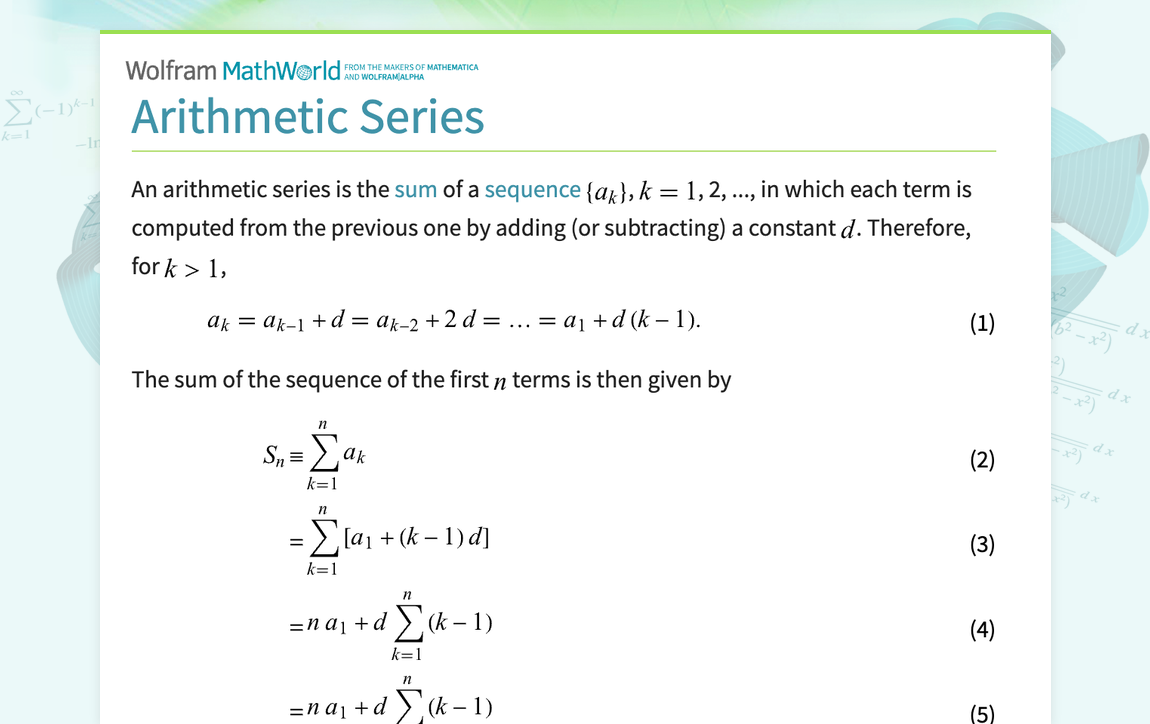
At its heart, an arithmetic series is the sum of the terms of an arithmetic sequence. To fully grasp a series, we must first understand its underlying sequence.
Sequences vs. Series: Laying the Groundwork
A sequence is an ordered list of numbers. For example, 2, 4, 6, 8, 10 is an arithmetic sequence. Each number in the sequence is called a “term.”
A series is the sum of the terms of a sequence. So, for the sequence above, the corresponding arithmetic series would be 2 + 4 + 6 + 8 + 10. In finance, we often deal with sequences of payments, investments, or returns, and we are interested in their cumulative sum—the series.
Key Components: Common Difference, First Term, Number of Terms
An arithmetic sequence is characterized by a “common difference.” This means that the difference between consecutive terms is constant.
-
First Term ($a_1$): This is the starting value of the sequence. In a financial context, this could be your initial savings contribution, the first payment in a series, or a starting revenue figure.
-
Common Difference ($d$): This is the constant value added to each term to get the next term. If you’re saving an extra $50 each month, $50 is your common difference. If a business’s revenue increases by $10,000 consistently each quarter, that’s the common difference.
-
Number of Terms ($n$): This represents how many terms are in the sequence or how many values you are adding up. This could be the number of months you save, the number of years a loan is repaid, or the number of periods for a business projection.
The Formula for the nth Term
To find any specific term in an arithmetic sequence without listing all of them, we use the formula for the nth term:
$an = a1 + (n-1)d$
Where:
-
$a_n$ is the nth term (the value of the term at position ‘n’)
-
$a_1$ is the first term
-
$n$ is the term number
-
$d$ is the common difference
Financial Example: Imagine you save $100 in January, and then increase your savings by $20 each month. What will be your savings contribution in the 12th month (December)?
$a_1 = 100$
$d = 20$
$n = 12$
$a_{12} = 100 + (12-1)20 = 100 + (11)20 = 100 + 220 = 320$.
So, in December, you would contribute $320.
Calculating the Sum of an Arithmetic Series
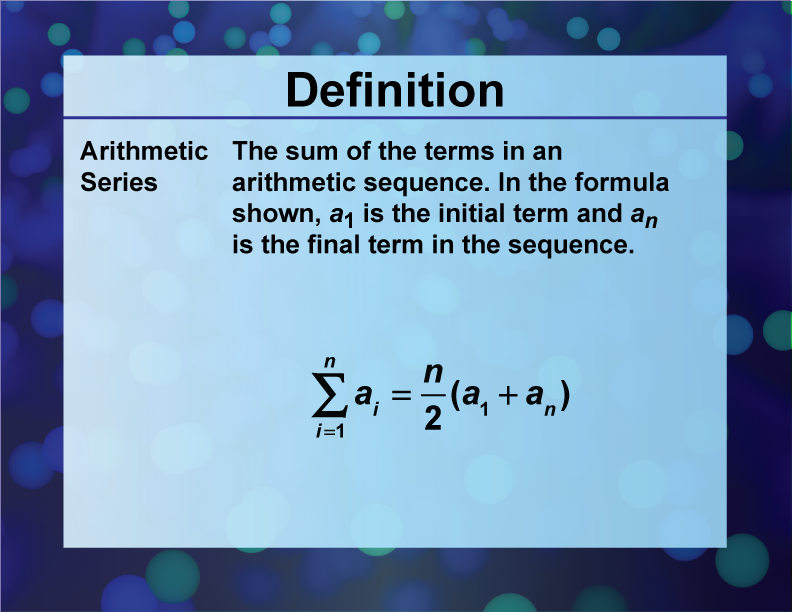
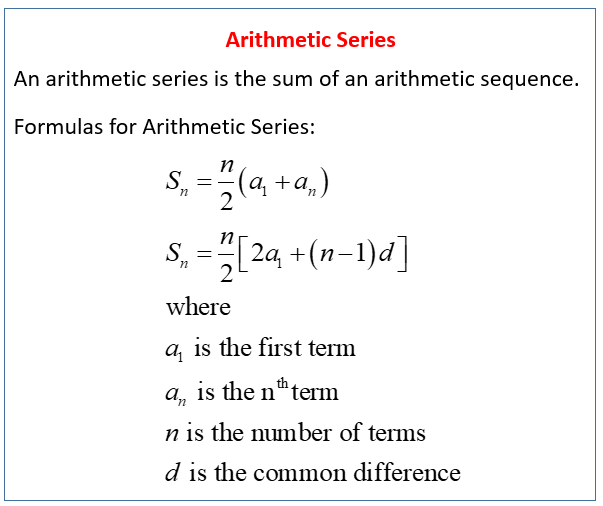
Often, we’re not just interested in a specific term but the total sum of all terms up to a certain point. The sum of an arithmetic series ($S_n$) can be calculated using two primary formulas:
-
When you know the first and last terms:
$Sn = frac{n}{2}(a1 + a_n)$
Where:
-
$S_n$ is the sum of the first ‘n’ terms
-
$n$ is the number of terms
-
$a_1$ is the first term
-
$a_n$ is the nth term (the last term in the sum)
-
-
When you know the first term and common difference (but not necessarily the last term):
$Sn = frac{n}{2}[2a1 + (n-1)d]$
This formula is derived by substituting the expression for $a_n$ into the first formula.
Financial Example (continued): Using the previous example, what is the total amount you would have saved over the entire year (12 months)?
We know $a1 = 100$, $d = 20$, $n = 12$, and we found $a{12} = 320$.
Using the first sum formula:
$S_{12} = frac{12}{2}(100 + 320) = 6(420) = 2520$.
You would have saved a total of $2520 over the year.
Why Arithmetic Series Matter in Finance
While a truly linear financial world is rare due to compounding effects, the arithmetic series serves as a powerful model for understanding situations where change occurs consistently by a fixed amount. Its importance lies in simplifying complex financial scenarios into digestible, predictable patterns.
Beyond Simple Interest: Regular Contributions and Payments
Many basic financial calculations involve fixed increments or decrements. Consider simple interest, where interest is earned only on the principal amount. If you earn simple interest year after year, the total interest earned forms an arithmetic sequence, as the amount added each period is constant. Similarly, if you make regular, fixed contributions to a savings account or repay a portion of a loan with a constant payment, these sequences can be analyzed using arithmetic series principles.
Understanding Linear Growth in Financial Models
Arithmetic series are excellent for modeling linear growth or decline. While exponential growth (geometric series) is more common in investing (due to compounding), linear models are invaluable for:
-
Budgeting: Tracking consistent increases or decreases in expenses or income over short periods.
-
Cost Analysis: Projecting manufacturing costs that increase by a fixed amount per unit or over time.
-
Depreciation: Many depreciation methods, such as the straight-line method, are inherently arithmetic.
Budgeting and Savings with Consistent Increments
For individuals aiming to increase their savings or reduce their debt systematically, arithmetic series provide a clear framework. If you decide to save $500 this month, $550 next month, $600 the month after, and so on, you are creating an arithmetic sequence of savings contributions. Understanding the sum of this series allows you to project your total accumulated savings over a specific period. This foresight is crucial for setting achievable financial goals and tracking progress.
Practical Applications in Personal Finance and Investing
The principles of arithmetic series find direct and highly useful applications in managing personal finances and making informed investment decisions, particularly for scenarios involving fixed or incrementally changing values.
Calculating Regular Savings Accumulation
One of the most straightforward applications is calculating the total accumulation of savings when contributions are made regularly and either stay constant or increase/decrease by a fixed amount each period.
Example: You start saving $200 per month. Each subsequent month, you increase your contribution by $10. How much will you have saved after 24 months?
Here, $a_1 = 200$, $d = 10$, $n = 24$.
First, find $a{24}$ (the last contribution): $a{24} = 200 + (24-1)10 = 200 + 230 = 430$.
Then, find the total sum: $S_{24} = frac{24}{2}(200 + 430) = 12(630) = 7560$.
This simple calculation helps you visualize your future financial position based on a clear savings plan.
Analyzing Loan Repayments (Simplified)
While most loans involve compound interest (geometric series), simple loan scenarios, or individual fixed principal payments, can leverage arithmetic series. For instance, if you’re paying back a loan with fixed principal payments and a decreasing interest component (where the interest part itself might be a decreasing arithmetic sequence if the principal reduction is linear), understanding arithmetic series helps model the principal repayment aspect. For educational purposes, imagining a loan where the total monthly payment decreases by a fixed amount due to a simplified interest structure could be modeled arithmetically.
Understanding Annuities (Simple, Fixed Payments)
An ordinary annuity involves a series of equal payments made at regular intervals. While the future value of an annuity typically involves geometric series due to compounding interest, if you are only summing the payments themselves without considering interest earned on each payment, it becomes an arithmetic series where the common difference is zero (i.e., each term is the same).
Example: A payment of $500 made at the end of each year for 10 years. The sum of payments is an arithmetic series with $a1 = 500$, $d = 0$, $n = 10$. $S{10} = frac{10}{2}(2 times 500 + (10-1)0) = 5(1000) = 5000$. This helps understand the total capital outlay or inflow over time, separate from its interest-earning potential.
Estimating Future Value with Fixed Increases
For certain long-term financial planning scenarios, especially those involving inflation adjustments or expected salary increases, arithmetic series can provide a first-pass estimation. If your salary is expected to increase by a fixed amount each year, you can use an arithmetic series to project your total earnings over a decade, provided the increases are absolute rather than percentage-based. This can inform decisions about retirement contributions or major purchase affordability.
Business Finance and Operational Insights
Beyond personal financial planning, arithmetic series provide a valuable framework for various aspects of business finance, aiding in projections, cost analysis, and understanding operational patterns.
Projecting Consistent Revenue Growth
For businesses experiencing stable, incremental growth, arithmetic series can be used to project future revenue. If a company consistently adds a fixed amount of new recurring revenue each quarter, an arithmetic series can sum up the total expected revenue over a specified number of quarters. This is particularly useful for businesses with subscription models or service contracts that grow linearly.
Example: A SaaS company acquires new clients generating $5,000 in monthly recurring revenue (MRR) in Q1, and expects to add an additional $1,000 MRR each subsequent quarter for the next two years.
$a_1 = 5,000$, $d = 1,000$, $n = 8$ (2 years * 4 quarters/year).
$S_8 = frac{8}{2}[2(5,000) + (8-1)1,000] = 4[10,000 + 7,000] = 4(17,000) = 68,000$.
The total additional MRR generated over the two years would be $68,000.
Cost Analysis with Fixed Increments
Businesses can use arithmetic series to analyze costs that change linearly. For instance, if the cost of raw materials for a product is fixed, but shipping costs increase by a predictable fixed amount per unit or per batch, an arithmetic series can help calculate the total shipping cost for an increasing number of units. Similarly, labor costs might increase by a fixed increment annually for certain contractual positions.
Depreciation Calculation Methods (Straight-Line)
One of the most common applications in accounting is the straight-line depreciation method. This method assumes that an asset loses an equal amount of its value each year over its useful life. The annual depreciation expense is constant, making the accumulated depreciation an arithmetic sequence where the common difference is the annual depreciation amount.
Example: An asset costing $10,000 with a salvage value of $1,000 and a useful life of 5 years.
Annual depreciation = $(text{Cost} – text{Salvage Value}) / text{Useful Life} = (10,000 – 1,000) / 5 = 9,000 / 5 = 1,800$.
The annual depreciation is $1,800. The sequence of accumulated depreciation would be $1,800, $3,600, $5,400, $7,200, $9,000. This is an arithmetic series with $a_1 = 1,800$ and $d = 1,800.
Inventory Management and Demand Forecasting (Simple Linear Trends)
While complex inventory models use advanced statistics, initial forecasts for demand that show a consistent linear increase or decrease can benefit from arithmetic series. If daily sales are projected to increase by a certain number of units each week, arithmetic series can sum up the total projected demand over a period, aiding in inventory ordering and production planning.
Leveraging Financial Tools for Series Calculations
While the formulas are straightforward, real-world financial data often involves many terms, making manual calculations tedious and prone to error. Fortunately, various financial tools are designed to streamline these calculations.
Spreadsheets (Excel/Google Sheets) for Arithmetic Series
Spreadsheets are incredibly powerful for arithmetic series calculations. You can easily set up columns for terms ($a_n$), common differences ($d$), and use built-in functions to sum up ranges.
-
Generate sequence: Enter $a_1$ in cell A1. In A2, enter
=A1+$D$1(assuming common difference is in D1). Drag down to generate terms. -
Calculate sum: Use the
SUM()function on the range of terms, or directly apply the sum formula using cell references. For example,=(N1/2)*(2*A1+(N1-1)*D1)where N1 contains ‘n’.
Financial Calculators and Software
Many financial calculators, both physical and software-based (like those in financial planning tools), can perform these calculations. While they might not have a specific “arithmetic series” button, understanding the underlying principles allows you to input terms, periods, and increments to derive the same results. For instance, many calculators can handle sequences of payments or deposits, implicitly performing these sums.
Limitations and When to Use Geometric Series
It’s crucial to understand the limitations of arithmetic series in finance. The financial world is heavily influenced by compounding, where interest earns interest, leading to exponential growth. This is the domain of geometric series, which involve a common ratio (multiplication) rather than a common difference (addition).
-
Use arithmetic series for: Simple interest calculations, straight-line depreciation, fixed periodic payments/contributions, linear growth models.
-
Use geometric series for: Compound interest, future value of annuities with interest, growth rates (percentage-based), inflation adjustments, present value calculations.
Understanding when to apply each type of series is paramount for accurate financial modeling and forecasting.
In conclusion, the arithmetic series, though a seemingly basic mathematical concept, is an indispensable tool in the financial toolkit. By providing a clear framework for understanding linear changes and cumulative sums, it empowers individuals and businesses to make more informed decisions about savings, investments, costs, and revenues. While it’s essential to distinguish its applications from those requiring geometric series, mastering the arithmetic series is a fundamental step towards robust financial literacy and analytical prowess.
aViewFromTheCave is a participant in the Amazon Services LLC Associates Program, an affiliate advertising program designed to provide a means for sites to earn advertising fees by advertising and linking to Amazon.com. Amazon, the Amazon logo, AmazonSupply, and the AmazonSupply logo are trademarks of Amazon.com, Inc. or its affiliates. As an Amazon Associate we earn affiliate commissions from qualifying purchases.