
In the vast landscape of fluid dynamics and natural phenomena, a swirl of water is most commonly referred to as a vortex. While the term might seem simple, the underlying mechanics of these rotational flows are central to how we understand fluid movement, energy distribution, and systemic efficiency. When we observe a vortex—whether in a kitchen sink, an ocean current, or a massive atmospheric system—we are witnessing a fundamental principle of physics where kinetic energy is concentrated into a central core.
In scientific terms, a vortex is a region in a fluid where the flow revolves around an axis line, which may be straight or curved. The motion of the fluid is characterized by a high degree of vorticity, a mathematical concept used to describe the local spinning motion of a fluid element. Understanding these structures allows engineers and scientists to predict everything from the lifespan of a storm to the efficiency of industrial mixing equipment.

The Mechanics of Vortex Formation
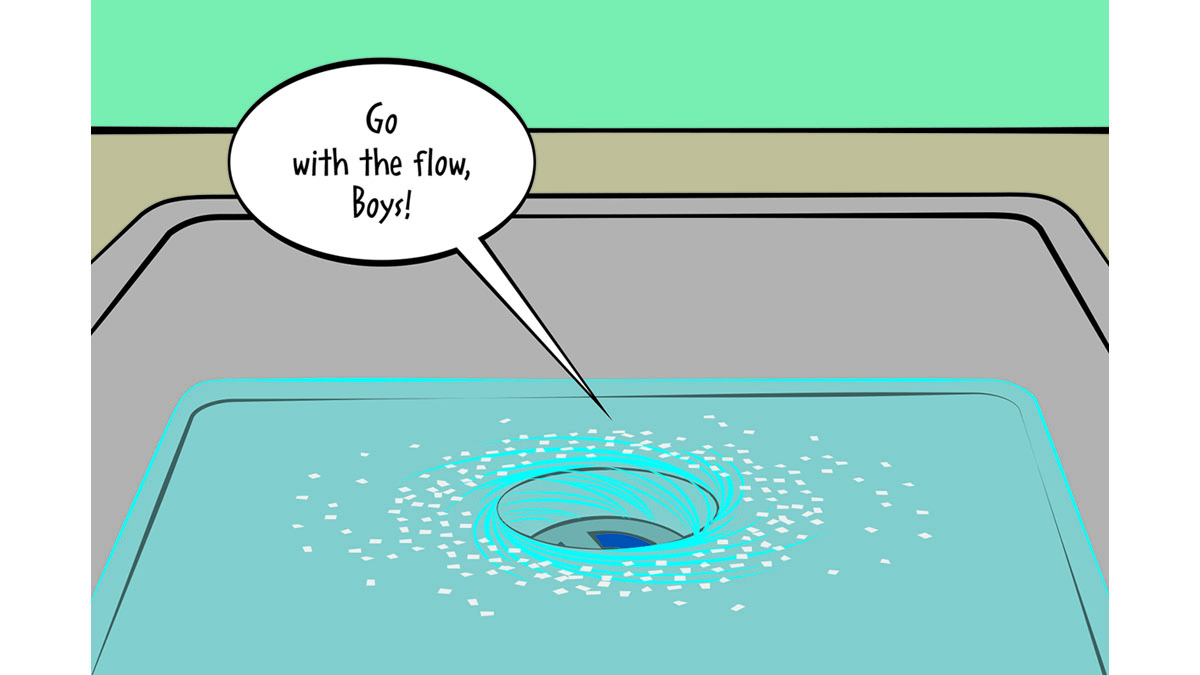
The formation of a swirl of water is rarely accidental; it is the result of conservation of angular momentum. As fluid moves toward a lower-pressure zone or an exit point—like a drain—any slight rotational movement is amplified as the radius of the flow decreases. This is the same principle that allows a figure skater to spin faster by pulling their arms closer to their body.
Pressure Gradients and Centrifugal Force
At the heart of every vortex lies a pressure gradient. The fluid at the center of the swirl is at a lower pressure than the fluid toward the perimeter. This pressure difference acts as a centripetal force, pulling the surrounding fluid inward. As the fluid accelerates toward this low-pressure center, it gains rotational velocity. If you observe a sink drain, the air core often visible in the center is evidence of this extreme pressure drop; the rotation is so intense that the liquid is physically pushed outward by centrifugal force, leaving a void in the middle.
The Role of Viscosity
Viscosity—the internal friction of a fluid—plays a critical role in the behavior of these swirls. In low-viscosity fluids like water, vortices can maintain their structure for extended periods. However, internal friction eventually dissipates the energy of the rotation. This is why a whirlpool in a bathtub eventually slows down and disappears once the inflow of water stops. Engineers must account for these frictional losses when designing hydroelectric turbines or cooling systems where vortex-driven flow is undesirable.
Taxonomy of Swirls: From Whirlpools to Eddies
Not all swirls are created equal. Depending on the scale, the medium, and the force initiating the movement, a vortex can take on many different names. Distinguishing between these allows for better technical analysis of fluid systems.
The Whirlpool
A whirlpool is essentially a large-scale, high-intensity vortex in water. These are often triggered by tides or currents passing through narrow constrictions. In maritime contexts, a very large and powerful whirlpool is technically referred to as a “maelstrom.” These occur when opposing currents meet or when water is forced through a narrow channel, creating a rotating mass that can be hazardous to surface vessels.
Eddies and Turbulent Flow
On a smaller, more frequent scale, we encounter eddies. An eddy is a circular current of water that diverges from the main flow, often created when a moving fluid encounters an obstacle, such as a rock in a stream or the pillar of a bridge. Unlike the singular, focused structure of a sink-drain vortex, an eddy is typically a byproduct of turbulence. In coastal engineering, mapping eddies is essential for predicting the transport of sediment and pollutants, as these “swirls” often act as traps for floating materials.
Tornadoes and Waterspouts: The Atmospheric Analogue
While we focus on water, it is important to recognize the crossover into fluid dynamics at large. A waterspout is essentially a vortex formed over a body of water, essentially a tornado that draws moisture and liquid droplets upward. These illustrate that the rules governing a small vortex in a laboratory beaker are identical to those governing massive, destructive weather systems. The energy transfer is consistent: rotational velocity increases as the radius decreases, leading to the concentrated force that defines these phenomena.
Practical Applications of Vortex Technology
The study of fluid swirls is not merely academic. Many modern industrial and technological advancements rely on the controlled creation or mitigation of vortices. By mastering the geometry of the swirl, engineers can optimize systems to be more efficient, faster, and more durable.
Hydroelectric Power Generation
In hydroelectric plants, the goal is to channel water through turbines with maximum efficiency. However, if a vortex forms near the intake pipe, it can draw air into the turbine, causing cavitation—a phenomenon where bubbles implode and damage metal components. Engineers design intake structures specifically to suppress vortex formation, ensuring a smooth, laminar flow that protects the machinery and maximizes electricity production. Conversely, in specific “vortex power plants,” the swirl is encouraged to drive a turbine located at the center of the rotation, converting the kinetic energy of the spinning water into sustainable energy.
Industrial Mixing and Separation
In the chemical and pharmaceutical industries, vortex formation is intentionally induced in large vats to ensure consistent mixing of ingredients. By utilizing high-shear impellers, engineers create controlled swirls that prevent sedimentation and ensure that solutes are evenly distributed throughout the solvent. In other applications, such as hydrocyclones, the vortex is used for separation. A mixture of solids and liquids is spun rapidly; the heavier particles are forced to the outside by centrifugal force and slide down the walls, while the cleaner liquid stays in the center and is drawn upward. This simple “swirl” technology is responsible for cleaning everything from wastewater to fine powders in manufacturing.
Cardiovascular Fluid Dynamics
Perhaps the most sophisticated use of vortex research is in medicine. The human heart relies on the formation of precise vortices to ensure blood flow remains efficient. During the filling of the left ventricle, blood enters in a swirling pattern—a vortex—that helps guide the fluid toward the exit valve with minimal turbulence. When the heart is diseased, these vortex patterns can become disrupted, leading to reduced cardiac output. Cardiologists use advanced imaging, such as 4D flow MRI, to map these swirls and assess the health of the heart’s valves and chambers.

The Future of Fluid Dynamics Research
As we look toward the future, the study of the “swirl” is entering a new frontier aided by computational fluid dynamics (CFD). We are no longer limited to observing water in a tank; we can now model millions of individual particles to see how they interact within a vortex at a microscopic level.
This level of precision is currently driving innovations in AI-led industrial design. Software tools can now simulate thousands of flow scenarios in seconds, identifying the exact geometry required to eliminate unwanted turbulence or optimize a swirling current for cooling high-performance microprocessors. By understanding the vortex—a shape as old as the movement of the tides—we are creating better ways to transport energy, clean our water, and improve human health.
Ultimately, the “swirl of water” is more than a natural curiosity. It is a fundamental geometry of the universe. Whether it is a small eddy in a garden pond or a massive oceanic current, the vortex remains a primary mechanism for the distribution of energy and the movement of matter. By continuing to study these patterns, we unlock the efficiency hidden within the chaos, transforming the simple rotation of water into a sophisticated tool for engineering and scientific progress.
aViewFromTheCave is a participant in the Amazon Services LLC Associates Program, an affiliate advertising program designed to provide a means for sites to earn advertising fees by advertising and linking to Amazon.com. Amazon, the Amazon logo, AmazonSupply, and the AmazonSupply logo are trademarks of Amazon.com, Inc. or its affiliates. As an Amazon Associate we earn affiliate commissions from qualifying purchases.