
For millions of federal employees, understanding their retirement benefits is a cornerstone of financial security. Among these benefits, the federal annuity stands as a critical component, offering a steady, predictable income stream throughout retirement. Far from being a mere perk, it represents a defined benefit plan, meticulously designed to reward dedicated service to the nation. However, the intricacies of a federal annuity can be complex, often leading to questions about eligibility, calculation, and how it integrates with broader retirement planning. This article aims to demystify the federal annuity, providing a comprehensive, insightful, and engaging guide for current and prospective federal employees, as well as anyone interested in the mechanics of government retirement benefits. We’ll delve into its definition, explore the systems it supports, and offer strategies for maximizing its value in your golden years.

Understanding the Foundation: What is an Annuity?
Before dissecting the specifics of a federal annuity, it’s essential to grasp the broader concept of what an annuity entails. At its core, an annuity is a financial product designed to provide a steady stream of income, typically during retirement. It’s essentially a contract, often with an insurance company, where an individual makes payments (either a lump sum or a series of payments) in exchange for regular disbursements, which can begin immediately or at a future date.
Basic Definition and Purpose
The primary purpose of any annuity is to provide longevity protection – the assurance that you will not outlive your income. Unlike a lump-sum payment, an annuity transforms a pool of money into a predictable income stream for a set period or, more commonly, for the remainder of your life. This offers a powerful safeguard against the financial uncertainties of a potentially long retirement.
Key Characteristics of Annuities
While there are many variations, several key characteristics define annuities:
-
Income Stream: The most defining feature is the generation of periodic payments. These payments can be monthly, quarterly, or annually.
-
Longevity Protection: Annuities are specifically designed to address the risk of outliving one’s savings, providing income for life.
-
Tax-Deferred Growth: Many annuities offer tax-deferred growth on the funds accumulated within the contract until distributions begin.
-
Payout Options: Annuitants can often choose various payout options, such as a single life annuity, joint and survivor annuity, or an annuity for a guaranteed period.
Types of Annuities (General Context)
It’s helpful to briefly touch upon the general types of annuities to understand where federal annuities fit:
-
Immediate vs. Deferred: Immediate annuities begin payments shortly after purchase, while deferred annuities accumulate value over time before payments start in the future.
-
Fixed vs. Variable vs. Indexed: Fixed annuities offer guaranteed interest rates and predictable payouts. Variable annuities allow for investment in sub-accounts, with payouts fluctuating based on market performance. Indexed annuities link returns to a market index, offering a balance of growth potential and some principal protection.
A federal annuity, as we will see, shares some characteristics with a fixed, deferred annuity but operates under a very specific set of rules governed by federal law and regulations, making it distinct from commercial products.
The Specifics of a Federal Annuity
A federal annuity is a cornerstone of the retirement benefits package offered to eligible civilian employees of the U.S. government. Unlike commercial annuities, it is not a product you purchase from an insurance company; rather, it is a defined benefit earned through years of federal service, administered by the Office of Personnel Management (OPM).
Who is Eligible?
Eligibility for a federal annuity is strictly tied to employment with the U.S. federal government and participation in one of its two primary retirement systems:
-
Civil Service Retirement System (CSRS): This older system primarily covers federal employees hired before January 1, 1984. CSRS annuitants generally do not pay into Social Security through their federal employment, as their annuity is the primary retirement benefit.
-
Federal Employees Retirement System (FERS): Established for employees hired on or after January 1, 1984 (and some who opted to switch from CSRS), FERS is a three-tiered retirement plan. It includes a basic annuity component, Social Security benefits, and the Thrift Savings Plan (TSP – a defined contribution plan similar to a 401(k)).
Eligibility for an annuity under either system typically requires meeting specific age and service requirements, often referred to as “minimum retirement age” (MRA) and a certain number of years of creditable service (e.g., 5, 10, 20, or 30 years).
How Federal Annuities Differ from Commercial Annuities
The distinctions between a federal annuity and a commercial annuity are crucial:
-
Defined Benefit vs. Defined Contribution (or Purchase): A federal annuity is a defined benefit. The formula for calculating your annual income is set by law, ensuring a predictable income stream based on your years of service and salary history. Commercial annuities, while providing an income stream, often depend on the amount you invest and the performance of underlying assets, or are purchased as a product.
-
Employer-Sponsored: Federal annuities are a direct benefit of federal employment, sponsored and funded by the U.S. government, not individual investment decisions (beyond contributing to the system through payroll deductions).
-
Guaranteed by Law: The payout formulas and benefit structures of federal annuities are enshrined in federal law, offering a high degree of security and reliability, backed by the full faith and credit of the U.S. government.
-
No Upfront “Purchase”: Employees do not purchase a federal annuity in the commercial sense. Instead, they contribute a small percentage of their salary over their careers, which, combined with government contributions, funds the system.
The Role of OPM (Office of Personnel Management)
The Office of Personnel Management (OPM) plays a pivotal role in the administration of federal annuities. OPM is responsible for:
-
Determining Eligibility: Reviewing service records and applications to confirm an employee meets the criteria for retirement.
-
Calculating Benefits: Applying the appropriate formulas (CSRS or FERS) to calculate the initial annuity amount.
-
Processing Payments: Ensuring that retired federal employees receive their monthly annuity payments accurately and on time.
-
Managing Records: Maintaining comprehensive records of federal service, contributions, and benefit elections.
-
Providing Guidance: Offering information and resources to federal employees regarding their retirement benefits.
Essentially, OPM is the central authority that ensures the federal annuity system operates smoothly, providing a vital financial lifeline to federal retirees.
The Two Main Federal Retirement Systems and Their Annuities
The U.S. federal government operates two distinct retirement systems for its civilian employees, each with its own annuity structure: the Civil Service Retirement System (CSRS) and the Federal Employees Retirement System (FERS). Understanding which system you fall under is paramount, as it directly impacts your annuity calculation and overall retirement planning.
Civil Service Retirement System (CSRS) Annuity
The CSRS is the older of the two systems, established in 1920. It covers most federal employees hired before January 1, 1984. Employees under CSRS typically do not pay Social Security taxes, as their CSRS annuity is designed to be the primary source of their retirement income.
-
Brief Overview of CSRS: CSRS is a robust defined benefit plan. Employees contribute a percentage of their salary (typically 7% or 8% for law enforcement/firefighters) directly into the system. The government also contributes. Upon retirement, an annuity is paid based on a formula that heavily favors longevity of service.
-
Calculation Basics: The CSRS annuity is calculated using a formula that considers your “High-3” average salary and your years and months of creditable service.
-
High-3 Average Salary: This is the highest average annual basic pay earned during any 3 consecutive years of service.
-
Formula: The general formula involves three tiers:
-
1.5% of High-3 average salary for the first 5 years of service.
-
1.75% of High-3 average salary for the next 5 years of service.
-
2.0% of High-3 average salary for service exceeding 10 years.
-
-
These percentages are applied to the respective years of service, and the results are summed to determine the annual annuity amount. For example, an employee with 30 years of service would have their annuity calculated as (5 * 1.5%) + (5 * 1.75%) + (20 * 2.0%) multiplied by their High-3 average salary. This makes CSRS annuities particularly generous for long-serving employees.
-
Federal Employees Retirement System (FERS) Annuity
FERS was established in 1987 to provide a more modern retirement system that aligns with private-sector practices, particularly by integrating with Social Security. Most federal employees hired on or after January 1, 1984, are covered by FERS.
-
Brief Overview of FERS: FERS is a three-tiered retirement system:
-
FERS Basic Annuity: A defined benefit plan, similar to CSRS but with a different formula and lower contribution rates (currently 0.8% for most, but higher for newer employees depending on hire date).
-
Social Security: FERS employees pay Social Security taxes and are eligible for Social Security benefits in retirement, just like most private-sector workers.
-
Thrift Savings Plan (TSP): A defined contribution plan where employees can save and invest pre-tax or Roth contributions, with agency matching contributions (up to 5% of salary).
-
-
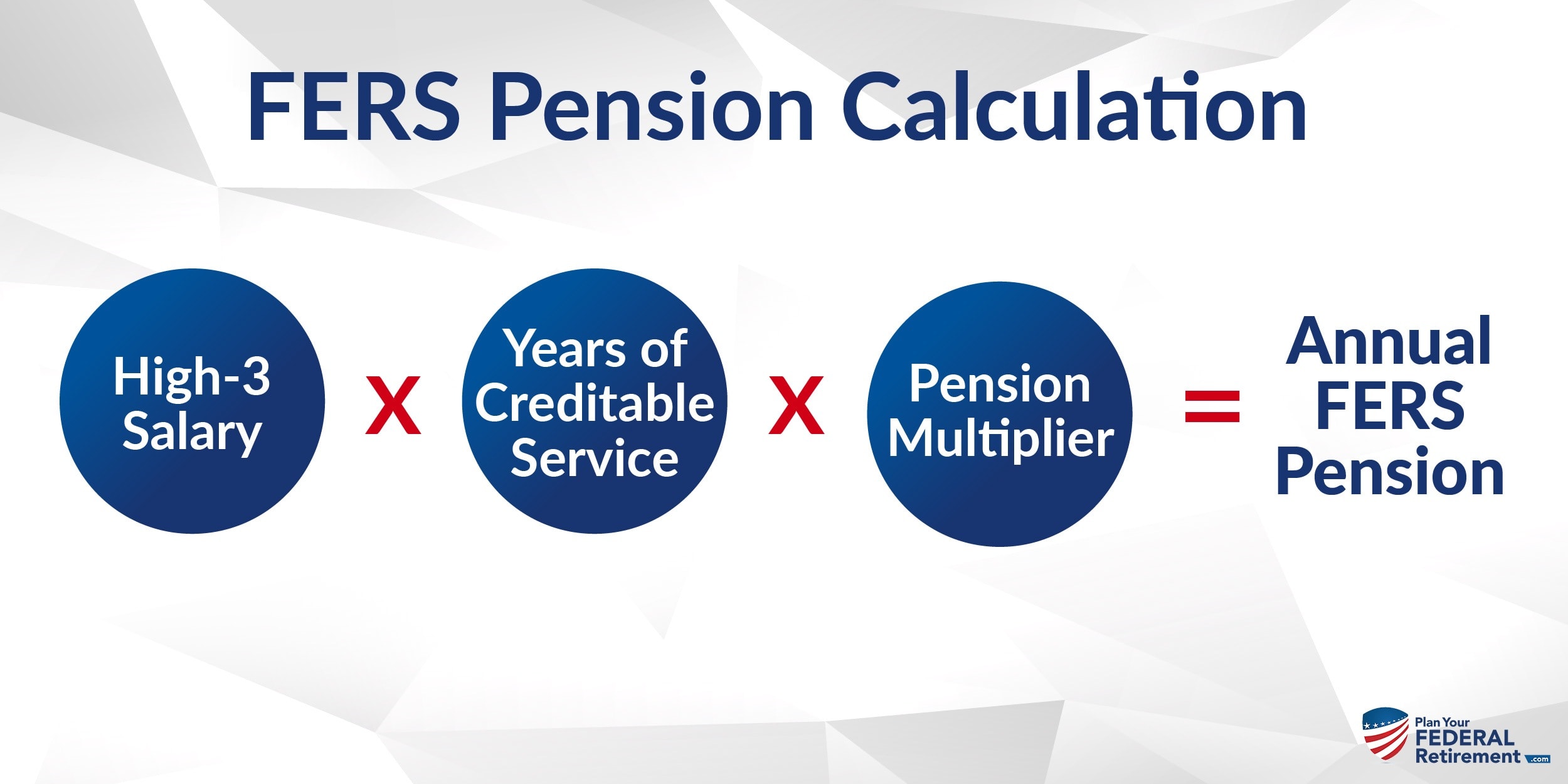
Calculation Basics for the FERS Basic Annuity: The FERS basic annuity calculation is generally simpler and less generous than CSRS, reflecting the fact that it’s just one part of a three-legged stool.
-
Standard Formula: 1.0% of your High-3 average salary multiplied by your years and months of creditable service.
-
Special Enhanced Formula (for those retiring at age 62 or later with 20+ years of service): 1.1% of your High-3 average salary multiplied by your years and months of creditable service. This enhancement provides a slight boost for those who work longer.
-
High-3 Average Salary: Similar to CSRS, this is the highest average annual basic pay during any 3 consecutive years.
-
-
Differences in Eligibility (Age and Service): Both systems have minimum retirement ages (MRAs) and service requirements. For FERS, the MRA varies based on your birth year (e.g., 56 for those born in 1965, 57 for those born in 1970 or later), and requires at least 5 years of service for a deferred annuity, 10 years for a reduced immediate annuity, and 30 years for an unreduced annuity at your MRA. CSRS typically allows for retirement with 30 years of service at age 55, 20 years at age 60, or 5 years at age 62.

Understanding these systems is not just an academic exercise; it’s fundamental to projecting your retirement income and making informed decisions about your career path and financial future as a federal employee.
Maximizing Your Federal Annuity Benefits
A federal annuity is a powerful financial asset, but its full potential is realized through informed decisions made throughout your career and during the retirement planning process. Maximizing your benefits involves understanding the factors that influence your annuity and making strategic choices.
Understanding Service Credit
Your years of creditable service are one of the most significant factors in calculating your federal annuity. More years of service directly translate to a larger annuity payment.
-
What Counts as Creditable Service? Generally, all periods of federal civilian employment for which retirement deductions were taken count. Certain periods of military service can also be credited toward your retirement if you make a deposit for that service.
-
Making Service Deposits: If you have prior temporary federal service or military service for which retirement contributions were not made, you may be able to make a “service deposit” (also known as a “redeposit” for refunded contributions) to count that time toward your annuity calculation. This can be a highly advantageous move, potentially adding years to your service credit and significantly increasing your annuity. It’s crucial to understand the costs and benefits of such deposits, as interest accrues over time.
-
Impact on Eligibility: Service credit also determines when you become eligible to retire with an immediate, unreduced annuity.
The Impact of High-3 Average Salary
Your “High-3” average salary is the other critical variable in your annuity calculation. This is the highest average annual basic pay you earned during any 3 consecutive years of service.
-
Strategic Salary Increases: While salary is often dictated by your position and pay grade, being aware of how your High-3 is calculated can influence career decisions. Promotions, quality step increases (QSIs), or strategic timing of retirement relative to a pay raise can all impact this crucial average.
-
Avoiding Pay Reductions Late in Career: Be cautious about taking a demotion or a position with significantly lower basic pay in the years leading up to retirement, as this could negatively affect your High-3 average.
Cost-of-Living Adjustments (COLAs)
COLAs are vital for maintaining the purchasing power of your annuity over time, protecting it against inflation.
-
How COLAs Work: OPM adjusts federal annuities annually based on the increase in the Consumer Price Index for Urban Wage Earners and Clerical Workers (CPI-W).
-
CSRS vs. FERS COLAs:
-
CSRS: Full COLAs are typically applied to CSRS annuities, meaning the percentage increase directly matches the CPI-W rise.
-
FERS: FERS COLAs are slightly different. If the CPI-W increase is 2% or less, FERS annuitants receive the full percentage. If it’s between 2% and 3%, FERS annuitants receive 2%. If it’s above 3%, FERS annuitants receive one percentage point less than the CPI-W increase (e.g., if CPI-W is 4%, FERS COLA is 3%). This difference is because FERS retirees also receive Social Security COLAs.
-
-
Importance for Long-Term Planning: Understanding COLA rules is essential for long-term financial projections, especially given the potential for decades in retirement.
Survivor Benefits: Protecting Your Loved Ones
Electing survivor benefits ensures that your spouse or eligible dependents continue to receive an income stream after your death.
-
Options and Reductions: You can elect to provide a full or partial survivor annuity for your spouse. However, electing a survivor benefit will reduce your own monthly annuity payment. The decision involves weighing current income needs against the security of your loved ones.
-
Spousal Consent: For married federal employees, electing less than the maximum survivor benefit typically requires spousal consent.
-
Children’s Benefits: Certain eligible children may also qualify for survivor benefits under federal retirement systems.
Health and Life Insurance Post-Retirement (FEHB, FEGLI)
Maintaining federal health and life insurance benefits into retirement is another critical aspect of a secure federal retirement.
-
Federal Employees Health Benefits (FEHB): To carry FEHB into retirement, you must have been continuously enrolled in FEHB for the 5 years of service immediately before your retirement, or for the full period of service since your first opportunity to enroll (if less than 5 years). The government continues to pay its share of the FEHB premiums.
-
Federal Employees Group Life Insurance (FEGLI): Similarly, you can continue FEGLI coverage into retirement if you’ve been enrolled for the 5 years immediately preceding retirement (or your entire career if less than 5 years). However, the cost of FEGLI can become significant in retirement, and many retirees opt to reduce or cancel certain options over time.
Strategic decisions regarding these benefits are just as important as the annuity itself, as healthcare costs and insurance needs evolve significantly in retirement.
Planning for a Secure Federal Retirement
A federal annuity provides a strong foundation, but a truly secure retirement requires a holistic approach that integrates all your financial resources and considers various life stages. Proactive planning is key to transforming your years of federal service into a comfortable and worry-free retirement.
Integrating Your Annuity with Other Retirement Income
Your federal annuity is a critical piece of the puzzle, but rarely the only one. For FERS employees, Social Security and the Thrift Savings Plan (TSP) are equally vital. CSRS employees, while not receiving Social Security from their federal employment, often have other investments or private sector earnings.
-
Thrift Savings Plan (TSP): For FERS employees, the TSP is a powerful defined contribution plan. Maximizing contributions, especially to get the full agency match, is paramount. Strategic investment choices within the TSP, and understanding withdrawal options in retirement, are crucial.
-
Social Security: FERS employees need to understand their estimated Social Security benefits and how the timing of claiming benefits (anywhere from age 62 to 70) impacts the monthly payout.
-
Personal Savings and Investments: Regardless of your federal retirement system, supplementing your federal benefits with personal savings, IRAs, 401(k)s from prior private-sector employment, or other investments provides additional flexibility and security. A diversified portfolio can help bridge potential income gaps and fund discretionary spending.
Early Retirement Considerations
While many federal employees work to their full retirement age, some consider early retirement options. These can significantly impact your annuity.
-
Voluntary Early Retirement Authority (VERA): Offered during agency reorganizations or downsizing, VERA allows employees to retire earlier than otherwise eligible, often without a reduction in their annuity.
-
Minimum Retirement Age (MRA) Plus 10 (MRA+10): Under FERS, you may be eligible to retire at your MRA with at least 10 years of service, but your annuity will be reduced by 5% for each year you are under age 62 (or under age 60 with 20 years of service, if you have not met those conditions). This reduction is permanent.
-
Deferred Annuity: If you separate from federal service before meeting the age and service requirements for an immediate annuity, you may still be eligible for a deferred annuity beginning at a later date.
-
Cost-Benefit Analysis: Early retirement often means fewer years of service credited, a lower High-3 average salary (potentially), and a longer retirement period over which your savings must stretch. A thorough financial analysis is essential to determine if early retirement is viable.
Common Pitfalls and How to Avoid Them
Even with a robust federal annuity, missteps can derail retirement plans.
-
Underestimating Healthcare Costs: Even with FEHB, healthcare costs in retirement can be substantial, especially for uncovered services or long-term care.
-
Ignoring Inflation: While COLAs help, relying solely on your annuity and Social Security without considering potential long-term inflation effects on discretionary spending can be risky.
-
Poor TSP Management: Failing to adequately contribute to the TSP, making overly conservative or aggressive investment choices without proper understanding, or making suboptimal withdrawal decisions can significantly reduce your retirement nest egg.
-
Not Understanding Survivor Benefits: Failure to adequately plan for a surviving spouse can leave them in a precarious financial situation.
-
Lack of an Emergency Fund: Relying entirely on monthly annuity payments without a separate emergency fund for unexpected expenses can create financial stress.
Seeking Professional Financial Advice
Navigating the complexities of federal retirement benefits and integrating them into a comprehensive financial plan often benefits from expert guidance.
-
Specialized Federal Employee Planners: Many financial advisors specialize in federal benefits and can provide tailored advice on maximizing your annuity, making service deposits, understanding FEHB/FEGLI options, and integrating your TSP and Social Security.
-
Holistic Planning: A good financial advisor can help you assess your overall financial picture, set retirement goals, develop an investment strategy, and create a budget that accounts for all income streams and expenses.
-
Estate Planning: Beyond income, a professional can assist with estate planning to ensure your assets are distributed according to your wishes and minimize tax implications.
Your federal annuity is a testament to your service and a valuable asset for your retirement. By understanding its mechanics, proactively managing your career, and integrating it into a comprehensive financial strategy, you can build a secure and fulfilling future beyond your working years.
aViewFromTheCave is a participant in the Amazon Services LLC Associates Program, an affiliate advertising program designed to provide a means for sites to earn advertising fees by advertising and linking to Amazon.com. Amazon, the Amazon logo, AmazonSupply, and the AmazonSupply logo are trademarks of Amazon.com, Inc. or its affiliates. As an Amazon Associate we earn affiliate commissions from qualifying purchases.