
Understanding the tax implications of your investments is as crucial as selecting the right assets. Capital gains tax, a levy on the profit you make from selling an asset, can significantly impact your net returns if not properly understood and planned for. For anyone engaging in investing—whether in stocks, real estate, mutual funds, or even collectibles—grasping the nuances of capital gains tax is not merely good practice; it’s essential for maximizing wealth and avoiding unpleasant surprises from the tax authorities. This guide will demystify capital gains taxation, breaking down what they are, how they’re taxed, and crucially, how you can strategically plan to optimize your after-tax investment income.

The Fundamentals of Capital Gains Tax
At its core, capital gains tax is a tax on the profit realized from the sale of a capital asset. However, the simplicity of this definition belies a complex web of rules, rates, and exceptions that investors must navigate.
Defining Capital Gains and Losses
A capital gain occurs when you sell a capital asset for more than you paid for it. Capital assets are broadly defined and include most personal property held for investment or personal use, such as stocks, bonds, real estate (beyond your primary residence), mutual fund shares, collectibles like art or coins, and even certain business assets. For instance, if you buy shares of a company for $100 and sell them for $150, you have a capital gain of $50. Conversely, if you sell an asset for less than its purchase price, you incur a capital loss, which can often be used to offset capital gains and potentially a limited amount of ordinary income. Understanding this fundamental concept is the first step toward effective tax planning.
Short-Term vs. Long-Term Capital Gains
One of the most critical distinctions in capital gains taxation is the holding period of the asset. This determines whether your gain is classified as “short-term” or “long-term,” which, in turn, dictates the applicable tax rate.
-
Short-Term Capital Gains: These are profits from assets held for one year or less before being sold. The key takeaway here is that short-term capital gains are taxed at your ordinary income tax rates. This means they are added to your other income (like wages) and taxed according to your federal income tax bracket, which can be as high as 37% in 2024 for the top bracket.
-
Long-Term Capital Gains: These are profits from assets held for more than one year before being sold. The good news for investors is that long-term capital gains are generally taxed at preferential rates, which are often significantly lower than ordinary income tax rates. This distinction alone highlights the powerful incentive for investors to hold onto their assets for longer periods.
Realized vs. Unrealized Gains
It’s important to understand that you only owe capital gains tax on realized gains. An unrealized gain (sometimes called a “paper gain”) is the increase in value of an asset you still own. For example, if you bought a stock for $100 and it’s now worth $200, but you haven’t sold it yet, you have an unrealized gain of $100. You won’t owe any tax on this gain until you actually sell the stock and “realize” the profit. This concept provides flexibility for investors to control when they incur taxable events.
Navigating Capital Gains Tax Rates in the U.S.
The United States federal tax system employs different rate structures for long-term and short-term capital gains. While short-term gains are straightforwardly taxed at ordinary income rates, long-term capital gains benefit from a unique, tiered system.
Long-Term Capital Gains Tax Brackets (0%, 15%, 20%)
For most investors, long-term capital gains are taxed at one of three preferential federal rates: 0%, 15%, or 20%. These rates depend entirely on your taxable income, including your long-term capital gains, and your filing status. For the 2024 tax year, the income thresholds for these rates are generally:
-
0% Rate: Applies to individuals with taxable income up to $47,025 (single filers), $94,050 (married filing jointly), or $63,050 (head of household). This bracket is a significant benefit, allowing lower-income earners or those strategically managing their income to sell appreciated assets without federal capital gains tax liability.
-
15% Rate: This is the most common rate and applies to individuals with taxable income above the 0% bracket thresholds up to $518,900 (single filers), $583,750 (married filing jointly), or $551,350 (head of household).
-
20% Rate: This highest long-term capital gains rate applies to individuals whose taxable income exceeds the 15% bracket thresholds (i.e., above $518,900 for single filers, $583,750 for married filing jointly, etc.).
It’s crucial to remember that these thresholds are adjusted annually for inflation.
Short-Term Capital Gains Tax Rates
As previously mentioned, short-term capital gains are taxed as ordinary income. This means they are subject to the same progressive tax rates that apply to your wages, salaries, and other regular income. These rates range from 10% to 37% for the 2024 tax year. The significant difference between short-term and long-term rates underscores the financial advantage of a long-term investment horizon. A short-term gain for a high-income earner could mean losing over a third of their profit to taxes, while a long-term gain would be taxed at a maximum of 20% (plus other potential surcharges).
Additional Taxes: Net Investment Income Tax (NIIT)
Beyond the standard capital gains tax rates, certain high-income individuals may also be subject to the Net Investment Income Tax (NIIT). This is a 3.8% surtax on net investment income, which includes capital gains, dividends, interest, and rental income. The NIIT applies to single filers with a modified adjusted gross income (MAGI) above $200,000, and to married couples filing jointly with a MAGI above $250,000. This tax can effectively increase the top long-term capital gains rate to 23.8% (20% + 3.8%) and the top short-term capital gains rate to 40.8% (37% + 3.8%).
Special Cases: Collectibles and Qualified Small Business Stock (QSBS)
While the 0%, 15%, and 20% rates cover most long-term capital gains, there are exceptions. Gains from the sale of collectibles (like art, antiques, precious metals, and stamps) held for more than one year are generally taxed at a maximum rate of 28%. Additionally, certain gains from qualified small business stock (QSBS) may be excluded from federal income tax entirely, provided specific criteria are met, offering a powerful incentive for investing in certain startups. Depreciation recapture on real estate also has a specific maximum tax rate of 25%.
Factors Influencing Your Capital Gains Tax Bill
Calculating your exact capital gains tax liability isn’t always straightforward. Several personal and financial factors play a significant role in determining how much you’ll owe.
Your Adjusted Gross Income (AGI)
Your Adjusted Gross Income (AGI) is a foundational element in determining your capital gains tax rate. AGI is calculated by taking your gross income and subtracting certain above-the-line deductions. It’s your AGI, in conjunction with your filing status, that places you into one of the federal income tax brackets, which then dictates which long-term capital gains rate (0%, 15%, or 20%) applies to your gains. For example, a married couple filing jointly with a high salary might find their long-term capital gains fall into the 15% or 20% bracket, whereas a retiree with minimal other income might pay 0% on some or all of their long-term gains. Your AGI also determines whether you are subject to the 3.8% Net Investment Income Tax.
Filing Status
Your tax filing status—single, married filing jointly, married filing separately, head of household, or qualifying widow(er)—directly impacts the income thresholds for each capital gains tax bracket. Married couples filing jointly, for instance, have significantly higher income thresholds for the 0% and 15% long-term capital gains rates compared to single filers. Choosing the optimal filing status, when applicable, can therefore be a crucial part of tax planning, especially for couples with disparate incomes or those transitioning into retirement.
State Capital Gains Taxes
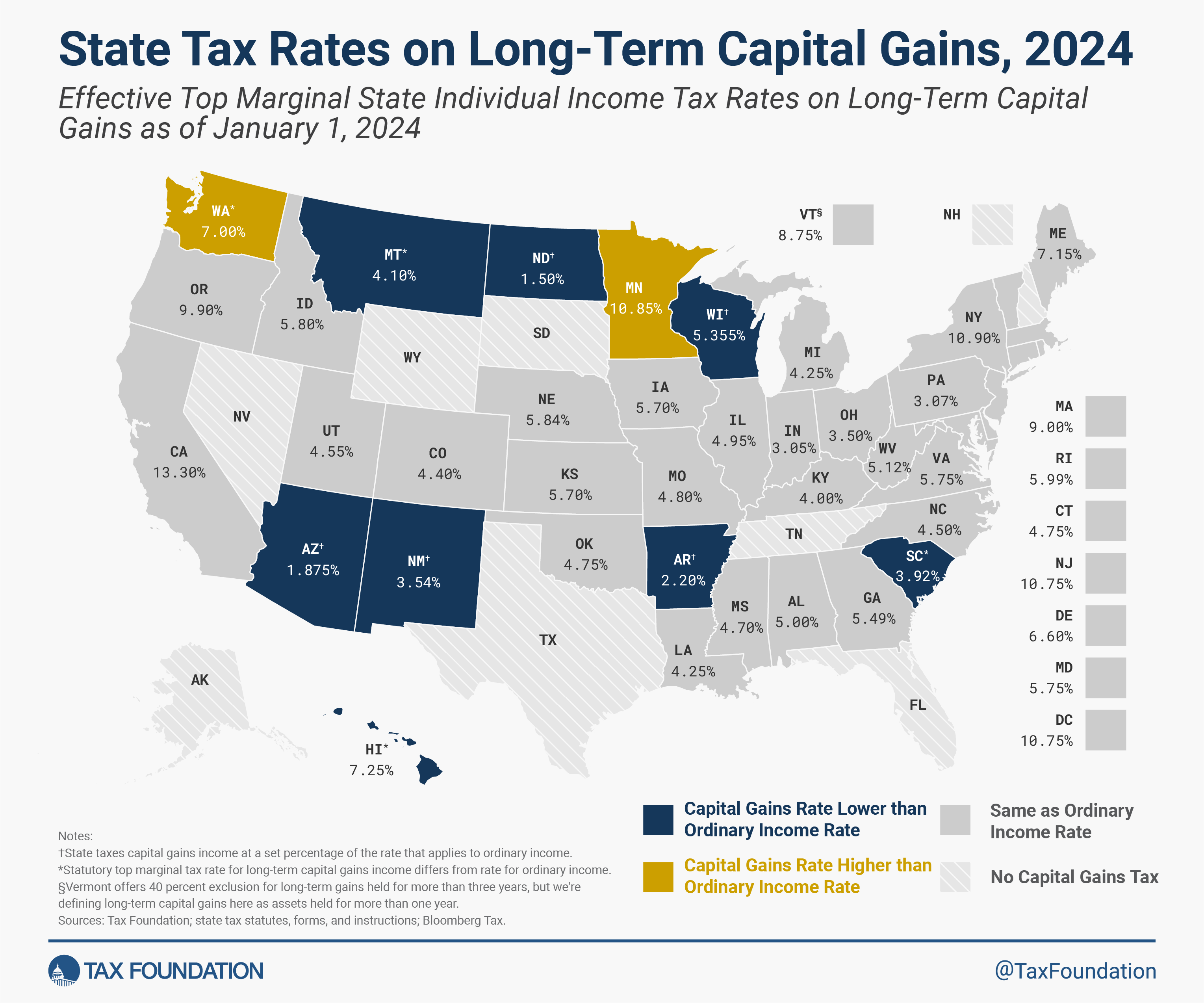
It’s important not to overlook state taxes. While the federal rates are universal, most states impose their own income taxes, and many of these states tax capital gains as ordinary income. This means your total tax burden on capital gains can be considerably higher than just the federal rate. A few states, such as Alaska, Florida, Nevada, South Dakota, Texas, Washington, and Wyoming, do not have a state income tax, meaning they also don’t have a state capital gains tax. New Hampshire does not tax earned income but does tax interest and dividends (though not capital gains). California, on the other hand, has some of the highest state income tax rates, which apply to both short-term and long-term capital gains as ordinary income. Always factor in your state’s tax laws when planning your investment strategy.
Basis Calculation
Accurately calculating your cost basis is fundamental to determining your capital gain or loss. Your basis is generally what you paid for an asset, plus any commissions or fees, and any significant improvements made to the asset (especially for real estate). If you don’t keep meticulous records of your purchases, reinvested dividends, stock splits, or home improvements, you could inadvertently overstate your gain and pay more tax than necessary. For example, if you bought stock over several years at different prices, you might use the “first-in, first-out” (FIFO) method, or you could opt for “specific identification” to sell shares with a higher basis first, thereby minimizing your taxable gain. Proper basis tracking is a key aspect of managing your tax liability.
Strategies for Minimizing Capital Gains Tax
While capital gains tax is an inevitable part of successful investing, there are several legitimate strategies you can employ to minimize your tax burden and maximize your after-tax returns.
Hold Investments Long-Term
The simplest and often most effective strategy is to hold your investments for more than one year. By doing so, you convert short-term capital gains, taxed at potentially much higher ordinary income rates, into long-term capital gains, which benefit from the preferential 0%, 15%, or 20% rates. This strategy encourages a disciplined, buy-and-hold approach to investing, aligning tax efficiency with sound investment principles. The difference in tax rates can be substantial, particularly for high-income earners.
Tax-Loss Harvesting
Tax-loss harvesting is a strategic move where you sell investments at a loss to offset capital gains. If you have realized capital gains during the year, you can sell other investments that have declined in value to generate capital losses. These losses can first offset any capital gains dollar-for-dollar. If your capital losses exceed your capital gains, you can use up to $3,000 of the remaining loss to offset ordinary income, and any further excess losses can be carried forward indefinitely to future tax years. This strategy requires careful timing and adherence to IRS “wash-sale” rules, which prevent you from buying a “substantially identical” security within 30 days before or after the sale.
Utilize Tax-Advantaged Accounts
Maximizing contributions to tax-advantaged retirement accounts like 401(k)s, IRAs (Traditional and Roth), and Health Savings Accounts (HSAs) is a powerful way to defer or entirely avoid capital gains taxes.
-
Traditional IRAs and 401(k)s: Investments within these accounts grow tax-deferred. You don’t pay capital gains tax until you withdraw the funds in retirement, often when you might be in a lower tax bracket.
-
Roth IRAs and Roth 401(k)s: Qualified withdrawals from these accounts in retirement are entirely tax-free, meaning all capital gains accumulated within the account are never taxed. This is a tremendous benefit for long-term growth.
-
Health Savings Accounts (HSAs): Often called the “triple-tax advantage” account, contributions are tax-deductible, investments grow tax-free, and qualified withdrawals for medical expenses are also tax-free. HSAs offer an excellent vehicle for tax-free capital gains.
Qualified Charitable Distributions (QCDs) and Donor-Advised Funds
For charitably inclined investors, especially those over 70 ½, directly donating appreciated stock or mutual fund shares to a qualified charity can be a highly tax-efficient strategy. By donating appreciated assets held for more than one year, you can typically avoid paying capital gains tax on the appreciation and also claim a charitable deduction for the fair market value of the asset (subject to AGI limitations). Donor-advised funds offer similar benefits, allowing you to make an irrevocable charitable contribution, receive an immediate tax deduction, and then recommend grants to charities over time, all while the assets grow tax-free within the fund.
Capital Gains Exclusion for Primary Residence
If you sell your primary residence, you may be able to exclude a significant portion of your capital gain from federal tax. Single filers can exclude up to $250,000 of gain, and married couples filing jointly can exclude up to $500,000, provided they meet certain ownership and use tests (typically, you must have owned and lived in the home as your main residence for at least two of the five years leading up to the sale). This exclusion applies only to your main home and has specific rules that must be followed.
Opportunity Zones
The Tax Cuts and Jobs Act of 2017 introduced Opportunity Zones, providing a tax incentive for investors to reinvest unrealized capital gains into designated low-income communities. By investing capital gains into a Qualified Opportunity Fund (QOF), investors can defer tax on the original gain, potentially reduce the original gain, and, if the investment is held for at least 10 years, eliminate capital gains tax on any appreciation of the new investment within the QOF. This is a complex strategy often better suited for sophisticated investors with significant capital gains.
The Importance of Professional Advice and Planning
The world of capital gains taxation is dynamic and intricate. While understanding the basics is vital, effective tax planning requires a deeper, personalized approach.
Navigating Complexity
The rules surrounding capital gains tax can be exceptionally complex. Factors such as asset type (e.g., real estate, stocks, collectibles, partnership interests), holding period, your specific income level, various deductions and credits, and state-specific tax laws all interact to determine your final tax liability. Additionally, tax laws are not static; they change with new legislation and IRS interpretations, making it challenging for individual investors to stay fully compliant and optimize their strategies without dedicated focus. Missteps can lead to overpayment of taxes or, worse, penalties and interest for underpayment.
Financial Planners and Tax Professionals
Given this complexity, consulting with qualified financial planners and tax professionals (like CPAs or enrolled agents) is not just advisable—it’s often essential. These experts can help you:
-
Develop personalized strategies: Based on your unique financial situation, investment goals, and risk tolerance.
-
Optimize asset location: Deciding which types of investments to hold in taxable versus tax-advantaged accounts.
-
Plan for major life events: Such as retirement, selling a business, or managing an inheritance, all of which have significant capital gains implications.
-
Ensure compliance: Accurately calculate your basis, report transactions correctly, and navigate specific forms like Schedule D (Capital Gains and Losses).
Their expertise can help you identify opportunities to save money and avoid costly mistakes, translating directly into higher after-tax returns.

Regular Review and Adjustment
Tax planning is not a one-time event; it’s an ongoing process. Your financial situation changes, investment values fluctuate, and tax laws evolve. Therefore, it’s crucial to regularly review your investment portfolio and tax strategy with your advisors. Annual check-ups can help you identify opportunities for tax-loss harvesting, adjust your asset allocation for tax efficiency, and ensure that your long-term plans remain aligned with current tax regulations and your personal financial goals. Proactive planning, rather than reactive responses, is key to sustained financial success.
In conclusion, understanding what percent tax on capital gains you might owe is a cornerstone of sound financial management. By differentiating between short-term and long-term gains, utilizing tax-advantaged accounts, employing strategies like tax-loss harvesting, and seeking professional guidance, you can navigate the complexities of capital gains taxation. This proactive approach ensures that you not only grow your wealth effectively but also retain more of your hard-earned investment returns for your future goals.
aViewFromTheCave is a participant in the Amazon Services LLC Associates Program, an affiliate advertising program designed to provide a means for sites to earn advertising fees by advertising and linking to Amazon.com. Amazon, the Amazon logo, AmazonSupply, and the AmazonSupply logo are trademarks of Amazon.com, Inc. or its affiliates. As an Amazon Associate we earn affiliate commissions from qualifying purchases.