
Aid, in its broadest sense, refers to assistance provided to individuals, groups, or countries in need. While the term can encompass various forms of support—from educational assistance to technological help—it most frequently and significantly denotes financial or material assistance. In the global landscape, aid plays a critical role in addressing poverty, responding to humanitarian crises, fostering economic development, and stabilizing regions affected by conflict or disaster. Understanding the multifaceted nature of aid, its sources, mechanisms, and impacts, is crucial for anyone interested in global finance, economics, and international relations. This article delves into the core definitions, diverse forms, profound impacts, and future trajectory of aid, specifically through the lens of monetary and material support.

The Core Concept of Aid: A Multifaceted Definition
At its heart, aid is about bridging gaps—be it a gap in resources, capabilities, or immediate necessities. While often perceived as a simple handout, aid is a complex system involving significant financial flows, strategic planning, and often, intricate political and economic considerations.
Defining “Aid” in the Financial Context
From a financial perspective, aid primarily refers to Official Development Assistance (ODA), a term coined by the Organisation for Economic Co-operation and Development (OECD). ODA consists of grants or loans (with a grant element of at least 25%) provided by official agencies (including state and local governments) to developing countries and multilateral institutions. The main objective of ODA is the promotion of economic development and welfare in recipient countries. Beyond ODA, a significant volume of aid also flows through private donations from individuals, corporations, and non-governmental organizations (NGOs), often categorized as private philanthropic aid. This financial definition distinguishes aid from other international financial flows, such as foreign direct investment or commercial loans, by its concessional nature and development focus.
Humanitarian Aid vs. Development Aid
A critical distinction within the realm of aid is between humanitarian aid and development aid, though their objectives can sometimes overlap.
-
Humanitarian Aid is short-term, emergency assistance designed to save lives, alleviate suffering, and maintain human dignity during and in the aftermath of human-made crises and natural disasters. It includes food, shelter, medical care, water, and sanitation. The core principles guiding humanitarian aid are humanity, impartiality, neutrality, and operational independence. Its focus is immediate relief and survival.
-
Development Aid, conversely, is long-term assistance aimed at addressing the root causes of poverty and underdevelopment. It seeks to promote sustainable economic growth, improve social services (health, education), build infrastructure, strengthen governance, and protect the environment. Development aid projects can span years or even decades, with an emphasis on building local capacity and fostering self-sufficiency.
Both forms of aid are vital, addressing different temporal and structural needs, and often, humanitarian aid can transition into early recovery and development efforts following a crisis.
The Underlying Principles of Aid Provision
Several foundational principles guide the provision and utilization of aid. Ownership emphasizes that recipient countries should lead and determine their own development priorities, with aid aligning to these national strategies. Partnership stresses collaboration and mutual accountability between donors and recipients. Results-orientation pushes for aid effectiveness to be measured by tangible outcomes and impacts, rather than merely inputs. Lastly, transparency and accountability are paramount, ensuring that aid funds are used appropriately and effectively, and that information about aid flows and impacts is publicly accessible. These principles aim to maximize aid’s positive impact and mitigate potential pitfalls like dependency or misuse of funds.
Diverse Forms of Financial Aid and Support
The channels and mechanisms through which aid is delivered are as varied as its objectives, reflecting the complex architecture of international development finance.
Government and Bilateral Aid: Nation-to-Nation Support
Bilateral aid represents direct financial or technical assistance from one government to another. Donor governments often channel a significant portion of their foreign aid budgets through bilateral agreements, directly funding projects, programs, or budgetary support in recipient countries. This form of aid allows donor countries to align their assistance with their foreign policy objectives, national interests, and specific development priorities. Examples include direct grants for infrastructure projects, technical assistance programs, or debt relief initiatives negotiated between two nations. Bilateral aid can be highly effective when targeted appropriately, but it can also be influenced by political considerations.
Multilateral Aid: International Institutions at Work
Multilateral aid is provided by multiple donor governments to international organizations, such as the World Bank, the International Monetary Fund (IMF), the United Nations agencies (e.g., UNICEF, UNDP, WHO), and regional development banks (e.g., African Development Bank, Asian Development Bank). These organizations then distribute the funds to developing countries based on their own mandates, assessment criteria, and global development priorities. The advantages of multilateral aid include its often politically neutral nature, its ability to pool resources for large-scale projects, and the specialized expertise these institutions possess in various development sectors. It also promotes a global approach to development challenges, reducing the perception of direct influence from any single donor nation.
Private and Philanthropic Aid: NGOs and Foundations
Beyond official government channels, a substantial amount of aid flows from private sources. This includes donations from individuals, corporations, and, most significantly, a vast network of non-governmental organizations (NGOs) and philanthropic foundations. NGOs often specialize in particular sectors (e.g., healthcare, education, environmental conservation) or regions, delivering aid directly to communities on the ground. Organizations like Médecins Sans Frontières, Oxfam, and the Bill & Melinda Gates Foundation exemplify the diverse roles of private aid. This form of aid is often praised for its flexibility, ability to reach marginalized populations, and innovative approaches, though it can sometimes face challenges related to coordination and scalability compared to government-led initiatives.
Emergency Aid and Disaster Relief
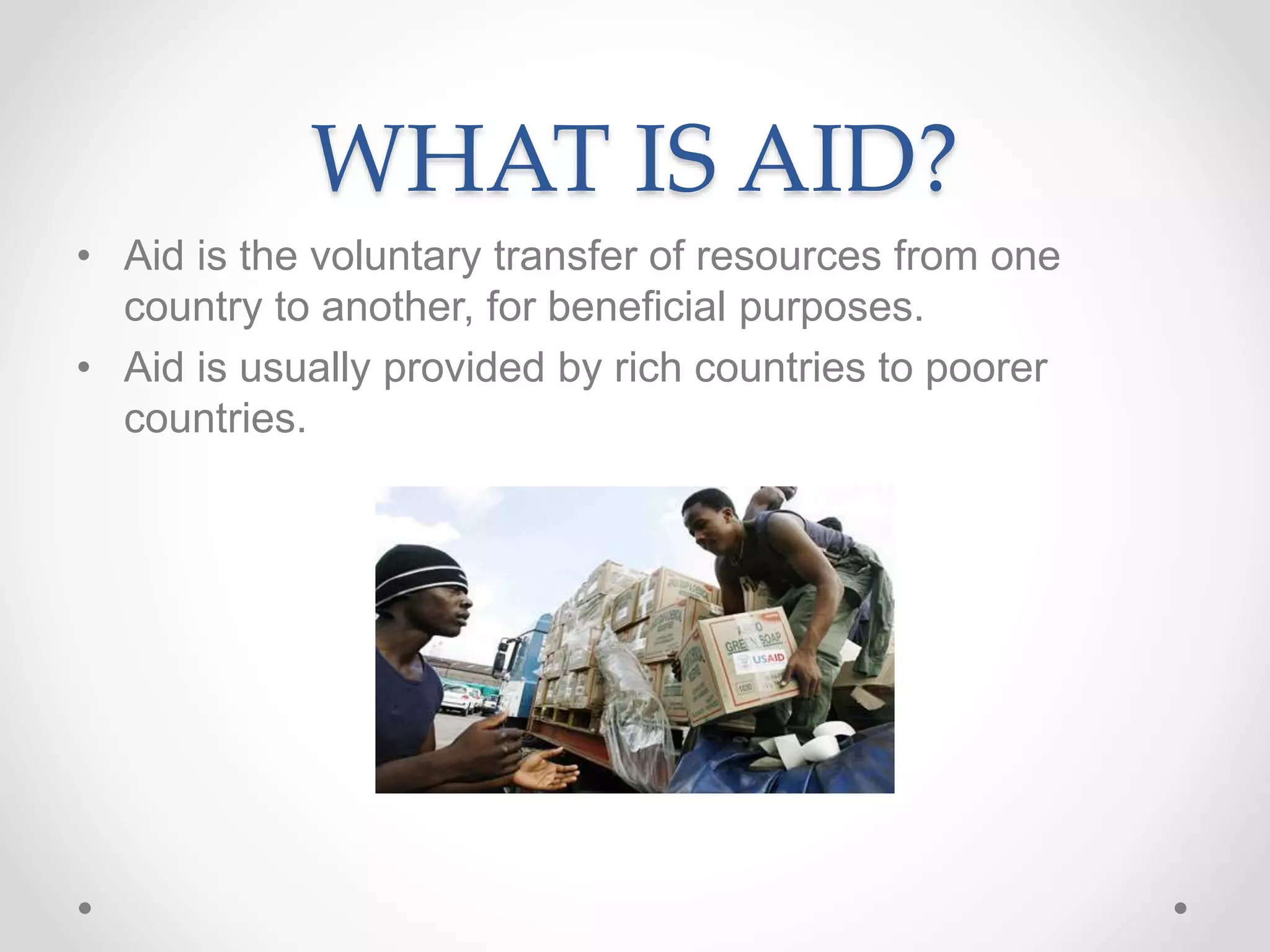
A distinct, yet crucial, category is emergency aid, often delivered in response to sudden-onset crises such as earthquakes, tsunamis, famines, or conflicts. This immediate response aims to provide life-saving assistance, including food, water, shelter, medical supplies, and logistical support. Emergency aid relies on rapid deployment and coordination among various actors—governments, UN agencies, international NGOs, and local responders. Financing for emergency aid comes from both official development assistance budgets and dedicated humanitarian appeals that draw heavily on private donations. The effectiveness of emergency aid is often measured by its speed, reach, and ability to mitigate immediate human suffering.
The Economic and Social Impact of Aid
The impact of aid is a subject of extensive debate and research, with proponents highlighting its transformative potential and critics pointing to its limitations and unintended consequences. However, numerous instances demonstrate aid’s profound positive influence.
Catalyzing Development and Growth
Aid can serve as a vital catalyst for economic development, particularly in low-income countries lacking sufficient domestic resources or access to capital markets. It funds critical infrastructure projects like roads, power plants, and communication networks, which are essential for economic activity. Aid also supports human capital development through investments in education and health, leading to a more productive workforce. By strengthening institutions, improving governance, and promoting policy reforms, aid can create a more conducive environment for private investment and sustainable growth. For instance, aid for agricultural research can boost food security, while support for small and medium-sized enterprises (SMEs) can stimulate local economies and create jobs.
Addressing Poverty and Inequality
One of aid’s primary objectives is to alleviate poverty and reduce inequalities. By providing direct support for basic services, aid ensures access to healthcare, clean water, and education for the poorest segments of society. Conditional cash transfers, often funded through aid, directly empower vulnerable households while promoting essential services. Aid can also target specific marginalized groups, such as women or ethnic minorities, promoting their economic and social inclusion. Significant strides in reducing child mortality, increasing primary school enrollment, and combating diseases like HIV/AIDS and malaria in developing countries are often attributed, in part, to sustained aid interventions.
Challenges and Criticisms of Aid Effectiveness
Despite its potential, aid is not without its critics. Concerns range from its potential to create dependency, distort local markets, and undermine local production, to issues of corruption and inefficient use of funds. Some argue that aid can sometimes prop up autocratic regimes or be tied to donor interests rather than recipient needs. The “aid curse” theory suggests that substantial inflows of aid can sometimes weaken governance by reducing the need for governments to raise revenue from their citizens, thereby diminishing accountability. Additionally, the fragmented nature of aid, with multiple donors pursuing different agendas, can create an administrative burden for recipient countries and hinder coordinated development efforts. These criticisms highlight the importance of effective aid modalities, strong governance, and mutual accountability to maximize positive outcomes.
Fostering Stability and International Relations
Beyond purely economic and social metrics, aid also plays a significant geopolitical role. It can be a tool for fostering stability in fragile states, preventing conflict, and addressing the root causes of migration. By helping to rebuild post-conflict societies or stabilize regions affected by political instability, aid contributes to global peace and security. Furthermore, aid strengthens diplomatic ties and promotes goodwill between donor and recipient nations, reflecting shared values and a commitment to global solidarity. In times of global crises, such as pandemics, aid often takes the form of international cooperation on vaccine development and distribution, underscoring its role in collective global good.
Navigating Aid: For Recipients and Providers
The effective deployment and utilization of aid require sophisticated strategies and robust frameworks from both the giving and receiving ends.
Strategic Planning for Effective Aid Utilization
For recipient countries, effective aid utilization hinges on robust national development strategies. Aid should not be a substitute for domestic resource mobilization but rather a complement, strategically integrated into national budgets and sectorial plans. This involves strong institutional capacity to absorb, manage, and account for aid, ensuring that funds are directed towards high-impact areas identified by the country itself. Prioritization, project design, and robust monitoring and evaluation frameworks are crucial to ensure aid delivers intended results and contributes to long-term self-sufficiency. Donors, in turn, must align their aid with these national strategies, reducing fragmentation and transaction costs.
Transparency and Accountability in Aid Programs
Transparency and accountability are paramount for building trust and ensuring aid effectiveness. Donors are increasingly committed to publishing comprehensive data on aid flows, including commitments, disbursements, and results, often through platforms like the International Aid Transparency Initiative (IATI). Recipient governments, in turn, are expected to demonstrate how aid funds are utilized, implement robust financial management systems, and engage civil society in oversight. This dual accountability helps to prevent corruption, improve efficiency, and ensure that aid truly benefits the intended populations. Without transparency, the risk of aid diversion or misuse significantly undermines its potential impact.
The Role of Technology in Aid Delivery and Monitoring
Technological advancements are revolutionizing aid delivery and monitoring. Mobile money platforms facilitate direct cash transfers to beneficiaries, bypassing traditional banking infrastructure and reducing transaction costs and the risk of corruption. Satellite imagery and GIS (Geographic Information Systems) enable better needs assessments and impact monitoring in remote areas. Data analytics and AI tools are being used to predict humanitarian crises, optimize logistics for relief efforts, and track the progress of development projects. Blockchain technology is even being explored for secure, transparent, and immutable tracking of aid flows. These innovations enhance efficiency, accountability, and the reach of aid programs, making them more responsive and impactful.
The Future of Aid: Towards Sustainable and Equitable Solutions
The landscape of global development is constantly evolving, and so too must the approach to aid. The future will likely see a greater emphasis on sustainability, equity, and innovative financing mechanisms.
Local Ownership and Capacity Building
There is a growing consensus that aid must transition from a donor-driven model to one rooted in local ownership and capacity building. This means empowering local communities, governments, and civil society organizations to design, implement, and manage their own development solutions. Aid will increasingly focus on strengthening local institutions, transferring knowledge and skills, and supporting local innovation, rather than simply providing external resources. The goal is to reduce dependency on external aid over time, fostering true self-reliance and resilience within recipient countries.
Climate Change and Green Aid Initiatives
Climate change represents one of the most significant development challenges of our time, disproportionately affecting developing countries. Consequently, “green aid” is becoming a major focus. This includes funding for climate adaptation measures (e.g., resilient infrastructure, early warning systems), mitigation efforts (e.g., renewable energy projects, sustainable agriculture), and support for countries to transition to low-carbon economies. Innovative financial instruments, such as climate bonds and carbon finance, are emerging to mobilize additional resources for climate action, integrating environmental sustainability directly into development objectives.
Innovation in Aid Financing and Delivery
The traditional model of government-to-government grants and loans is being supplemented by a wave of financial innovations. Impact investing, where private capital is deployed to achieve both financial returns and positive social/environmental impact, is gaining traction. Blended finance mechanisms combine public and private funds to de-risk investments in developing countries, attracting commercial capital to development projects. Development Impact Bonds (DIBs) tie payments to the achievement of pre-agreed social outcomes, incentivizing results. These innovations aim to diversify funding sources, increase efficiency, and ensure that aid resources are used as strategically and sustainably as possible, paving the way for a more equitable and prosperous global future.
In conclusion, aid, particularly in its financial and material forms, is a critical component of global efforts to address poverty, inequality, and human suffering. While facing legitimate challenges and criticisms, its positive impacts on economic growth, social development, and international stability are undeniable. As the world confronts new and complex challenges, the evolution of aid—towards greater local ownership, climate focus, and financial innovation—will be key to building a more sustainable and equitable future for all.
aViewFromTheCave is a participant in the Amazon Services LLC Associates Program, an affiliate advertising program designed to provide a means for sites to earn advertising fees by advertising and linking to Amazon.com. Amazon, the Amazon logo, AmazonSupply, and the AmazonSupply logo are trademarks of Amazon.com, Inc. or its affiliates. As an Amazon Associate we earn affiliate commissions from qualifying purchases.