
In the intricate and fast-paced world of technology, where systems operate around the clock and digital services underpin nearly every facet of business and daily life, reliability and performance are not just desirable — they are imperative. This is where the Service Level Agreement, or SLA, steps in as a critical cornerstone. At its core, an SLA is a contractual commitment between a service provider and a customer that defines the standard of service expected. While often associated with external vendors, SLAs are equally crucial internally, governing the relationship between an IT department and the business units it supports.

In the tech sphere, an SLA is far more than a mere formality; it’s a living document that sets clear expectations, outlines responsibilities, and provides a framework for accountability. It transforms abstract notions of “good service” into quantifiable metrics, ensuring that both parties have a mutual understanding of what constitutes success and what remedial actions are necessary if those standards are not met. Without a well-defined SLA, technical operations risk falling into a quagmire of unmet expectations, finger-pointing, and ultimately, service degradation that can cripple an organization’s digital infrastructure and reputation. From cloud computing providers guaranteeing uptime to SaaS vendors promising rapid incident resolution, and from managed IT service providers ensuring network latency to internal IT departments supporting mission-critical applications, SLAs are the silent guardians of digital quality and operational efficiency. They are the bedrock upon which trust is built in technology partnerships, dictating the very pulse of digital service delivery.
The Core Components of an SLA
An effective Service Level Agreement is a meticulously crafted document, designed to leave no ambiguity regarding the nature and quality of the service provided. While the specifics can vary widely depending on the type of service and the industry, several core components are universally critical for any tech-focused SLA. These elements ensure that all stakeholders have a clear, measurable understanding of what is being delivered and expected.
Service Description and Scope
This foundational section explicitly details the services being provided and, crucially, what is not included. For a cloud provider, this might delineate specific virtual machine configurations, storage capacities, networking capabilities, and supported operating systems. For a software-as-a-service (SaaS) vendor, it would describe the specific features, user limits, and data processing capabilities of the application. It also outlines the environment in which the service operates, such as data center locations, network architecture, and any specific hardware or software dependencies. Clearly defining the scope prevents disputes arising from misinterpretations of the service offering.
Service Availability and Performance Metrics
Perhaps the most recognized component of an SLA, this section quantifies the service quality.
-
Availability/Uptime: Often expressed as a percentage (e.g., “99.99% uptime”), this metric defines the permissible downtime within a given period. For critical systems, this percentage can mean the difference between minor inconvenience and catastrophic business loss.
-
Response Time: For technical support or system incidents, this defines how quickly a service provider will acknowledge an issue after it has been reported.
-
Resolution Time: This metric specifies the target timeframe within which an issue is expected to be fully resolved after acknowledgement. Different severities (e.g., critical, high, medium, low) typically have different resolution targets.
-
Performance Metrics: These can include a range of indicators such as data throughput (e.g., network bandwidth), latency (e.g., response time for a web application), error rates (e.g., percentage of failed API calls), or transaction processing speed. The specific metrics chosen are tailored to the nature of the service and what truly impacts user experience or business operations.
-
Capacity: For scalable services, this might include guarantees about the speed at which capacity can be expanded or contracted.
Problem Management and Resolution
This section details the procedures for identifying, reporting, tracking, and resolving service incidents. It typically includes:
-
Incident Reporting Mechanisms: How users or automated systems report issues (e.g., ticketing system, phone line, email).
-
Categorization of Incidents: Defining different severity levels (e.g., P1 for critical, P2 for major) and their associated impact on the business.
-
Escalation Procedures: A clear path for escalating unresolved issues to higher technical tiers or management, ensuring no problem goes unaddressed.
-
Communication Protocols: How and when customers will be updated on the status of their issues.
Security and Data Protection
Given the pervasive threat landscape, this has become a non-negotiable component of any tech SLA. It addresses how data is protected and managed, including:
-
Data Privacy and Confidentiality: Compliance with regulations like GDPR, CCPA, HIPAA, detailing how sensitive information is handled.
-
Security Measures: Description of physical, network, and application security protocols, including encryption standards, access controls, and vulnerability management.
-
Incident Response for Security Breaches: Procedures for detecting, containing, reporting, and recovering from security incidents.
-
Backup and Disaster Recovery: Commitments around data backup frequency, retention policies, and recovery point objectives (RPO) and recovery time objectives (RTO) in the event of data loss or system failure.
Reporting and Review Mechanisms
SLAs are living documents that require ongoing monitoring and evaluation. This section outlines:
-
Performance Reporting: The frequency (e.g., monthly, quarterly) and format of reports on SLA performance, including metrics, trends, and any breaches.
-
Review Meetings: Scheduled discussions between the service provider and customer to review performance, discuss any issues, and plan for future adjustments or improvements.
-
Auditing Rights: Customer rights to audit the provider’s adherence to security and operational standards.
Penalties and Remedies
This crucial component specifies the consequences of failing to meet the agreed-upon service levels. Common remedies include:
-
Service Credits: A monetary credit applied to the customer’s bill, usually a percentage of the service fee, based on the severity and duration of the SLA breach.
-
Right to Terminate: In cases of egregious or repeated breaches, the customer may have the right to terminate the contract without penalty.
-
Escalation to Management: A process for formal escalation of persistent issues to executive management.
Roles and Responsibilities
Finally, a clear delineation of who is responsible for what ensures efficient operation. This includes identifying specific points of contact, outlining responsibilities for monitoring, reporting, and maintenance, and defining the roles of both the service provider’s team and the customer’s team in managing the service.
Types of Service Level Agreements in the Tech Landscape
The architecture of an SLA is not monolithic; it adapts to the specific relationships and requirements within the technology ecosystem. Understanding the different types of SLAs is crucial for businesses navigating vendor relationships, managing internal IT, and offering their own digital services. Each type addresses a distinct contractual dynamic, ensuring clarity and accountability where it’s most needed.
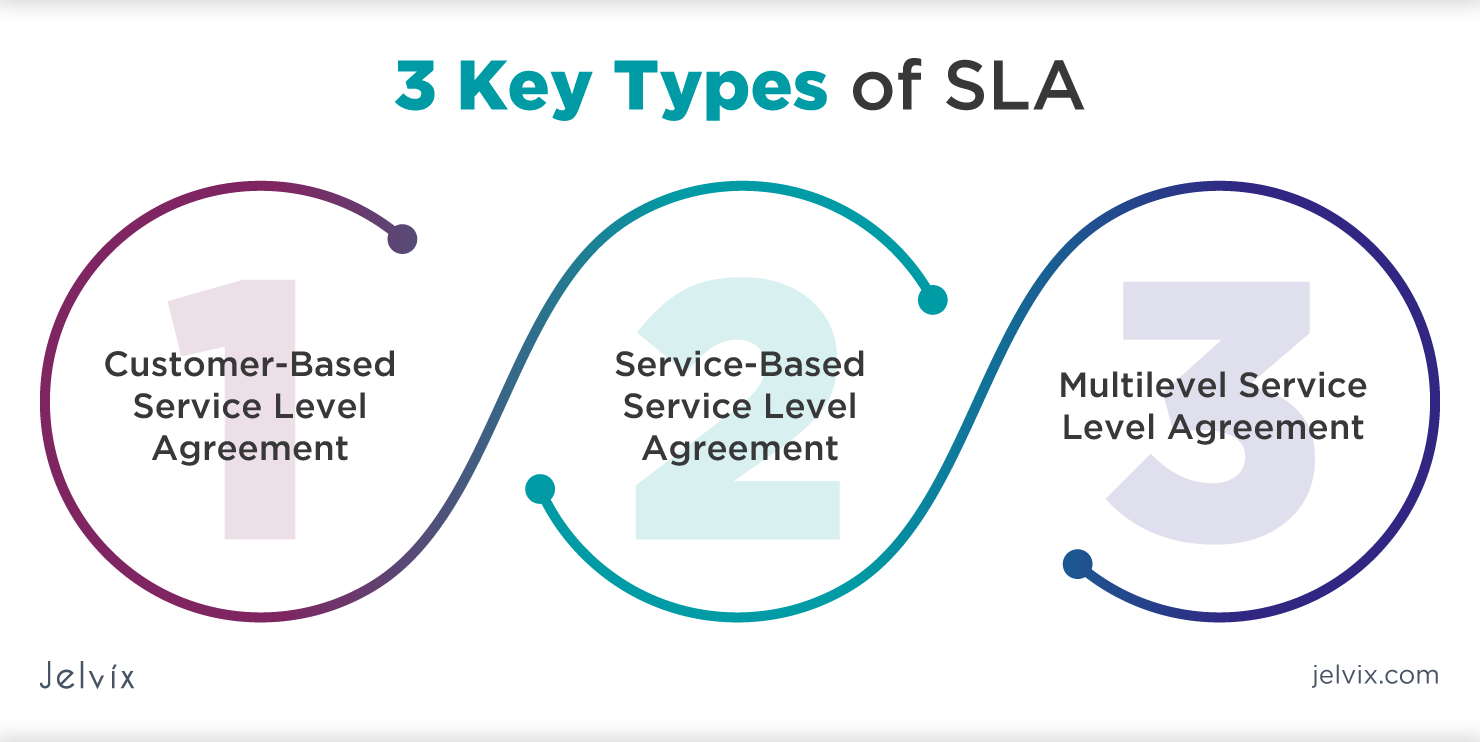
Customer-Based SLA
This type of SLA is tailored to a specific customer or customer group, encompassing all the services they consume from a provider. For example, a large enterprise might have a customer-based SLA with a telecommunications company that covers all their data lines, internet access, and voice services across multiple global offices. This approach offers the benefit of a single, comprehensive agreement that simplifies management for both parties, providing a holistic view of service delivery for that particular customer. It often involves customized terms to fit the customer’s unique operational needs and criticality levels.
Service-Based SLA
In contrast, a service-based SLA defines the service level for a particular service that is offered to all its customers. Think of a public cloud provider like AWS or Azure, which offers compute instances (e.g., EC2, Virtual Machines) with a standard uptime guarantee to all users of that service. Similarly, a Software-as-a-Service (SaaS) provider might guarantee certain performance metrics (e.g., API response times, application availability) for its core application to every subscriber. This type of SLA standardizes expectations across a broad customer base for a specific product or offering, allowing providers to scale their operations and support more efficiently.
Multi-Level SLA
The multi-level SLA structure is designed for organizations with complex service delivery models, where different levels of an agreement apply to various aspects of the business or service. It typically comprises three layers:
-
Corporate-Level SLA: This is the broadest agreement, covering all generic service level management issues relevant to every customer within the organization. It might define company-wide policies on data security, privacy, and general service availability.
-
Customer-Level SLA: As described above, this agreement is tailored to individual customer groups, covering the services specific to them. For example, a finance department might have different availability requirements for its ERP system compared to a marketing department for its CRM.
-
Service-Level SLA: This is the most granular level, addressing the specific service level requirements for a particular service, independent of the customer group. An example would be the uptime guarantee for a particular database service, which might be a component of various customer-specific applications.
This tiered approach allows for both standardization across the organization and customization for specific needs, providing flexibility and precision in managing diverse service offerings.
Vendor SLA / External SLA
This is arguably the most common and visible type of SLA in the tech world. It’s a formal contract between a company and an external service provider, such as a cloud hosting provider, an internet service provider (ISP), a managed security service provider (MSSP), or a software vendor. These agreements are critical for managing external dependencies and ensuring that third-party services meet the necessary performance, security, and availability standards required for the business’s own operations. Failure to negotiate robust vendor SLAs can expose a company to significant operational and financial risks, particularly when core business functions rely on external tech infrastructure or applications.
Internal SLA
While often less formal than external agreements, internal SLAs are equally vital for large organizations. These agreements define the service levels between different departments or teams within the same company, particularly between the central IT department and various business units (e.g., Finance, HR, Operations). An internal SLA might specify the expected response time for IT support tickets, the availability of internal applications, or the turnaround time for provisioning new hardware. The primary purpose of an internal SLA is to foster accountability, improve inter-departmental collaboration, and ensure that internal IT services effectively support the business’s strategic objectives. It helps prevent “shadow IT” and ensures that the business units understand the capabilities and limitations of their internal technology partners.
Each of these SLA types plays a distinct yet interconnected role in orchestrating the seamless delivery and consumption of technology services, establishing clear boundaries and expectations that underpin modern digital operations.
The Indispensable Role of SLAs in the Digital Age
In an era defined by digital transformation, cloud reliance, and ever-increasing cyber threats, the importance of Service Level Agreements transcends mere contractual obligations. SLAs have become indispensable tools for managing risk, ensuring continuity, and fostering robust relationships across the entire technology ecosystem. Their role extends beyond mere compliance, actively shaping how businesses operate and innovate.
Ensuring Service Quality and Reliability
At its most fundamental level, an SLA is the promise of quality. For any technology service – be it a critical enterprise application, a foundational cloud infrastructure component, or a customer-facing web service – consistency and reliability are paramount. An SLA quantifies these promises, turning vague expectations into concrete, measurable metrics like uptime percentages, data throughput, and error rates. Without these defined standards, providers could deliver inconsistent service, leading to unpredictable system performance, frustrated users, and significant operational disruptions. SLAs compel providers to maintain a high standard of service, driving better engineering practices and more robust infrastructure, which in turn guarantees the dependable operation of digital assets that businesses rely upon.
Building Trust and Accountability
Technology partnerships, whether internal or external, thrive on trust. An SLA is the written embodiment of that trust, clearly delineating the responsibilities of both the service provider and the customer. By setting clear expectations for performance, support, and communication, SLAs eliminate ambiguity and provide a common ground for evaluating service delivery. When a provider consistently meets its SLA commitments, it builds confidence in its capabilities. Conversely, when breaches occur, the SLA provides a framework for addressing issues, assigning accountability, and implementing corrective actions. This transparency fosters a relationship built on mutual understanding and shared objectives, moving beyond simple vendor-client dynamics to a true partnership model.
Risk Mitigation and Financial Protection
The financial and reputational fallout from service outages or performance degradation can be devastating. An SLA acts as a critical risk mitigation tool by defining the consequences of service failures. Penalties, such as service credits, provide a financial safeguard for customers, compensating them for the impact of unmet service levels. For providers, the penalties incentivize them to invest in robust infrastructure and proactive monitoring to avoid costly breaches. Beyond direct financial impact, SLAs often detail disaster recovery plans and data backup protocols, ensuring that businesses can recover from unforeseen events with minimal data loss and downtime, thereby protecting critical business operations and customer data.
Driving Operational Efficiency
SLAs don’t just measure performance; they actively drive it. By setting specific targets for response times, resolution times, and system availability, SLAs encourage service providers to optimize their processes, invest in automation, and ensure their technical support teams are adequately staffed and trained. Internally, an SLA can help IT departments streamline their operations, prioritize resources, and align their services more closely with business needs. The metrics within an SLA provide valuable data for continuous improvement, allowing organizations to identify bottlenecks, refine workflows, and allocate resources more effectively, ultimately leading to greater operational efficiency across the tech stack.
Supporting Compliance and Governance
In today’s regulatory environment, businesses operate under a complex web of laws governing data privacy, security, and operational resilience (e.g., GDPR, HIPAA, PCI DSS). SLAs play a crucial role in demonstrating compliance, especially when third-party vendors handle sensitive data or critical infrastructure. An SLA can explicitly detail the provider’s commitment to adhering to specific security standards, audit requirements, and data handling protocols. This helps organizations meet their governance obligations, providing a clear audit trail and demonstrating due diligence in managing their technology supply chain. For highly regulated industries, a robust SLA is not just good practice; it’s a legal necessity.
Facilitating Vendor Management
For businesses heavily reliant on a multitude of technology vendors, SLAs are indispensable for effective vendor management. They provide a standardized basis for evaluating and comparing the performance of different providers. Through regular reporting and review mechanisms mandated by the SLA, organizations can objectively assess whether their vendors are delivering on their promises. This empowers businesses to make informed decisions about renewing contracts, negotiating new terms, or seeking alternative providers. A strong SLA enables strategic vendor relationships, ensuring that all external technology partners contribute positively to the organization’s overall tech strategy and business goals.
In essence, SLAs are the unsung heroes of the digital economy. They are not merely legal documents but strategic instruments that enable businesses to harness the power of technology with confidence, mitigating risks, fostering accountability, and ensuring the consistent, high-quality delivery of the digital services that define our modern world.
Crafting and Managing Effective Tech SLAs
Developing and maintaining robust Service Level Agreements in the technology sector is an ongoing process that demands foresight, collaboration, and a commitment to continuous improvement. An effective SLA is a dynamic tool, not a static contract, designed to evolve with changing technological landscapes and business requirements. Crafting and managing these agreements strategically is paramount to harnessing their full potential.
Define Clear and Measurable Metrics
The cornerstone of any effective tech SLA is the clarity and measurability of its metrics. Vague terms like “fast response” or “highly available” are useless; an SLA must specify “99.99% uptime,” “response time within 15 minutes for critical incidents,” or “data transfer rates of 1 Gbps.” These metrics must adhere to the SMART criteria: Specific, Measurable, Achievable, Relevant, and Time-bound.
-
Specificity: Clearly define what is being measured (e.g., “CPU utilization” not just “performance”).
-
Measurability: Ensure there are reliable tools and methods to track the metric (e.g., monitoring software, logs).
-
Achievability: Set targets that are realistic for both the provider and the technology’s capabilities. Overly ambitious targets lead to consistent breaches and eroded trust.
-
Relevance: The metrics must directly impact the customer’s business objectives or user experience. Measuring irrelevant metrics is a waste of resources.
-
Time-bound: Metrics should specify the timeframe (e.g., “monthly uptime,” “hourly error rate”).
Furthermore, it’s crucial to define the methodology for measuring these metrics, including the tools used, the data collection points, and any exclusions (e.g., scheduled maintenance windows).
Involve All Stakeholders
An SLA is not a document to be drafted in isolation. Its effectiveness hinges on input and agreement from all relevant stakeholders, both on the provider and customer sides. This includes:
-
Technical Teams: Engineers, architects, and operations staff who understand the capabilities and limitations of the technology, and who will be responsible for meeting the SLA.
-
Business Units/Service Owners: The end-users or departments who consume the service, understanding its criticality and impact on their operations.
-
Legal Counsel: To ensure the agreement is legally sound, enforceable, and protects both parties’ interests.
-
Security Teams: To incorporate necessary data protection and cybersecurity clauses.
-
Financial Teams: To understand the cost implications of different service levels and penalties.
This collaborative approach ensures that the SLA is comprehensive, realistic, and mutually beneficial, preventing future disputes rooted in misunderstandings or overlooked requirements.
Establish Robust Monitoring and Reporting
An SLA is only as good as its ability to be monitored and reported upon. Implementing robust monitoring tools and processes is essential to continuously track performance against agreed-upon metrics. This involves:
-
Automated Monitoring Systems: Deploying specialized software that tracks uptime, latency, throughput, resource utilization, and other KPIs in real-time.
-
Alerting Mechanisms: Setting up notifications for when performance thresholds are approached or breached.
-
Data Collection and Storage: Ensuring that performance data is reliably collected, stored, and accessible for analysis and auditing.
-
Standardized Reporting: Defining the format, content, and frequency of performance reports (e.g., monthly summary reports, incident post-mortems). These reports should clearly indicate adherence to the SLA and any instances of non-compliance, along with root cause analyses.
Transparency in monitoring and reporting builds trust and allows for proactive problem-solving before minor issues escalate into major breaches.
Regular Review and Updates
The technology landscape is in constant flux, and so too should be SLAs. An SLA is a living document that requires periodic review and updates to remain relevant and effective.
-
Scheduled Reviews: Plan regular meetings (e.g., quarterly, annually) between all stakeholders to review past performance, discuss new requirements, and address any evolving technical or business needs.
-
Flexibility and Adaptability: The SLA should include clauses that allow for amendments and updates as services evolve, technology changes, or business priorities shift.
-
Performance Baselines: Re-evaluating performance baselines and targets periodically, especially after significant system upgrades or changes in usage patterns.
Ignoring this aspect can lead to an outdated SLA that no longer accurately reflects the service provided or the customer’s expectations, rendering it ineffective.
Understand the Legal Ramifications
Finally, an SLA is a legally binding contract. Both parties must understand its legal implications, including:
-
Enforceability: Ensuring the terms are clear enough to be legally enforceable.
-
Jurisdiction: Specifying the governing law and jurisdiction in case of disputes.
-
Dispute Resolution: Outlining the process for resolving disagreements (e.g., mediation, arbitration, litigation).
-
Indemnification Clauses: Defining responsibilities for legal costs or damages arising from breaches.
-
Termination Clauses: Detailing the conditions under which either party can terminate the agreement.
Consulting legal counsel during the drafting phase is crucial to protect both the service provider and the customer from potential legal liabilities and to ensure the agreement is robust and fair.
By meticulously crafting and diligently managing SLAs according to these principles, organizations can transform them from mere bureaucratic hurdles into powerful strategic assets that drive service excellence, foster strong partnerships, and ensure the reliable delivery of critical technology services in a dynamic digital world.
In conclusion, the Service Level Agreement stands as an essential pillar in the architecture of modern technology. Far from being a mere administrative document, it is a dynamic contract that underpins trust, mandates accountability, and quantifies the very quality of service delivery. Within the intricate web of digital operations, whether governing the uptime of a global cloud infrastructure, the responsiveness of a critical SaaS application, or the efficiency of an internal IT department, SLAs provide clarity and certainty. By meticulously defining expectations, establishing measurable metrics, outlining responsibilities, and setting clear consequences, SLAs enable businesses to mitigate risk, drive operational excellence, and foster robust, transparent relationships with their technology partners and internal stakeholders. As our reliance on digital services continues to grow exponentially, the strategic development and diligent management of Service Level Agreements will remain paramount to navigating the complexities of the tech landscape and ensuring the seamless operation of the digital world.
aViewFromTheCave is a participant in the Amazon Services LLC Associates Program, an affiliate advertising program designed to provide a means for sites to earn advertising fees by advertising and linking to Amazon.com. Amazon, the Amazon logo, AmazonSupply, and the AmazonSupply logo are trademarks of Amazon.com, Inc. or its affiliates. As an Amazon Associate we earn affiliate commissions from qualifying purchases.