
In the intricate world of computer graphics, where the ultimate goal is often to blur the line between digital illusion and tangible reality, myriad techniques work in concert to achieve astonishing levels of visual fidelity. Among these, one subtle yet profoundly impactful technique stands out for its ability to inject depth, realism, and a sense of “groundedness” into virtual scenes: Ambient Occlusion (AO). Far from being a primary light source or a flashy special effect, ambient occlusion operates quietly in the background, simulating how surfaces obscure ambient light, thereby creating soft, contact shadows that define spatial relationships and enhance the perception of form. Understanding what ambient occlusion does is to grasp a fundamental pillar of modern visual rendering, crucial for everything from the immersive environments of AAA video games to the meticulous visualizations of architectural designs and cinematic special effects. It’s a testament to the idea that sometimes, the most significant improvements come not from adding more light, but from intelligently simulating its absence.

The Science Behind Realistic Shadows
At its core, computer graphics is about simulating how light interacts with objects and surfaces in a virtual 3D space. While direct light sources like suns or lamps are relatively straightforward to model, the complexities arise when considering indirect lighting—light that bounces off multiple surfaces before reaching the viewer. Ambient occlusion is a clever and efficient approximation of a crucial aspect of this indirect lighting, specifically focusing on how surrounding geometry blocks ambient light, producing soft, diffuse shadows in recesses and corners.
Understanding Light Interaction in 3D Environments
Traditional rendering pipelines primarily focus on direct illumination: calculating how light rays from explicit light sources hit a surface and reflect towards the camera. This method is efficient but often results in scenes that feel flat and artificial, lacking the subtle shading that occurs in the real world due to bounced light. In reality, light reflects and scatters in countless directions, illuminating areas that are not directly exposed to a primary light source. This phenomenon, known as global illumination (GI), is incredibly complex to simulate in real-time.
Ambient occlusion steps in as a practical, performance-friendly compromise for a specific component of global illumination. It doesn’t attempt to simulate light bounces comprehensively; instead, it focuses on the “occlusion” aspect, determining how much of a point on a surface is blocked from receiving ambient (omnidirectional) light by nearby geometry. Think of it as a form of self-shadowing that isn’t dependent on the direction of a direct light source.
How Ambient Occlusion Works: A Simplified Overview
The fundamental principle behind ambient occlusion is remarkably intuitive: areas that are more enclosed or surrounded by other objects receive less ambient light and thus appear darker. Conversely, areas that are more exposed and open receive more ambient light and appear brighter.
To calculate this, a rendering engine typically performs a “local” analysis for each point on a surface. It imagines a hemisphere above that point and then “casts rays” or samples directions within that hemisphere. For each sample direction, it checks if there’s any other geometry blocking the path. The more directions that are blocked, the more “occluded” that point is considered, and the darker it becomes. This process is computationally intensive if done perfectly, so various approximation techniques have been developed for real-time applications.
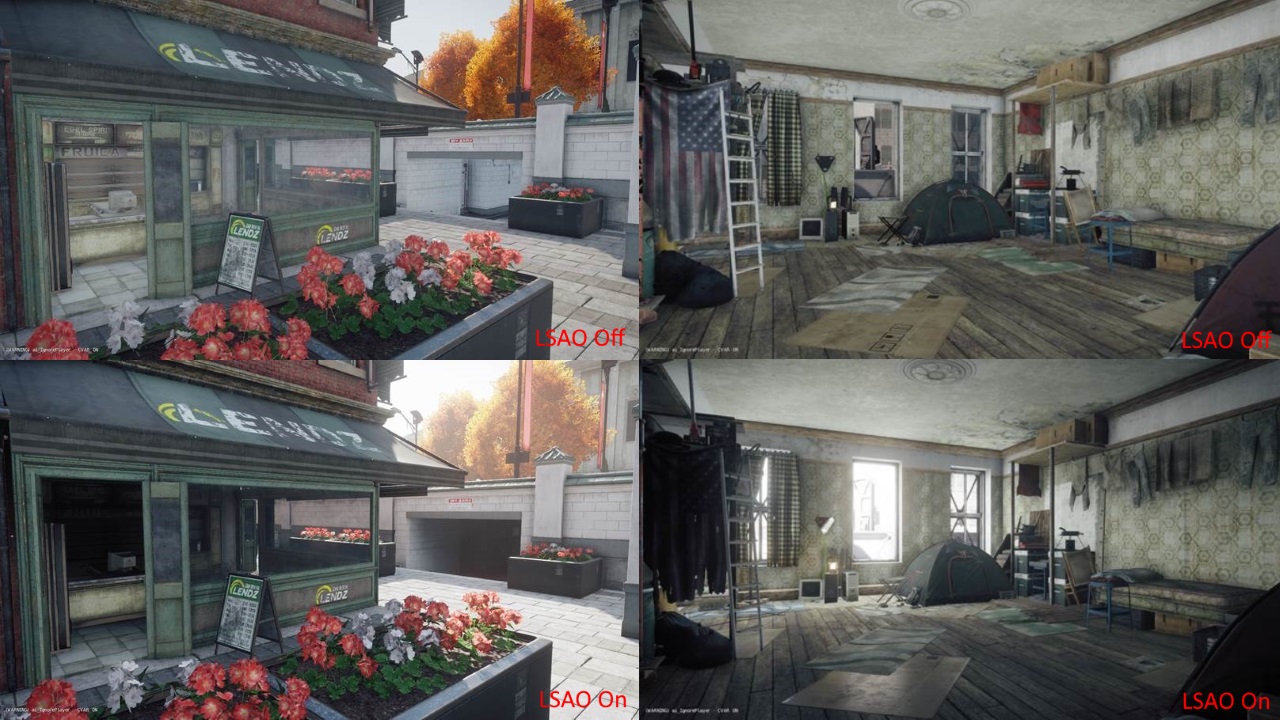
The result of this calculation is not a sharp, directional shadow but a soft, graded darkening. This darkening is most pronounced in corners, crevices, where objects meet other surfaces (like a table leg meeting the floor), and inside hollows. It’s these subtle details that add incredible depth and realism, making objects feel physically present and integrated into their environment.
Differentiating AO from Direct Shadows
It’s crucial to distinguish ambient occlusion from the more familiar direct shadows cast by explicit light sources (e.g., a sun shadow or a lamp shadow). Direct shadows are sharp or soft depending on the light source’s size and distance, and their directionality is determined by the light’s position. They tell you where direct light can’t reach.
Ambient occlusion, by contrast, is not concerned with direct light. It’s about how much ambient (non-directional, scattered) light reaches a surface. AO creates “contact shadows” and “crevice shadows” that exist regardless of where the sun is positioned. It tells you where light, in general, has a harder time penetrating due to local geometry. A classic example is the shadow cast underneath a cup where it meets a table surface; this is largely an ambient occlusion effect, not a direct shadow from an overhead light. Both direct shadows and ambient occlusion are essential for a convincing scene, each contributing a different but complementary layer of realism.
The Visual Impact: Enhancing Depth and Realism
The true magic of ambient occlusion lies in its ability to transform a sterile 3D scene into one that feels tangible, deep, and believable. While direct shadows define the primary lighting, AO adds the secondary layers of shading that visually ground objects and articulate their forms with remarkable subtlety.
Bringing Objects to Life with Subtle Shading
Without ambient occlusion, objects in a scene can often appear to float weightlessly, lacking a strong connection to the surfaces they rest upon. Corners and edges might look unnaturally sharp, and the internal geometry of complex models can lack definition. AO resolves these issues by introducing subtle shading precisely where objects meet or where geometry is recessed.
This subtle darkening has several powerful visual effects:
-
Defines Spatial Relationships: It clearly indicates where one object touches or comes very close to another, reinforcing their physical presence in the scene. A book on a shelf, for example, will have soft AO shadows between it and its neighbors, making the books feel like a cohesive unit rather than separate entities hovering near each other.
-
Enhances Form and Volume: AO accentuates the contours and intricacies of complex models. Crevices, folds, and sculptural details become much more apparent and gain a sense of depth and volume that would otherwise be missing.
-
Grounds Objects: By creating contact shadows, AO firmly “grounds” objects to the surfaces they inhabit. A character’s foot on the ground, a vase on a table, or a rock on a landscape all look more integrated and less like they are merely pasted onto the background.
A More Immersive Gaming and Cinematic Experience
The quest for immersion is paramount in both video games and cinematic production. Ambient occlusion plays a vital, often unnoticed, role in achieving this. In games, where real-time performance is a strict constraint, AO techniques have been developed and refined to provide a significant visual boost without crippling frame rates.
Modern AAA games heavily rely on AO to make their worlds feel richer and more plausible. From the intricate details of character models and weapons to the sprawling landscapes and detailed interior environments, AO contributes to the overall visual fidelity that players have come to expect. It helps bridge the gap between simple polygon models and believable virtual objects, making environments feel lived-in and characters feel substantial.
Similarly, in film and animation, where the pursuit of photorealism is constant, offline rendering techniques use highly accurate forms of ambient occlusion (often integrated into full global illumination solutions) to ensure that every frame resonates with depth and believability. It’s part of the unseen artistry that makes digital characters and environments indistinguishable from real ones.
Bridging the Gap to Photorealism
Ultimately, ambient occlusion is a critical component in the arsenal of techniques aimed at photorealism. While it’s an approximation, it’s an approximation of a physical phenomenon that is ever-present in the real world. Our brains are highly attuned to these subtle variations in light and shadow, using them to interpret depth, distance, and the physical properties of objects.
By accurately simulating how ambient light is occluded, AO contributes to a more natural and convincing distribution of light and shadow, making rendered images resonate more closely with our real-world experiences. It helps ensure that even without direct sunlight or a clear key light, a scene still possesses a fundamental level of visual integrity and realism that elevates it beyond mere computer-generated imagery.
Types and Techniques of Ambient Occlusion
The fundamental concept of ambient occlusion is straightforward, but its implementation in various rendering contexts has led to the development of numerous techniques, each with its own trade-offs between visual quality, performance, and accuracy. These techniques range from highly optimized real-time solutions to computationally intensive offline methods.
Screen Space Ambient Occlusion (SSAO)
SSAO is arguably the most widely adopted ambient occlusion technique, especially in real-time applications like video games. Introduced by Crytek, SSAO revolutionized real-time graphics by offering a performance-friendly way to approximate AO.

-
How it Works: Instead of calculating occlusion in 3D object space, SSAO works in “screen space.” It processes information from the depth buffer and normal buffer (which store per-pixel depth and surface orientation, respectively) of the currently rendered scene. For each pixel on the screen, it samples nearby pixels within a defined radius, comparing their depths to determine if they are closer and thus “occluding” the current pixel.
-
Advantages: It’s fast and GPU-friendly because it only operates on the data visible on the screen. It’s also agnostic to scene complexity; it costs the same for a million polygons as it does for a hundred, as long as they fit on screen.
-
Limitations: Because it’s screen-space, it suffers from several issues:
-
View-Dependency: Objects outside the screen’s view frustum cannot occlude pixels, leading to popping artifacts at screen edges.
-
Haloing/Flickering: Fast camera movements or object animations can cause visible artifacts as the sampling patterns change rapidly.
-
Lack of True 3D Context: It can’t “see” behind objects or accurately assess occlusion from unseen geometry.
-
Horizon-Based Ambient Occlusion (HBAO) and Adaptive Compute Ambient Occlusion (ACAO)
Building upon SSAO, techniques like NVIDIA’s HBAO and AMD’s ACAO (or other similar variants like Intel’s SSDO and Ubisoft’s SSBC) aim to address some of its limitations while retaining real-time performance.
-
HBAO (Horizon-Based Ambient Occlusion): Improves upon SSAO by taking into account the actual normal orientation of surfaces, and estimating the height of the “occluding horizon” around a pixel. This leads to more accurate and less noisy occlusion, especially in complex geometry. It tends to produce more robust and visually pleasing results than basic SSAO.
-
ACAO (Adaptive Compute Ambient Occlusion): Aims for even higher quality and better performance by using an adaptive sampling strategy, focusing computational effort where it’s most needed. It often leverages compute shaders for parallel processing, making it efficient on modern GPUs. These techniques generally offer a better balance of quality and performance for current-generation games.
Voxel-Based, Ray-Traced, and Baked Ambient Occlusion
Beyond screen-space techniques, other methods offer varying levels of accuracy and are suited for different applications.
-
Voxel-Based Ambient Occlusion: This technique represents the scene as a grid of 3D voxels (volume pixels). Occlusion is then calculated by querying these voxels for density, providing a more volumetric and accurate representation of blocked light. While more resource-intensive than screen-space methods, it can offer higher quality and is less prone to screen-space artifacts.
-
Ray-Traced Ambient Occlusion (RTAO): With the advent of hardware-accelerated ray tracing, RTAO offers the most physically accurate approach to ambient occlusion in real-time. Instead of approximations, actual rays are cast from surface points into the scene. If these rays hit other geometry, that point is occluded. RTAO is inherently more accurate, less prone to artifacts, and integrates seamlessly with other ray-traced effects, producing superior contact shadows and environmental shading.
-
Baked Ambient Occlusion: For static scenes or parts of scenes (like environmental geometry in a game), AO can be pre-calculated and “baked” into texture maps (lightmaps or vertex colors) during the asset creation process. This is the most performance-efficient method at runtime because the calculations are done once offline. It provides very high quality without any runtime cost, but it’s only suitable for stationary geometry and can consume significant texture memory. This is often used in mobile games or VR experiences where runtime performance is critical.
Implementation and Performance Considerations
Integrating ambient occlusion into a graphics pipeline involves careful consideration of both visual quality and computational cost. Developers must continually balance the desire for realism with the practical constraints of hardware and real-time performance.
Integrating AO into Graphics Pipelines
Most real-time ambient occlusion techniques are implemented as a post-processing effect. This means they are applied after the initial rendering of the 3D scene (which generates color, depth, and normal information).
The typical pipeline for screen-space AO involves:
-
G-Buffer Pass: Render the scene’s geometry, storing per-pixel information like depth, surface normals, and potentially albedo (color) into multiple textures known as a G-buffer.
-
AO Pass: Use the depth and normal textures from the G-buffer as input to a shader program that calculates the AO factor for each pixel. This pass usually outputs a grayscale texture representing the occlusion intensity.
-
Final Composite: The calculated AO texture is then multiplied (or blended in another way) with the fully lit and shaded scene (which might include direct lighting, reflections, etc.) to apply the darkening effect.
For baked AO, the calculation happens in a 3D modeling or rendering software (like Blender, Maya, 3ds Max) and the resulting occlusion map is applied as a texture to the model’s material during runtime. Ray-traced AO is integrated more fundamentally into the ray tracing pipeline itself, where rays are explicitly traced to determine occlusion.
Balancing Visual Quality with Performance
The computational cost of ambient occlusion can be significant, especially for high-quality, real-time methods. The primary factors influencing performance are:
-
Sampling Count: The number of “rays” or samples taken per pixel to determine occlusion. More samples lead to smoother, more accurate results but increase calculation time.
-
Sample Radius: How far out the algorithm looks for occluding geometry. A larger radius can capture more distant occluders but is more expensive.
-
Resolution: The resolution at which AO is calculated. Often, AO is rendered at a lower resolution than the main scene and then upscaled to save performance.
-
Blurring/Denoising: To reduce noise (grainy artifacts) from low sample counts, AO results are often blurred, which has its own performance cost.
Developers often expose different AO quality settings (e.g., “Low,” “Medium,” “High,” “Ultra”) in game menus. These settings typically adjust the sampling count, radius, and resolution, allowing players to find a balance that suits their hardware and preferences.
Common Artifacts and Solutions
Despite their benefits, real-time ambient occlusion techniques can introduce visual artifacts:
-
Flickering/Shimmering: Especially with SSAO, rapid camera or object movement can cause the occlusion to appear unstable or “noisy” due to constantly changing sampling patterns.
-
Haloing: A “halo” effect around objects or at screen edges where occlusion is incorrectly calculated due to missing information outside the screen space.
-
Bleeding: Occlusion “leaking” through thin geometry or across surfaces it shouldn’t, due to approximation errors.
-
Loss of Detail: Excessive blurring to hide noise can wash out fine details that AO is meant to enhance.
Solutions to these artifacts include:
-
Improved Sampling Patterns: Using randomized or spatio-temporal filtering to distribute samples better over time and space.
-
Denoising Filters: Applying advanced image processing techniques to reduce noise without excessive blurring.
-
Temporal Reprojection: Reusing and blending AO results from previous frames to stabilize the effect.
-
Higher Quality Algorithms: Transitioning to techniques like HBAO+, ACAO, or RTAO, which are inherently more robust and less prone to approximation errors.
The Evolving Landscape of Realism
As computer graphics hardware and algorithms continue to advance, the role and implementation of ambient occlusion are also evolving, particularly with the rise of hardware-accelerated ray tracing.
Ambient Occlusion in the Era of Ray Tracing
Ray tracing represents a fundamental shift in how light is simulated in computer graphics. Instead of rasterization (rendering polygons and approximating light), ray tracing simulates light by tracing individual rays of light through a scene, mimicking how light behaves in the real world.
With hardware-accelerated ray tracing, Ray-Traced Ambient Occlusion (RTAO) becomes the gold standard. Instead of screen-space approximations, RTAO physically traces rays from a point to determine what geometry truly blocks ambient light.
-
Accuracy: RTAO offers physically accurate occlusion, free from the view-dependent artifacts, haloing, and limited range of screen-space methods. It “sees” the entire 3D scene, not just what’s on screen.
-
Integration: RTAO often integrates seamlessly with other ray-traced effects like reflections, shadows, and global illumination, contributing to a more coherent and physically plausible lighting model across the entire scene.
While RTAO offers superior quality, it still carries a performance cost. For this reason, many modern games utilize a hybrid rendering approach, combining ray-traced elements for critical lighting with traditional rasterization and screen-space techniques (like SSAO/HBAO) for other elements or as a fallback.
Beyond AO: Future of Indirect Lighting
Ambient occlusion, even RTAO, is still fundamentally about occlusion—how much ambient light is blocked. It doesn’t fully simulate the bouncing of light or the color bleeding effects that occur when light reflects off a colored surface and tints nearby objects (a phenomenon known as color bleeding).
The ultimate goal for photorealistic indirect lighting is full Global Illumination (GI), which comprehensively models all light bounces. Techniques like path tracing (used in offline rendering for films) or real-time GI solutions (like NVIDIA’s RTXGI, Lumen in Unreal Engine, or various voxel-based GI methods) aim to achieve this. These advanced GI solutions often naturally encompass and supersede the role of ambient occlusion, as they calculate all forms of indirect light, including the absence thereof.
The Enduring Value of AO in Graphics
Despite the emergence of more comprehensive global illumination techniques, ambient occlusion retains its vital importance.
-
Performance Baseline: For hardware or applications that cannot afford full real-time GI, AO (especially screen-space variants or baked AO) remains an incredibly effective and efficient way to add significant depth and realism.
-
Complementary Role: Even with advanced GI, AO can still serve a complementary role, subtly enhancing contact shadows or providing a fallback when GI details are too sparse.
-
Foundational Understanding: The principles behind AO—understanding how local geometry influences light perception—are foundational to anyone working in computer graphics.
In conclusion, ambient occlusion is far more than just another graphics setting; it’s a foundational technique that profoundly impacts the perceived depth, realism, and immersion of digital environments. By intelligently simulating how ambient light is blocked, it adds those crucial, subtle shadows in corners and crevices that ground objects, define forms, and make virtual worlds feel truly tangible. From its humble screen-space beginnings to its sophisticated ray-traced future, ambient occlusion continues to be an indispensable tool in the relentless pursuit of visual perfection in computer graphics, proving that sometimes, the most powerful visual enhancements come from understanding the nuances of darkness.
aViewFromTheCave is a participant in the Amazon Services LLC Associates Program, an affiliate advertising program designed to provide a means for sites to earn advertising fees by advertising and linking to Amazon.com. Amazon, the Amazon logo, AmazonSupply, and the AmazonSupply logo are trademarks of Amazon.com, Inc. or its affiliates. As an Amazon Associate we earn affiliate commissions from qualifying purchases.