
The question, “what is the most sold game?”, transcends simple trivia; it delves into the heart of an industry boasting colossal financial might and transformative economic impact. Far from a mere popularity contest, the title of “most sold game” signifies a product that has achieved unparalleled market penetration, generating billions in revenue and shaping the financial trajectories of developers, publishers, and the broader entertainment sector. Understanding this phenomenon requires an intricate examination of sales figures, monetization strategies, long-term economic ecosystems, and the profound financial ripple effects that emanate from such global successes. This analysis will explore what it truly means for a game to achieve this apex, not just in units shifted, but in its substantial financial footprint.
Defining “Most Sold”: Beyond Unit Sales to Economic Impact
While intuitively “most sold” refers to the sheer volume of copies distributed, the economic reality within the gaming industry is far more nuanced. A game’s financial success is not solely determined by its initial retail price times the number of units. Modern gaming landscapes introduce complex layers of revenue generation, making a direct unit-to-revenue comparison challenging and often misleading.
The Elusive Crown: Identifying the Top Contenders and Their Revenue Streams
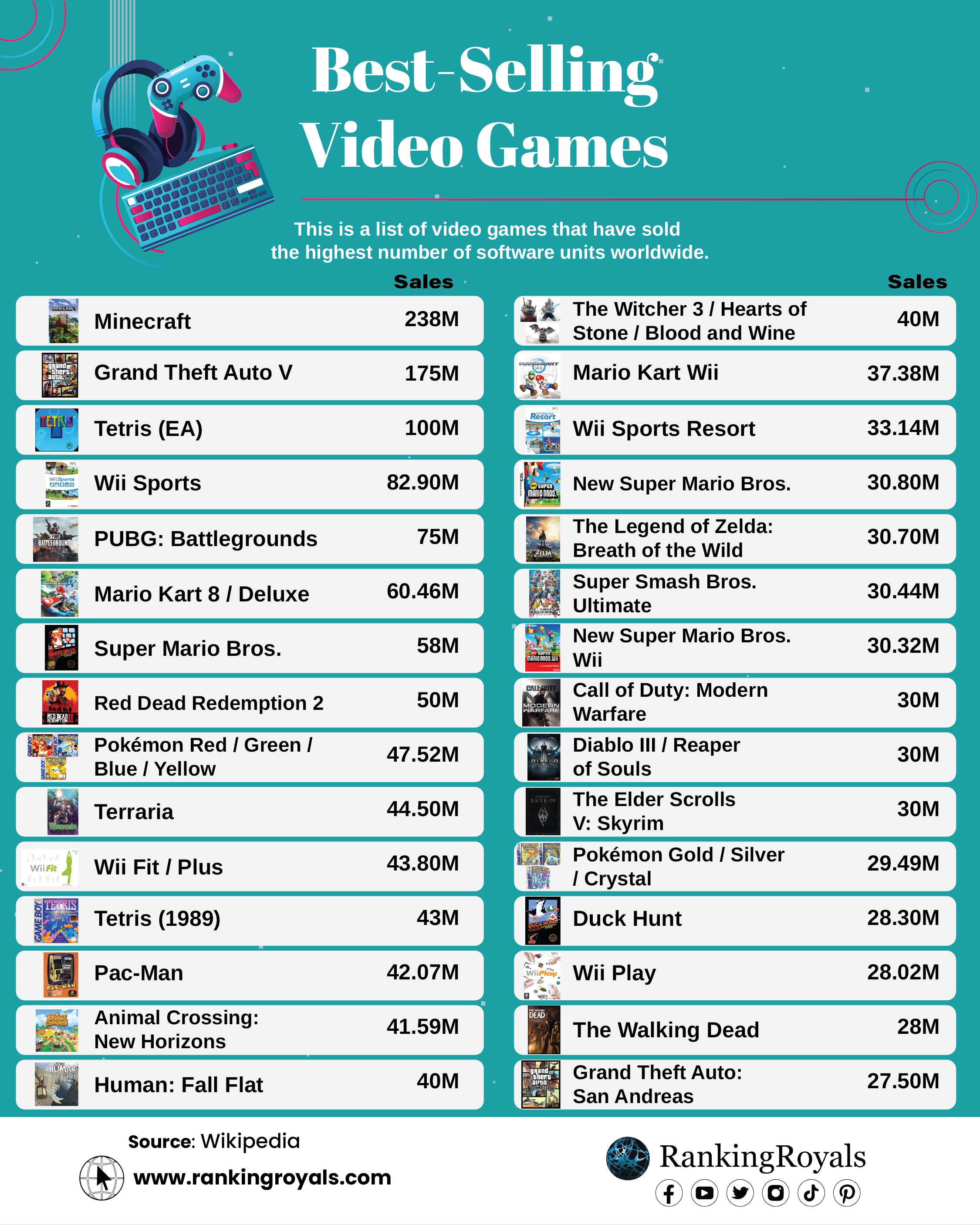
Pinpointing the absolute “most sold game” is a dynamic and often debated topic, largely due to varying reporting methodologies and the vast historical timeline of gaming. However, perennial front-runners consistently appear, often surprising in their simplicity or longevity. Minecraft, with its sandbox freedom, frequently holds the top spot, boasting well over 300 million units sold across virtually every platform imaginable since its full release in 2011. Close behind, Grand Theft Auto V (GTA V) has sold over 195 million units, an astonishing feat for a title released in 2013, still generating massive revenue through its online component. Historically, titles like Tetris (in its myriad forms, particularly mobile versions) also contend for the top, though definitive, verifiable unit sales figures across all platforms and iterations are harder to consolidate.
What makes these games financial titans is not just the initial purchase. Minecraft‘s ongoing sales are bolstered by its continuous updates, merchandise, educational versions, and the sheer breadth of its IP utilization. GTA V, a premium game, owes a significant portion of its sustained financial success to Grand Theft Auto Online, a multiplayer component that consistently ranks among the highest-grossing live-service games through its microtransactions and battle pass-like structures. These examples illustrate that while initial unit sales provide a strong foundation, the true financial juggernaut status is built upon diverse, recurring revenue streams long after the original game hits the shelves. For publishers like Microsoft (owner of Mojang, Minecraft‘s developer) and Take-Two Interactive (publisher of GTA V), these titles are not just products; they are perpetual money-making machines, underpinning significant portions of their annual financial reports.
Sales vs. Revenue: A Crucial Distinction in Gaming Economics
The distinction between unit sales and total revenue is paramount in understanding the financial prowess of the gaming industry’s top performers. A game might sell fewer units but generate significantly more revenue than a higher-selling counterpart due to its monetization strategy. For instance, a free-to-play (F2P) game like PUBG Mobile or Honor of Kings might have “billions of downloads” (a proxy for units sold for F2P), but its revenue comes entirely from in-game purchases. These games, though “free,” often generate more annual revenue than many premium, high-unit-selling titles. Fortnite, another F2P behemoth, has generated tens of billions in revenue despite having no initial purchase price.
Conversely, a premium title like The Legend of Zelda: Tears of the Kingdom sells for $70 and generates revenue directly from each unit sold. However, its long-term revenue potential beyond the initial sale might be limited unless it introduces paid DLC or sequels. The “most sold game,” therefore, must be assessed not just by the copies in players’ hands, but by the comprehensive financial ecosystem it establishes, encompassing initial purchases, microtransactions, subscription models, expansions, and brand extensions. Financial analysts meticulously track these metrics, as they paint a more accurate picture of a game’s economic value and its contribution to its parent company’s bottom line.
The Business of Blockbusters: Financial Strategies Behind Gaming’s Top Sellers
The journey from concept to “most sold” is paved with astute financial planning, strategic market positioning, and a commitment to long-term economic sustainability. The top-selling games are not merely lucky; they are products of deliberate business strategies designed to maximize revenue and establish enduring market dominance.
Longevity and Ecosystems: Sustaining Revenue Over Decades
One of the most impressive financial feats of games like Minecraft and GTA V is their unparalleled longevity and ability to generate substantial revenue years, even a decade, after their initial release. This is largely attributed to the creation of robust game ecosystems. Minecraft‘s open-ended nature naturally fosters community-generated content, but Mojang has also continuously updated the game with new features, biomes, and creatures, encouraging existing players to return and attracting new generations. This persistent engagement fuels sales of the base game, associated merchandise, and even educational licensing deals, turning it into a stable, long-term asset for Microsoft.
Grand Theft Auto Online, the multiplayer component of GTA V, is a masterclass in live-service monetization. Rockstar Games regularly releases free content updates, including new vehicles, missions, and properties, which in turn drive player engagement. This engagement translates directly into sales of “Shark Cards” (in-game currency bought with real money) as players seek to acquire new items and progress. By continuously evolving the game world and providing new avenues for interaction and progression, Rockstar has cultivated a self-sustaining financial engine that ensures GTA V‘s continued presence on sales charts and its consistent contribution to Take-Two’s financial results quarter after quarter. This strategy turns a one-time purchase into a recurring revenue stream, a golden standard in modern gaming finance.
Monetization Models: From Premium Sales to Free-to-Play Giants
The financial strategies employed by the “most sold” games reflect a diverse array of monetization models. The traditional premium model, where players buy the game once, still accounts for significant sales, particularly for single-player narrative experiences or highly anticipated sequels. Games like Call of Duty or FIFA (now EA Sports FC) have historically relied on yearly premium releases, coupled with seasonal content passes and cosmetic microtransactions, to drive substantial annual revenue. These franchises leverage strong brand recognition and established player bases to guarantee massive launch sales.
However, the rise of the free-to-play model, particularly on mobile and PC, has redefined the concept of “most sold” from a purely financial perspective. While F2P games have no upfront cost, they excel at converting engaged players into paying customers through battle passes, cosmetic items, loot boxes, and other in-game purchases. Titles like Fortnite, Genshin Impact, and the aforementioned mobile giants like PUBG Mobile demonstrate how a game can achieve astronomical revenue figures without a single unit sold at retail price. Their financial success hinges on massive user acquisition (made easy by being free) and highly effective engagement loops that encourage discretionary spending. For investors, understanding the specifics of these monetization models is critical to valuing a game company, as they dictate revenue predictability, growth potential, and profitability margins.
Marketing and Brand Investment: Fueling the Sales Machine
Behind every financial success story in gaming is a substantial, often multi-million-dollar, investment in marketing and brand building. The “most sold” games are not only great products; they are also expertly marketed phenomena. This financial outlay is strategic, designed to create hype, foster community, and convert potential players into purchasers or engaged spenders. Companies invest heavily in pre-release campaigns, influencer marketing, cross-promotions, and ongoing community management. For a game like GTA V, its marketing budget would have been enormous, creating global awareness and positioning it as a must-have cultural event, leading to record-breaking launch sales that recouped these investments rapidly.

The brand investment extends beyond initial marketing. It encompasses building a recognizable intellectual property (IP) that can be leveraged across different media—movies, merchandise, esports, and theme park attractions. Minecraft‘s blocky aesthetic is instantly recognizable, spawning a vast array of branded products that generate passive income streams. This robust brand equity acts as a financial multiplier, increasing the value of the core game and extending its revenue-generating capabilities far beyond software sales. Financially, these marketing and brand investments are calculated risks, often with incredibly high returns on investment, making them indispensable components of a top-selling game’s financial strategy.
The Broader Economic Ripple: Impact on Developers, Publishers, and the Industry
The success of a “most sold game” reverberates far beyond the immediate sales figures, sending profound economic ripples through the entire gaming industry and wider financial markets. Such titles become economic engines, driving valuations, fostering innovation, and creating a vast ecosystem of related businesses and employment opportunities.
Valuation and Stock Performance: When a Game Lifts a Company
The release and sustained success of a “most sold game” can dramatically impact the market capitalization and stock performance of its parent company. When Minecraft was acquired by Microsoft for $2.5 billion in 2014, it was a testament to the game’s immense financial value and future potential. Since then, Minecraft‘s continued sales and expansive ecosystem have contributed significantly to Microsoft’s Xbox division revenue, underscoring the strategic financial acumen of that acquisition. Similarly, the consistent, multi-billion-dollar revenue generated by GTA V and Grand Theft Auto Online has been a cornerstone of Take-Two Interactive’s financial health and investor confidence for years, often leading to spikes in stock price with positive earnings reports related to the title.
For publicly traded companies, a blockbuster game can represent a significant portion of their financial outlook, influencing investor sentiment, analyst ratings, and overall corporate valuation. The expectation of a highly anticipated sequel from a top-selling franchise can cause stock prices to soar, driven by projected future revenue. This financial leverage illustrates how a single, massively successful game can become a primary asset, dictating the economic fortunes of an entire corporation.
Job Creation and Ecosystem Development: Beyond the Game Itself
The economic impact of a “most sold game” extends far beyond the direct revenue of the developer and publisher. These titles act as catalysts for significant job creation and the development of sprawling ancillary ecosystems. From game designers and programmers to marketing specialists, community managers, and customer support, thousands of individuals are employed directly in the creation and maintenance of these games.
Beyond the core development teams, a successful game fuels numerous supporting industries. Content creators on platforms like YouTube and Twitch build entire careers around playing, reviewing, and analyzing top-selling titles, generating advertising revenue and sponsorships. Esports leagues, often centered around highly competitive, popular games, create professional player opportunities, event management roles, and broadcasting jobs. Hardware manufacturers (PCs, consoles, accessories) see increased sales driven by the demand to play these graphically intensive or online-focused games. Even merchandise industries, from toys to apparel, thrive on the popularity of recognizable characters and branding from the “most sold” franchises. This intricate web of economic activity underscores the pervasive influence of a highly successful game on the broader economy.
Investment Opportunities: The Allure of the Gaming Sector
The consistent profitability and explosive growth demonstrated by the “most sold games” have made the gaming sector an increasingly attractive target for investors, both institutional and individual. Companies involved in game development, publishing, distribution platforms (like Steam or Epic Games Store), and even hardware manufacturing often present compelling investment opportunities. The success of a game like Minecraft or GTA V highlights the immense returns possible within the industry, driving venture capital into promising startups and attracting significant mergers and acquisitions activity.
Investors look for companies with strong intellectual properties, diversified revenue streams (including live services), and a proven track record of delivering financially successful titles. The stability offered by evergreen “most sold” games provides a dependable revenue base, making companies like Take-Two, Microsoft (Xbox), Sony (PlayStation), and Nintendo appealing for long-term growth portfolios. Understanding the mechanics behind a game’s financial success is thus not just for industry insiders, but for anyone looking to capitalize on the booming digital entertainment market.
Future Trends and the Evolution of Gaming’s Financial Landscape
The gaming industry is in a constant state of evolution, and with it, the definition and drivers of a “most sold game” continue to shift. New technologies and evolving consumer behaviors are reshaping how games are developed, monetized, and ultimately, how they achieve financial dominance.
The Rise of Live Services and Recurring Revenue Models
The trend towards live service games, exemplified by the enduring financial success of Grand Theft Auto Online and Fortnite, is set to become even more dominant. The future “most sold games” will likely be those that effectively transform a one-time purchase or initial download into a continuous engagement model, generating recurring revenue through seasonal content, battle passes, and cosmetic customization. This shift prioritizes long-term player retention and continuous monetization over large, episodic sales spikes. Financially, this means a more predictable and stable revenue stream for publishers, moving away from the “hit-driven” cyclical nature of traditional game releases. Investment will increasingly flow towards studios proficient in building and maintaining these sprawling, evolving game worlds.
New Frontiers: Metaverse, Web3 Gaming, and Emerging Income Streams
Looking further ahead, emerging technologies such as the metaverse and Web3 gaming threaten to fundamentally redefine what “most sold” means. The metaverse concept envisions persistent, interconnected virtual worlds where users can create, interact, and transact. In such a paradigm, “selling” a game might evolve into selling virtual land, unique digital assets (NFTs), or services within a vast, always-on digital economy. Games leveraging blockchain technology and NFTs could introduce true digital ownership and player-driven economies, where in-game assets have real-world monetary value, potentially generating entirely new income streams for both players and developers.
While still in nascent stages, these technologies present both immense financial opportunities and significant challenges regarding regulation, scalability, and mainstream adoption. A future “most sold game” might not be a single title at all, but rather a highly successful virtual world platform that facilitates countless user-generated experiences and transactions, turning its creators into digital landlords and economic orchestrators. Understanding these shifts is crucial for investors and businesses aiming to position themselves at the forefront of the next wave of gaming’s financial revolution.
In conclusion, the most sold game is far more than a simple sales statistic; it is a profound testament to astute financial strategy, continuous market engagement, and the creation of enduring economic ecosystems. It signifies not just popular appeal but also immense revenue generation, significant corporate valuation impacts, and a widespread economic ripple effect across an entire industry. As gaming continues to evolve, so too will the metrics and models that define its greatest financial triumphs, offering new insights into the immense power of digital entertainment.
aViewFromTheCave is a participant in the Amazon Services LLC Associates Program, an affiliate advertising program designed to provide a means for sites to earn advertising fees by advertising and linking to Amazon.com. Amazon, the Amazon logo, AmazonSupply, and the AmazonSupply logo are trademarks of Amazon.com, Inc. or its affiliates. As an Amazon Associate we earn affiliate commissions from qualifying purchases.