
Java, a cornerstone of modern software development, thrives on the principles of Object-Oriented Programming (OOP). Among these principles—encapsulation, inheritance, and abstraction—polymorphism stands out as a particularly powerful concept, offering unparalleled flexibility, extensibility, and reusability in code. Derived from Greek words “poly” (many) and “morph” (forms), polymorphism literally means “many forms.” In the context of Java, it signifies the ability of an object to take on many forms or, more accurately, the ability of a variable, function, or object to take on different behaviors or types at different times.
Understanding polymorphism is not just about memorizing definitions; it’s about grasping a fundamental paradigm that enables developers to write cleaner, more maintainable, and highly adaptable code. It allows you to define a general interface and then provide multiple implementations of that interface, treating all these implementations uniformly through a common type. This capability is crucial for designing robust and scalable systems, as it reduces coupling and promotes a more modular architecture. From handling diverse data types to creating versatile class hierarchies, polymorphism is deeply embedded in the very fabric of Java, empowering developers to build sophisticated applications with remarkable efficiency.

Understanding the Pillars of OOP and Polymorphism’s Role
To truly appreciate polymorphism, it’s essential to understand its place within the broader landscape of Object-Oriented Programming (OOP) principles. OOP is a programming paradigm based on the concept of “objects,” which can contain data and code. Java is inherently an object-oriented language, and its power lies in how these principles interoperate.
Brief Overview of OOP Principles
-
Encapsulation: This principle involves bundling the data (attributes) and methods (functions) that operate on the data into a single unit, or class. It restricts direct access to some of an object’s components, typically by making attributes private and providing public methods to access or modify them. This protects the internal state of an object and prevents unintended external interference.
-
Inheritance: Inheritance is a mechanism where one class (subclass or child class) acquires the properties and behaviors of another class (superclass or parent class). It promotes code reusability and establishes a natural “is-a” relationship between classes, forming a hierarchical structure. For example, a
Dog“is a”Animal. -
Abstraction: Abstraction focuses on showing only essential information and hiding the complex implementation details. In Java, this is achieved using abstract classes and interfaces. It allows you to define a common interface for a group of related classes without specifying their detailed implementation. Users interact with the abstraction, not the concrete details.
How Polymorphism Complements Other Principles
Polymorphism doesn’t operate in isolation; it works in concert with encapsulation, inheritance, and abstraction to create powerful and flexible designs.
-
With Inheritance: Inheritance provides the foundational “is-a” relationship that polymorphism leverages. When a subclass inherits from a superclass, an object of the subclass can be treated as an object of the superclass. This allows you to write code that operates on the superclass type, but dynamically dispatches to the correct subclass method at runtime.
-
With Abstraction: Abstraction sets the stage for polymorphism by defining common interfaces or abstract methods. Polymorphism then enables different concrete implementations of these abstractions to be used interchangeably. For example, an
Animalabstract class might have an abstractmakeSound()method.DogandCatclasses can implementmakeSound()differently, but both can be treated asAnimalobjects when callingmakeSound(). -
With Encapsulation: While less direct, encapsulation ensures that the internal workings of polymorphic objects are well-contained. When you call a polymorphic method, you don’t need to know the specific internal implementation; you just trust the object to perform its defined behavior.
In essence, inheritance provides the hierarchy, abstraction defines the contract, and polymorphism enables dynamic behavior based on the actual object type within that hierarchy or contract.
Types of Polymorphism in Java
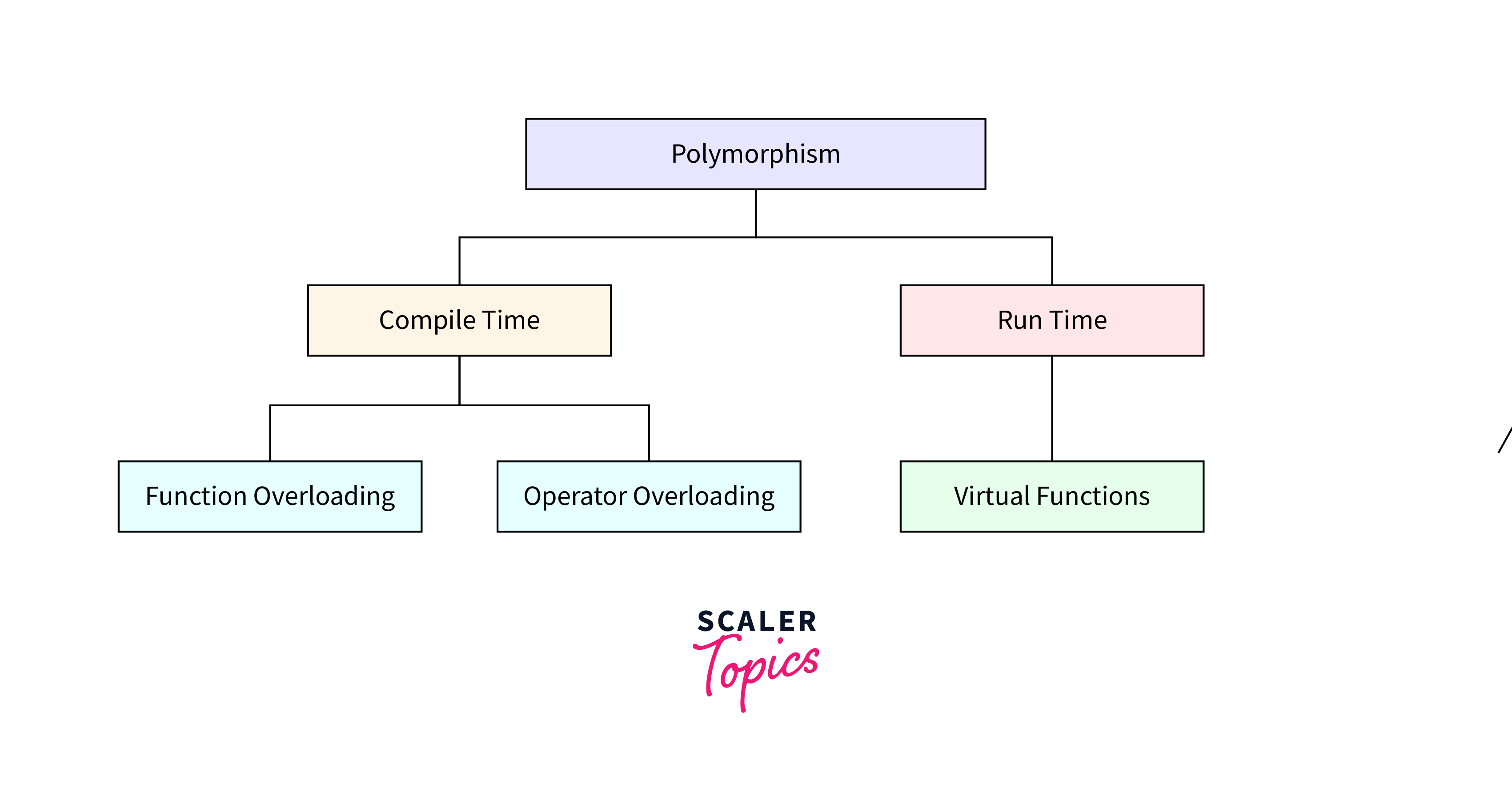
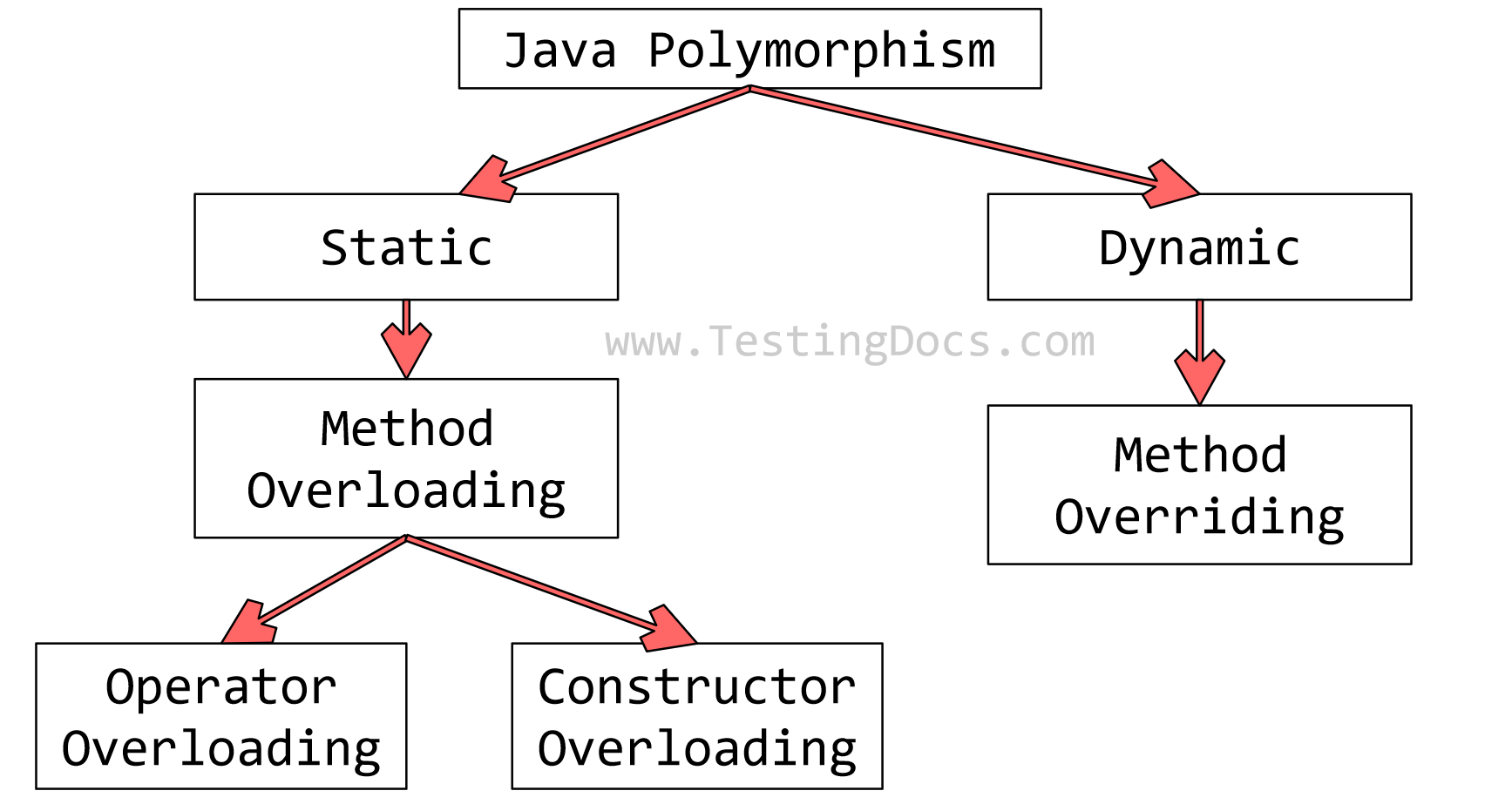
Java supports two primary types of polymorphism, categorized by when the polymorphism is resolved: at compile time or at runtime.
Compile-time Polymorphism (Method Overloading)
Compile-time polymorphism, also known as static polymorphism or early binding, is achieved through method overloading. Method overloading occurs when a class has multiple methods with the same name but different parameters. The parameters can differ in their number, type, or order. The Java compiler determines which overloaded method to call based on the number and type of arguments passed during the method call.
Key Characteristics:
-
Same method name: All overloaded methods share the same name.
-
Different signatures: Their parameter lists (number, type, or order of arguments) must be unique.
-
Return type can be different: While return type can differ, it is not sufficient to distinguish overloaded methods if parameter lists are identical.
-
Early Binding: The decision of which method to execute is made at compile time.
Example:
class Calculator {

    public int add(int a, int b) {

        return a + b;

    }


    public int add(int a, int b, int c) {

        return a + b + c;

    }


    public double add(double a, double b) {

        return a + b;

    }

}


// Usage:

Calculator calc = new Calculator();

System.out.println(calc.add(5, 10));         // Calls add(int, int)

System.out.println(calc.add(5, 10, 15));    // Calls add(int, int, int)

System.out.println(calc.add(5.5, 10.5));    // Calls add(double, double)
In this example, the add method is overloaded. The compiler checks the arguments passed and matches them to the appropriate method signature at compile time.
Runtime Polymorphism (Method Overriding)
Runtime polymorphism, also known as dynamic polymorphism or late binding, is achieved through method overriding. Method overriding occurs when a subclass provides a specific implementation for a method that is already defined in its superclass. To achieve runtime polymorphism, you need an “is-a” relationship (inheritance) between classes and a reference variable of the superclass type holding an object of the subclass type.
Key Characteristics:
-
Inheritance: Requires a parent-child relationship between classes.
-
Same method signature: The overridden method in the subclass must have the exact same name, return type, and parameter list as the method in the superclass.
-
Access modifiers: The access modifier of the overriding method cannot be more restrictive than the overridden method.
-
Late Binding: The decision of which method to execute is made at runtime, based on the actual type of the object being referred to by the reference variable. This is why it’s called dynamic method dispatch.
Example:
class Animal {

    public void makeSound() {

        System.out.println("Animal makes a sound");

    }

}


class Dog extends Animal {

    @Override // Optional but recommended annotation

    public void makeSound() {

        System.out.println("Dog barks");

    }

}


class Cat extends Animal {

    @Override

    public void makeSound() {

        System.out.println("Cat meows");

    }

}


// Usage:

public class Zoo {

    public static void main(String[] args) {

        Animal myAnimal = new Animal();

        Animal myDog = new Dog(); // myDog is an Animal reference, but holds a Dog object

        Animal myCat = new Cat(); // myCat is an Animal reference, but holds a Cat object


        myAnimal.makeSound(); // Output: Animal makes a sound

        myDog.makeSound();    // Output: Dog barks (runtime decision based on Dog object)

        myCat.makeSound();    // Output: Cat meows (runtime decision based on Cat object)

    }

}
In this Zoo example, even though myDog and myCat are declared as type Animal, the Java Virtual Machine (JVM) correctly identifies their actual object types at runtime and invokes the overridden makeSound() method of the Dog and Cat classes, respectively. The @Override annotation is a best practice, helping the compiler detect errors if the method signature doesn’t exactly match the superclass method.
Practical Applications and Benefits of Polymorphism
Polymorphism is not merely an academic concept; it is a fundamental tool for building flexible, efficient, and scalable Java applications. Its practical applications permeate every layer of a well-designed system.
Enhancing Code Reusability and Maintainability
One of the most significant advantages of polymorphism is its ability to boost code reusability. By treating objects of different classes uniformly through a common supertype (parent class or interface), you can write generic code that works with a variety of specific types.
-
Generic Programming: Imagine a system that processes various types of “documents” (PDF, Word, Excel). Without polymorphism, you might need a separate method for each document type. With polymorphism, you can define a
Documentinterface with aprint()method, and thenPdfDocument,WordDocument, andExcelDocumentclasses can implement it. A singleprintDocument(Document doc)method can then handle any document type, reducing redundancy. -
Simplified Maintenance: When requirements change, or new document types are introduced, you simply create a new class implementing the
Documentinterface. Existing code that processesDocumentobjects doesn’t need to be modified, making maintenance far easier and less error-prone. This adheres to the Open/Closed Principle (OCP) from SOLID principles: software entities should be open for extension but closed for modification.
Achieving Flexibility and Extensibility
Polymorphism makes your code highly flexible and easily extensible. It allows you to design systems that can evolve and adapt to new requirements without undergoing major structural changes.
-
Decoupling: By depending on abstractions (interfaces or abstract classes) rather than concrete implementations, you achieve a high degree of decoupling between components. If one implementation changes, it typically doesn’t impact other parts of the system as long as the abstraction’s contract is upheld.
-
Plug-and-Play Architecture: Polymorphism facilitates a “plug-and-play” architecture. You can dynamically swap out different implementations of a component at runtime. For instance, a payment processing system could support various payment gateways (PayPal, Stripe, custom gateway) by treating them all as implementations of a
PaymentGatewayinterface. The application logic doesn’t care which gateway it’s using, only that it fulfills thePaymentGatewaycontract.
Designing Robust and Scalable Systems
Polymorphism is indispensable for building robust and scalable applications capable of handling increasing complexity and workload.
-
Framework Design: Major Java frameworks (like Spring, Hibernate, JavaFX) heavily rely on polymorphism to provide flexible and extensible architectures. They define interfaces and abstract classes, allowing developers to plug in their custom implementations seamlessly.
-
Strategy Pattern: A classic design pattern, the Strategy Pattern, uses polymorphism to define a family of algorithms, encapsulate each one, and make them interchangeable. This allows the algorithm to vary independently from the clients that use it. For example, different sorting algorithms (
QuickSort,MergeSort) can implement aSortStrategyinterface. -
Collections Framework: The Java Collections Framework is a prime example of polymorphism in action. You can declare a variable of type
List<String>and assign it anArrayList<String>or aLinkedList<String>. TheListinterface provides a common set of methods (add,remove,get), and the specific implementation determines the underlying data structure and performance characteristics.
import java.util.ArrayList;

import java.util.LinkedList;

import java.util.List;


public class CollectionExample {

    public static void main(String[] args) {

        List<String> names1 = new ArrayList<>(); // Polymorphic assignment

        names1.add("Alice");

        names1.add("Bob");

        processList(names1);


        List<String> names2 = new LinkedList<>(); // Another polymorphic assignment

        names2.add("Charlie");

        names2.add("David");

        processList(names2);

    }


    public static void processList(List<String> list) {

        System.out.println("Processing list (type: " + list.getClass().getSimpleName() + "):");

        for (String name : list) {

            System.out.println(" - " + name);

        }

    }

}
In this example, the processList method is designed to accept any object that implements the List interface, demonstrating the power of polymorphism to work with different underlying implementations through a common interface.
Delving Deeper: Polymorphism with Interfaces and Abstract Classes
While inheritance is the bedrock for runtime polymorphism, interfaces and abstract classes elevate its utility by providing powerful mechanisms for defining contracts and enforcing common behaviors across diverse, potentially unrelated, class hierarchies.
Polymorphism with Interfaces
Interfaces in Java define a contract: a set of abstract methods that any class implementing the interface must provide an implementation for. They enable polymorphism by allowing objects of different, unrelated classes to be treated uniformly if they all implement the same interface.
-
Decoupling Implementations from Types: An interface reference can hold an object of any class that implements that interface. This is a crucial form of polymorphism.
interface Flyable {void fly();}
class Bird implements Flyable {
@Override public void fly() { System.out.println("Bird flies with wings."); }}
class Airplane implements Flyable {
@Override public void fly() { System.out.println("Airplane flies with engines."); }}
// Usage:
public class AirTrafficControl {
public static void main(String[] args) { Flyable flier1 = new Bird(); Flyable flier2 = new Airplane(); flier1.fly(); // Bird flies with wings. flier2.fly(); // Airplane flies with engines. }}
Here,
flier1andflier2are bothFlyablereferences, but they point to objects of different concrete types. Whenfly()is called, the specific implementation associated with the actual object type is invoked at runtime. This allows theAirTrafficControlsystem to manage variousFlyableentities without needing to know their specific class details.
Polymorphism with Abstract Classes
Abstract classes are similar to interfaces but can also contain concrete (implemented) methods, constructors, and instance variables. They can also define abstract methods that must be implemented by concrete subclasses. Abstract classes are typically used when there’s an “is-a” relationship, and you want to provide a partial implementation or a common base for related classes.
-
Partial Implementation and Common Behavior: An abstract class reference can hold an object of any concrete subclass that extends it.
abstract class Shape {private String color; public Shape(String color) { this.color = color; } public String getColor() { return color; } // Abstract method - must be implemented by subclasses public abstract double getArea(); // Concrete method - inherited as is public void displayColor() { System.out.println("Color: " + color); }}
class Circle extends Shape {
private double radius; public Circle(String color, double radius) { super(color); this.radius = radius; } @Override public double getArea() { return Math.PI * radius * radius; }}
class Rectangle extends Shape {
private double width; private double height; public Rectangle(String color, double width, double height) { super(color); this.width = width; this.height = height; } @Override public double getArea() { return width * height; }}
// Usage:
public class GeometryApp {
public static void main(String[] args) { Shape shape1 = new Circle("Red", 5.0); Shape shape2 = new Rectangle("Blue", 4.0, 6.0); shape1.displayColor(); // Inherited concrete method System.out.println("Circle Area: " + shape1.getArea()); // Polymorphic call to getArea() shape2.displayColor(); System.out.println("Rectangle Area: " + shape2.getArea()); // Polymorphic call to getArea() }}
Here,
shape1andshape2areShapereferences, but they point toCircleandRectangleobjects respectively. ThegetArea()method call invokes the correct implementation based on the actual object type at runtime.
The Role of instanceof (Careful use)
While polymorphism encourages treating objects through their common supertype or interface, there are rare scenarios where you might need to determine the actual type of an object at runtime. The instanceof operator allows you to check if an object is an instance of a particular class or an interface.
// Continuing from the Animal example

Animal myDog = new Dog();

if (myDog instanceof Dog) {

    System.out.println("myDog is indeed a Dog!");

    ((Dog) myDog).bark(); // Downcasting to access Dog-specific methods

}
Using instanceof often indicates a slight deviation from pure polymorphic design, as it reintroduces knowledge of concrete types. It should be used sparingly and only when necessary, typically for specific type-based behavior that cannot be abstracted into the common interface. Excessive use of instanceof can lead to less flexible code and might suggest that the class hierarchy could be refined.
Conclusion
Polymorphism is not just a feature of Java; it’s a mindset that shapes how you design and build software. By embracing its principles—method overloading for static flexibility and method overriding for dynamic adaptability—developers gain the ability to write code that is not only robust and efficient but also elegant and maintainable. It allows us to interact with diverse objects through a unified interface, simplifying complex systems and fostering an architecture where components can be easily extended or swapped without impacting the overall structure.
From empowering the Java Collections Framework to underpinning sophisticated design patterns, polymorphism is an omnipresent force in modern Java development. Mastering this concept is crucial for any developer aiming to write high-quality, scalable, and future-proof applications. It frees you from rigid, type-specific coding, paving the way for software that truly takes on “many forms” to meet evolving demands. Embrace polymorphism, and you unlock a new level of power and flexibility in your Java journey.
aViewFromTheCave is a participant in the Amazon Services LLC Associates Program, an affiliate advertising program designed to provide a means for sites to earn advertising fees by advertising and linking to Amazon.com. Amazon, the Amazon logo, AmazonSupply, and the AmazonSupply logo are trademarks of Amazon.com, Inc. or its affiliates. As an Amazon Associate we earn affiliate commissions from qualifying purchases.