
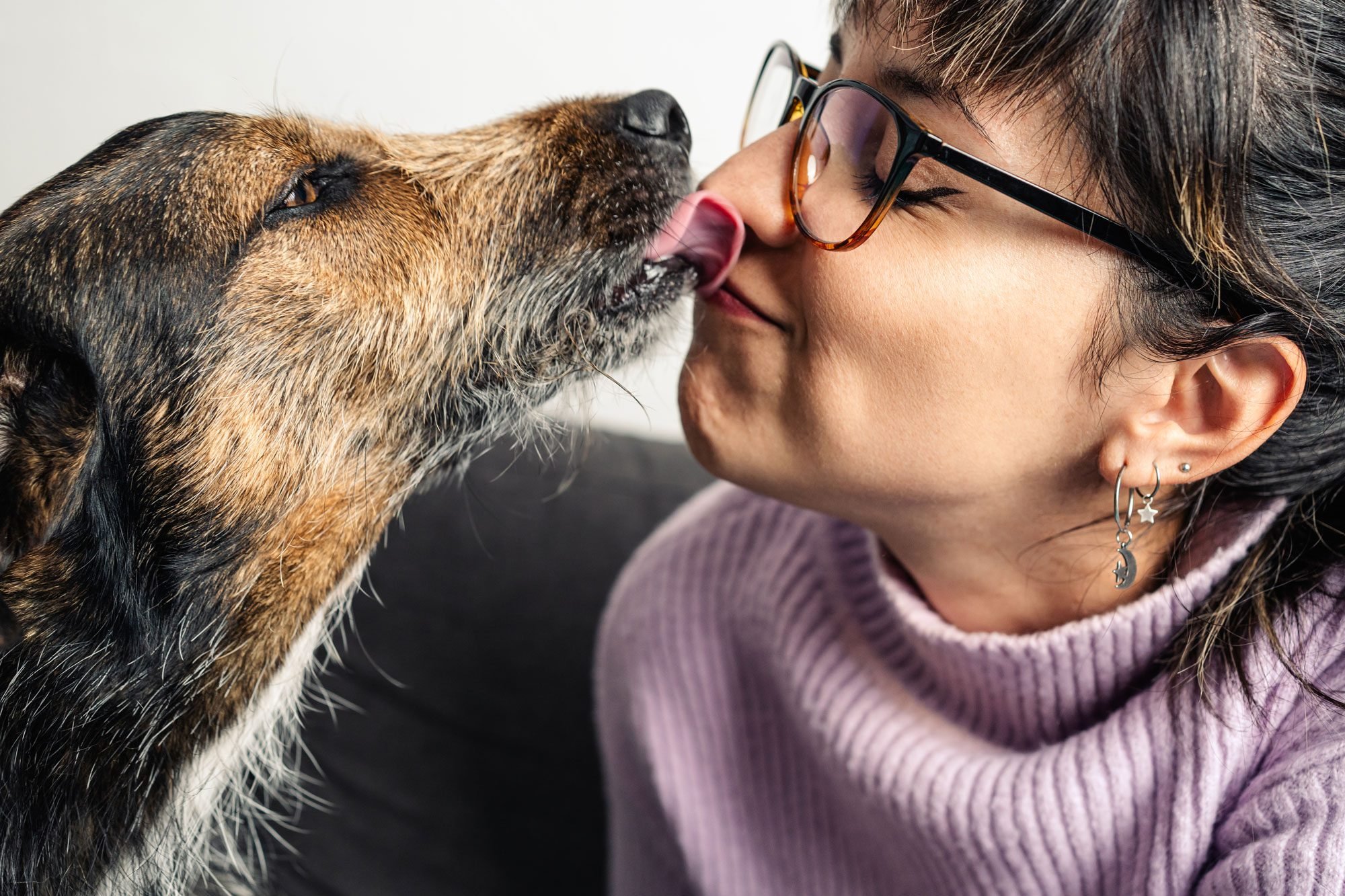
The bond between humans and dogs is one of the most ancient and profound relationships on Earth. For centuries, we’ve sought to understand our canine companions, interpreting their barks, tail wags, and, perhaps most endearingly, their licks. A dog’s lick, often dismissed as a simple sign of affection or a messy greeting, is in fact a complex communication signal laden with meaning. In an increasingly data-driven world, technology is now stepping in to move beyond mere anecdotal interpretation, offering unprecedented insights into this seemingly simple gesture. From advanced wearable sensors to sophisticated AI algorithms, the tech landscape is transforming our ability to truly understand “what does it mean a dog licks you,” paving the way for enhanced pet care and deeper human-animal connections.

The Age-Old Question, The Modern Answers
For generations, understanding a dog’s lick relied heavily on contextual observation and intuition. A lick to the face might be a “kiss,” a lick to a wound might signify empathy, and a persistent lick might suggest a need for attention. While these interpretations hold anecdotal truth, they lack the scientific rigor and consistency needed for comprehensive understanding.
Traditional Interpretations of Dog Licking
Historically, dog owners and trainers have offered a range of reasons for why dogs lick, often categorizing them based on observed behavior:
-
Affection/Greeting: The most common belief is that a dog licks to show love or greet its human, mirroring how puppies lick their mothers.
-
Attention Seeking: Licking can be a learned behavior where dogs realize it elicits a reaction from their owner, positive or negative.
-
Taste/Exploration: Dogs explore their world through scent and taste, and licking can be a way to gather information about their environment or their human, especially after a salty snack or a sweaty workout.
-
Submission/Appeasement: In a pack dynamic, a subordinate dog might lick a dominant one’s mouth to show respect or appease them.
-
Grooming/Comfort: Dogs groom themselves and each other, and licking can be a comforting, self-soothing action, or an attempt to “clean” a human.
-
Health Issues: Excessive licking, especially of themselves or specific body parts, can sometimes indicate pain, allergies, or anxiety.
While these traditional interpretations provide a foundational understanding, they are often subjective and lack the empirical data to confirm precise intent. The challenge lies in distinguishing between these various motivations, especially when they can occur simultaneously or subtly. This is where modern technology offers a revolutionary leap forward, moving from educated guesses to data-backed insights.
Limitations of Human Observation Alone
Relying solely on human observation, no matter how keen, presents inherent limitations. Our interpretations are influenced by our own biases, emotions, and limited sensory perception. We cannot detect subtle physiological changes in a dog that might accompany a lick, nor can we objectively quantify the frequency, duration, or intensity of licks across various contexts.
Furthermore, interpreting dog behavior in real-time is often reactive rather than predictive. We understand after the fact what a lick might have meant, but we lack the tools to anticipate underlying needs or to discern patterns that might indicate emerging health or behavioral issues. This gap between intuitive understanding and concrete data underscores the need for technological solutions that can collect, analyze, and interpret canine communication with greater precision and objectivity.
Technological Frontiers in Canine Behavioral Analysis
The advent of affordable sensors, powerful artificial intelligence, and sophisticated data analytics is ushering in a new era of pet understanding. These technologies are providing unprecedented insights into canine behavior, allowing us to decode the nuances of a dog’s lick with scientific precision.
Wearable Sensors and Biometric Data
Just as fitness trackers monitor human health, specialized wearable sensors for dogs are revolutionizing our ability to collect physiological and behavioral data. Collars, harnesses, and even embedded microchips can monitor a dog’s heart rate, respiration, skin temperature, sleep patterns, activity levels, and vocalizations.
When it comes to licking, these sensors can track not just the act itself (e.g., through accelerometers detecting head movements or cameras), but also the dog’s internal state during the licking episode. For instance, a lick accompanied by an elevated heart rate and increased skin temperature might indicate anxiety or stress, whereas a lick with a stable heart rate and relaxed posture might confirm simple affection. These biometric markers, collected continuously and non-invasively, provide objective context that traditional observation cannot. Startups are developing smart collars that can even detect specific types of muscle contractions associated with different licking behaviors, further refining our understanding.
AI and Machine Learning for Pattern Recognition
The true power of these data streams emerges when combined with Artificial Intelligence (AI) and Machine Learning (ML). Pet tech companies are leveraging these advanced algorithms to identify complex patterns within the vast amounts of biometric and behavioral data collected from dogs.
AI models can be trained on datasets comprising thousands of hours of dog behavior, correlating specific licking patterns with various internal states and external stimuli. For example, an ML model could learn to distinguish between a “greeting lick” (characterized by certain biometric readings and preceding behaviors) and an “anxiety lick” (with different physiological signatures). These systems can recognize subtle changes in a dog’s licking frequency, duration, or intensity that might be imperceptible to the human eye or ear. This allows for:
-
Predictive Analysis: Identifying early indicators of stress, pain, or discomfort before they manifest as overt behavioral problems.
-
Personalized Insights: Tailoring interpretations to individual dogs, as what one dog means by a lick, another might express differently.
-
Objective Classification: Moving beyond subjective human interpretation to categorize licking behaviors based on data-driven evidence.
The potential here is to create a universal language translator for canine behavior, where AI acts as the bridge between animal expression and human understanding.
Advanced Video Analytics and Computer Vision
Beyond internal biometrics, external observation is also being transformed by technology. Advanced video analytics combined with computer vision algorithms can meticulously track a dog’s body language, facial expressions, and interaction dynamics during licking episodes.
High-resolution cameras, often integrated into home monitoring systems or smart pet feeders, can record and analyze a dog’s posture, tail position, ear movements, and eye gaze. Computer vision can identify specific behavioral sequences that precede, accompany, and follow a lick. For instance, an AI might detect that a series of licks is always preceded by tail tucking and averted gaze when a new person enters the room, suggesting appeasement rather than simple greeting. Conversely, a lick accompanied by relaxed body language and direct eye contact would reinforce an interpretation of affection.
These systems can even track the target of the lick – whether it’s a human hand, face, an object, or themselves – adding another layer of contextual data. By integrating video analysis with biometric data, tech platforms are building comprehensive profiles of dog behavior, offering a holistic understanding of what each lick truly communicates.

From Data to Understanding: Practical Applications for Pet Owners
The sophisticated insights gained from pet tech are not just for academic researchers; they have profound practical implications for everyday pet owners, enabling more informed care and fostering deeper connections.
Personalized Pet Care Apps
The most immediate application of this technology is found in personalized pet care apps. Imagine an app connected to your dog’s smart collar and home cameras that provides real-time alerts and insights. “Your dog’s heart rate increased shortly before a sustained licking session, which our AI suggests might indicate mild anxiety due to the storm outside. Consider offering comfort.” or “Repeated licking of their paw, coupled with elevated skin temperature in that area, could be a sign of irritation. A vet check is recommended.”
These apps can track patterns over time, creating a behavioral baseline for each individual dog. Deviations from this baseline, identified by AI, can trigger alerts for owners, prompting them to intervene or seek professional advice. This moves pet care from reactive to proactive, empowering owners with data-driven guidance on their dog’s well-being and communication.
Early Detection of Health Issues
Perhaps one of the most critical applications is the early detection of health issues. Excessive or unusual licking can often be a subtle indicator of pain, discomfort, allergies, or underlying medical conditions. However, without objective data, these signs might be missed or misinterpreted until the condition becomes more severe.
By continuously monitoring licking behavior alongside other biometric data, AI-powered systems can flag anomalies that suggest a medical problem. For example, an increase in self-licking focused on a specific joint, coupled with slight lameness detected by an accelerometer in a smart harness, could indicate early arthritis. Similarly, persistent licking of the anal area combined with changes in stool consistency (if recorded via a smart litter box for cats, or inferred from bathroom habits for dogs) might suggest digestive issues. Early detection means earlier veterinary intervention, potentially saving pets from prolonged suffering and owners from costly advanced treatments.
Enhancing the Human-Canine Bond
Ultimately, understanding “what does it mean a dog licks you” with the precision that technology offers profoundly enhances the human-canine bond. When owners can accurately interpret their dog’s subtle signals, they can respond more appropriately and empathetically to their pet’s needs.
-
Improved Training: Understanding the precise motivation behind a lick can inform more effective training strategies, addressing underlying anxieties or reinforcing positive behaviors.
-
Reduced Stress: For both dog and owner, clarity in communication reduces frustration and misunderstandings, leading to a more harmonious household.
-
Deeper Connection: Knowing that you truly understand what your dog is trying to tell you – whether it’s a plea for comfort, a sign of joy, or a subtle indicator of discomfort – strengthens the emotional connection and fosters greater trust.
Technology moves us beyond simply loving our dogs to truly knowing them on a deeper, more empirical level, enriching the relationship for both species.
The Future of Pet Tech and Interspecies Communication
The current wave of pet technology is just the beginning. The ongoing advancements in AI, sensor miniaturization, and data processing promise an even more integrated and intuitive future for understanding our furry friends.
Next-Gen Devices and AI Integration
Future pet wearables will likely be even more sophisticated, with enhanced biometric capabilities, non-invasive glucose monitoring, and perhaps even stress hormone detection. Imagine smart collars that not only detect licking but also analyze the chemical composition of saliva for health markers. These devices will seamlessly integrate with smart home ecosystems, creating an “internet of pets” where data from various sources (feeders, beds, play toys, pet doors) converges to provide a holistic view of a dog’s life.
AI will move beyond pattern recognition to predictive modeling, not just identifying what a dog is doing, but why and what it might do next. This could lead to AI assistants that offer real-time behavioral coaching, suggesting play activities when a dog is bored or calming techniques when they are stressed, all based on their nuanced communication signals, including their licks.
Ethical Considerations and Data Privacy
As with all data-driven technologies, the rise of pet tech brings important ethical considerations. The vast amount of sensitive information collected about our pets (and, by extension, our households) raises questions about data privacy and security. Who owns this data? How is it protected from breaches? How is it used by manufacturers or third parties?
Furthermore, there’s the ethical dilemma of “over-monitoring.” While understanding our pets is invaluable, it’s crucial to strike a balance to avoid anthropomorphizing data or creating undue anxiety for owners. The goal should be to enhance well-being and understanding, not to turn our pets into data points to be constantly optimized. Regulations and industry standards will need to evolve to ensure responsible development and deployment of these powerful technologies.
Predictive Behavioral Models
The ultimate frontier is the development of predictive behavioral models that can anticipate a dog’s needs or potential issues before they even arise. By analyzing complex correlations between environment, physiology, and behavior over time, AI could one day alert an owner to a potential behavioral problem (e.g., separation anxiety) weeks before it fully manifests, recommending preventative measures.
These models could also contribute to breakthroughs in veterinary medicine, behavioral science, and even conservation efforts, providing unprecedented insights into animal welfare and interspecies communication across a broader spectrum of species. The simple act of a dog licking could become a powerful dataset, contributing to a much larger understanding of animal sentience and interaction.
Conclusion
The question “what does it mean a dog licks you” has evolved from a matter of simple observation to a complex challenge being tackled by cutting-edge technology. Through wearable sensors, AI, machine learning, and advanced video analytics, we are beginning to unlock the intricate language of canine communication. This technological revolution is not merely about data; it’s about fostering deeper empathy, improving pet welfare, and strengthening the unbreakable bond we share with our most loyal companions. As pet tech continues to advance, our understanding of these cherished gestures, like a dog’s lick, will only grow richer, allowing us to truly connect with our dogs in ways we once only dreamed were possible.
aViewFromTheCave is a participant in the Amazon Services LLC Associates Program, an affiliate advertising program designed to provide a means for sites to earn advertising fees by advertising and linking to Amazon.com. Amazon, the Amazon logo, AmazonSupply, and the AmazonSupply logo are trademarks of Amazon.com, Inc. or its affiliates. As an Amazon Associate we earn affiliate commissions from qualifying purchases.