
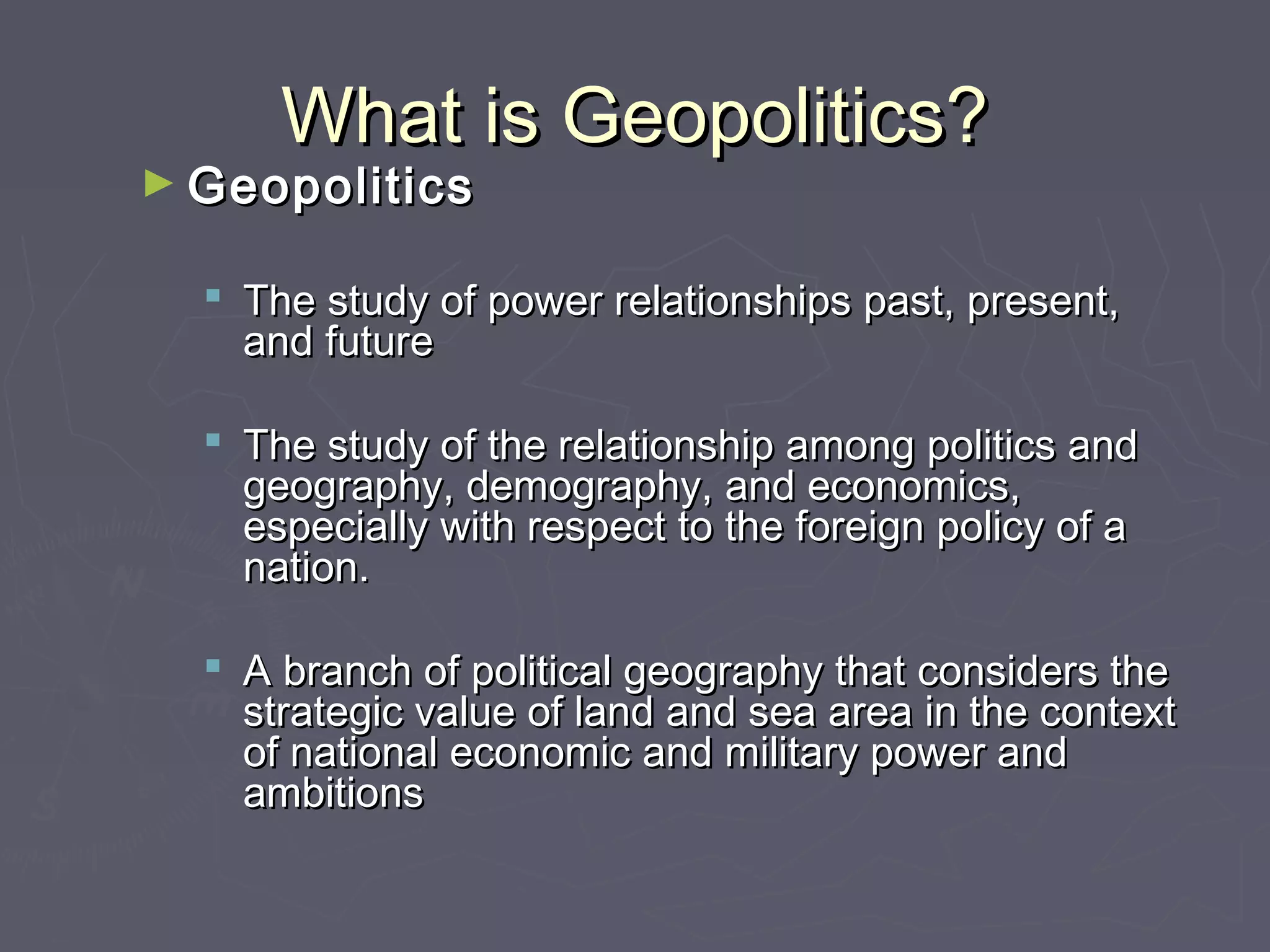
In the contemporary landscape of global commerce, the term “geopolitical” has evolved from a niche academic concept into a critical variable for any serious investor or business leader. Understanding geopolitics is no longer the sole domain of diplomats and military strategists; it is now a fundamental requirement for protecting capital, identifying market opportunities, and managing long-term portfolio risk. At its core, geopolitics refers to the interplay between geographic factors—such as physical location, natural resources, and terrain—and political power dynamics. When these forces collide, they dictate the flow of trade, the stability of currencies, and the viability of international investments.
The Financial Impact of Geopolitical Risk
For the modern investor, geopolitics acts as a silent undercurrent that can either amplify growth or erode asset values overnight. When we speak of “geopolitical risk,” we are referring to the probability that international political events—ranging from trade wars and regulatory shifts to outright conflicts—will have an adverse effect on your financial interests.
Market Volatility and Asset Allocation
Geopolitical friction often translates directly into market volatility. When tensions flare in a resource-rich region, energy prices often spike, creating inflationary pressure that forces central banks to adjust interest rates. Investors must account for this by diversifying across geographic jurisdictions. If your entire portfolio is tethered to the domestic economy of a single nation, you are inherently exposed to that nation’s specific geopolitical hurdles. Geographical diversification serves as a financial hedge; when one region experiences a political downturn, the stability of another may provide a buffer.
The Role of Natural Resources and Supply Chains
Geopolitics is deeply rooted in the physical reality of geography. Consider the control of strategic chokepoints, such as the Strait of Hormuz or the Suez Canal. Any disruption in these corridors due to political instability can cause immediate spikes in shipping costs and commodity prices. Similarly, the “scramble for rare earth minerals” has become a central geopolitical narrative. Companies and nations that secure access to the raw materials required for the green energy transition are positioning themselves for long-term economic dominance. For the investor, understanding which companies have secured their supply chains against these political bottlenecks is a key metric for determining future profitability.
Geopolitical Shifts and the Evolution of Global Trade
The global order is currently shifting from a period of relative globalization toward one of “regionalization” or “near-shoring.” This transition has profound implications for corporate strategy and business finance.
The Rise of Economic Nationalism
We are witnessing a clear trend where nations are prioritizing domestic industry over global efficiency. This “economic nationalism” often manifests through tariffs, export controls, and domestic subsidies. For a business, this means the regulatory environment is no longer static. An investment strategy that relies on the assumption of free-flowing international trade may quickly become obsolete. Financial planning must now incorporate scenario analysis that accounts for sudden trade barriers, requiring businesses to be more agile in their regional operational setups.

Sanctions and Financial Warfare
In the modern era, economic sanctions have become the weapon of choice for nations seeking to exert influence without resorting to kinetic conflict. For investors, this creates a complex landscape of compliance. The freezing of sovereign assets and the exclusion of nations from global payment systems like SWIFT represent a seismic shift in how capital moves. Financial advisors and asset managers must maintain a rigorous understanding of these sanctions to avoid holding assets that could be rendered illiquid or legally toxic by sudden diplomatic changes. The ability to monitor these shifts is now as essential as tracking quarterly earnings reports.
Strategic Investing in a Fragmented World
As the global landscape becomes increasingly multipolar, traditional investment benchmarks are changing. How should one allocate capital when the rules of the international order seem to be in flux?
Identifying Stable Jurisdictions
While no country is entirely immune to political volatility, certain nations offer a higher degree of institutional stability. When evaluating an investment, look for countries with strong rule of law, transparent regulatory frameworks, and independent judiciaries. These institutions act as shock absorbers during times of political instability. Conversely, investing in regions where political power is concentrated in the hands of a few often carries a “political premium,” where the risk of expropriation or arbitrary regulation is significantly higher.
The Infrastructure of Tomorrow
Geopolitics is increasingly focused on the infrastructure of the future: digital networks, undersea cables, and satellite arrays. The nation that controls the physical and digital infrastructure of the global economy exerts immense power over the financial systems that run on top of it. Investors should look toward companies involved in critical infrastructure projects that are supported by government-level bilateral agreements. These projects often enjoy lower risk profiles because they are viewed as vital to the national security interests of the host countries.
Navigating the Intersection of Policy and Profit
To navigate this landscape, one must learn to “think geopolitically.” This involves filtering news through the lens of long-term power dynamics rather than short-term headline shock value.
Thinking Like a Strategist
Begin by identifying the major geopolitical fault lines. Where are the areas of competition between major powers? What are the key resource dependencies? By mapping these out, you can better understand where market shocks are likely to occur. For example, if you notice a consistent pattern of trade protectionism in the semiconductor sector, you might decide to shift capital toward companies that have localized their production within stable geopolitical alliances.

The Future of Financial Literacy
Financial literacy in the 21st century must extend beyond balance sheets and P/E ratios. It requires a foundational understanding of history, geography, and political science. The businesses that succeed in the coming decades will be those that have integrated geopolitical risk management into their core strategic planning. Likewise, the investors who preserve their wealth will be those who recognize that money does not exist in a vacuum; it flows through the cracks and conduits created by human geography and power.
As we move forward, the “what” of geopolitics remains simple—it is the influence of geography on power. The “how” of responding to it, however, is what will define the successful portfolios and businesses of the future. Whether you are managing personal wealth or guiding corporate strategy, your ability to synthesize geopolitical trends into actionable financial decisions will be the ultimate determinant of your long-term success. By shifting your focus from purely financial metrics to include the broader canvas of global dynamics, you protect your capital from the unexpected and place yourself in a position to capitalize on the shifts that define our era.
aViewFromTheCave is a participant in the Amazon Services LLC Associates Program, an affiliate advertising program designed to provide a means for sites to earn advertising fees by advertising and linking to Amazon.com. Amazon, the Amazon logo, AmazonSupply, and the AmazonSupply logo are trademarks of Amazon.com, Inc. or its affiliates. As an Amazon Associate we earn affiliate commissions from qualifying purchases.