
In the intricate tapestry of modern technology, where speed, precision, and endurance are paramount, certain components work tirelessly behind the scenes, often unnoticed but absolutely indispensable. Among these silent workhorses, bearings stand out as fundamental mechanical elements that underpin nearly every machine, device, and system that involves rotational or linear motion. From the whisper-quiet fan in your laptop to the colossal wind turbines generating renewable energy, and from the sophisticated robotics on a factory floor to the wheels of your car, bearings are the critical interfaces that enable smooth operation, reduce friction, support loads, and ensure longevity.

At its core, a bearing is a machine element that constrains relative motion between two parts to only the desired motion, and reduces friction between the moving parts to the greatest extent possible. Without bearings, the friction generated by metal-on-metal contact would quickly lead to wear, heat buildup, energy loss, and ultimately, catastrophic failure of machinery. Understanding what bearings are, how they function, and their diverse applications is crucial for anyone seeking to grasp the fundamental principles of mechanical engineering and the technological advancements that define our world.
The Fundamental Role of Bearings in Modern Technology
The significance of bearings transcends their simple mechanical definition; they are the linchpins that unlock efficiency, precision, and durability across a vast spectrum of technological applications. Their primary functions, though seemingly straightforward, are foundational to the performance and viability of virtually all moving mechanisms.
Reducing Friction: The Primary Imperative
The most critical function of a bearing is to minimize friction between moving surfaces. When two surfaces rub against each other, they generate kinetic friction, which manifests as heat and causes material wear. Bearings achieve friction reduction primarily by converting sliding friction into rolling friction, or by separating the surfaces with a fluid film. Rolling friction is significantly lower than sliding friction, requiring less energy to initiate and maintain motion. This reduction in friction translates directly into enhanced energy efficiency, lower operating temperatures, and extended component lifespan, all of which are vital considerations in any technological design. In an era where energy conservation is a global priority, the role of bearings in mitigating energy losses due to friction cannot be overstated.
Supporting Loads and Guiding Motion
Beyond friction reduction, bearings are engineered to support various types of loads—radial (perpendicular to the shaft), axial (parallel to the shaft), or a combination of both—while precisely guiding the movement of a shaft or component. They ensure that moving parts remain accurately aligned and operate within specified tolerances, preventing misalignment that could lead to vibrations, noise, and premature failure. Whether it’s the enormous weight of a train axle or the delicate balance of a gyroscopic instrument, bearings provide the necessary structural support and directional control, allowing complex machinery to perform its intended functions reliably and repeatedly.
Enabling High-Speed Operation and Precision
Modern technology often demands operations at incredibly high speeds and with extreme precision. Bearings are meticulously designed to meet these exacting requirements. By maintaining stable rotation and minimizing vibrations, they allow machines to operate at elevated RPMs (revolutions per minute) without excessive heat generation or dynamic instability. In applications like machine tools, surgical instruments, and aerospace components, the precision offered by high-quality bearings is non-negotiable, directly impacting the accuracy of manufacturing processes, the efficacy of medical procedures, and the safety of flight. The continuous advancement in bearing manufacturing tolerances and material science directly contributes to pushing the boundaries of what high-speed, high-precision technology can achieve.
A Ubiquitous Component Across Industries
The omnipresence of bearings is truly astounding. They are found in household appliances like washing machines and blenders, within the engines and wheels of every vehicle, in massive industrial equipment like excavators and conveyor systems, and in the delicate mechanisms of hard disk drives and dental drills. In the burgeoning fields of robotics and automation, precise and reliable motion is paramount, making advanced bearings indispensable. From the sub-millimeter scales of micro-electromechanical systems (MEMS) to the multi-meter diameters of tunnel boring machines, bearings are tailored to provide optimal performance, making them truly ubiquitous components across virtually every industry touched by mechanical motion.
A Deep Dive into Bearing Types and Their Applications
The vast array of technological applications has led to the development of numerous bearing types, each optimized for specific operating conditions, load capacities, speeds, and environmental factors. Understanding these different types is key to appreciating the engineering ingenuity behind them.
Ball Bearings: Versatility and High-Speed Performance
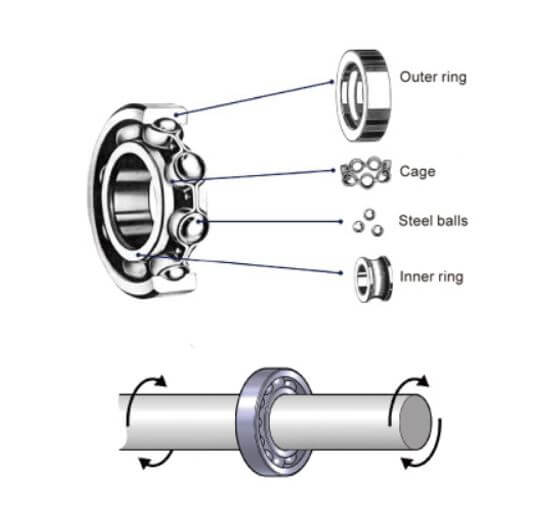
Ball bearings are perhaps the most common type, recognized by their spherical rolling elements. They are excellent at handling both radial and light thrust loads and are well-suited for high-speed applications due to their relatively small contact area, which reduces friction. Their versatility makes them ideal for a wide range of uses, from skateboards and bicycles to electric motors, household appliances, and automotive components. Variations include deep groove ball bearings (most common), angular contact ball bearings (for combined radial and high axial loads in one direction), and self-aligning ball bearings (to accommodate minor shaft misalignment).
Roller Bearings: Heavy Loads and Specific Geometries
Roller bearings utilize cylindrical, tapered, or spherical rollers instead of balls, which provide a larger contact area with the raceways. This larger contact area allows them to support significantly higher radial loads compared to ball bearings.
-
Cylindrical Roller Bearings: Feature rollers with a large surface area for contact with the raceways. They are excellent for very heavy radial loads and high speeds but typically cannot handle thrust loads. They are commonly found in industrial gearboxes, pumps, and railway axle-boxes.
-
Tapered Roller Bearings: Employ rollers shaped like truncated cones, allowing them to support very high radial and axial (thrust) loads simultaneously. They are often used in pairs, opposing each other, to manage forces in different directions. Automotive wheel hubs, gear reducers, and agricultural machinery are typical applications.
-
Spherical Roller Bearings: Designed with two rows of barrel-shaped rollers that operate on a spherical outer ring raceway. This design gives them exceptional self-aligning capabilities, making them tolerant of significant misalignment between the shaft and housing. They are ideal for heavy loads and shock conditions in applications like wind turbines, mining equipment, and pulp and paper machinery.
Plain Bearings (Bushings): Simplicity and Cost-Effectiveness
Unlike rolling-element bearings, plain bearings (also known as bushings or sleeve bearings) do not use rolling elements. Instead, they operate on the principle of direct contact between a shaft and a bearing surface, often separated by a lubricating film. They are simple, compact, and cost-effective, particularly for low-speed, high-load applications or when space is limited. Materials range from bronze and brass to plastics and advanced composites, often incorporating self-lubricating properties. Examples include door hinges, engine crankshafts, and various pivots in construction equipment.
Thrust Bearings: Handling Axial Loads
Thrust bearings are specifically designed to handle loads acting parallel to the axis of rotation (axial loads). They can be ball thrust bearings, roller thrust bearings, or fluid film thrust bearings, depending on the load and speed requirements. They are crucial in applications where components exert significant force along the shaft, such as in car clutches, propeller shafts, and turntable supports.
Magnetic Bearings: Frictionless Frontiers
A cutting-edge technology, magnetic bearings levitate the rotating shaft using magnetic forces, entirely eliminating mechanical contact and friction. This allows for extremely high speeds, virtually no wear, and operations in vacuum environments or at very high temperatures. While more complex and expensive, they are increasingly used in advanced applications like turbo machinery, high-speed centrifuges, and flywheel energy storage systems, pushing the boundaries of what is mechanically possible.
The Engineering and Technological Advancements in Bearing Design
The performance and reliability of bearings are not static; they are the result of continuous innovation in materials science, manufacturing processes, and lubrication technologies. The pursuit of greater efficiency, longer lifespan, and higher performance drives ongoing research and development in this critical field.
Materials Science: From Steel to Ceramics and Composites
Traditionally, bearings have been made from hardened steel (e.g., chrome steel). However, modern demands have spurred the development of advanced materials. Hybrid bearings, combining steel rings with ceramic (silicon nitride) balls, offer superior stiffness, lighter weight, higher speed capability, and resistance to corrosion and electrical erosion. These are crucial in high-precision spindles and electric motors. Polymer composites are also gaining traction for self-lubricating plain bearings, offering advantages in lightweight applications, chemical resistance, and maintenance-free operation. Research into smart materials and surface coatings continues to enhance bearing performance in extreme environments.

Lubrication Technologies: The Lifeline of Bearings
Lubrication is arguably as important as the bearing itself. It creates a thin film that separates the moving surfaces, further reducing friction, dissipating heat, and preventing corrosion.
-
Grease vs. Oil Lubrication: Grease is often preferred for its sealing properties and ability to stay in place, making it suitable for sealed-for-life bearings and where maintenance access is limited. Oil offers better cooling, can be filtered to remove contaminants, and is used in high-speed or heavy-load applications where a continuous flow is required.
-
Self-Lubricating Bearings: These bearings are made from materials impregnated with solid lubricants (like PTFE, graphite, or molybdenum disulfide) or have solid lubricant inserts. They are ideal for applications where traditional lubrication is impractical, such as in food processing, high-temperature environments, or remote locations requiring maintenance-free operation.
Sealing Technologies: Protection from Contaminants
Even the best-designed bearing will fail prematurely if contaminants (dust, moisture, chemicals) enter its delicate internal structure. Advanced sealing solutions, ranging from simple contact seals (like lip seals) to non-contact labyrinth seals and magnetic fluid seals, are crucial for protecting bearings in harsh environments. Effective sealing preserves the lubricant and prevents abrasive particles from causing wear, significantly extending bearing life.
Precision Manufacturing: Micro-Tolerances and Performance
The performance of a bearing is directly tied to the precision of its manufacturing. Bearing components are produced with incredibly tight tolerances, often measured in micrometers. Advanced machining processes, super-finishing techniques, and meticulous assembly in controlled environments ensure that raceways are perfectly smooth, rolling elements are uniformly sized, and components fit together with minimal runout. These precision levels are critical for achieving high rotational accuracy, low noise, and extended fatigue life, especially in high-speed and high-precision applications.
Sensor Integration and Smart Bearings: Towards Predictive Maintenance
The integration of sensors into bearings represents a significant leap forward. Smart bearings can monitor their own condition in real-time, tracking parameters such as temperature, vibration, speed, and even lubrication levels. This data can be transmitted to a central system for analysis, enabling predictive maintenance strategies. Instead of scheduled replacements or waiting for failure, maintenance can be performed precisely when needed, preventing costly downtime, optimizing resource allocation, and extending the operational life of machinery. This trend aligns perfectly with Industry 4.0 and the Internet of Things (IoT), transforming bearings from passive components into active data sources.
The Impact of Bearings on Technological Evolution and Sustainability
The continuous improvement in bearing technology has a profound ripple effect, driving advancements across numerous sectors and contributing significantly to global sustainability efforts.
Enhancing Energy Efficiency and Reducing Waste
By minimizing friction, modern bearings directly contribute to the energy efficiency of machines. Less friction means less energy is wasted as heat, leading to lower power consumption for a given output. This is particularly critical in energy-intensive industries and in the context of global efforts to reduce carbon emissions. Furthermore, the extended lifespan of durable bearings reduces the frequency of replacements, leading to less material waste and a smaller environmental footprint.
Enabling Miniaturization and High-Performance Systems
The ability of modern bearings to operate reliably at high speeds and under significant loads, all while being increasingly compact, facilitates the miniaturization of technological systems. This is vital in fields like medical devices, consumer electronics, and robotics, where smaller, lighter, and more powerful components are consistently sought after. From micro-bearings in dental drills to advanced bearings in high-density data storage, they enable complex functionality within ever-smaller packages.
The Role in Robotics, Aerospace, and Renewable Energy
In robotics, precision bearings enable the fluid, accurate movements required for complex tasks, from surgical robots to industrial manipulators. In aerospace, lightweight, high-performance bearings are critical for jet engines, control surfaces, and landing gear, operating reliably under extreme conditions of temperature, pressure, and speed. In renewable energy, particularly wind turbines, massive bearings support the rotor blades, enduring immense loads and operating continuously for decades in harsh environments, making efficient power generation possible. These sectors epitomize how advanced bearing technology is a cornerstone of cutting-edge innovation.
Future Trends: Advanced Materials and Digital Integration
The future of bearings will likely see even greater integration of advanced materials, such as self-healing composites and even lighter, stronger alloys. Digital integration will become more pervasive, with every bearing potentially being a “smart” component, providing real-time data for optimized performance and predictive maintenance. Nanotechnology may allow for ultra-low friction surfaces, and adaptive bearing systems could dynamically adjust their properties based on operating conditions. These advancements will further solidify bearings’ role as indispensable components in the next generation of technological marvels.
Selecting the Right Bearing: A Critical Engineering Decision
Choosing the correct bearing for a specific application is a complex engineering decision that requires careful consideration of numerous factors. An incorrect choice can lead to premature failure, inefficiency, and increased operational costs.
Load Capacity and Type of Load
The primary consideration is the nature and magnitude of the load the bearing must support. This includes whether the load is primarily radial, axial, or a combination, and if it’s static, dynamic, or involves shock loads. Different bearing types are inherently better suited for specific load conditions, and their load ratings must never be exceeded.
Speed Requirements and Operating Environment
The rotational speed of the shaft dictates the type of bearing and lubrication system. High speeds require bearings with low friction and excellent heat dissipation, often necessitating oil lubrication. The operating environment, including temperature extremes, presence of contaminants (dust, moisture, chemicals), and vibrations, also heavily influences material selection, seal type, and lubrication choice.
Precision, Rigidity, and Expected Lifespan
Some applications demand extremely high rotational precision and rigidity to minimize runout or deflection. Machine tool spindles, for instance, require bearings with very tight tolerances. The desired operational lifespan of the bearing is also a key factor, influencing material selection, heat treatment, and lubrication strategies to prevent fatigue failure.
Cost-Benefit Analysis and Maintenance Considerations
While performance is paramount, cost is always a factor. Engineers must balance the performance requirements with the overall cost of the bearing, its installation, and its maintenance. Some bearings are “sealed for life” and require no maintenance, while others require periodic lubrication or inspection, impacting long-term operational costs and downtime.
In conclusion, bearings, though often out of sight, are critical enablers of almost every moving part in our technological world. They are not merely simple mechanical components but sophisticated engineering marvels whose continuous evolution in design, materials, and smart integration continues to drive efficiency, precision, and sustainability across industries. Understanding “what are bearings” is truly understanding the fundamental building blocks of modern mechanical and technological progress.
aViewFromTheCave is a participant in the Amazon Services LLC Associates Program, an affiliate advertising program designed to provide a means for sites to earn advertising fees by advertising and linking to Amazon.com. Amazon, the Amazon logo, AmazonSupply, and the AmazonSupply logo are trademarks of Amazon.com, Inc. or its affiliates. As an Amazon Associate we earn affiliate commissions from qualifying purchases.