
In an age dominated by algorithms, artificial intelligence, and sophisticated digital interfaces, the fundamental principles of mathematics often serve as the silent architects behind the scenes. While many technical conversations gravitate towards frameworks, languages, and hardware, the underlying calculus remains indispensable. Among these foundational concepts, the derivative of the inverse tangent function—arctan(x)—holds a surprisingly significant position within various branches of technology. Far from being a mere academic exercise, understanding d/dx (arctan(x)) is crucial for anyone delving into fields from computer graphics and robotics to machine learning and signal processing.
This article aims to demystify the derivative of arctan(x) and, more importantly, illuminate its profound relevance in the technological landscape. We will explore its mathematical derivation, its practical implications, and how this seemingly abstract concept underpins some of the most innovative solutions in today’s digital world. By connecting the dots between pure mathematics and real-world tech applications, we hope to showcase the enduring power of calculus in shaping our technological future.
The Mathematical Foundation: Understanding Arctan and Derivatives
Before diving into its technological applications, it’s essential to grasp what arctan(x) represents and the fundamental concept of a derivative. These building blocks are critical for appreciating why its derivative takes the form it does and why it’s so useful in tech.
Recapping Inverse Tangent and its Geometric Intuition
The tangent function, tan(θ), is defined in a right-angled triangle as the ratio of the length of the opposite side to the length of the adjacent side. It relates an angle θ to a ratio of side lengths. The inverse tangent function, arctan(x) (often written as tan⁻¹(x)), does the opposite: it takes a ratio x and returns the angle θ whose tangent is x. In essence, y = arctan(x) means x = tan(y).
Geometrically, if you have a point (x, y) in a Cartesian coordinate system, the angle θ that the line from the origin to (x, y) makes with the positive x-axis can be found using arctan(y/x). This capability to translate a ratio or a slope back into an angle is invaluable, particularly in domains where direction, orientation, and rotational motion are paramount. Consider a robot arm needing to orient itself, or a 3D model calculating the angle of a light source—these all rely on inverse trigonometric functions to interpret spatial data.
The Essence of the Derivative: Rate of Change in Action
The derivative, a cornerstone of differential calculus, quantifies how a function changes as its input changes. It measures the instantaneous rate of change or the slope of the tangent line to the function’s graph at any given point. If a function f(x) describes a quantity, its derivative f'(x) or df/dx describes how sensitive that quantity is to small changes in x.
In the technological context, derivatives are everywhere. They help us understand how fast a variable is increasing or decreasing, how sensitive an output is to an input, or how to find the optimal point of a system. For instance, in machine learning, derivatives are used to find the minimum of a loss function (gradient descent), allowing models to learn and improve. In physics simulations, derivatives calculate velocities and accelerations from position data. Understanding the “rate of change” is fundamental to modeling dynamic systems and optimizing processes, making the derivation of arctan(x) a particularly potent tool.
Deriving the Derivative: A Step-by-Step Tech Perspective
Understanding how the derivative of arctan(x) is obtained not only solidifies the mathematical concept but also showcases a powerful technique—implicit differentiation—that has analogues in computational problem-solving.
The Implicit Differentiation Approach
Let’s derive d/dx (arctan(x)).
-
Start with the inverse relationship: Let
y = arctan(x). This impliesx = tan(y). -
Differentiate both sides with respect to x: We apply the derivative operator
d/dxto both sides:d/dx (x) = d/dx (tan(y)) -
Evaluate the left side:
d/dx (x) = 1. -
Evaluate the right side using the chain rule: The derivative of
tan(y)with respect toyissec²(y). Sinceyis a function ofx, we must multiply bydy/dx(the chain rule):d/dx (tan(y)) = sec²(y) * dy/dx -
Combine and solve for dy/dx:
1 = sec²(y) * dy/dxdy/dx = 1 / sec²(y) -
Express sec²(y) in terms of x: We know the trigonometric identity
sec²(y) = 1 + tan²(y).Since
x = tan(y), we can substitutexinto the identity:sec²(y) = 1 + x². -
Final result: Substitute this back into the equation for
dy/dx:dy/dx = 1 / (1 + x²)
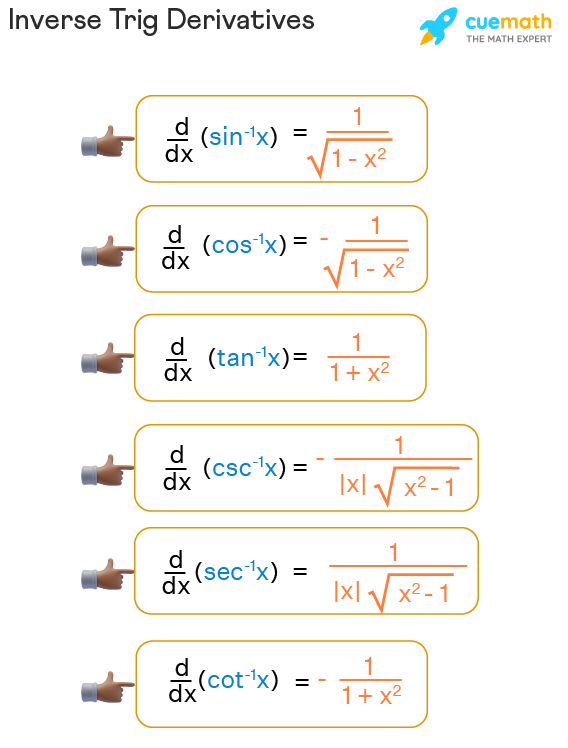
Thus, the derivative of arctan(x) is 1 / (1 + x²). This elegant result is simple yet incredibly versatile. The 1 + x² in the denominator implies that the rate of change is highest when x is close to zero and gradually decreases as x moves further away from zero. This characteristic behavior has direct implications in how systems respond to angular changes.
Verification through Computational Tools
In a tech environment, it’s not enough to derive a formula; one must also be able to verify and implement it efficiently. Modern computational tools and symbolic math libraries allow us to do just that. Software like Wolfram Alpha, MATLAB’s Symbolic Math Toolbox, Python’s SymPy, or even advanced calculators can compute derivatives symbolically.
For instance, in Python using SymPy:
from sympy import symbols, diff, atan

x = symbols('x')

f = atan(x)

derivative = diff(f, x)

print(derivative)

# Output: 1/(x**2 + 1)
This confirms our manual derivation, reinforcing the bridge between theoretical mathematics and practical computational verification. Such tools are indispensable for engineers and data scientists, allowing them to rapidly check derivations, simplify complex expressions, and focus on the application of these mathematical insights.
Why Arctan’s Derivative Matters in Tech
The seemingly abstract formula 1 / (1 + x²) finds concrete applications in diverse technological domains, influencing everything from visual fidelity to robotic precision and intelligent decision-making.
Computer Graphics and Robotics: Navigating Angular Data
In computer graphics, 3D transformations often involve rotations. When calculating the angle required to orient an object or determining the direction of a vector, arctan is frequently used. For example, calculating the angle between two vectors or determining the viewing angle in a camera system might involve arctan2(y, x), a variant that handles all quadrants. The derivative of this angle is crucial for understanding how rapidly an object’s orientation is changing or how sensitive the view is to subtle movements. This is vital for smooth animations, accurate collision detection, and realistic physics simulations.

In robotics, path planning, inverse kinematics (determining joint angles to achieve a desired end-effector position), and sensor fusion all heavily rely on manipulating angles. If a robot’s joint angle is a function of time or position, its derivative helps determine angular velocity. The 1 / (1 + x²) term can appear when analyzing the sensitivity of an angle to changes in a linear dimension, providing insights into control system design and stability. For instance, adjusting a camera’s pan based on detected motion might use arctan, and its derivative would inform how aggressively the camera should adjust its angle based on the input change.
Machine Learning and AI: Optimization and Activation Functions
While not a direct activation function itself, the underlying principle of derivatives is paramount in machine learning. Gradient descent, the workhorse algorithm for training neural networks, relies entirely on calculating the derivative (gradient) of a loss function with respect to model parameters. The goal is to find the minimum of this loss function, which represents the optimal set of parameters.
Although arctan(x) isn’t a common activation function like ReLU or sigmoid, its derivative’s shape (peaking at x=0 and decaying) is characteristic of derivatives of other common activation functions like tanh(x) (whose derivative is sech²(x)) and the sigmoid function. Understanding how derivatives of functions like arctan behave provides insight into the “vanishing gradient problem” in deep learning, where gradients become extremely small, slowing down or halting learning. The 1 / (1 + x²) term provides a clear example of a derivative that has a bounded output, which is a desirable property for ensuring numerical stability in some computational contexts.
Signal Processing and Control Systems: Understanding Dynamic Behavior
In signal processing, signals often contain phase information that relates to angles. Analyzing the frequency response of a system might involve phase shifts, and arctan helps to extract these angles from complex numbers. The derivative then describes how quickly the phase is changing with respect to frequency, which is crucial for filter design and understanding signal distortion. For example, in communication systems, phase modulation relies on encoding data in phase shifts, and understanding the rate of these shifts is critical.
In control systems, such as those governing aircraft, industrial machinery, or even cruise control in a car, the stability and responsiveness of the system are paramount. Feedback loops often involve PID (Proportional-Integral-Derivative) controllers. While the “D” term of PID directly uses the derivative of the error signal, the analysis of system stability often involves frequency domain techniques like Bode plots, which relate directly to phase and magnitude responses. Here, the derivative of arctan might emerge when analyzing the phase margin of a system, giving engineers insights into how close a system is to instability and how quickly its phase response changes with frequency.
Implementing and Utilizing Arctan Derivatives in Software
Beyond theoretical understanding, the practical application of d/dx (arctan(x)) lies in its efficient implementation within software. Modern programming environments offer robust tools to handle these computations.
Practical Applications in Programming Languages (Python, C++)
Programming languages like Python and C++ provide built-in functions for arctan (usually atan or atan2). While you wouldn’t typically directly code the derivative 1 / (1 + x**2) by hand for every scenario, understanding its form is critical for debugging, optimizing, or designing custom functions.
In Python:
import math


def arctan_derivative(x):

    """Calculates the derivative of arctan(x)."""

    return 1 / (1 + x**2)


# Example usage in a simulated control system:

# If 'x' represents a deviation from a target, the derivative tells us how

# sensitive the angular correction should be to that deviation.

deviation = 0.5

correction_sensitivity = arctan_derivative(deviation)

print(f"Correction sensitivity for deviation {deviation}: {correction_sensitivity}")

# Output: Correction sensitivity for deviation 0.5: 0.8
In C++, the atan function is available in the <cmath> library. High-performance applications, like real-time graphics engines or embedded robotics systems, might implement these mathematical functions with extreme optimization, where every clock cycle counts. Knowing the mathematical form helps engineers verify performance characteristics and numerical stability.
Leveraging Math Libraries for Efficiency and Accuracy
For complex mathematical operations, software engineers rarely “reinvent the wheel.” Instead, they leverage highly optimized mathematical libraries. Libraries like NumPy and SciPy in Python, Eigen in C++, or MATLAB’s extensive toolboxes provide optimized implementations of trigonometric functions and their derivatives, often with numerical stability considerations built-in.
These libraries can handle vectorized operations, meaning they can apply the derivative to an entire array of numbers simultaneously, which is crucial for performance in data-intensive tasks like machine learning model training or processing large sensor datasets. The accuracy and efficiency of these library functions are critical for ensuring reliable and performant technological solutions. When a machine learning framework computes gradients during backpropagation, it relies on such underlying mathematical functions and their derivatives, often implicitly calculated by auto-differentiation engines.
The Broader Impact: Mathematical Literacy in the Digital Age
The journey from y = arctan(x) to dy/dx = 1 / (1 + x²) and its subsequent application in computer vision, AI, and control systems highlights a fundamental truth: robust mathematical understanding is indispensable for innovation in technology.
Bridging Theory and Application for Innovation
The ability to connect abstract mathematical concepts with tangible technological challenges is a hallmark of truly innovative engineering. Understanding the derivative of arctan isn’t just about memorizing a formula; it’s about comprehending its behavior, its limitations, and its potential. This theoretical depth allows engineers to design more efficient algorithms, debug complex systems, and predict the behavior of novel technologies. Whether it’s fine-tuning a robot’s movement trajectory or optimizing a neural network’s learning rate, the insights derived from calculus provide a powerful lens through which to view and solve intricate problems.

Empowering the Next Generation of Tech Professionals
For aspiring tech professionals, a solid grounding in mathematics, particularly calculus, is not merely a gatekeeper but an enabler. It provides the analytical toolkit necessary to not just use existing technologies but to create new ones. As technology continues to advance, the demand for individuals who can bridge the gap between theoretical models and practical implementation will only grow. Understanding concepts like the derivative of arctan(x) empowers these professionals to delve deeper, innovate faster, and contribute meaningfully to the next wave of technological breakthroughs, ensuring that the elegant language of mathematics continues to drive our digital future.
aViewFromTheCave is a participant in the Amazon Services LLC Associates Program, an affiliate advertising program designed to provide a means for sites to earn advertising fees by advertising and linking to Amazon.com. Amazon, the Amazon logo, AmazonSupply, and the AmazonSupply logo are trademarks of Amazon.com, Inc. or its affiliates. As an Amazon Associate we earn affiliate commissions from qualifying purchases.