
In the realm of pure mathematics, the square root of 2—often written as $sqrt{2}$ or approximately 1.414—is known as Pythagoras’s constant. It is the first irrational number ever discovered, a value that cannot be expressed as a simple fraction and whose decimal expansion continues infinitely without repeating. While this might seem like a concern for high school geometry students, the square root of 2 is actually a cornerstone of modern technology. From the hardware engineering of the devices in our pockets to the complex algorithms that render 3D environments in real-time, $sqrt{2}$ is a silent protagonist in the digital age.
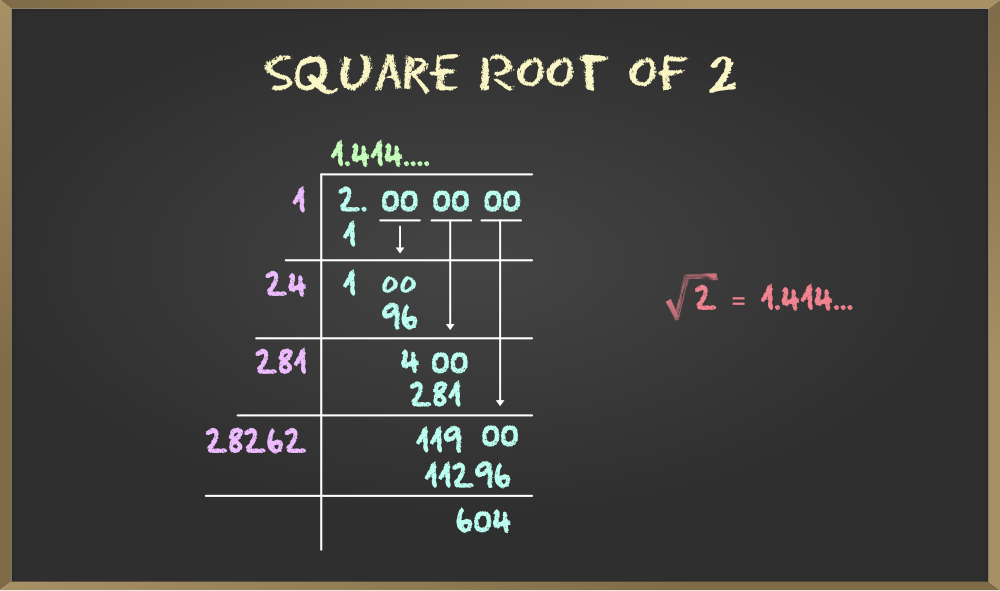
Understanding what the square root of 2 represents from a technological perspective requires looking beyond the digits. It is a fundamental ratio that dictates how we scale hardware, how we optimize software performance, and how we manage data precision in an era of high-performance computing.
The Computational Challenge of Irrationality
At the heart of computer science lies a fundamental conflict: computers are finite, but mathematics is often infinite. Because the square root of 2 is irrational, a computer can never truly “know” the exact value of $sqrt{2}$. It can only approximate it to a certain level of precision.
Floating-Point Arithmetic and the Approximation Problem
Modern CPUs and GPUs use floating-point arithmetic to handle non-integer values. The IEEE 754 standard defines how these numbers are stored in binary. When a developer writes code that requires the square root of 2, the system must decide how many bits to allocate to that value. In a 32-bit “single precision” float, $sqrt{2}$ is rounded to a specific number of decimal places. In 64-bit “double precision,” the approximation is much tighter.
The tech industry relies on these approximations for everything from GPS calculations to financial modeling. However, “rounding errors” are a constant threat. In high-stakes software engineering, such as aerospace or autonomous vehicle programming, the slight deviation between the true $sqrt{2}$ and its digital approximation must be managed through rigorous error-bound analysis to prevent catastrophic system failures.
Memory Allocation and Numerical Stability
Calculating $sqrt{2}$ to millions of digits is a common benchmark for testing the stability and speed of new hardware. When a new processor architecture is released, tech reviewers often run “Pi” or “Root” benchmarks to see how the silicon handles sustained numerical throughput. This is because calculating an irrational constant forces the CPU to utilize its floating-point unit (FPU) intensely, revealing the thermal and computational limits of the chip.
Hardware Standards and the “Root 2” Ratio
Beyond the software, $sqrt{2}$ is physically embedded in the technology we use every day. One of the most elegant applications of this number is found in the international standard for paper sizes (ISO 216) and the sensors used in digital photography.
The ISO 216 Standard: Engineering the Perfect Page
If you have ever used an A4 sheet of paper, you have interacted with the square root of 2. The aspect ratio of the ISO paper series is $1:sqrt{2}$. This is not an aesthetic choice, but a brilliant piece of technological engineering. Because of this specific ratio, when you fold a piece of A4 paper in half, the resulting two pieces (A5) have the exact same aspect ratio as the original.
In the world of digital scanning and printing, this allows for seamless scaling. A digital document can be enlarged or reduced without any “letterboxing” or distortion. From a tech workflow perspective, this mathematical constant ensures that software-to-hardware communication in the printing industry remains efficient and standardized.
Aspect Ratios and Sensor Technology
In digital imaging and display tech, the geometric properties of $sqrt{2}$ are used to calculate diagonal distances and pixel densities. When engineers design ultra-high-definition displays, they must balance the width and height to maximize the diagonal viewing area. The relationship between the sides of a square pixel grid and the diagonal path across those pixels is defined by $sqrt{2}$. This constant is essential for developers working on anti-aliasing algorithms—software techniques that smooth out the jagged edges of digital images by calculating the “true” distance between pixel centers.
Algorithms: How Software Calculates the Square Root of 2
In modern software development, we rarely think about how a computer finds a square root; we simply call a function like Math.sqrt(2). However, the underlying algorithms are masterpieces of computer science.

The Babylonian Method: An Early Iterative Algorithm
One of the oldest known methods for calculating square roots is the Babylonian method, a form of Heron’s formula. In a tech context, this is an iterative algorithm. It starts with a rough guess and then repeatedly averages that guess with the number divided by the guess.
For developers, this is a classic example of an “early exit” algorithm. A computer can be programmed to run these iterations until the difference between two results is smaller than a predefined threshold (epsilon). This allows software to balance speed and accuracy, providing “just enough” precision for the task at hand—whether it’s a simple calculator app or a complex physics engine.
Newton-Raphson: The Gold Standard for Modern Processors
Most modern programming libraries use the Newton-Raphson method for root-finding. This method uses calculus (specifically derivatives) to find the zeros of a function. In the case of $sqrt{2}$, the computer finds the root of $f(x) = x^2 – 2$.
The beauty of the Newton-Raphson method in technology is its “quadratic convergence.” This means that the number of correct digits roughly doubles with every iteration. For a high-performance AI tool or a heavy-duty data analysis suite, this efficiency is vital. It minimizes the number of clock cycles a CPU spends on a single operation, reducing power consumption and increasing the speed of the overall application.
The Fast Inverse Square Root: A Tech Legend
One cannot discuss square roots in technology without mentioning the “Fast Inverse Square Root” algorithm famously used in the Quake III Arena source code. While it calculates $1/sqrt{x}$, it relies on the same geometric principles. This clever bit of “hacker” math used a “magic number” (0x5f3759df) to compute the value much faster than traditional methods. It serves as a reminder that in the tech world, the way we handle mathematical constants like $sqrt{2}$ can be the difference between a game that runs smoothly and one that lags.
Digital Security and Cryptographic Implications
While $sqrt{2}$ itself is not usually the key to an encryption algorithm (prime numbers usually take that role), the concept of irrationality and transcendental numbers is crucial for digital security.
Entropy and Pseudo-Random Number Generation
In cryptography, we need numbers that are unpredictable. Because the decimal expansion of $sqrt{2}$ is non-repeating and appears statistically random, irrational constants have been used as sources of “nothing-up-my-sleeve” numbers. These are values that prove a cryptographic protocol hasn’t been “backdoored” by a developer, as the digits are derived from a universal mathematical constant rather than a hand-picked string.
Geometric Hashing and Computer Vision
In the field of AI-driven computer vision, the square root of 2 is used in feature detection. When an AI tool like an autonomous driving system or a facial recognition app “looks” at an image, it uses algorithms like SIFT (Scale-Invariant Feature Transform). These algorithms often use a “Gaussian scale-space,” where images are blurred at scales that increase by a factor of $sqrt{2}$. This allows the software to recognize objects regardless of their size or distance from the camera, providing a standardized way to scale digital perception.
The Future of High-Precision Computing
As we move toward the next frontier of technology—Quantum Computing and AI-driven hardware—our relationship with constants like $sqrt{2}$ is evolving.
Quantum Computing and Arbitrary Precision
Standard binary computers are limited by their bit-depth. Quantum computers, however, operate using qubits which can represent probabilities. This could potentially allow for “arbitrary precision” calculations where irrational numbers are handled in entirely new ways. Instead of approximating $sqrt{2}$ in a 64-bit container, quantum algorithms might process the geometric relationship directly, leading to breakthroughs in materials science and fluid dynamics simulations.
AI-Driven Optimization and Numerical Analysis
We are also seeing the rise of “Approximate Computing” in AI hardware. For certain machine learning tasks, you don’t actually need 15 decimal places of $sqrt{2}$ to identify a cat in a video. By intentionally reducing the precision of these calculations, AI chips can run significantly faster and use less energy. The challenge for future tech architects is determining exactly how much of the “true” square root of 2 we can sacrifice for the sake of speed without compromising the integrity of the system.

Conclusion
So, what is the square root of 2? To a mathematician, it is the diagonal of a unit square. But to the tech world, it is a fundamental constant that influences everything from the physical size of a tablet to the way a GPU calculates lighting in a video game. It is a testament to the fact that our most advanced software and hardware are built upon ancient mathematical foundations. As technology continues to advance, our ability to calculate, approximate, and apply $sqrt{2}$ will remain a benchmark of our computational progress.
aViewFromTheCave is a participant in the Amazon Services LLC Associates Program, an affiliate advertising program designed to provide a means for sites to earn advertising fees by advertising and linking to Amazon.com. Amazon, the Amazon logo, AmazonSupply, and the AmazonSupply logo are trademarks of Amazon.com, Inc. or its affiliates. As an Amazon Associate we earn affiliate commissions from qualifying purchases.