
For decades, the culinary world was divided into two primary camps: gas and electric. Gas offered the responsiveness of an open flame, while traditional electric ranges provided a flat surface that was easy to clean, albeit slow to react. However, a third contender has emerged as the definitive technological leader in modern kitchen appliances: the induction cooktop. Unlike its predecessors, which rely on thermal conduction or radiation, induction is a feat of electromagnetic engineering. It represents a paradigm shift in how we apply energy to matter, moving away from “heating an element” toward “stimulating molecules.”
To understand induction cooktops, one must look past the sleek glass surface and into the sophisticated world of electromagnetism, sensors, and solid-state electronics. This technology is not just an alternative way to boil water; it is a high-tech solution that optimizes energy transfer, safety, and precision in ways that traditional methods simply cannot match.
The Science of Electromagnetism: How Induction Works
At the heart of every induction cooktop lies a complex interplay of physics and electrical engineering. While a gas burner creates a chemical reaction to produce heat and a traditional electric burner uses resistance to glow red-hot, an induction cooktop remains structurally cool to the touch. The magic—or rather, the science—happens through the principle of electromagnetic induction.
The Copper Coil and the Magnetic Field
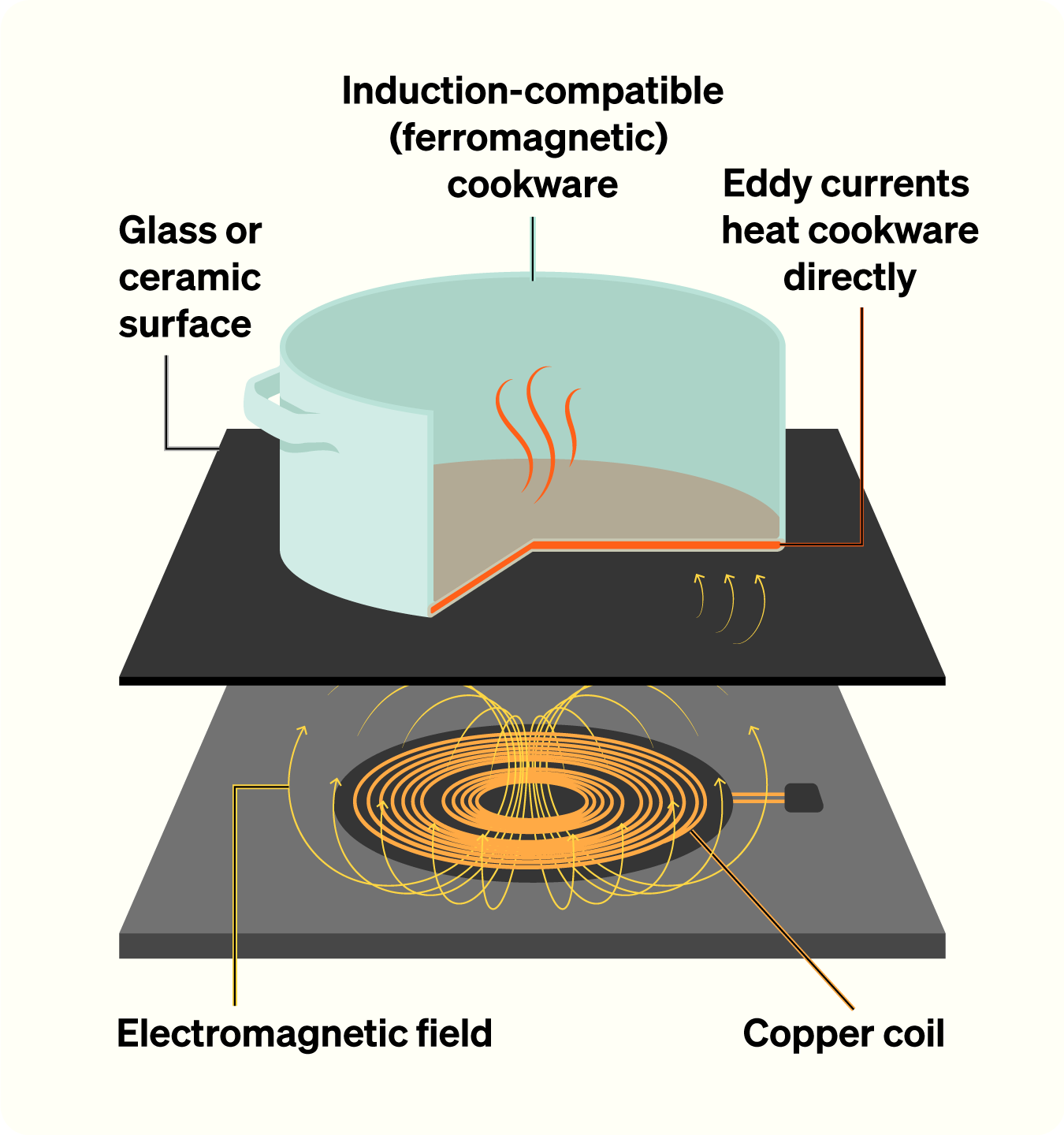
Underneath the ceramic glass surface of an induction cooktop sits a tightly wound coil of copper wire. When the unit is powered on, an alternating current (AC) flows through this coil. According to Ampere’s Law, this current creates a high-frequency magnetic field that fluctuates rapidly. This field passes through the glass cooktop effortlessly because glass is a non-conductive, non-magnetic material. However, the energy is “looking” for something specific to interact with: a ferromagnetic material.
Ferrous Material Requirements and Eddy Currents
For the induction process to complete, the user must place a pot or pan made of magnetic material (such as cast iron or stainless steel) on the surface. When the magnetic field penetrates the metal of the pan, it induces “eddy currents” within the cookware. These are essentially circular electric currents that swirl through the metal. Because the metal has a level of electrical resistance, these currents encounter friction at the molecular level, which is converted into heat.
Joule Heating vs. Thermal Conduction
This process is known as Joule heating. The critical technological distinction here is that the cooktop itself is not the source of the heat; the pan is. In a traditional setup, the burner gets hot and eventually transfers that heat to the pan (thermal conduction). In induction, the pan becomes the heating element. This direct energy transfer is the reason induction is significantly faster and more efficient than any other cooking technology currently available on the consumer market.
Key Technological Advantages Over Traditional Cooking
The transition to induction is often driven by a desire for a more “tech-forward” lifestyle. When we analyze the performance metrics of induction against gas or radiant electric, the technological superiority becomes clear through data and precision.
Precision Temperature Control and Digital Sensors
One of the most significant tech hurdles in cooking has always been the lag time. When you turn down a gas flame, the grate remains hot. When you turn off a radiant electric coil, it takes minutes to cool down. Induction solves this through digital precision. Because the heat is generated directly in the pan via a magnetic field, the moment the current is adjusted, the heat production changes instantaneously. Modern induction units use sophisticated sensors that monitor the temperature of the cookware’s base hundreds of times per second, allowing the onboard computer to maintain a constant temperature within a single degree of variance.
Energy Efficiency and Thermal Transfer Rates
From a technical efficiency standpoint, induction is the clear winner. A gas cooktop is roughly 40% efficient, meaning 60% of the energy produced by the flame escapes into the ambient air of the kitchen. Traditional electric cooktops hover around 70% efficiency. Induction, however, boasts an efficiency rating of approximately 90%. Because almost no energy is lost to the surrounding environment, induction cooktops can boil water in nearly half the time of a high-end gas range, representing a massive leap in thermal engineering efficiency.
Safety Innovations and Auto-Shutoff Systems
From a digital security and safety perspective, induction offers features that are impossible with open flames. Since the surface does not get hot (other than the residual heat transferred back from the pan), there is a negligible risk of accidental burns or kitchen fires. Furthermore, the technology is inherently “smart.” If a burner is turned on without a pan, or if a non-magnetic pan is used, the magnetic circuit remains open and no heat is generated. Most high-tech induction units feature automatic pan detection and shutoff sensors that deactivate the magnetic field the moment the cookware is lifted.

Modern Features and Smart Integration
As with all modern gadgets, induction cooktops are becoming increasingly integrated into the “Smart Home” ecosystem. They are no longer isolated appliances but are now connected nodes within a digital network.
Touch Interfaces and Haptic Feedback
Gone are the analog plastic knobs of the past. Modern induction cooktops utilize capacitive touch interfaces similar to smartphones. These interfaces allow for sleek, “dead-front” designs where the controls are invisible until the unit is powered on. Many premium models now include haptic feedback or LED “virtual flames” projected onto the cookware to provide a visual cue for the intensity of the magnetic field, bridging the gap between tactile traditional cooking and high-tech digital interfaces.
IoT and App Connectivity
The latest generation of induction technology includes Wi-Fi and Bluetooth connectivity. This allows the cooktop to communicate with other appliances. For example, a “smart” induction range can signal a compatible ventilation hood to activate and adjust its fan speed based on the intensity of the cooking surface. Furthermore, users can monitor their cooktop via smartphone apps, ensuring that the device is turned off remotely or receiving firmware updates that optimize power distribution and sensor accuracy.
Zone-Free Cooking and Flexible Induction Areas
The most advanced tech in this space is “Full-Surface” or “Flex-Induction.” Traditional cooktops have specific circular zones. However, high-end tech now utilizes a dense matrix of smaller induction coils. The onboard processor detects the size, shape, and position of any pan placed anywhere on the surface. You can move a pot from the left side to the right side, and the computer will “follow” the pan, transferring the settings and heat levels to the new location seamlessly. This level of spatial awareness is a hallmark of modern sensor technology.
Installation Requirements and Technical Infrastructure
Bringing induction technology into a home is not as simple as “plug and play.” It requires a specific technical infrastructure to handle the high-power demands of electromagnetic switching.
Electrical Load and Circuitry Needs
Induction cooktops are power-hungry devices at their peak. They typically require a dedicated 240-volt circuit with an amperage rating between 40 and 50 amps. The internal power electronics must convert the standard 60Hz household AC power into a much higher frequency (usually between 24kHz and 40kHz) to create an effective magnetic field. This requires heavy-duty capacitors and power transistors (IGBTs) that can handle rapid switching without overheating.
Ventilation and Cooling Fans
Because induction cooktops are packed with sensitive electronics, transistors, and microprocessors, they require internal cooling. Unlike a gas range, which is mostly metal and pipes, an induction cooktop has an internal “computer” that must stay within a specific operating temperature range. Most units feature integrated high-performance fans that exhaust heat from the internal components out through a front or rear vent. This is a crucial technical consideration for installation, as cabinetry must allow for adequate airflow to prevent the electronics from throttling or failing.
The Evolution of Kitchen Gadgets: Why Tech is Moving Toward Induction
The shift toward induction is part of a broader technological movement toward electrification and precision. As the world seeks to move away from fossil fuels, the kitchen is a primary frontier for decarbonization.
Environmental Impact and Decarbonization
From a tech-trend perspective, the “electrification of everything” is a dominant theme. Gas ranges contribute to indoor air pollution by releasing nitrogen dioxide and carbon monoxide. Induction, being purely electric, provides a cleaner alternative that aligns with the “Green Tech” movement. By utilizing high-efficiency electromagnetic energy, users can reduce their carbon footprint while enjoying a superior cooking experience.
The Convergence of Appliance and Computing
We are reaching a point where the distinction between a “kitchen appliance” and a “computer” is blurring. With the integration of temperature probes that communicate via Bluetooth to the cooktop to maintain a perfect simmer, and software-guided cooking that adjusts power levels based on a recipe, the induction cooktop has become the ultimate kitchen gadget. It represents the successful application of industrial-grade electromagnetic science to the domestic environment, proving that the future of the home is not just smart—it is magnetic.
aViewFromTheCave is a participant in the Amazon Services LLC Associates Program, an affiliate advertising program designed to provide a means for sites to earn advertising fees by advertising and linking to Amazon.com. Amazon, the Amazon logo, AmazonSupply, and the AmazonSupply logo are trademarks of Amazon.com, Inc. or its affiliates. As an Amazon Associate we earn affiliate commissions from qualifying purchases.