
In the realm of pure mathematics, a prime number is often described as an “atomic unit” of the number system. However, in the fast-paced world of technology, software engineering, and digital security, the definition of a prime number transcends simple divisibility. It represents the structural foundation of the encryption protocols that protect our global financial systems, private communications, and cloud infrastructures. Understanding what defines a prime number—and more importantly, how those definitions are leveraged in modern computing—is essential for any tech professional or enthusiast.
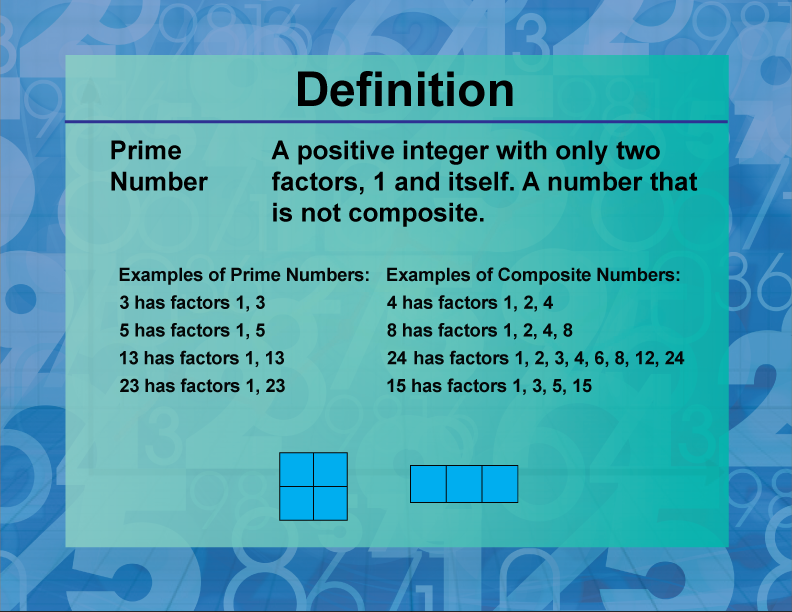
At its core, a prime number is a natural number greater than 1 that cannot be formed by multiplying two smaller natural numbers. While this definition sounds elementary, the computational implications of primality are what drive the security of the modern web.
The Fundamental Properties of Primality in Computational Logic
To understand the tech-centric definition of a prime number, we must first look at the logical constraints that separate primes from composite numbers. In digital systems, where everything is reduced to binary logic and discrete mathematics, the unique properties of primes allow for the creation of “one-way” functions that are easy to compute but nearly impossible to reverse.
The Integer Constraint and Digital Divisibility
In software development, particularly when dealing with algorithms and data structures, the definition of a prime number relies on its strict adherence to two factors: 1 and itself. A number like 7 is prime because its only integer factors are 1 and 7. Conversely, 8 is composite because it can be broken down into 2 and 4.
This lack of divisibility makes prime numbers the “building blocks” of all other integers, a concept known as the Fundamental Theorem of Arithmetic. For tech professionals, this means that every large integer in a database or a cryptographic key can be uniquely decomposed into a product of primes. This uniqueness is the cornerstone of hash functions and data integrity checks.
The Role of Primality in Algorithmic Efficiency
From a programming perspective, identifying prime numbers is a classic challenge in algorithmic complexity. The “Sieve of Eratosthenes” is one of the earliest known algorithms used to find primes up to a certain limit. In modern software, however, we use much more sophisticated methods.
The tech-focused definition of a prime number often involves the “density” of these numbers within a given range. According to the Prime Number Theorem, primes become less frequent as numbers grow larger. For developers working on high-speed encryption, this means that finding a new, massive prime number (often hundreds of digits long) requires significant computational power and highly optimized search algorithms.
Prime Numbers as the Guardians of the Internet: RSA and Encryption
If you have ever used an “https” website, sent an encrypted message, or accessed a secure VPN, you have relied on the definition of a prime number. In the niche of digital security, prime numbers are defined by their utility in Public Key Infrastructure (PKI).
Public Key Infrastructure and the Trapdoor Function
The most famous application of prime numbers in technology is the RSA (Rivest-Shamir-Adleman) algorithm. RSA encryption is based on a simple mathematical reality: it is computationally easy to multiply two large prime numbers together, but it is extraordinarily difficult to factor the resulting product back into its original primes.
In this context, a prime number is defined as a “private component.” When you generate a security key, your computer chooses two massive prime numbers ($p$ and $q$). It multiplies them to create a “public key” ($n$). While the world can see $n$, only those who know the original $p$ and $q$ can decrypt the data. This is what technologists call a “trapdoor function”—a mathematical door that is easy to fall through in one direction but requires a “key” (the prime factors) to climb back out.
Why Large Primes are Computationally Hard to Factor
The security of our digital world depends on the “hardness” of prime factorization. If a hacker or a rogue AI could quickly determine which two primes were multiplied to create a 2048-bit RSA key, all modern encryption would collapse.
Current “brute-force” attacks involve trying every possible prime factor. However, because prime numbers are distributed in a way that is seemingly random but governed by strict laws, the number of possibilities is astronomical. For a standard 2048-bit key, there are more possible prime combinations than there are atoms in the observable universe. Thus, in tech, a prime number is often defined by its “computational cost”—the sheer amount of energy and time required to reverse-engineer its product.

Modern Algorithms for Primality Testing in Software
In high-level software engineering, we don’t just “find” primes; we “test” for them. Because verifying primality is essential for generating secure keys, developers must use specific software tools and mathematical tests to ensure a number is truly prime before it is used in a security protocol.
Probabilistic Tests: The Miller-Rabin Approach
In real-world software applications, we rarely use deterministic tests to prove primality because they are too slow for very large numbers. Instead, developers rely on probabilistic tests like the Miller-Rabin primality test.
These algorithms don’t say “this number is definitely prime” with 100% certainty in one pass. Instead, they run a series of checks. If a number fails, it is definitely composite. If it passes, the probability of it being prime increases. By running the test dozens of times, the chance of a “false positive” (a composite number disguised as a prime) becomes smaller than the chance of a hardware error occurring in the computer itself. In the tech industry, a “prime” is often defined by its ability to pass these rigorous probabilistic filters.
Deterministic Approaches: The AKS Primality Test
For decades, computer scientists searched for a “polynomial time” algorithm that could prove primality with absolute certainty. In 2002, the AKS (Agrawal–Kayal–Saxena) primality test was discovered. While mathematically revolutionary, it is rarely used in production software because it is much slower than probabilistic methods.
This highlights a key tension in technology: the definition of a prime number must balance mathematical perfection with computational efficiency. For a software engineer building a secure messaging app, a “prime” is a number that is “prime enough” to withstand any practical attack, rather than a number that has been proven through a slow, deterministic proof.
The Future of Primes: Quantum Computing and Post-Quantum Cryptography
The definition of a prime number as a “secure lock” is currently under threat. The emergence of quantum computing represents the most significant shift in how we view primes in the history of technology.
Shor’s Algorithm and the Threat to Prime-Based Security
In 1994, mathematician Peter Shor developed an algorithm that could theoretically factor large integers exponentially faster than any classical computer. If a sufficiently powerful quantum computer is ever built, Shor’s Algorithm could “crack” the prime factorization that protects the global economy in minutes.
In this future tech landscape, the definition of a prime number as a “security barrier” changes. We are currently seeing a massive shift toward “Post-Quantum Cryptography” (PQC). Tech giants like Google, Cloudflare, and IBM are already testing new encryption methods that do not rely on prime factorization.
Moving Toward Lattice-Based and Isogeny-Based Encryption
While primes will always be mathematically fundamental, the tech world is diversifying its “security DNA.” New algorithms use complex geometric structures called lattices or the properties of elliptic curves. In these systems, the security doesn’t come from the difficulty of finding prime factors, but from the difficulty of finding the shortest vector in a high-dimensional space.
However, even in these new systems, prime numbers remain in the background. They are often used to define the “finite fields” in which these complex geometric operations take place. Even as we move away from RSA, the prime number remains the silent architect of digital trust.

Conclusion: Why Primes Remain the DNA of the Digital World
What defines a prime number? In mathematics, it is a simple rule of divisibility. In technology, it is much more. It is the core of our encryption standards, the benchmark for our algorithmic efficiency, and the primary target of our most advanced computational research.
As we look toward an era of Artificial Intelligence and Quantum Logic, the prime number continues to serve as the bridge between abstract logic and practical application. For the developer, the security analyst, and the hardware engineer, the prime number is not just a digit—it is the fundamental unit of digital integrity. Whether we are securing a blockchain transaction or protecting a private email, we are relying on the unique, stubborn, and unyielding nature of the prime number to keep our digital world safe. Understanding its definition is the first step in mastering the complex architecture of the modern technological landscape.
aViewFromTheCave is a participant in the Amazon Services LLC Associates Program, an affiliate advertising program designed to provide a means for sites to earn advertising fees by advertising and linking to Amazon.com. Amazon, the Amazon logo, AmazonSupply, and the AmazonSupply logo are trademarks of Amazon.com, Inc. or its affiliates. As an Amazon Associate we earn affiliate commissions from qualifying purchases.