
The history of technology is often written in the aftermath of its most dangerous failures. While modern tech enthusiasts focus on silicon wafers, artificial intelligence, and quantum computing, the bedrock of high-stakes engineering was forged in the laboratories of the Manhattan Project. At the center of this history sits a 6.2-kilogram sphere of plutonium-gallium alloy known as the “Demon Core.”
Originally intended as the third nuclear core for the war effort, this piece of hardware became a catalyst for a radical shift in how humanity manages high-risk technology. To understand the Demon Core is to understand the evolution of safety protocols, the physics of criticality, and the transition from manual experimentation to the automated, remote-controlled systems that define modern nuclear and industrial technology.

The Engineering of a Supercritical Mass
At its technical base, the Demon Core was a marvel of mid-1940s metallurgy. It was a solid sphere, roughly 3.5 inches in diameter, engineered to be just shy of its “critical” state—the point at which a nuclear chain reaction becomes self-sustaining.
Plutonium-Gallium Alloying
The core was not pure plutonium-239. Early nuclear engineers discovered that plutonium is a fickle material; it exists in several allotropic phases, many of which are brittle or unstable under pressure. To make the core stable enough for a weaponized application, scientists alloyed it with a small percentage of gallium. This technical choice stabilized the plutonium in its delta phase, allowing it to be machined and handled with greater predictability. This metallurgical breakthrough was the precursor to the advanced material sciences we use today in aerospace and reactor design.
The Mechanics of Criticality
The “tech” of the core relied on neutron economy. In a subcritical state, the core releases neutrons, but most escape into the surrounding environment. To trigger a reaction, these neutrons must be reflected back into the mass. The Demon Core was designed to be “subcritical” in a vacuum but “critical” when surrounded by neutron reflectors. Understanding this threshold required high-precision measurements that, in the 1940s, were performed with startlingly primitive manual tools.
The Technical Failures of 1945 and 1946
The Demon Core earned its name after two fatal accidents involving “criticality excursions.” These events were not explosions, but rather sudden bursts of ionizing radiation caused by the core momentarily reaching a supercritical state. These incidents represent the ultimate “edge case” in systems testing, where human error bypassed physical safety margins.
The Daghlian Incident: Tungsten Carbide Reflectors
In August 1945, physicist Harry Daghlian was performing a manual experiment to see how close the core was to criticality. He used bricks made of tungsten carbide—a highly dense material used today in cutting tools and armor—to act as a neutron reflector. The technical procedure involved stacking these bricks around the core.
The system failure occurred when Daghlian accidentally dropped a brick directly onto the core. This immediate increase in neutron reflection pushed the core into a supercritical state. The technical takeaway from this incident was the danger of “open-loop” manual systems; there was no fail-safe to prevent a dropped object from triggering a catastrophic output.
The Slotin Incident: The Beryllium Hemisphere
The second, more infamous incident occurred in May 1946, involving physicist Louis Slotin. Slotin used a technique known as “tickling the dragon’s tail.” He utilized two beryllium hemispheres (neutron reflectors) and lowered the upper half over the core using a flat-head screwdriver to maintain a small gap.
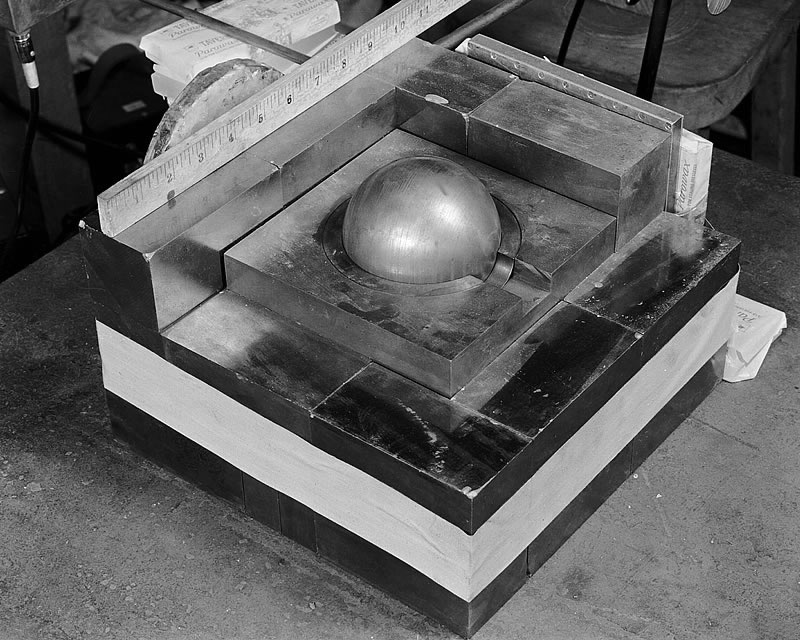
The screwdriver—a low-tech tool used to regulate a high-tech reaction—slipped. The shell closed completely, and the core instantly went “prompt critical.” A flash of blue light, caused by the ionization of the air (similar to Cherenkov radiation), signaled a massive radiation release. This event highlighted a fundamental flaw in early tech culture: the reliance on individual “heroic” skill rather than standardized, hardware-based interlocks.
From Manual Trials to Automated Safety Protocols
The legacy of the Demon Core is not just one of tragedy, but of the rapid development of safety engineering and remote operations. Following the 1946 accident, the era of “hands-on” nuclear physics came to an abrupt end at Los Alamos and across the global scientific community.
The “Tickling the Dragon’s Tail” Methodology
The term “tickling the dragon’s tail” has since become a cautionary metaphor in the tech world for pushing a system to its absolute limits without sufficient safeguards. In the 1940s, this was a standard methodology because sensors and remote manipulators were in their infancy. The transition away from this method marked the birth of “Defense in Depth,” a security and safety philosophy used in everything from nuclear power plants to modern cybersecurity frameworks. This philosophy dictates that systems should have multiple redundant layers of protection so that no single failure—human or mechanical—can lead to a catastrophe.
Remote Operations and the Birth of Modern Nuclear Security
In the wake of the Demon Core accidents, the Pajarito Site at Los Alamos was restructured to focus on remote-control technology. Engineers developed “Godiva,” a device that could perform criticality experiments in a shielded room while operators remained hundreds of yards away in a reinforced bunker. This was a pivotal moment in the history of robotics and remote sensing. It forced the development of high-fidelity cameras, remote mechanical arms, and real-time telemetry—technologies that would eventually pave the way for the exploration of space and the deep sea.
The Tech Legacy: How the Demon Core Shaped Modern Physics
The data gathered from the Demon Core, though bought at a terrible price, provided the technical specifications for the safe handling of fissile materials for the next 80 years. It influenced how we build reactors, how we decommission old weapons, and how we monitor radiation.
Monitoring and Sensing Technology
Today’s nuclear facilities are packed with arrays of neutron detectors and gamma-ray sensors that provide millisecond-response times. During the Slotin incident, the “sensor” was the human eye seeing a blue flash and the human body feeling the heat. This led to the development of Scram (Safety Control Rod Axe Man) systems in reactors—automated shutdowns that occur the moment a sensor detects a flux in neutron levels. The logic gates used in these safety systems are the direct descendants of the protocols written in response to the Demon Core’s lethality.
Radiation Shielding and Simulation
Modern software has largely replaced the need for physical “criticality experiments.” High-performance computing (HPC) and Monte Carlo N-Particle (MCNP) simulations allow engineers to model the behavior of neutrons in a core with pinpoint accuracy without ever touching a piece of plutonium. We can now simulate millions of “dropped bricks” or “slipping screwdrivers” in a virtual environment, ensuring that by the time a physical system is built, the margins of error are mathematically ironclad.

The Enduring Technical Lesson
The Demon Core was eventually melted down and its material recycled into other cores, but its impact on the technological landscape remains. It serves as a stark reminder that the more powerful a technology becomes, the more robust its safety infrastructure must be.
In the modern era, where we deal with the “digital criticality” of AI or the “biological criticality” of gene editing, the lessons of Los Alamos remain relevant. Technology is not just the hardware or the code; it is the system of constraints, protocols, and fail-safes that surround it. The Demon Core taught us that “hand-tuning” high-stakes systems is a recipe for disaster.
True technological maturity is found in the move from the manual to the automated, from the intuitive to the measured, and from the reckless to the redundant. The Demon Core was a terrifying piece of tech history, but it forced the engineering world to grow up, leading to the sophisticated safety standards that protect us today in an increasingly complex and high-energy world.
aViewFromTheCave is a participant in the Amazon Services LLC Associates Program, an affiliate advertising program designed to provide a means for sites to earn advertising fees by advertising and linking to Amazon.com. Amazon, the Amazon logo, AmazonSupply, and the AmazonSupply logo are trademarks of Amazon.com, Inc. or its affiliates. As an Amazon Associate we earn affiliate commissions from qualifying purchases.