
When a user types “what time is it in Australia” into a search engine, they are met with an instantaneous, hyper-accurate response. While it seems like a simple query, the underlying technological framework required to deliver that answer is a marvel of modern engineering. Australia, with its vast geographical expanse and its adoption of non-standard time offsets, presents one of the most complex challenges for global time synchronization protocols, software development, and digital infrastructure.
To understand the “time” in Australia is to understand the intersection of atomic physics, network protocols, and complex database management. This article explores the sophisticated tech stack that keeps the Land Down Under in sync with the rest of the digital world.

The Digital Architecture of Australian Time
The foundation of any digital clock is not a mechanical gear but a sequence of data packets governed by the Network Time Protocol (NTP). For a country like Australia, which spans three primary time zones—and several more during seasonal shifts—the digital architecture must be robust enough to handle high-precision synchronization across thousands of miles.
NTP Stratums and Atomic Clock Integration
At the heart of Australia’s timekeeping is the National Measurement Institute (NMI). They maintain the primary standard for Australian Eastern Standard Time (AEST) using a suite of caesium atomic clocks and hydrogen masers. In the tech world, these are known as “Stratum 0” devices.
Network Time Protocol (NTP) organizes time distribution into hierarchical layers called stratums. Stratum 1 servers are directly linked to these atomic clocks. For Australian tech infrastructure, low-latency access to Stratum 1 and Stratum 2 servers is critical. Organizations like the Australian Academic and Research Network (AARNet) operate high-availability NTP clusters that ensure servers across the continent remain within milliseconds of the official national time. This precision is vital for everything from telecommunications handovers to high-frequency data logging.
The Challenge of Multiple and Fractional Time Zones
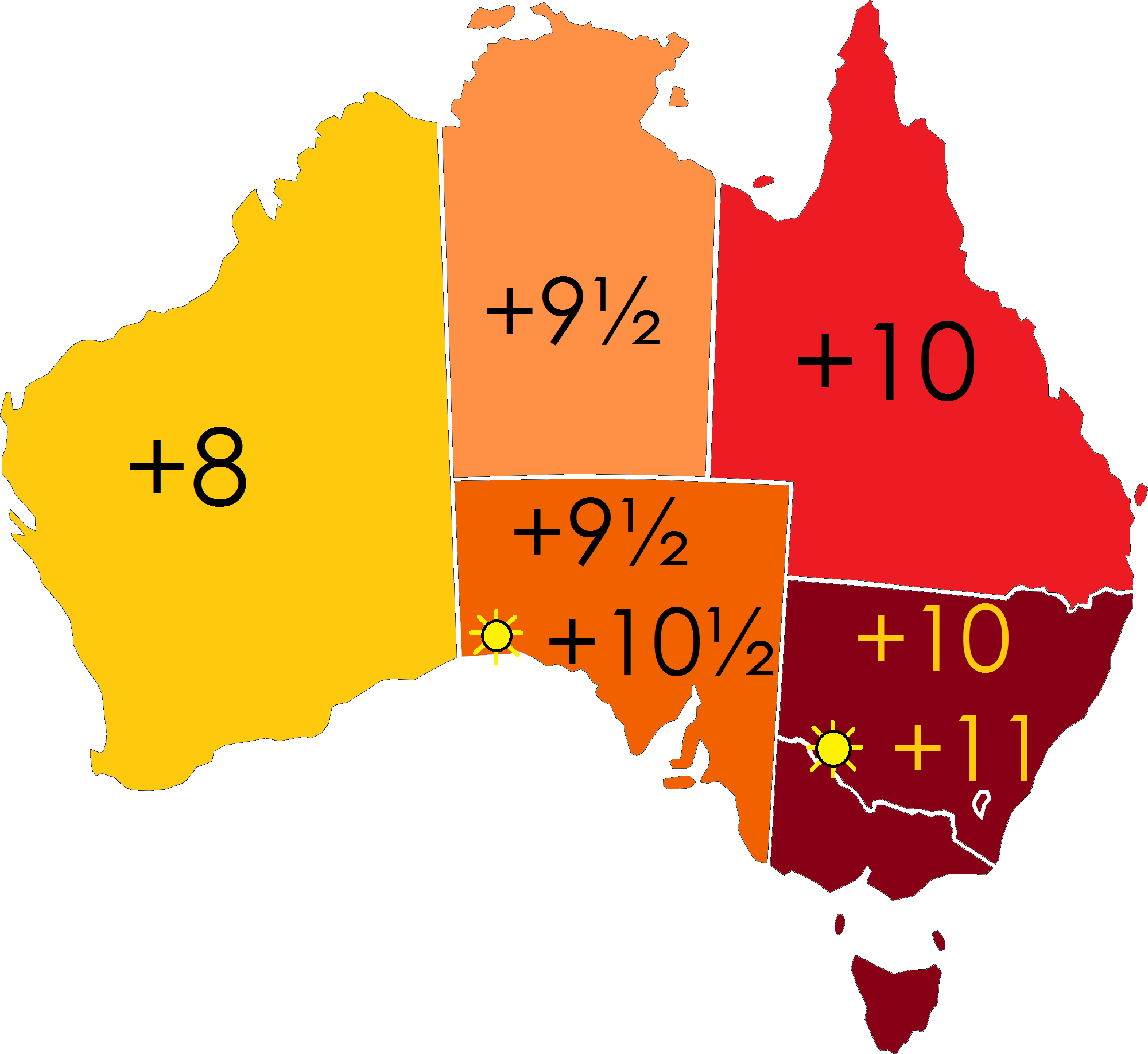
Australia is one of the few places in the world that utilizes fractional time zones. While most of the world operates on full-hour offsets from Coordinated Universal Time (UTC), places like South Australia and the Northern Territory use UTC+9:30. Even more complex is the tiny enclave of Eucla, which operates on UTC+8:45.
From a software engineering perspective, these “half-hour” and “forty-five-minute” offsets are a common source of bugs. Legacy systems designed with the assumption of 60-minute increments often fail in the Australian context. Modern tech stacks must utilize the IANA Time Zone Database (often called the Olson database), which maps every geographical region to its specific temporal rules, ensuring that when a server in Perth communicates with one in Adelaide, the delta is calculated with mathematical precision.
Managing Temporal Complexity in Software Development
For developers building global applications, “Australia” is often a litmus test for the robustness of their temporal logic. Handling time in software is notoriously difficult, and the Australian landscape serves as a masterclass in why developers should never attempt to “roll their own” time logic.
Handling Daylight Saving Time (DST) Logic
One of the greatest technical hurdles in Australian timekeeping is the inconsistent application of Daylight Saving Time. Western Australia, the Northern Territory, and Queensland do not observe DST, while New South Wales, Victoria, Tasmania, and the ACT do. This creates a “shifting” temporal map within the country itself.
When writing code for Australian users, developers must rely on libraries like Luxon, Moment.js (now in maintenance), or the native Intl.DateTimeFormat in JavaScript. These tools do not just calculate time; they reference the IANA database to check the current date against historical and future DST legislation. A failure to update these libraries can result in “time jumps” that desynchronize database entries, leading to corrupted logs or failed scheduled tasks.
The “Single Source of Truth” Strategy
To mitigate the risks of time-zone fragmentation, modern cloud architecture adopts a “Single Source of Truth” strategy. Tech-heavy industries in Australia—such as fintech and logistics—standardize all backend operations on UTC (Coordinated Universal Time).
In this model, the database records the event in UTC, and the conversion to “Australian Central Daylight Time” (ACDT) happens exclusively at the UI/UX layer. This prevents “double-conversion” errors, where a timestamp might accidentally be adjusted for DST twice, a common bug in distributed systems where different nodes might have different local clock settings.
The Role of APIs and Cloud Infrastructure
When you ask a smartphone “what time is it in Australia,” you are interacting with a sophisticated ecosystem of APIs (Application Programming Interfaces) and edge computing nodes designed to minimize latency.
World Time APIs and Serverless Functions
Modern web applications rarely calculate time locally. Instead, they fetch data from highly available APIs like the Google Maps Time Zone API or the World Time API. These services provide JSON payloads that include the raw offset, the DST offset, and the “abbreviation” (e.g., AEST vs. AEDT).
In a serverless environment (using AWS Lambda or Google Cloud Functions), the physical location of the server might be in a data center in Singapore or the US West Coast. If a developer relies on System.DateTime.Now, the application returns the time of the data center, not the user. Tech leads must ensure that geolocation data is passed through the API to fetch the correct Australian regional time, ensuring a seamless user experience regardless of where the cloud compute is actually occurring.
Edge Computing and Latency Reduction
For real-time applications, such as online gaming or live sports betting in Australia, every millisecond counts. This has led to the rise of “Edge Computing” in the region. Providers like Cloudflare and AWS have established “Edge Locations” in Sydney, Melbourne, Perth, and Brisbane. By moving the “time logic” to the edge of the network, closer to the Australian user, the round-trip time for a synchronization request is reduced from 200ms (to a US server) to under 10ms. This ensures that the digital clock on a user’s screen is a perfect reflection of the server’s state.
Cybersecurity and Temporal Integrity
Time is not just a utility; it is a fundamental pillar of digital security. In the realm of cybersecurity, time synchronization is a prerequisite for encryption, authentication, and forensic analysis.
Time-Based One-Time Passwords (TOTP)
Most Australians use Two-Factor Authentication (2FA) for banking or work. Apps like Google Authenticator or Authy use the Time-based One-Time Password (TOTP) algorithm. This algorithm generates a code based on a shared secret and the current time, typically in 30-second intervals.
If a user’s smartphone clock is out of sync with the authentication server by even a minute, the codes will be rejected. This is why mobile operating systems like iOS and Android use NITZ (Network Identity and Time Zone) to constantly poll cellular towers for the exact local time. In Australia’s remote areas, where cellular signal might be weak, devices often fall back to GPS-based timekeeping to maintain the integrity of these security protocols.
Log Synchronization and Digital Forensics
From a digital security standpoint, if a cyber-attack occurs on an Australian corporate network, the subsequent investigation depends entirely on “Log Correlation.” If the firewall logs are in UTC, the server logs are in AEST, and the employee’s laptop is in AWST (Western Australia), reconstructing the timeline of the breach becomes a nightmare.
Tech-mature organizations use PTP (Precision Time Protocol) for local area networks where sub-microsecond accuracy is required. This ensures that every packet captured during a security event is timestamped with absolute consistency, allowing security analysts to trace the lateral movement of a threat actor across different geographical zones with surgical precision.
The Future of Time: Quantum Clocks and 5G Connectivity
As we move further into the decade, the technology used to determine the time in Australia is set to undergo a radical transformation. The limitations of traditional NTP over the open internet are becoming apparent as we move toward the Internet of Things (IoT) and autonomous systems.
Precision in the 5G and IoT Era
The rollout of 5G across Australia is not just about faster downloads; it is about better synchronization. 5G base stations require incredibly tight time synchronization (within 1.5 microseconds) to manage the ultra-reliable low-latency communication (URLLC) needed for autonomous vehicles and remote surgery. As these technologies become mainstream in Australian cities, the “clock” will become an even more critical piece of the national tech infrastructure, moving from software-based NTP to hardware-based PTP and GNSS (Global Navigation Satellite System) integration.

Moving Toward Quantum Chronometry
Looking even further ahead, Australian researchers are at the forefront of quantum technology. The development of portable quantum clocks could eventually replace the need for constant satellite or server polling. Imagine a device that maintains nanosecond accuracy for years without ever needing to “check” the time with an external server. For the vast, remote stretches of the Australian Outback, where connectivity is a challenge, quantum timekeeping could provide the stable temporal foundation needed for the next generation of industrial and scientific technology.
In conclusion, “what time is it in Australia” is a question that triggers a massive cascade of technological events. From atomic clocks in Canberra to edge servers in Perth, the infrastructure of time is a silent, complex, and essential part of our digital lives. As software and hardware continue to evolve, our ability to measure and synchronize our lives across the Australian continent will only become more precise, secure, and integrated.
aViewFromTheCave is a participant in the Amazon Services LLC Associates Program, an affiliate advertising program designed to provide a means for sites to earn advertising fees by advertising and linking to Amazon.com. Amazon, the Amazon logo, AmazonSupply, and the AmazonSupply logo are trademarks of Amazon.com, Inc. or its affiliates. As an Amazon Associate we earn affiliate commissions from qualifying purchases.