
In the realm of personal finance and wealth management, the ability to calculate percentages is not merely a mathematical skill; it is a fundamental survival tool. Whether you are calculating the interest on a high-yield savings account, determining the impact of inflation on your purchasing power, or evaluating the dividend yield of a potential stock investment, percentages are the universal language of value. Understanding how to find the percentage of any number allows you to strip away the ambiguity of raw data and reveal the underlying trends that dictate your financial health.

This guide moves beyond basic classroom arithmetic to provide a comprehensive framework for applying percentage calculations within the context of money management, investment analysis, and business operations. By mastering these techniques, you equip yourself with the mental models necessary to make informed, data-driven decisions that can significantly alter your long-term financial trajectory.
The Fundamental Mechanics of Percentages in Personal Finance
To master money, one must first master the “part of a whole.” At its simplest level, a percentage represents a fraction of 100. In financial terms, this represents the proportion of a total sum that is allocated toward a specific purpose, such as taxes, savings, or debt repayment.
Understanding the “Per Centum” Concept
The word “percent” originates from the Latin per centum, meaning “by the hundred.” When we say a credit card has an APR of 18%, we are essentially stating that for every $100 borrowed, $18 is charged in interest annually. This standardization is what allows us to compare disparate financial products. You might have two investment opportunities: one offering a $500 return on a $5,000 investment, and another offering a $200 return on a $1,000 investment. Without converting these to percentages (10% vs. 20%), it is difficult to immediately identify which asset is working harder for you.
The Core Formula: Part over Whole
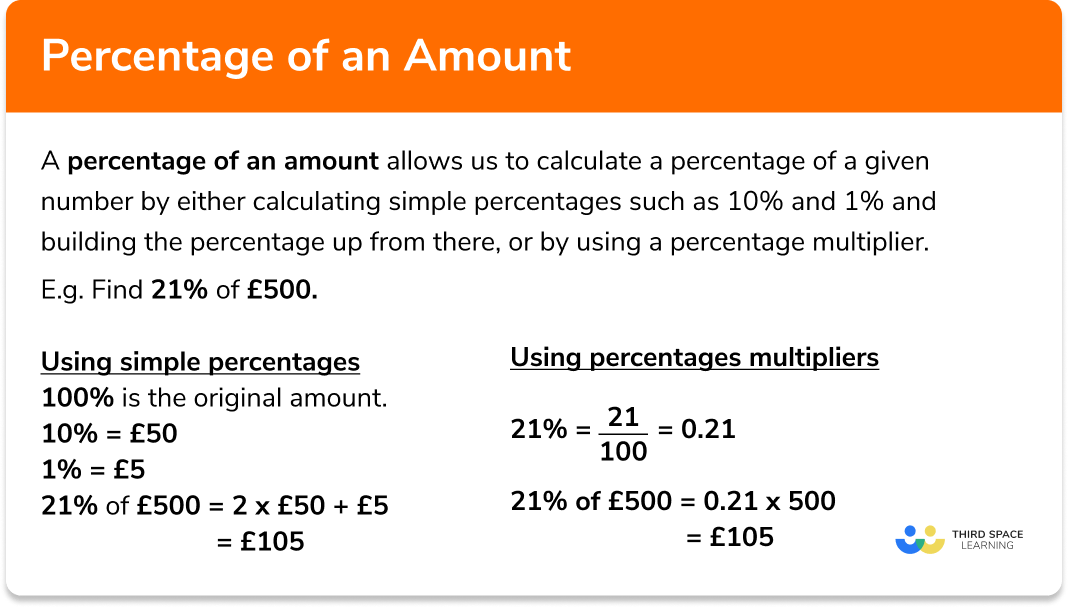
The most reliable way to find the percentage of a number is the classic formula:
(Part / Whole) × 100 = Percentage.
In a personal finance setting, if you earn $6,000 a month and your mortgage is $1,500, you calculate your housing ratio by dividing 1,500 by 6,000 to get 0.25, then multiplying by 100 to find that 25% of your income is dedicated to housing. Conversely, if you need to find a specific amount (the “part”) from a known percentage, the formula is:
(Percentage / 100) × Whole = Part.
If you want to save 15% of an $80,000 salary, you calculate (15/100) × 80,000 to arrive at a $12,000 annual savings goal.
Decimal Conversions for Rapid Calculation
For those who manage money on the go, converting percentages to decimals is the fastest route to a solution. Moving the decimal point two places to the left transforms a percentage into a multiplier. For example, 7.5% becomes 0.075. If you are calculating a 7.5% sales tax on a $1,200 laptop, simply multiplying 1,200 by 0.075 gives you $90 instantly. This mental shortcut is invaluable during negotiations or when quickly assessing the cost of a financial service.
Practical Applications: Navigating Discounts, Taxes, and Gratuities
Percentages are most frequently encountered in daily transactions. Proficiency in these calculations ensures that you are never overcharged and that you are maximizing the value of every dollar spent.
Mastering Retail Math and Sales Discounts
Retailers often use percentages to entice consumers, but the psychological impact of “30% off” can sometimes cloud financial judgment. To find the sale price of an item, you can calculate the discount amount and subtract it from the original, or more efficiently, multiply the original price by the “remaining” percentage. If a professional wardrobe upgrade costs $500 but is on sale for 40% off, you are paying 60% of the price. Calculating $500 × 0.60 gives you a final price of $300 far faster than calculating the $200 discount first.
Calculating Sales Tax and Value Added Tax (VAT)
In many regions, the price on the tag is not the price at the register. Understanding how to add a percentage to a total is critical for budgeting. To find a total including tax, multiply the base price by (1 + the tax rate). For a $200 item with an 8% sales tax, multiply 200 by 1.08 to get $216. This “1 + decimal” method is the cornerstone of projecting total costs in business procurement and personal big-ticket purchases.
Gratuity and Service Charges in Professional Settings
In professional and business dining, calculating gratuity is a standard courtesy. While many rely on apps, the “10% rule” allows for effortless mental math. To find 20% of a $145.00 bill, find 10% first by moving the decimal one place to the left ($14.50), then double it ($29.00). This ability to manipulate percentages mentally conveys a level of financial literacy and competence that is often noted in professional circles.

Advanced Financial Calculations: Interest Rates and Investment Growth
When we transition from spending to building wealth, percentage calculations become more complex, involving the factor of time. This is where “finding the percentage” evolves into calculating yields and returns.
Simple Interest vs. Compound Interest
Simple interest is calculated only on the principal amount. However, most modern financial instruments use compound interest, where interest is calculated on the principal plus the accumulated interest of previous periods. The “percentage” here is the interest rate. To understand the growth of a $10,000 investment at a 5% annual rate compounded annually, you multiply the total by 1.05 each year. Over time, the “percentage” stays the same, but the “number” it acts upon grows, creating the exponential curve that is vital for retirement planning.
Determining Annual Percentage Yield (APY)
The nominal interest rate doesn’t always tell the whole story. The APY reflects the real rate of return on a savings account or investment, taking the frequency of compounding into account. If a bank offers a 4% interest rate compounded monthly, the APY is actually higher (approximately 4.07%). Finding this percentage is crucial for comparing different banking products to ensure your cash reserves are earning the maximum possible return.
Evaluating Portfolio Performance and ROI
Return on Investment (ROI) is perhaps the most important percentage in a wealth-builder’s vocabulary. It is calculated by taking the gain from an investment, subtracting the cost, and dividing that number by the initial cost.
ROI = [(Current Value – Initial Cost) / Initial Cost] × 100.
If you bought shares for $2,000 and sold them for $2,600, your gain is $600. Dividing $600 by $2,000 gives 0.30, or a 30% ROI. In the world of investing, everything is relative; a $600 profit is impressive on a $2,000 investment but negligible on a $200,000 investment. The percentage provides the necessary context.
Business Finance: Margin, Markup, and Profitability Ratios
For entrepreneurs and business professionals, percentage calculations are used to measure the health and viability of an enterprise. Miscalculating these can lead to “profitable” businesses running out of cash.
The Crucial Difference Between Margin and Markup
One of the most common errors in business finance is confusing markup with margin.
-
Markup is the percentage added to the cost to reach a selling price. If an item costs $100 and you sell it for $150, the markup is 50%.
-
Gross Margin is the percentage of the selling price that is profit. In the same example, the $50 profit divided by the $150 selling price results in a 33.3% margin.
Successful business owners know that to achieve a specific margin, they must calculate the percentage based on the revenue, not the cost. Understanding this distinction is the difference between a sustainable business model and one that fails to cover its overhead.
Analyzing Year-over-Year (YoY) Growth Percentages
Investors and managers use YoY growth to evaluate a company’s trajectory. This is found by taking the current period’s value, subtracting the previous period’s value, and dividing by the previous period’s value. If a side hustle earned $10,000 in 2022 and $15,000 in 2023, the growth is ($15,000 – $10,000) / $10,000 = 50%. Tracking these percentages allows you to identify whether your income streams are accelerating or stagnating.
Debt-to-Income and Expense Ratios
Lenders use percentages to determine creditworthiness. The Debt-to-Income (DTI) ratio is calculated by dividing your total monthly debt payments by your gross monthly income. Maintaining a DTI below 36% is often the threshold for qualifying for the best mortgage rates. Similarly, businesses track “expense ratios” to see what percentage of revenue is being consumed by operating costs. Finding these percentages allows for “gap analysis”—identifying exactly where money is leaking from a budget.
Leveraging Digital Tools for Complex Percentage Modeling
While mental math and manual formulas are essential for quick decisions, modern financial management often requires the precision and scale of digital tools.
Spreadsheet Formulas for Automation
For anyone managing a diverse portfolio or a complex budget, Excel or Google Sheets are the ultimate tools for percentage calculation.
-
To find a percentage in a spreadsheet, you use a simple formula like
=B1/A1and then format the cell as a percentage. -
To increase a value by a percentage (such as a projected 3% raise), use
=A1*1.03. -
To find the percentage of a total sum in a list, use
=A1/SUM($A$1:$A$10).
Automating these calculations ensures that your financial projections remain accurate even as your raw data changes.
Financial Calculators and Specialized ROI Tools
Beyond basic spreadsheets, specialized tools exist for “reverse percentage” calculations—finding the original number before a percentage was added or subtracted. For example, if you know you received $920 after a 8% fee was taken, you can find the original amount by dividing 920 by 0.92 ($1,000).
In conclusion, finding the percentage of any number is more than a arithmetic exercise; it is a gateway to financial clarity. By applying these formulas to your spending, your investments, and your business ventures, you move away from emotional decision-making and toward a strategy rooted in mathematical reality. Whether you are calculating the “percentage off” a clearance item or the “percentage yield” of a complex bond, the logic remains the same: it is the art of understanding how parts relate to the whole, and how those relationships can be leveraged to build lasting wealth.
aViewFromTheCave is a participant in the Amazon Services LLC Associates Program, an affiliate advertising program designed to provide a means for sites to earn advertising fees by advertising and linking to Amazon.com. Amazon, the Amazon logo, AmazonSupply, and the AmazonSupply logo are trademarks of Amazon.com, Inc. or its affiliates. As an Amazon Associate we earn affiliate commissions from qualifying purchases.