
In an increasingly complex financial world, fundamental mathematical skills remain the bedrock of sound decision-making. Among these, the ability to quickly and accurately calculate percentages stands out as indispensable. While all percentages are important, understanding “how to find 25 percent of a number” holds a special place due to its prevalence across various financial scenarios, from everyday budgeting to intricate investment strategies. This seemingly simple calculation is, in essence, a gateway to greater financial literacy and empowers individuals to navigate sales, manage savings, evaluate investments, and even understand tax implications with confidence.

This article delves into the straightforward methods of finding 25 percent of any given number and, more importantly, illustrates its profound relevance within the realm of personal and business finance. By mastering this single calculation, you unlock a powerful tool that simplifies complex financial puzzles, helping you make smarter, more informed choices that contribute to your overall financial well-being.
The Foundation: Understanding Percentages and Their Practicality
Before we dive into the mechanics of finding 25 percent, it’s crucial to grasp what a percentage truly represents and why it’s such a ubiquitous unit in finance. A percentage is simply a way of expressing a number as a fraction of 100. The word “percent” itself comes from the Latin “per centum,” meaning “by the hundred.” Therefore, 25 percent means 25 out of every 100, or 25/100.
What Exactly is a Percentage?
Conceptually, percentages provide a standardized way to compare parts to a whole, regardless of the size of the whole. For instance, whether you’re looking at 25% off a $100 item or 25% off a $1,000 item, the proportion of the discount is clearly understood, even if the absolute monetary value differs. This comparative power makes percentages invaluable for financial analysis, allowing for easy comprehension of rates, ratios, and changes over time.
Think of it in terms of fractions or decimals:
-
25% as a fraction is 25/100, which simplifies to 1/4.
-
25% as a decimal is 0.25.
These equivalencies are key to understanding the various calculation methods we’ll explore.
Why 25 Percent Matters: A Common Financial Benchmark
The number 25 percent is not arbitrary; it frequently appears as a significant benchmark across personal finance, investing, and business. From common sales discounts like “25% off” to financial rules of thumb like saving “25% of your income,” or even understanding quarterly financial reports (a quarter being 25%), its presence is hard to ignore. Its ease of calculation (often just dividing by four) makes it a favored figure for quick assessments and mental math, making it a cornerstone of practical financial literacy.
Simple Methods for Calculating 25 Percent
Calculating 25 percent of a number can be approached in several straightforward ways. The beauty lies in choosing the method that best suits your comfort level and the context of the calculation.
The Division Method: Dividing by Four
Perhaps the simplest and most intuitive method, especially for mental math, is to recognize that 25 percent is equivalent to one-quarter (1/4). Therefore, to find 25 percent of any number, you simply divide that number by four.
Formula: Number / 4 = 25% of the Number
Example: You see a shirt on sale for $80, with a 25% discount.
$80 / 4 = $20.
The discount is $20, so the new price is $80 – $20 = $60.
This method is particularly useful for whole numbers or numbers easily divisible by four, allowing for rapid calculations without a calculator.
The Decimal Method: Multiplying by 0.25
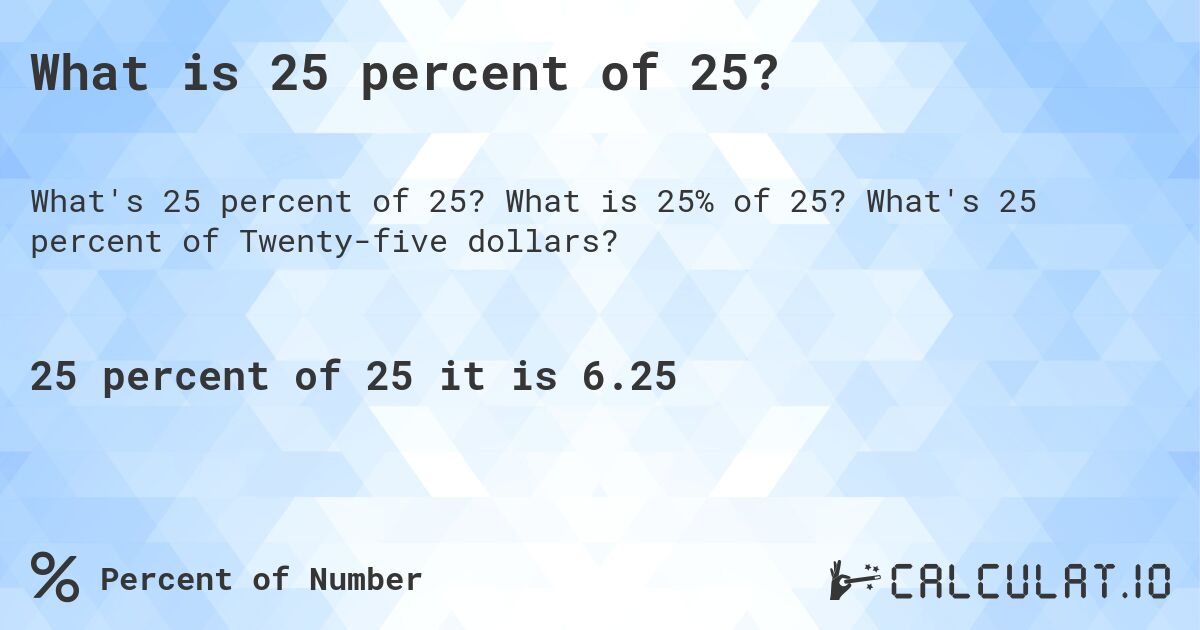
Converting the percentage to its decimal equivalent is a universally applicable method. To do this, simply divide the percentage by 100. So, 25% becomes 0.25. Then, multiply this decimal by the number you’re working with.
Formula: Number x 0.25 = 25% of the Number
Example: You want to calculate 25% of your $3,200 monthly income for savings.
$3,200 x 0.25 = $800.
You should aim to save $800 per month.
This method is highly precise and works well with any number, including those with decimals, and is easily performed using a calculator or spreadsheet software.
The Fraction Method: Using 1/4
As mentioned, 25 percent is exactly 1/4. This method is identical in principle to the division method but emphasizes the fractional representation. To find 1/4 of a number, you multiply the number by 1/4.
Formula: Number x (1/4) = 25% of the Number
Example: An investment gained 25% on an initial principal of $5,000.
$5,000 x (1/4) = $1,250.
The gain is $1,250.
This method reinforces the understanding of percentages as fractions, which can be helpful for those who prefer working with fractions.
Mental Math Tricks: Halving Twice
For quick mental calculations, especially with even numbers, a powerful trick is to “half it twice.” Since dividing by four is the same as dividing by two, and then dividing by two again, this method is incredibly intuitive.

Example: You need to calculate a 25% tip on a $64 meal.
-
Half $64: $64 / 2 = $32.
-
Half $32: $32 / 2 = $16.
The 25% tip is $16.
This technique is excellent for estimates and situations where a calculator isn’t readily available, making you more financially agile in everyday scenarios.
Real-World Applications in Personal Finance
Understanding how to find 25 percent of a number isn’t just an academic exercise; it has tangible, everyday applications that directly impact your personal finances.
Budgeting and Savings: The 25% Rule
Many financial advisors suggest saving or investing a specific percentage of your income. While the “20% rule” is common, sometimes a more aggressive “25% rule” is advocated, especially for those looking to accelerate their financial goals. Knowing how to quickly calculate this ensures you allocate the correct amount towards your savings accounts, investment portfolios, or debt repayment. For instance, if your net monthly income is $4,000, setting aside 25% means you automatically earmark $1,000 for savings and investments, putting you firmly on track to financial independence.
Discounts and Sales: Snagging the Best Deals
Black Friday, seasonal sales, clearance racks – “25% off” is one of the most common discount figures you’ll encounter. Being able to instantly calculate the actual savings and the final price allows you to quickly assess whether a deal is truly worth it, compare prices effectively, and avoid overspending on perceived bargains. A 25% discount on a $200 item saves you $50; knowing this instantly helps you budget your shopping spree.
Taxes and Contributions: Understanding Your Deductions
While tax rates vary, understanding percentages is crucial for comprehending your pay stub. Your gross pay will have various deductions, often expressed as percentages, for things like federal taxes, state taxes, social security, Medicare, and retirement contributions (e.g., 401(k)). If your company matches 25% of your 401(k) contribution up to a certain limit, knowing how to calculate this helps you maximize employer benefits. Similarly, when estimating quarterly tax payments or understanding tax brackets, knowing how to calculate a percentage quickly is invaluable.
Tipping Etiquette: Quick Calculations for Service Gratuity
In many service industries, tipping is customary. While 15-20% is standard, knowing how to quickly calculate 25% can be useful for exceptional service or when you simply want to be generous. Instead of fumbling with a calculator or relying on rough estimates, a quick mental calculation ensures you leave an appropriate tip, reflecting your appreciation without breaking your budget.
Leveraging 25 Percent in Investing and Business
Beyond personal finance, the 25 percent calculation extends its utility significantly into the realms of investing and business operations, offering insights into performance, profitability, and strategic planning.
Investment Returns and Portfolio Allocation
In investing, percentages are the language of performance. A stock might show a 25% gain over a year, or a mutual fund might have increased in value by 25%. Understanding this immediately translates into monetary value for your portfolio. Moreover, portfolio allocation often involves percentages. You might decide to dedicate 25% of your portfolio to growth stocks or rebalance your assets so that 25% is in bonds. Calculating these allocations helps maintain your desired risk profile and strategic investment plan. For example, if your target allocation for a specific asset class is 25% of a $100,000 portfolio, you know you need to allocate $25,000 to that class.
Profit Margins and Business Growth
For entrepreneurs and business owners, calculating 25 percent is a daily necessity. A common business goal might be to achieve a gross profit margin of 25%. If your sales are $10,000, you aim for $2,500 in gross profit. Businesses also use percentages to track growth, market share, and operational efficiency. If your sales increased by 25% quarter-over-quarter, it’s a significant indicator of business health. Understanding how to derive these figures quickly helps in making critical business decisions, from pricing strategies to expense management.
Debt Management: Accelerating Repayments
While the focus is often on earning or saving 25%, the principle also applies to debt. If you decide to allocate an additional 25% of your discretionary income towards an existing loan, you can significantly accelerate your debt repayment. For example, if your minimum payment is $200, an extra 25% would mean an additional $50, totaling $250. This seemingly small increase can shave months or even years off your repayment schedule and save you substantial interest costs, illustrating the power of consistent, percentage-based efforts in debt reduction.
Tools and Technology for Effortless Percentage Calculations
While mental math and manual calculations are essential skills, modern financial life is also supported by a plethora of tools that can make percentage calculations even more effortless and accurate.
Calculator Use: The Basics
Every smartphone, computer, and even many watches come equipped with a calculator. Using it to find 25 percent of a number is as simple as inputting the number and multiplying by 0.25 (or dividing by 4). For larger, more complex numbers or when precision is paramount, a calculator remains your most reliable ally. Familiarity with its functions ensures accuracy in all your financial computations.
Spreadsheet Formulas: Automating Financial Analysis
For more sophisticated financial planning, budgeting, or business analysis, spreadsheet software like Microsoft Excel or Google Sheets is invaluable. You can easily set up formulas to automatically calculate 25 percent of a series of numbers. For instance, if your income is in cell A1, you can simply type =A1*0.25 in cell B1 to instantly get 25% of your income. This automation is particularly useful for tracking budgets, forecasting financial scenarios, or analyzing investment performance over time, eliminating manual errors and saving significant time.
Mobile Apps for On-the-Go Calculations
Numerous mobile apps are designed specifically for financial calculations, including specialized percentage calculators or budgeting apps that integrate percentage-based rules. These apps offer convenience and often additional features like expense tracking or goal setting, making it easy to apply the “25 percent rule” to your daily spending or savings targets while you’re out and about.
Empowering Your Financial Decisions
Mastering how to find 25 percent of a number is far more than a simple arithmetic trick; it’s a foundational skill that profoundly impacts your financial life. From wisely spending on discounted goods and meticulously planning your budget to strategically allocating investments and optimizing business profits, the applications are endless. By integrating these simple calculation methods into your financial toolkit, you gain not only accuracy but also confidence and agility in navigating the myriad financial decisions that come your way.
In a world where every dollar counts, empowering yourself with such fundamental numerical dexterity is a proactive step towards achieving financial mastery and securing a brighter economic future. Embrace the power of 25 percent, and watch as your financial understanding and decision-making capabilities flourish.
aViewFromTheCave is a participant in the Amazon Services LLC Associates Program, an affiliate advertising program designed to provide a means for sites to earn advertising fees by advertising and linking to Amazon.com. Amazon, the Amazon logo, AmazonSupply, and the AmazonSupply logo are trademarks of Amazon.com, Inc. or its affiliates. As an Amazon Associate we earn affiliate commissions from qualifying purchases.