
In an increasingly complex financial world, the ability to understand and calculate percentages is not merely an academic exercise—it is a fundamental life skill. From evaluating investment returns and understanding loan interest rates to decoding discounts, sales taxes, and budget allocations, percentages are woven into the very fabric of our financial existence. Mastering percent calculations empowers individuals to make informed decisions, manage their money more effectively, and navigate the intricacies of personal and business finance with greater confidence. This article will demystify the process of calculating percents, providing a practical guide grounded firmly in real-world financial applications, transforming what many perceive as a daunting mathematical task into an accessible tool for financial empowerment.
The Foundational Concepts: What is a Percent?
Before diving into specific calculations, it’s crucial to establish a solid understanding of what a percentage truly represents. This foundational knowledge will serve as the bedrock for all subsequent financial applications.
Understanding the Basics: Parts of a Whole
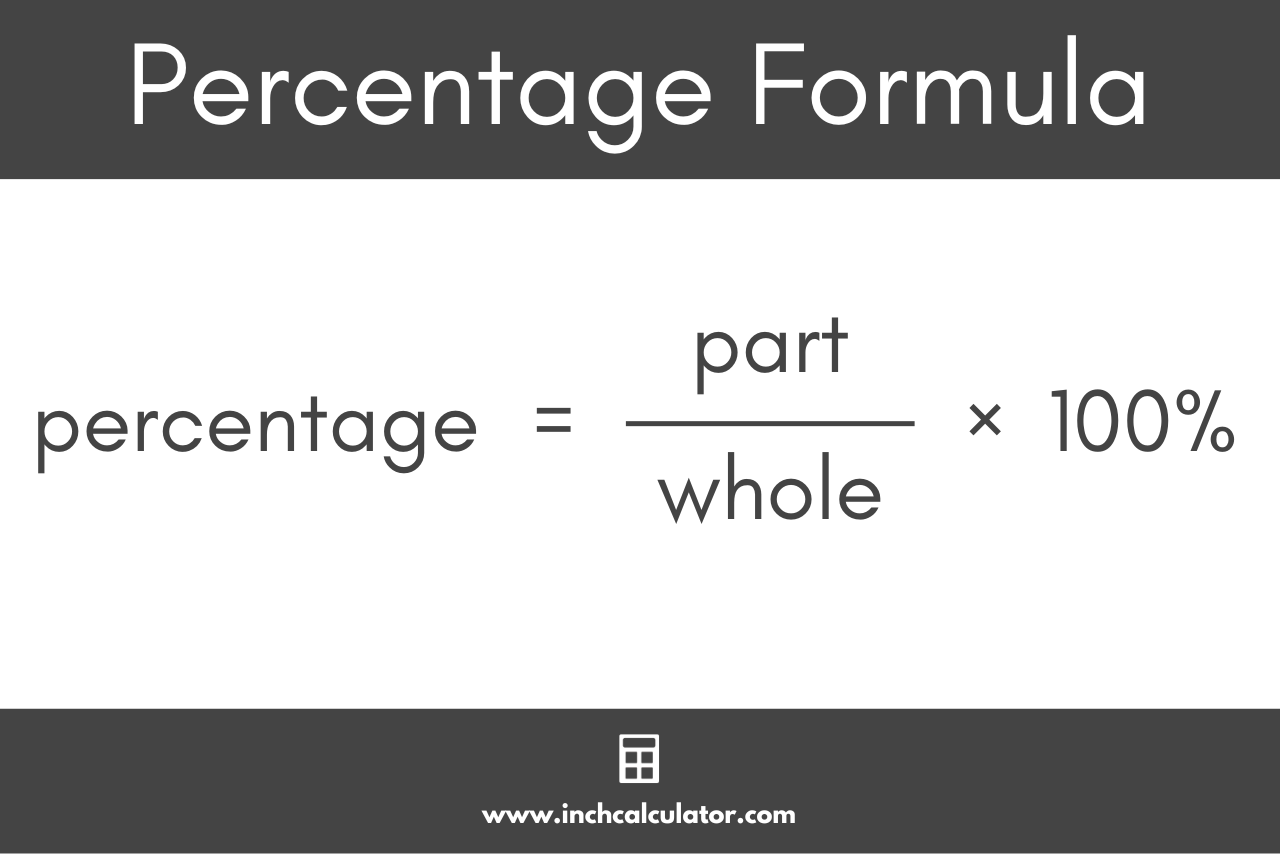
At its heart, a percent simply means “per hundred.” The symbol “%” is shorthand for expressing a fraction of 100. So, 25% means 25 out of 100, or 25/100. This understanding is critical because most financial calculations require converting percentages into either decimals or fractions. For instance, 25% becomes 0.25 (by dividing 25 by 100) when used in multiplication or division for calculation purposes. Similarly, 7% becomes 0.07, and 120% becomes 1.20. This conversion is the first, and perhaps most vital, step in accurately working with percentages in any financial context, from calculating a sales tax to projecting investment growth. Without this foundational understanding, errors in financial calculations are almost inevitable.
Key Terminology: Base, Part, and Rate
To effectively calculate percentages, it helps to understand the three primary components involved in most problems:
-
The Base: This is the total amount, the whole, or the original number to which the percentage applies. In financial terms, it could be the original price of an item, your total income, the principal amount of a loan, or your initial investment.
-
The Part: This is the portion of the base that the percentage represents. Financially, this might be the discount amount, the sales tax amount, the interest paid, or a specific expense category from your budget.
-
The Rate: This is the percentage itself, typically expressed as a number followed by the percent symbol (e.g., 15%, 2.5%). It indicates the proportional relationship between the part and the base.
By correctly identifying these three components within any given financial scenario, you can choose the appropriate formula and solve for the unknown, whether it’s determining a discount amount or figuring out your profit margin.
Core Percent Calculations for Everyday Finance
With the foundational concepts in place, we can now explore the most common percent calculations essential for managing personal and business finances effectively.
Calculating a Percentage of a Number (e.g., Discounts, Taxes)
This is perhaps the most frequent percentage calculation encountered in daily financial life. Whether you’re figuring out a discount on a sale item, calculating sales tax on a purchase, or determining the commission earned, this formula is indispensable.
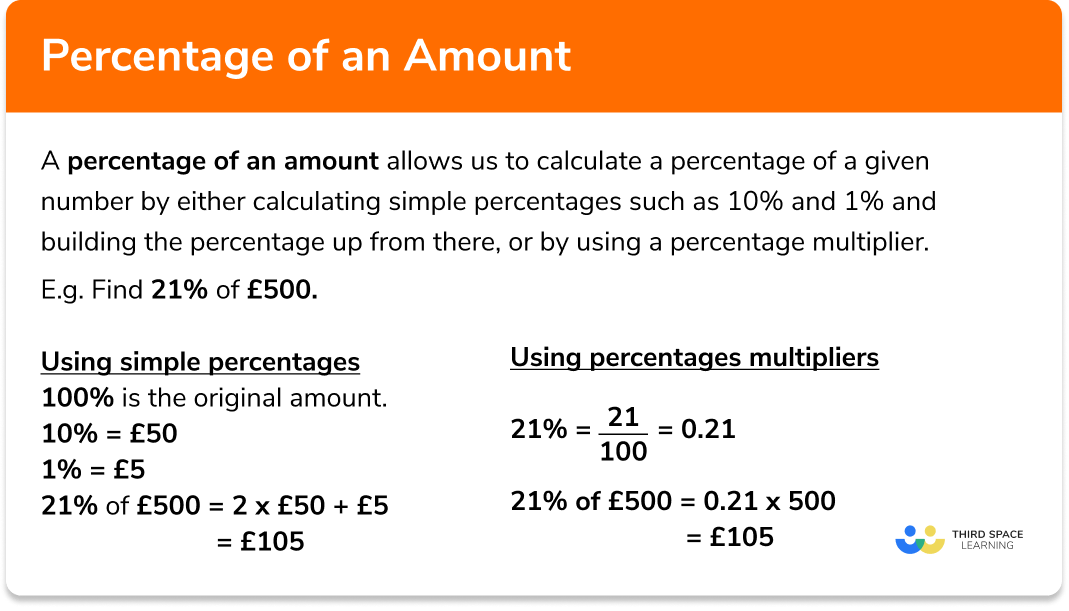
The formula is: Part = Rate (as a decimal) × Base
-
Example 1: Sales Tax. If an item costs $80 and the sales tax rate is 7%, you would calculate the tax as:
Tax = 0.07 × $80 = $5.60. The total cost would then be $80 + $5.60 = $85.60. -
Example 2: Discount. A shirt originally priced at $50 is on sale for 20% off. The discount amount is:
Discount = 0.20 × $50 = $10. The sale price is $50 – $10 = $40. -
Example 3: Commission. If you earn a 15% commission on sales totaling $1,200, your commission earned is:
Commission = 0.15 × $1,200 = $180.
Mastering this calculation allows you to quickly verify bills, assess the true cost of purchases, and accurately project earnings based on percentage-based compensation.
Finding the Percentage One Number Is of Another (e.g., Profit Margins, Budget Allocation)
This calculation is vital for analyzing financial performance, assessing efficiency, and understanding proportionality within budgets or investments. It allows you to express a portion of a whole as a percentage.
The formula is: Rate = (Part / Base) × 100
-
Example 1: Budget Allocation. If your monthly income (Base) is $4,000 and you spend $1,200 (Part) on housing, the percentage of your income spent on housing is:
Percentage = ($1,200 / $4,000) × 100 = 0.30 × 100 = 30%. -
Example 2: Profit Margin. A business sells an item for $150 (Base) and makes a profit of $45 (Part) on it. The profit margin is:
Profit Margin = ($45 / $150) × 100 = 0.30 × 100 = 30%. -
Example 3: Investment Return. You invested $5,000 (Base) and earned $300 (Part) in returns. Your percentage return is:
Return = ($300 / $5,000) × 100 = 0.06 × 100 = 6%.
This calculation is critical for understanding where your money goes, evaluating business profitability, and comparing the performance of different investments or financial assets.
Calculating the Original Number from a Percentage (e.g., Pre-Tax Price, Original Price After Discount)
This is often referred to as “reverse percentage” calculation and is particularly useful when you know a part and its percentage, but need to find the original total.
The formula is: Base = Part / Rate (as a decimal)
-
Example 1: Finding Original Price Before Tax. You bought an item for $107, which included a 7% sales tax. To find the original price before tax:
-
The $107 represents 100% (original price) + 7% (tax) = 107% of the original price.
-
So,
Original Price = $107 / 1.07 = $100.
-
-
Example 2: Original Price After Discount. You paid $60 for a jacket that was advertised as 25% off. To find the original price:
-
The $60 represents 100% (original price) – 25% (discount) = 75% of the original price.
-
So,
Original Price = $60 / 0.75 = $80.
-
This type of calculation is invaluable for deciphering sale prices, understanding the true value of goods, and for business finance scenarios where costs or revenues need to be reverse-engineered from percentage-adjusted figures.
Advanced Percent Applications in Personal Finance and Investing
Beyond the basic calculations, percentages are central to understanding more sophisticated financial concepts that impact long-term wealth building and debt management.
Understanding Percentage Change (Increase/Decrease)
When tracking the performance of investments, the impact of inflation, or changes in income, percentage change provides a standardized way to measure growth or decline over time.
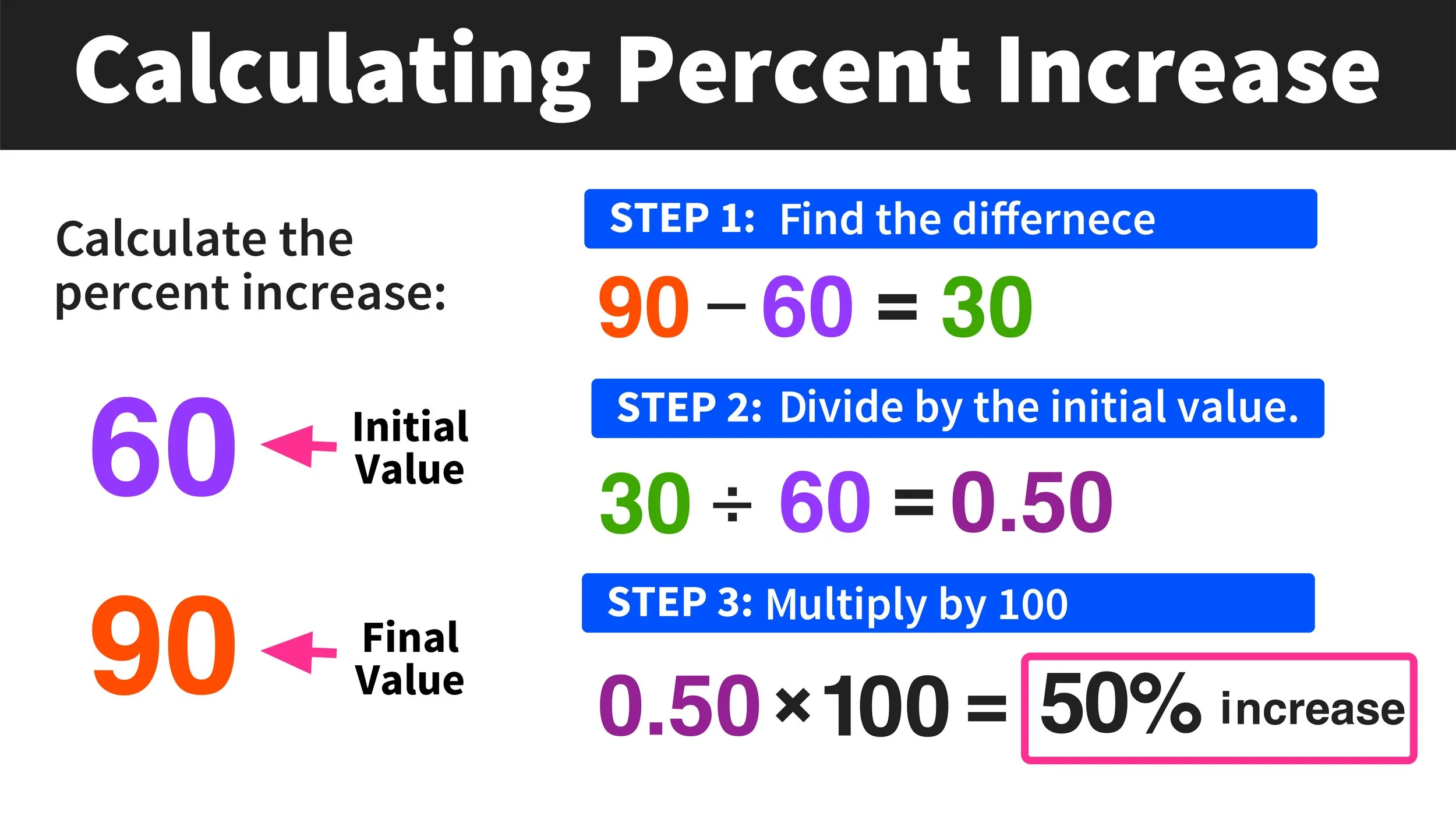
The formula is: Percentage Change = ((New Value – Old Value) / Old Value) × 100
-
Example 1: Stock Price Change. A stock was $50 last year and is now $55. The percentage increase is:
(($55 - $50) / $50) × 100 = ($5 / $50) × 100 = 0.10 × 100 = 10%. -
Example 2: Inflation Rate. If a basket of goods cost $100 last year and $103 this year, the inflation rate is:
(($103 - $100) / $100) × 100 = ($3 / $100) × 100 = 3%. -
Example 3: Portfolio Decline. Your investment portfolio decreased from $20,000 to $18,000. The percentage decrease is:
(($18,000 - $20,000) / $20,000) × 100 = (-$2,000 / $20,000) × 100 = -0.10 × 100 = -10%.
Percentage change is critical for evaluating financial trends, comparing performance across different time periods or assets, and understanding the real impact of economic forces on your wealth.
Compound Interest and Annual Percentage Yield (APY)
Compound interest, often hailed as the “eighth wonder of the world,” relies entirely on percentages. It’s the interest earned on both the initial principal and the accumulated interest from previous periods. Understanding APY is crucial for savings accounts, CDs, and other interest-bearing investments. APY represents the actual annual rate of return, taking into account the effect of compounding interest. A seemingly small difference in APY can lead to significant differences in earnings over time. Knowing how to interpret and compare APYs ensures you get the best return on your savings.
Loan Interest Rates and Annual Percentage Rate (APR)
When borrowing money, interest rates (percentages) determine the cost of your loan. The Annual Percentage Rate (APR) is a standardized way to express the total cost of borrowing, including the interest rate and certain fees, over a year. Unlike simple interest, APR gives a more comprehensive picture of the true cost. Comparing APRs across different lenders for mortgages, car loans, or credit cards is essential for securing the most affordable financing and avoiding excessive debt. A slight difference in APR can translate to thousands of dollars saved or spent over the life of a loan.
Tools and Tips for Accurate Percent Calculations
While understanding the underlying mathematics is essential, practical tools can significantly enhance accuracy and efficiency in financial calculations.
Leveraging Calculators and Spreadsheets
For everyday calculations, a basic calculator (even the one on your smartphone) is perfectly adequate. For more complex financial planning, budgeting, and investment tracking, spreadsheets like Microsoft Excel or Google Sheets are invaluable. These tools allow you to set up formulas once and apply them to changing data, automating calculations for budgeting, projected investment returns, or debt repayment schedules. Spreadsheets also offer built-in functions specifically for percentages, making intricate financial analysis far more manageable.
Mental Math Shortcuts for Quick Estimates
Sometimes, you need a quick estimate without access to a calculator. Developing mental math shortcuts for percentages can be incredibly useful:
-
Calculating 10%: Move the decimal point one place to the left (e.g., 10% of $75 is $7.50).
-
Calculating 1%: Move the decimal point two places to the left (e.g., 1% of $75 is $0.75).
-
Using these for other percentages: To find 20%, calculate 10% and double it. To find 15%, calculate 10% and add half of that amount (5%). This skill is great for quickly estimating tips, discounts, or sales tax while shopping.
Avoiding Common Pitfalls
Even with the right formulas, common mistakes can lead to inaccuracies:
-
Forgetting to convert percentages to decimals: Always convert the percentage rate (e.g., 25%) to its decimal equivalent (0.25) before multiplying or dividing.
-
Confusing percentage of with percentage point changes: A stock going from 10% to 12% is a 2 percentage point increase, but a 20% percentage increase ((12-10)/10 * 100). This distinction is crucial in financial reporting.
-
Always identifying the correct “base” for the calculation: Ensure you are applying the percentage to the correct original amount, especially in multi-step problems involving discounts, then taxes, or vice-versa.
The Strategic Importance of Percent Fluency for Financial Success
Beyond the mechanics, the true value of mastering percent calculations lies in the profound impact it has on an individual’s financial journey.
Empowering Informed Decision-Making
A solid grasp of percentages provides the clarity needed to make smarter financial choices. It allows you to:
-
Evaluate loans and credit cards: Compare APRs to choose the most cost-effective financing.
-
Understand investment returns: Accurately assess portfolio growth and compare different investment vehicles.
-
Plan for retirement: Project future savings and withdrawals with greater accuracy.
-
Negotiate salaries and compensation: Understand the impact of percentage-based raises or commission structures.
-
Analyze business proposals: Quickly ascertain profitability, market share, and growth potential.
Without this understanding, individuals often rely on gut feelings or external advice, potentially missing critical details that impact their financial well-being.
Building Confidence and Financial Control
There is an inherent sense of control and confidence that comes with understanding your money. Being able to independently calculate and verify financial figures reduces reliance on others, whether it’s a salesperson, a financial advisor, or even automated tools. It fosters a deeper engagement with personal finances, enabling more proactive budgeting, strategic saving, and effective wealth creation. This mastery transforms percentages from abstract mathematical concepts into practical tools for achieving financial independence and security.
Conclusion
The ability to calculate percents is far more than a simple arithmetic skill; it is a cornerstone of financial literacy. From navigating everyday transactions like discounts and taxes to making critical long-term decisions about investments, loans, and retirement planning, percentages are the universal language of finance. By understanding the foundational concepts, mastering core calculations, recognizing advanced applications, and leveraging appropriate tools, individuals can demystify financial complexities. Embracing percent fluency empowers you to make informed decisions, build confidence in your financial acumen, and ultimately, gain greater control over your financial destiny, paving the way for sustained financial success and well-being.
aViewFromTheCave is a participant in the Amazon Services LLC Associates Program, an affiliate advertising program designed to provide a means for sites to earn advertising fees by advertising and linking to Amazon.com. Amazon, the Amazon logo, AmazonSupply, and the AmazonSupply logo are trademarks of Amazon.com, Inc. or its affiliates. As an Amazon Associate we earn affiliate commissions from qualifying purchases.