
Understanding and calculating compounded interest is a cornerstone of sound financial literacy. Often hailed as the “eighth wonder of the world” by Albert Einstein, compounding is the process of earning interest not only on your initial principal but also on the accumulated interest from previous periods. This powerful mechanism can dramatically accelerate wealth creation over time, making it an indispensable concept for anyone looking to grow their savings, investments, or even understand the true cost of debt.
While the concept might seem intimidating at first glance, the underlying principles and calculations are straightforward once you grasp the key variables and the fundamental formula. This article will demystify compounded interest, providing a clear, step-by-step guide to its calculation, illustrating its profound impact on your financial journey, and equipping you with the knowledge to harness its power effectively. Whether you’re planning for retirement, saving for a major purchase, or analyzing loan terms, mastering compound interest is a crucial step towards achieving your financial goals.
Understanding the Fundamentals of Compound Interest
Before diving into the formulas, it’s essential to establish a solid understanding of what compound interest is and how it differs from its simpler counterpart. Grasping these foundational elements will make the subsequent calculations much clearer and more intuitive.
Simple vs. Compound Interest: A Crucial Distinction
To truly appreciate the power of compound interest, it’s helpful to first understand simple interest.
Simple Interest is calculated only on the principal amount of a loan or deposit. It is a fixed percentage of the original sum, paid or charged over a specific period. The formula for simple interest is:
- Simple Interest = Principal × Rate × Time
For example, if you invest $1,000 at a 5% simple interest rate for 10 years, you would earn $50 in interest each year ($1,000 × 0.05). Over 10 years, your total interest would be $500, and your total balance would be $1,500. The interest earned never changes because it’s always calculated on the initial principal.
Compounded Interest, on the other hand, is interest on interest. It’s calculated on the initial principal and also on all the accumulated interest from previous periods. This means that as time passes, your balance grows not just from your principal but also from the interest that has already been added, creating an accelerating growth curve.
Imagine that same $1,000 investment at 5% interest, but this time it compounds annually.
-
Year 1: You earn $50 interest on $1,000. Your new balance is $1,050.
-
Year 2: You earn 5% interest on $1,050, which is $52.50. Your new balance is $1,102.50.
-
Year 3: You earn 5% interest on $1,102.50, which is $55.13. Your new balance is $1,157.63.
As you can see, the interest earned each year increases because the base on which it’s calculated (the principal + accumulated interest) grows. This exponential growth is the magic of compounding.
Key Variables in Compound Interest Calculation
To calculate compound interest accurately, you need to identify and understand a few key variables:
-
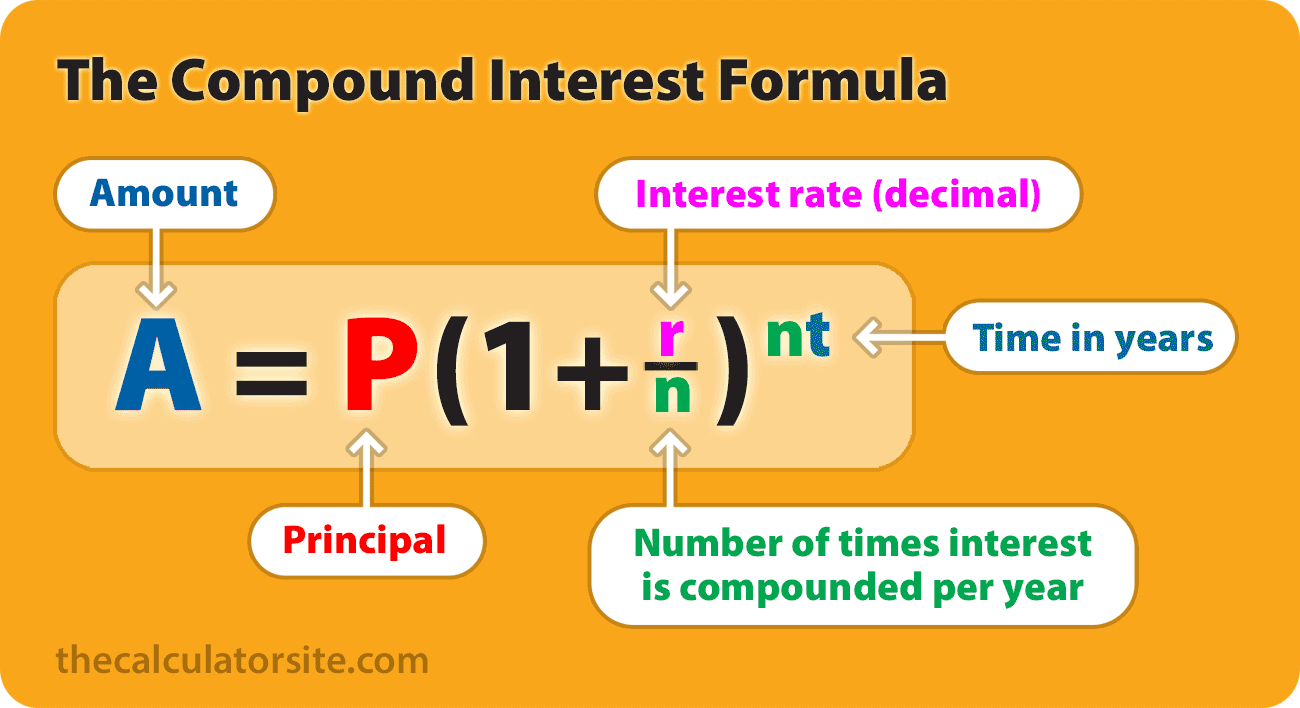
Principal (P): This is the initial amount of money deposited or borrowed. It’s your starting capital.
-
Annual Interest Rate (r): This is the nominal interest rate per year, expressed as a decimal. For example, 5% would be 0.05.
-
Number of Times Interest is Compounded Per Year (n): This crucial variable determines how often the interest is added to the principal within a year. Common compounding frequencies include:
-
Annually: n = 1
-
Semi-annually: n = 2
-
Quarterly: n = 4
-
Monthly: n = 12
-
Daily: n = 365
-
-
Time in Years (t): This is the duration for which the money is invested or borrowed, expressed in years.
-
Future Value (FV): This is the total amount of money, including both the principal and all accumulated compound interest, at the end of the specified time period. This is typically what you are calculating.
The Compound Interest Formula: Demystified
With the variables defined, we can now introduce the fundamental formula used to calculate the future value of an investment or loan with compound interest.
Breaking Down the Formula
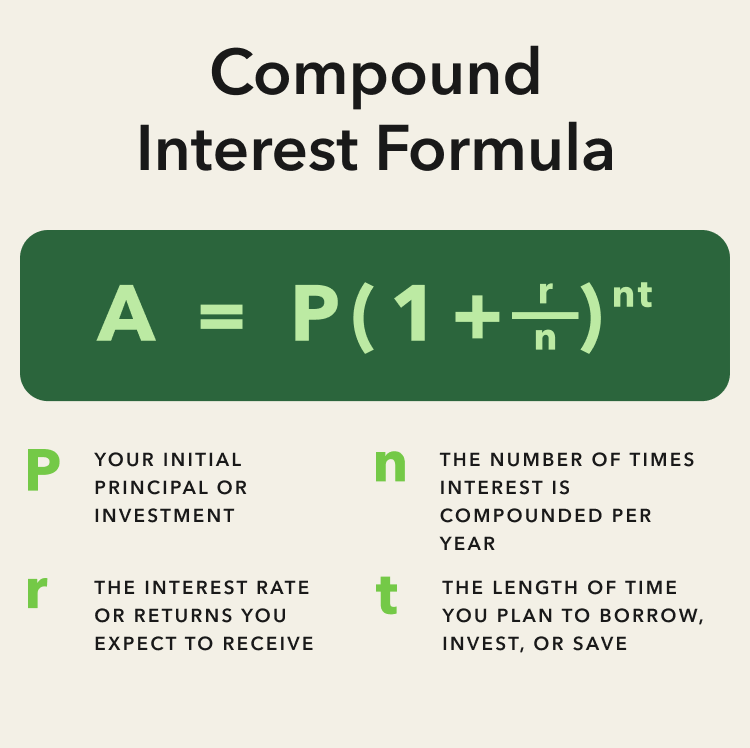
The formula for compound interest is:
FV = P (1 + r/n)^(nt)
Let’s break down each part of this formula and then walk through an example.
-
FV: Future Value of the investment/loan, including interest.
-
P: Principal investment amount (the initial deposit or loan amount).
-
r: Annual interest rate (as a decimal).
-
n: Number of times that interest is compounded per year.
-
t: The number of years the money is invested or borrowed for.
Example 1: Annual Compounding
Let’s say you invest $5,000 (P) at an annual interest rate of 6% (r = 0.06) for 10 years (t = 10), with interest compounded annually (n = 1).
-
Substitute the values into the formula:
FV = 5000 * (1 + 0.06/1)^(1*10)
-
Simplify inside the parentheses:
FV = 5000 * (1 + 0.06)^10
FV = 5000 * (1.06)^10
-
Calculate the exponent:
(1.06)^10 ≈ 1.790847
-
Multiply by the principal:
FV = 5000 * 1.790847
FV ≈ $8,954.24
So, after 10 years, your initial $5,000 investment would grow to approximately $8,954.24. The total interest earned would be $8,954.24 – $5,000 = $3,954.24.
Example 2: Quarterly Compounding
Now, let’s consider the same $5,000 investment at 6% for 10 years, but this time with interest compounded quarterly (n = 4).
-
Substitute the values:
FV = 5000 * (1 + 0.06/4)^(4*10)
-
Simplify inside the parentheses and the exponent:
FV = 5000 * (1 + 0.015)^40
FV = 5000 * (1.015)^40
-
Calculate the exponent:
(1.015)^40 ≈ 1.814018
-
Multiply by the principal:
FV = 5000 * 1.814018
FV ≈ $9,070.09
By compounding quarterly instead of annually, your investment grows by an additional $9,070.09 – $8,954.24 = $115.85 over the 10 years, demonstrating the impact of compounding frequency.
The Impact of Compounding Frequency
As seen in the examples, the number of times interest is compounded per year (n) significantly impacts the final future value. The more frequently interest is compounded, the higher the future value will be, assuming all other variables remain constant. This is because interest begins earning interest sooner.
Consider an investment of $10,000 at 7% annual interest over 20 years with different compounding frequencies:
-
Annually (n=1): FV = 10000 * (1 + 0.07/1)^(1*20) ≈ $38,696.84
-
Semi-annually (n=2): FV = 10000 * (1 + 0.07/2)^(2*20) ≈ $39,592.51
-
Quarterly (n=4): FV = 10000 * (1 + 0.07/4)^(4*20) ≈ $40,064.95
-
Monthly (n=12): FV = 10000 * (1 + 0.07/12)^(12*20) ≈ $40,387.39
-
Daily (n=365): FV = 10000 * (1 + 0.07/365)^(365*20) ≈ $40,547.45
While the differences might seem small over a single year, they accumulate significantly over longer periods. This illustrates why accounts offering daily or monthly compounding are generally more advantageous for investors than those offering annual compounding, even if the nominal annual interest rate is the same.
Practical Applications and Tools for Calculation
While understanding the formula is crucial for conceptual clarity, for day-to-day financial planning and quick calculations, leveraging modern tools can save time and reduce the potential for errors.
Using Online Calculators and Spreadsheets
For most practical purposes, relying on online compound interest calculators or spreadsheet software is the most efficient approach.
Online Compound Interest Calculators:
Numerous websites offer free compound interest calculators. These tools typically require you to input the principal, interest rate, compounding frequency, and time period. They instantly provide the future value and often break down the total interest earned. They are user-friendly, quick, and ideal for comparing different scenarios. Simply search for “compound interest calculator” to find many options.
Spreadsheet Software (e.g., Excel, Google Sheets):
Spreadsheets offer greater flexibility, allowing you to build models, compare multiple scenarios side-by-side, and even incorporate additional contributions.
-
Using the FV function: Spreadsheets have a built-in
FV(Future Value) function, which is designed precisely for compound interest calculations.-
The syntax is:
FV(rate, nper, pmt, [pv], [type]) -
rate: The interest rate per period (annual rate / n). -
nper: The total number of payment periods in an investment (n * t). -
pmt: The payment made each period (for compound interest, this is usually 0 unless you are making regular additional contributions). -
[pv]: The present value, or the lump-sum amount that a series of future payments is worth right now. This is your Principal (P), entered as a negative number. -
[type]: Optional, indicates when payments are due (0 for end of period, 1 for beginning). Leave blank or use 0 for typical compound interest.
Example (from Example 2 above):
If P = $5,000, r = 6% (0.06), n = 4 (quarterly), t = 10 years.
-
Rate per period = 0.06 / 4 = 0.015
-
Total number of periods = 4 * 10 = 40
-
Present Value (P) = -5000 (negative because it’s an outflow of money)
-
The formula in Excel would be:
=FV(0.015, 40, 0, -5000) -
This will return approximately
$9,070.09.
-
-
Using the direct formula: You can also directly input the compound interest formula into a cell, referencing cells where you’ve stored your variables.
-
Let A1 = 5000 (Principal), A2 = 0.06 (Rate), A3 = 4 (n), A4 = 10 (t).
-
In another cell, enter:
=A1 * (1 + A2/A3)^(A3*A4) -
This provides the same result and allows for easy modification of variables.
-
Manual Calculation for Deeper Understanding
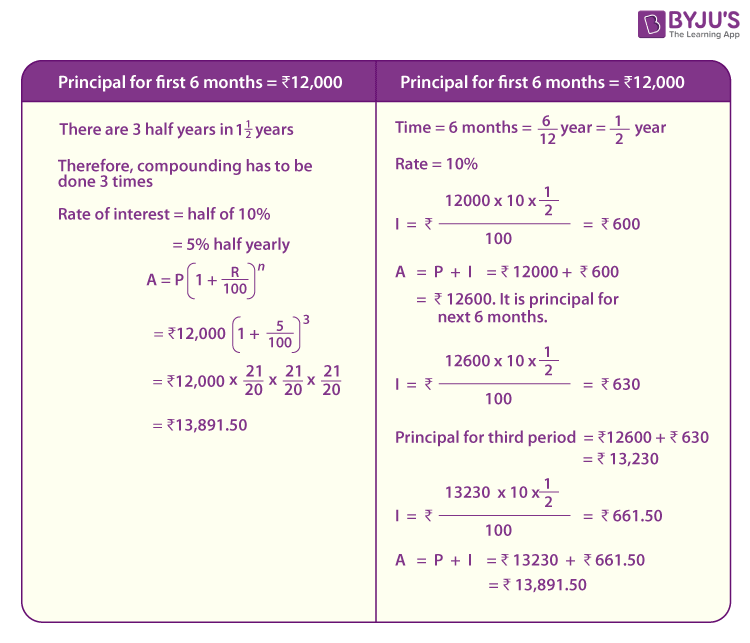
While tools are efficient, performing a manual calculation for a short period can provide a deeper, intuitive understanding of how interest compounds. Let’s do a two-year calculation with annual compounding.
Scenario: Invest $1,000 at 5% annual interest, compounded annually for 2 years.
-
Year 0 (Start): Principal = $1,000.00
-
End of Year 1:
-
Interest for Year 1 = Principal × Rate = $1,000.00 × 0.05 = $50.00
-
Balance at End of Year 1 = Principal + Interest = $1,000.00 + $50.00 = $1,050.00
-
-
End of Year 2:
-
Interest for Year 2 = New Balance (from Year 1) × Rate = $1,050.00 × 0.05 = $52.50
-
Balance at End of Year 2 = New Balance (from Year 1) + Interest = $1,050.00 + $52.50 = $1,102.50
-
This manual step-by-step approach clearly shows how the interest from Year 1 ($50) is added to the principal, and then Year 2’s interest is calculated on this larger sum, including the previous interest. This “interest on interest” is the core concept of compounding.
The Power of Compounding: Strategies for Wealth Building
Understanding how to calculate compound interest is merely the first step. The true value lies in applying this knowledge to make informed financial decisions and strategically build wealth.
Starting Early: The Time Advantage
Of all the variables in the compound interest formula, “time (t)” is arguably the most powerful for investors. The longer your money has to compound, the more significant the impact of “interest on interest” becomes. This leads to the golden rule of investing: start early.
Consider two individuals, both investing $5,000 per year at a 7% annual return:
-
Investor A: Starts at age 25, invests for 10 years ($5,000/year, total $50,000 invested), then stops investing but lets the money grow until age 65 (30 years of compounding after last contribution).
-
At age 35, their $50,000 contributions have grown to approximately $70,236.
-
This $70,236 then compounds for another 30 years without further contributions.
-
At age 65, their portfolio could be worth approximately $534,443.
-
-
Investor B: Starts at age 35, invests for 30 years ($5,000/year, total $150,000 invested) until age 65.
- At age 65, despite contributing three times as much money ($150,000 vs. $50,000), their portfolio would be worth approximately $507,705.
Investor A, who contributed less overall but started earlier, ended up with more money thanks to the extended period of compounding. This illustrates why time is often considered an investor’s best friend.
Regular Contributions and “Dollar-Cost Averaging”
While the initial compound interest formula focuses on a single lump sum, most personal finance strategies involve making regular contributions to savings and investment accounts (e.g., monthly contributions to a retirement fund). Each new contribution becomes a new principal that starts compounding.
This strategy, often paired with “dollar-cost averaging” (investing a fixed amount regularly, regardless of market fluctuations), not only increases your total principal over time but also continuously feeds the compounding machine. The more capital you have, the more interest you earn, and the faster your wealth grows. Consistent saving, even small amounts, combined with compounding, can lead to substantial wealth over decades.
Reinvesting Dividends and Interest
Many investments, such as stocks, mutual funds, or bonds, pay out dividends or interest. A powerful strategy to supercharge your compounding is to automatically reinvest these payouts. Instead of taking the cash, you use the dividends or interest to buy more shares or increase your principal. This immediately increases your “P” (principal) in the compound interest formula, allowing even more interest to accumulate in the next period. This accelerates the compounding effect and can significantly boost long-term returns, especially in dividend-growth investing.
Understanding Compounding for Debt: The “Bad” Side
While compound interest is a powerful ally for wealth creation, it can be a formidable adversary when it comes to debt. Just as your investments grow exponentially, so too can your debt.
Credit cards are a prime example. They often have high annual interest rates (e.g., 15-25%) that compound daily or monthly. If you carry a balance, the interest charged in one period is added to your principal, and then the next period’s interest is calculated on that new, larger balance. This is why credit card debt can spiral out of control rapidly, making it difficult to pay off if only minimum payments are made. Student loans and mortgages also involve compound interest, though typically at lower rates and with less frequent compounding than credit cards. Understanding this mechanism is crucial for managing and minimizing debt, emphasizing the importance of paying down high-interest liabilities quickly.
Conclusion
Calculating compounded interest is more than just a mathematical exercise; it’s an insight into one of the most fundamental forces in personal finance and investing. From understanding the core formula and its variables to appreciating the critical role of compounding frequency and time, mastering this concept empowers you to make smarter financial decisions.
Whether you’re diligently saving for a down payment, strategically planning for retirement, or navigating the complexities of debt, the principles of compounded interest are always at play. By embracing the power of early investing, consistent contributions, and the reinvestment of earnings, you can effectively harness compounding to build substantial long-term wealth. Conversely, recognizing its detrimental effect on high-interest debt is equally vital for maintaining financial health. Armed with this knowledge, you are well-equipped to embark on a more prosperous financial journey, turning the abstract idea of “interest on interest” into tangible financial success.
aViewFromTheCave is a participant in the Amazon Services LLC Associates Program, an affiliate advertising program designed to provide a means for sites to earn advertising fees by advertising and linking to Amazon.com. Amazon, the Amazon logo, AmazonSupply, and the AmazonSupply logo are trademarks of Amazon.com, Inc. or its affiliates. As an Amazon Associate we earn affiliate commissions from qualifying purchases.