
Return on Investment, or ROI, is perhaps the most critical metric in the world of finance. Whether you are a retail investor dabbling in the stock market, a small business owner evaluating a new piece of equipment, or an individual trying to decide if a graduate degree is worth the tuition, ROI provides a universal language for measuring efficiency. At its core, ROI tells you how much money you made—or lost—relative to how much you put in.
However, while the basic concept is straightforward, “figuring out” ROI in a way that truly informs financial decision-making requires looking beyond a simple percentage. It involves understanding the nuances of costs, the impact of time, and the weight of risk. To master your personal or business finances, you must move from a basic calculation to a comprehensive analysis of value.

The Fundamental Mathematics of ROI
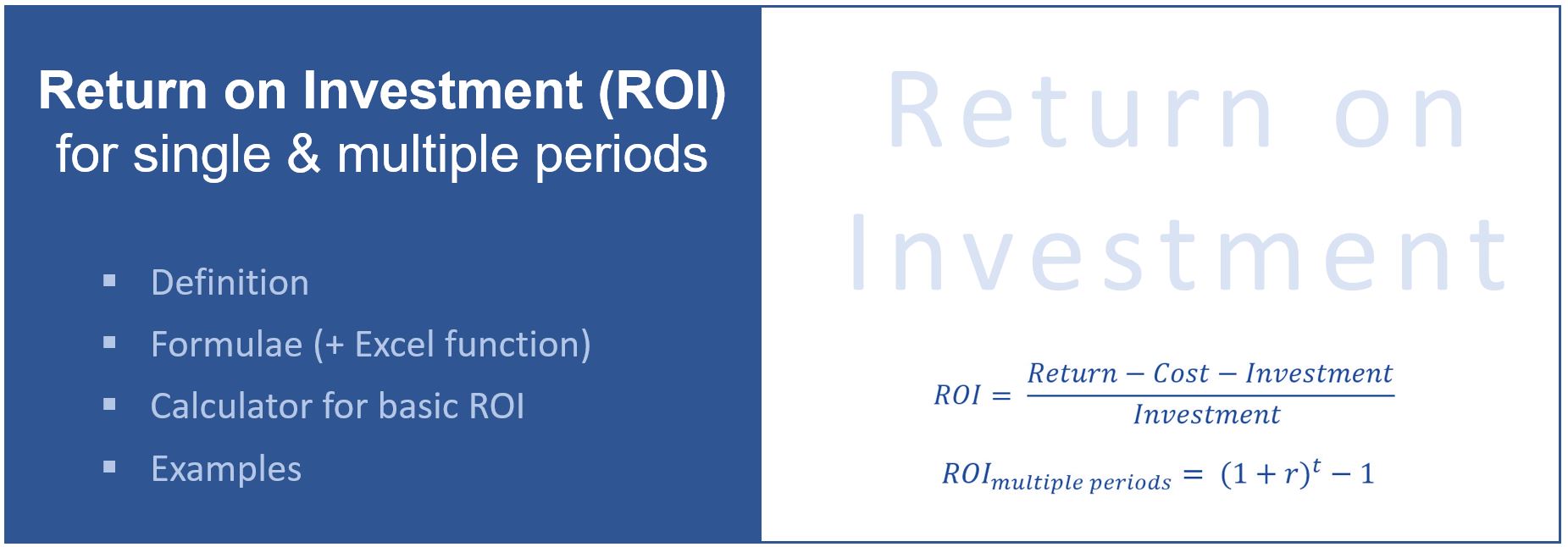
To determine the return on an investment, you must first isolate two primary figures: the current value of the investment and the original cost of the investment. The formula used globally by analysts and investors is remarkably simple:
ROI = (Current Value of Investment – Cost of Investment) / Cost of Investment
To express this as a percentage, which is the standard practice, you multiply the final result by 100.
The Basic ROI Formula in Action
Consider a straightforward scenario. You purchase 100 shares of a technology company at $10 per share, totaling a $1,000 investment. A year later, you sell those shares for $1,250.
To find the ROI, you subtract the initial $1,000 from the $1,250 to find your “net profit” of $250. You then divide that $250 by your original $1,000 investment, resulting in 0.25. Multiplied by 100, your ROI is 25%. On the surface, this looks like a highly successful venture.
Defining the “Cost” of Investment
One of the most common mistakes in figuring out ROI is failing to account for the “true” cost. In the example above, the calculation assumes there were no transaction fees. In reality, if a brokerage charged you $10 to buy the stock and $10 to sell it, your total cost was actually $1,020, and your net proceeds were $1,240.
Recalculating with these “frictional costs” changes the net profit to $220. Dividing $220 by the total cost of $1,020 results in an ROI of approximately 21.5%. While still positive, the four-percent difference illustrates why it is vital to include every penny spent to acquire and maintain the asset.
Beyond the Basics: Adjusted ROI and Timeframes
The primary weakness of the basic ROI formula is that it ignores the element of time. A 50% return is incredible if it happens in six months, but it is lackluster if it takes twenty years to achieve. To truly understand the performance of your money, you must learn to annualize your returns.
Annualized ROI
The annualized ROI provides a way to compare investments that have been held for different lengths of time. If Investment A returns 20% over two years and Investment B returns 30% over five years, which is better? At a glance, B looks superior, but on an annual basis, Investment A is the winner.
The formula for annualized ROI is:
[(1 + ROI)^1/n — 1] x 100
(where ‘n’ is the number of years the investment was held)
Using this method, you can level the playing field between a high-yield savings account, a long-term real estate holding, and a short-term stock trade. It allows for a more disciplined approach to capital allocation, ensuring that your money is working as hard as possible every single year.
Factoring in Taxes and Inflation
In the realm of personal finance, “nominal” ROI—the number you see on your brokerage statement—can be deceptive. To find your “real” ROI, you must account for the eroding power of inflation and the inevitable reach of the tax authorities.

If your investment earns a 7% ROI but inflation is running at 3%, your purchasing power has only increased by 4%. Furthermore, if you are in a 15% capital gains tax bracket, a significant portion of your profit belongs to the government. When professionals figure out ROI, they often look at “After-Tax Real ROI” to decide if an investment actually moves the needle on their long-term wealth.
ROI in Different Asset Classes
The way you calculate and interpret ROI varies significantly depending on what you are investing in. Each asset class has its own set of “hidden” inputs that can skew the results if ignored.
Stock Market Investments
In the stock market, ROI isn’t just about the change in share price. Total Return is the preferred metric here, which includes both capital appreciation (the price going up) and dividends (cash payments to shareholders). If a stock’s price remains flat but it pays a 4% dividend yield, your ROI is 4%. If you ignore those dividends in your calculation, you are underestimating the performance of your portfolio.
Real Estate Portfolios
Real estate ROI is notoriously complex. Unlike a stock, a property requires ongoing capital injections. When figuring out the ROI on a rental property, you must subtract mortgage interest, property taxes, insurance, maintenance, and vacancy costs from the rental income.
Investors often use “Cash-on-Cash Return” for real estate, which measures the annual net cash flow relative to the actual cash invested (the down payment and closing costs), rather than the total value of the property. This is a specialized form of ROI that helps investors understand the liquidity and immediate cash benefits of their property holdings.
Business Capital Expenditures
For business owners, ROI is often used to justify “CapEx” (Capital Expenditure). If you spend $50,000 on a new software system that automates a process previously handled by a full-time employee earning $60,000 a year, the ROI is realized through cost savings. In this context, the “profit” is the reduction in operating expenses. Calculating this accurately requires a deep dive into “soft costs,” such as the time required to train staff on the new system, which acts as a hidden investment cost.
The Limitations of ROI as a Single Metric
While ROI is a powerful tool, relying on it exclusively can lead to poor financial decisions. It is a historical metric—it tells you what happened in the past, but it does not guarantee future results. Furthermore, it fails to account for two of the most important factors in finance: risk and opportunity cost.
Ignoring Risk and Volatility
A high ROI often comes with high risk. If you “invest” $1,000 in a lottery ticket and win $100,000, your ROI is an astronomical 9,900%. However, this does not mean buying lottery tickets is a sound financial strategy.
When comparing two investments—for instance, a government bond with a 4% ROI and a speculative cryptocurrency with a 40% ROI—the ROI alone doesn’t tell the story. You must weigh the ROI against the probability of losing your principal. Financial experts often use the Sharpe Ratio or other risk-adjusted metrics to see if the “excess” ROI is worth the “excess” stress and potential for loss.
The Omission of Opportunity Cost
Opportunity cost is the profit you miss out on by choosing one investment over another. If you figure out your ROI on a side business is 5%, you might feel successful. However, if the stock market returned 10% during that same period with much less effort required from you, your “economic ROI” is actually negative. You have essentially “lost” 5% by not choosing the better alternative. Effective financial management requires constantly comparing your current ROI against the “next best thing.”
Best Practices for Financial Decision Making
To use ROI effectively in your financial life, you must be consistent and honest with your data. Figuring out ROI is not just a math exercise; it is a diagnostic tool for your wealth-building journey.
First, always use the same formula across all your assets. If you include taxes for your stocks but forget them for your real estate, your comparisons will be flawed. Create a spreadsheet that tracks every investment, including the date of purchase, all associated costs, any income generated (dividends/rent), and the current market value.
Second, set an “ROI Hurdle Rate.” This is the minimum return you are willing to accept for a given level of risk. For many, the hurdle rate is the average return of a low-cost S&P 500 index fund. If a potential investment or business venture cannot realistically beat that hurdle rate after accounting for taxes and effort, it may not be worth your time.
Finally, remember that ROI is a tool for clarity, not a rule for life. Sometimes, the “return” on an investment is qualitative. Investing in a home office might have a low financial ROI in terms of resale value, but the “return” in terms of productivity and mental health might be invaluable. However, for your brokerage accounts, your business ventures, and your retirement planning, the math must remain the priority. By mastering how to figure out ROI, you take control of your financial narrative, ensuring that every dollar you deploy is a dollar that is purposefully growing.
aViewFromTheCave is a participant in the Amazon Services LLC Associates Program, an affiliate advertising program designed to provide a means for sites to earn advertising fees by advertising and linking to Amazon.com. Amazon, the Amazon logo, AmazonSupply, and the AmazonSupply logo are trademarks of Amazon.com, Inc. or its affiliates. As an Amazon Associate we earn affiliate commissions from qualifying purchases.