
In the vast and often complex world of finance, few concepts are as fundamental and universally applied as percentages. From personal budgeting and understanding investment returns to analyzing business profits and navigating tax implications, percentages are the silent workhorses that underpin almost every financial decision and metric. Despite their omnipresence, many individuals shy away from engaging with percentages, viewing them as a purely mathematical construct best left to accountants and financial analysts. This perspective, however, is a significant barrier to achieving true financial fluency and confidence.
To “do percentage” correctly isn’t just about arithmetic; it’s about unlocking a deeper understanding of financial relationships, growth, decline, and proportionality. This comprehensive guide aims to demystify percentages, transforming them from intimidating figures into powerful tools for informed decision-making in every aspect of your financial life. We will break down the core concepts, explore their myriad applications in personal and business finance, highlight common pitfalls, and ultimately empower you to embrace percentages as a cornerstone of your financial literacy.

The Fundamentals: What is a Percentage and How to Calculate It
At its heart, a percentage is a way of expressing a number as a fraction of 100. The term “percent” literally means “per hundred,” or “out of one hundred.” This simple definition makes percentages an incredibly versatile tool for comparing parts of a whole, standardizing comparisons, and expressing ratios in a universally understood format.
Defining the Percentage: Parts of a Whole
Imagine a pie cut into 100 slices. If you have 25 slices, you have 25 percent of the pie. If you spend 30 units of currency out of 100 units, you’ve spent 30 percent. Percentages help us visualize and quantify proportions without needing to know the exact total size of the “whole,” as long as we can relate the “part” to it. They act as a common language, whether we’re discussing a small portion of a budget or a massive global market share. Percentages can also be easily converted into decimal form (e.g., 25% = 0.25) or fraction form (e.g., 25% = 1/4), making them adaptable for various calculations.
Basic Calculation: From Fraction to Percentage
The most common way to calculate a percentage is to divide the “part” by the “whole” and then multiply the result by 100.
Formula: (Part / Whole) × 100 = Percentage
Example 1: Test Scores
If you score 45 out of 50 on a test, what is your percentage score?
(45 / 50) × 100 = 0.9 × 100 = 90%
Example 2: Discount Rate
A product originally costs $80, and it’s on sale for $64. What is the percentage discount?
First, find the discount amount: $80 – $64 = $16.
Then, calculate the percentage discount relative to the original price:
($16 / $80) × 100 = 0.2 × 100 = 20%
Reversing the Process: Finding the Part from a Percentage
Sometimes, you know the percentage and the whole, and you need to find the specific part. This is common when calculating tips, sales tax, or a specific allocation from a budget.
Formula: Percentage (as decimal) × Whole = Part
Example 1: Calculating a Tip
You want to leave a 15% tip on a bill of $60. How much is the tip?
Convert 15% to a decimal: 0.15
0.15 × $60 = $9.00
Example 2: Finding Sales Tax
If sales tax is 8% and your purchase is $120, what is the tax amount?
Convert 8% to a decimal: 0.08
0.08 × $120 = $9.60
Percentage Change: Increase and Decrease
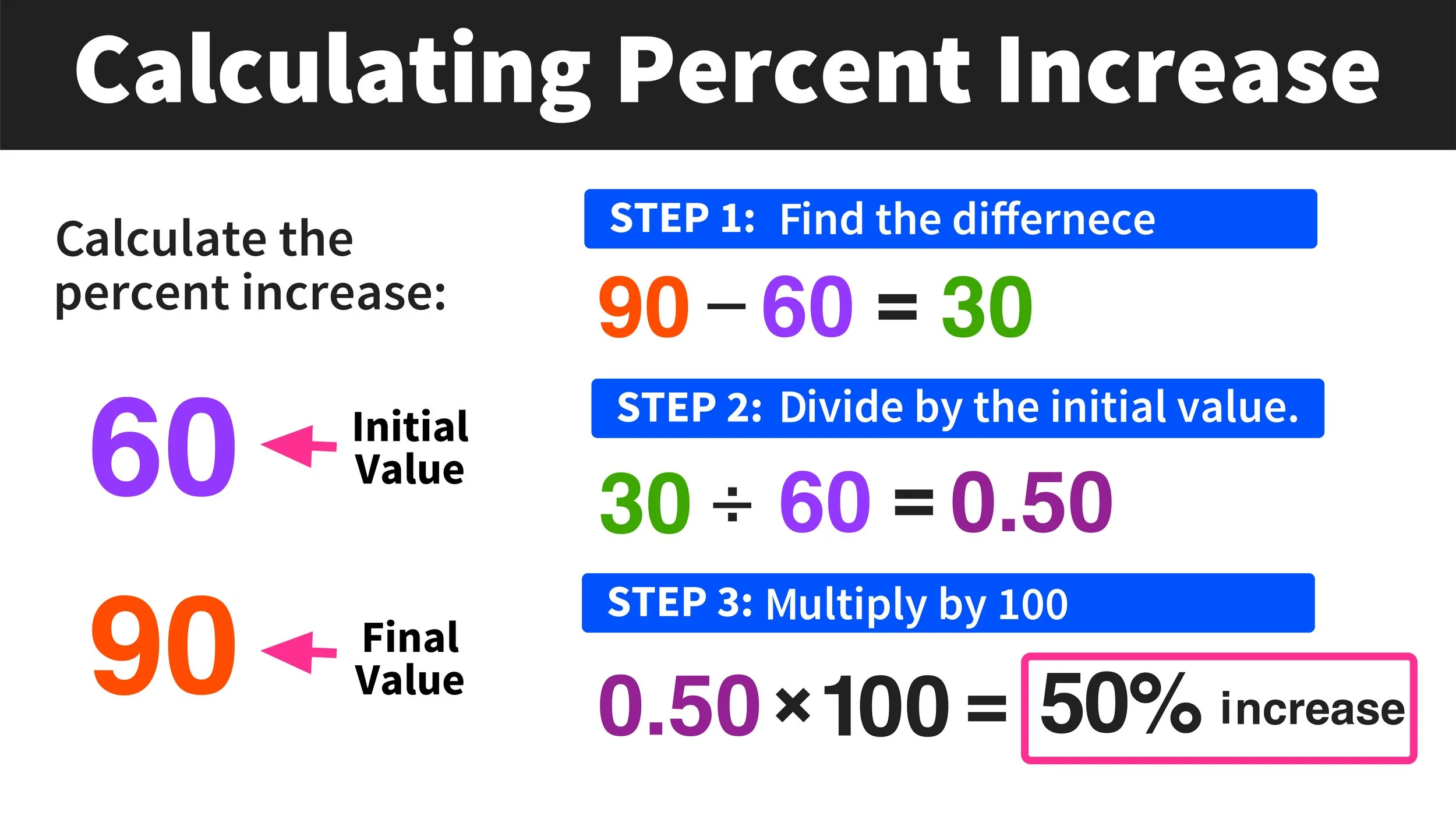
Understanding percentage change is crucial for evaluating growth, decline, and overall performance in finance. Whether tracking investment returns, inflation, or changes in sales figures, this calculation provides a standardized way to compare shifts over time.
Formula: ((New Value – Old Value) / Old Value) × 100 = Percentage Change
Example 1: Investment Growth
Your investment account grew from $10,000 to $12,000. What is the percentage increase?
(($12,000 – $10,000) / $10,000) × 100 = ($2,000 / $10,000) × 100 = 0.2 × 100 = 20% increase.
Example 2: Salary Decrease
Due to unforeseen circumstances, your monthly salary decreased from $5,000 to $4,500. What is the percentage decrease?
(($4,500 – $5,000) / $5,000) × 100 = (-$500 / $5,000) × 100 = -0.1 × 100 = -10% (or a 10% decrease).
Percentages in Personal Finance: Everyday Applications
Percentages are not abstract mathematical concepts; they are the language of your daily financial life. Mastering them empowers you to make smarter decisions about your money, from how you spend to how you save and invest.
Budgeting and Expense Tracking
A well-structured budget often relies heavily on percentages. Popular budgeting methods, like the 50/30/20 rule, dictate allocating specific percentages of your after-tax income to different categories: 50% for needs, 30% for wants, and 20% for savings and debt repayment. Understanding the percentage of your income that goes towards housing, food, transportation, or entertainment helps you visualize where your money truly goes and identify areas for adjustment. If your housing expenses take up 40% of your income, it might be clear you’re above the recommended threshold.
Savings and Investments
This is where percentages truly shine.
-
Interest Rates: Whether it’s the interest earned on your savings account (APR – Annual Percentage Rate) or the interest charged on your loans, percentages dictate how much your money grows or costs. Understanding compound interest, where interest is earned not only on the initial principal but also on accumulated interest, is critical for long-term wealth building. A seemingly small difference in percentage points can lead to vastly different outcomes over time.
-
Return on Investment (ROI): Investors constantly use ROI percentages to evaluate the performance of their assets. An ROI of 10% on an investment means you gained 10 cents for every dollar invested.
-
Portfolio Allocation: Financial advisors often recommend diversifying investments across different asset classes (stocks, bonds, real estate) based on percentages suitable for your risk tolerance and age. For instance, a common guideline might be 60% stocks and 40% bonds.
-
Inflation: The rate of inflation, expressed as a percentage, tells you how quickly the purchasing power of your money is eroding. If inflation is 3%, your money buys 3% less than it did a year ago.
Debt Management
Percentages are central to understanding and managing debt.
-
Loan Interest Rates (APR): Every loan, from mortgages and car loans to personal loans, comes with an interest rate expressed as a percentage. A higher APR means more of your payment goes towards interest rather than the principal, prolonging your debt.
-
Credit Card Interest: Credit cards often carry very high-interest rates, sometimes upwards of 20-30%. Understanding how quickly these percentages can compound if balances are not paid in full is vital to avoid spiraling debt.
-
Debt-to-Income Ratio: Lenders use this percentage to assess your ability to manage monthly payments and repay new debts. It’s calculated by dividing your total monthly debt payments by your gross monthly income. A high ratio (e.g., above 43%) can make it difficult to qualify for new loans.
Discounts, Sales, and Taxes

From grocery shopping to filing taxes, percentages are part of our everyday transactions.
-
Sales and Discounts: A “25% off” sale immediately tells you how much money you save. Calculating the final price (Original Price × (1 – Discount Percentage as decimal)) allows you to quickly assess the true cost.
-
Sales Tax: Added to most purchases, sales tax is a percentage of the item’s price.
-
Income Tax: Your income tax bracket, which determines the percentage of your income you pay in taxes, is a crucial personal finance concept. Understanding effective tax rates (the actual percentage of your total income paid in taxes) gives a clearer picture than just your marginal tax bracket.
Percentages in Business and Online Income: Growth and Profitability
For entrepreneurs, business owners, and those earning online income, percentages are indispensable for tracking performance, evaluating profitability, and strategizing for growth. They provide a standardized way to compare financial health and operational efficiency across different periods or against competitors.
Profitability Metrics
Understanding your business’s profitability is paramount, and percentages offer clear, concise metrics.
-
Gross Profit Margin: This vital metric shows the percentage of revenue left after subtracting the cost of goods sold (COGS). Formula: (Gross Profit / Revenue) × 100. A healthy gross margin indicates efficient production or service delivery.
-
Net Profit Margin: This takes profitability a step further, showing the percentage of revenue remaining after all expenses, including COGS, operating expenses, interest, and taxes, have been deducted. Formula: (Net Profit / Revenue) × 100. This is the ultimate measure of a company’s overall financial health.
-
Operating Profit Margin: This focuses on the profitability of a company’s core operations, before interest and taxes.
Growth and Performance Indicators
Businesses use percentages to quantify growth and operational efficiency.
-
Sales Growth Percentage: Measures the increase in sales revenue over a specific period. This percentage is a key indicator of market acceptance and business expansion.
-
Market Share Percentage: Represents the portion of a total market that a company controls. A growing market share percentage signifies increased competitiveness.
-
Website Conversion Rates: For online businesses, this is the percentage of website visitors who complete a desired action, such as making a purchase or filling out a form. Optimizing this percentage is crucial for e-commerce success.
-
Customer Retention Rates: The percentage of customers a business retains over a given period, indicating customer loyalty and the effectiveness of retention strategies.
Online Income and Commissions
Many online income models are built on percentages.
-
Affiliate Commission Percentages: If you promote products or services as an affiliate, you earn a percentage of each sale you generate. These rates can vary widely (e.g., 5% to 50% or more), directly impacting your earnings.
-
Royalty Rates for Creators: Authors, musicians, and other creators often earn royalties as a percentage of sales or streams of their work.
-
Service Fee Percentages: Platforms like Etsy, eBay, or payment processors like PayPal or Stripe charge a percentage of each transaction as their fee. Understanding these percentages is essential for calculating net income.
Business Finance Decisions
Percentages inform critical business decisions.
-
Break-even Analysis: Determining the sales volume (often expressed as a percentage of capacity) at which total costs equal total revenue, meaning the business makes no profit or loss.
-
Cost-Benefit Analysis: Businesses weigh the percentage benefits against the percentage costs of a project or investment to make informed decisions.
-
Overhead Percentages: Understanding what percentage of revenue goes towards fixed costs (rent, salaries) helps manage expenses and pricing strategies.
Common Pitfalls and Advanced Percentage Concepts
While percentages are powerful, they can also be misinterpreted if not understood fully. Awareness of common pitfalls and some more advanced concepts will further solidify your financial literacy.
The Percentage Point vs. Percentage Change
This is one of the most common sources of confusion, particularly in financial news.
-
Percentage Point: Refers to the absolute difference between two percentages. If an interest rate goes from 4% to 5%, that’s an increase of 1 percentage point.
-
Percentage Change: Refers to the relative change between two values, calculated using the percentage change formula. In the example above, an increase from 4% to 5% is a ((5-4)/4) * 100 = 25% percentage change (a 25% increase in the rate itself). Misinterpreting these can lead to wildly inaccurate conclusions about the magnitude of a change.
Cumulative Percentages and Compounding
-
Compounding Interest: This phenomenon, where interest is earned on both the initial principal and the accumulated interest, is a powerful engine of wealth growth. Understanding how percentages compound over time (e.g., in a savings account or investment) is crucial for long-term financial planning.
-
Sequential Discounts: When multiple discounts are applied, they are usually applied sequentially, not cumulatively as a single, larger discount. A “20% off, then an additional 10% off” sale does not mean 30% off. It means 20% off the original price, and then 10% off the new discounted price. This subtle distinction can significantly affect the final cost.
Base Value Matters
A percentage is always relative to its base. A “10% increase” means very different things if the base is $100 versus $1,000,000. Large percentage changes on small bases can be less significant than small percentage changes on large bases. Always consider the absolute numbers behind the percentages to avoid being misled by statistics that cherry-pick or distort the base.
Using Financial Tools for Percentage Calculations
While mental math and basic calculators are useful, financial tools simplify complex percentage calculations.
-
Spreadsheets (Excel, Google Sheets): Invaluable for budgeting, investment tracking, and business analysis. Functions like
PERCENTAGE,RATE, andPMTcan handle complex scenarios. -
Online Calculators: Numerous websites offer free calculators for mortgages, interest, tips, currency conversion, and more.
-
Financial Calculators: Dedicated handheld devices or apps can perform advanced financial functions, including time value of money calculations (which heavily rely on percentages).
Cultivating Financial Confidence Through Percentage Proficiency
Beyond the numbers, mastering percentages is about building a foundation of financial confidence and critical thinking.
Empowering Financial Decision-Making
When you confidently understand percentages, you are better equipped to:
-
Evaluate loan offers and choose the most favorable interest rates.
-
Assess investment opportunities and understand their potential returns and risks.
-
Negotiate salaries and employment benefits, understanding the percentage increase or decrease in your compensation.
-
Make informed purchasing decisions, quickly calculating discounts, interest on financing, and total costs.
-
Craft and stick to a budget that truly reflects your financial goals.
Recognizing Misleading Information
In an age of constant information, percentages are often used to sway opinions or present data in a particular light. With a strong grasp of percentage principles, you can:
-
Critically evaluate news reports, advertisements, and political claims that cite percentage statistics.
-
Spot discrepancies, base value manipulations, or the confusion between percentage points and percentage change.
-
Ask clarifying questions to uncover the true meaning behind the numbers.
Continuous Learning and Practice
Like any skill, financial literacy and percentage proficiency improve with practice. Integrate percentage calculations into your daily financial life: estimate tips, calculate discounts, review your investment statements for percentage returns, and analyze your budget using percentage allocations. The more you engage, the more intuitive these concepts will become.
Conclusion
Percentages are far more than mere mathematical figures; they are the bedrock of financial understanding, offering clarity, comparability, and insight into virtually every monetary transaction and decision. By demystifying “how to do percentage” and applying these fundamental principles to personal finance, investing, business operations, and online income, you unlock a powerful capability. This mastery transcends simple arithmetic, evolving into a critical life skill that empowers you to navigate the financial landscape with confidence, make informed choices, and ultimately, secure your financial well-being. Embrace percentages, and you embrace a clearer, more financially fluent future.
aViewFromTheCave is a participant in the Amazon Services LLC Associates Program, an affiliate advertising program designed to provide a means for sites to earn advertising fees by advertising and linking to Amazon.com. Amazon, the Amazon logo, AmazonSupply, and the AmazonSupply logo are trademarks of Amazon.com, Inc. or its affiliates. As an Amazon Associate we earn affiliate commissions from qualifying purchases.