
In an increasingly complex financial world, the ability to understand and calculate percentages is not just a mathematical skill – it’s a fundamental pillar of financial literacy. From dissecting personal budgets and evaluating investment returns to understanding loan interest and spotting the true value of a sale, percentages are woven into the very fabric of our monetary lives. Without a solid grasp of how to figure a percentage of a number, individuals and businesses alike risk making uninformed decisions, missing opportunities, or falling prey to misleading figures.
This article serves as your comprehensive guide to demystifying percentages, specifically through the lens of personal finance, investing, and business. We’ll explore not just the “how-to” but also the critical “why” behind these calculations, empowering you to navigate your financial landscape with confidence and precision. Whether you’re a budding investor, a meticulous budgeter, or a small business owner, mastering percentages will unlock a deeper understanding of your financial health and potential.

The Foundation: Understanding What a Percentage Is
Before diving into calculations, it’s crucial to grasp the core concept of a percentage. At its heart, a percentage represents a proportion or a fraction of a whole, expressed as a number out of 100. The term “percent” literally means “per one hundred” or “for every hundred.” When you see 25%, it means 25 out of 100, or 25/100, which can also be written as the decimal 0.25. This simple concept is the bedrock upon which all percentage calculations are built.
Deciphering the “Whole” and the “Part”
Every percentage calculation involves a “whole” (the base number) and a “part” (the specific portion you’re interested in). For instance, if you have $500 and you want to know what 10% of it is, $500 is your “whole,” and the amount representing 10% is your “part.” Understanding which figure is the whole and which is the part is often the first step to correctly setting up your calculation.
Why Percentages Matter in the World of Money
The financial world speaks in percentages. They offer a standardized way to compare different values, regardless of their absolute size.
-
Discounts: A 20% discount on a $100 item is easy to compare with a 20% discount on a $1000 item – you immediately know the relative saving.
-
Interest Rates: Whether it’s the interest on your savings account or the rate on a loan, percentages allow you to quantify the cost of borrowing or the gain from saving over time.
-
Taxes: Income tax rates, sales tax, property tax – all are expressed as percentages, determining how much of your income or expenditure goes to the government.
-
Growth and Decline: Economic growth, investment returns, inflation, and market drops are almost universally communicated as percentage changes, providing a clear indication of performance or impact.
Without percentages, comparing financial data would be cumbersome and often misleading, as absolute numbers might not reflect the true scale of an event or opportunity.
Essential Methods for Calculating a Percentage of a Number
Now that we understand the ‘what’ and ‘why,’ let’s delve into the practical ‘how.’ There are primary methods for calculating percentages, each vital for specific financial scenarios.
Method 1: Finding a Percentage of a Given Number
This is the most common and fundamental calculation: “What is X% of Y?”
The Formula:
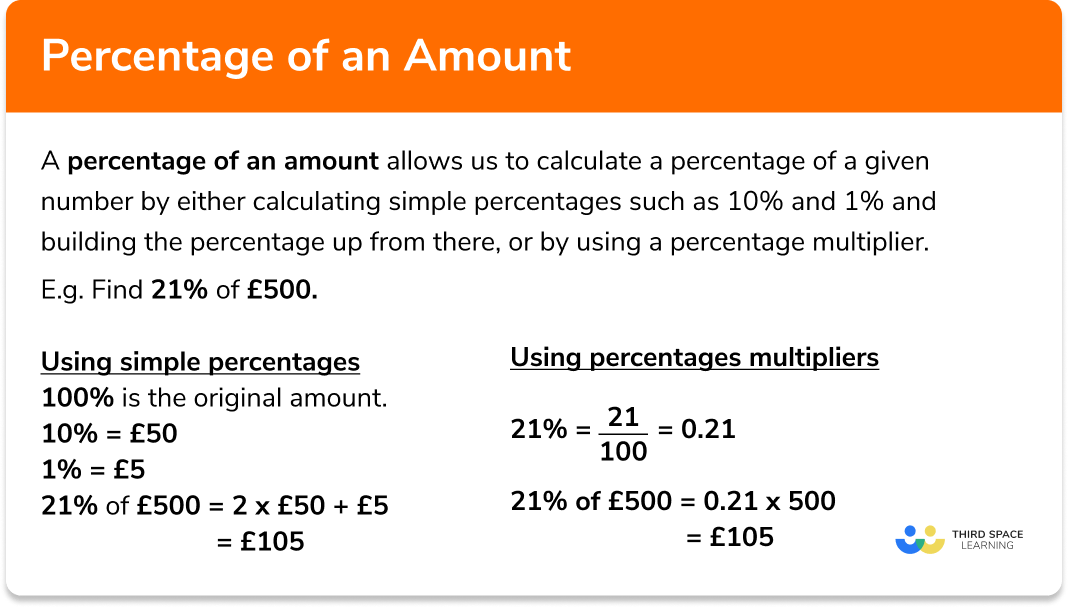
To find X% of Y, you convert the percentage to a decimal and multiply it by the number.
Percentage (as decimal) × Number = Part
Or, (Percentage / 100) × Number = Part
Example 1: Calculating a Discount
You want to buy a laptop that costs $1,200, and it’s on sale for 15% off. How much is the discount?
-
Convert 15% to a decimal: 15 / 100 = 0.15
-
Multiply the decimal by the total cost: 0.15 × $1,200 = $180
The discount is $180. The final price would be $1,200 – $180 = $1,020.
Example 2: Calculating Sales Tax
You’re buying an item for $75, and the sales tax rate is 8%. How much sales tax will you pay?
-
Convert 8% to a decimal: 8 / 100 = 0.08
-
Multiply the decimal by the item cost: 0.08 × $75 = $6
The sales tax is $6. Your total cost will be $75 + $6 = $81.
Method 2: Calculating What Percentage One Number Is of Another
This method answers the question: “What percentage is A of B?” This is crucial for understanding ratios, margins, and performance.
The Formula:
(Part / Whole) × 100 = Percentage
Example 1: Calculating Your Savings Rate
You earn $4,000 per month after taxes and manage to save $600. What percentage of your income are you saving?
-
Divide the part (savings) by the whole (income): $600 / $4,000 = 0.15
-
Multiply by 100 to get the percentage: 0.15 × 100 = 15%
You are saving 15% of your income.
Example 2: Determining Profit Margin
A product sells for $50, and its cost to produce was $30. What is the gross profit margin percentage?
-
First, calculate the gross profit: $50 (revenue) – $30 (cost) = $20 (profit). This is your ‘part’.
-
Divide the profit by the selling price (the ‘whole’ for margin calculation): $20 / $50 = 0.40
-
Multiply by 100: 0.40 × 100 = 40%
The gross profit margin is 40%.
Method 3: Finding the Original Number Before a Percentage Increase or Decrease
This is a slightly more advanced but incredibly useful calculation, especially when dealing with taxes, markups, or discounts where you only know the final amount and the percentage applied.
The Formula:
Original Number = Final Number / (1 + Percentage as decimal for increase)
Original Number = Final Number / (1 - Percentage as decimal for decrease)
Example 1: Finding the Original Price Before Sales Tax (Increase)
You bought an item for $108, which included an 8% sales tax. What was the original price of the item before tax?
-
Convert 8% to a decimal: 0.08
-
Add 1 to the decimal: 1 + 0.08 = 1.08
-
Divide the final price by this value: $108 / 1.08 = $100
The original price before tax was $100.
Example 2: Finding the Original Price Before a Discount (Decrease)
You bought a shirt for $24 during a 25% off sale. What was the original price of the shirt?
-
Convert 25% to a decimal: 0.25
-
Subtract the decimal from 1: 1 – 0.25 = 0.75
-
Divide the discounted price by this value: $24 / 0.75 = $32
The original price of the shirt was $32.
Practical Applications in Personal Finance
Mastering percentage calculations directly translates to better personal financial management.
Budgeting and Expense Tracking
Percentages are invaluable for understanding where your money goes.
-
The 50/30/20 Rule: A popular budgeting guideline suggests allocating 50% of your income to needs, 30% to wants, and 20% to savings and debt repayment. Calculating these percentages of your net income helps you stay on track.
-
Identifying Spending Patterns: By converting individual expense categories (e.g., groceries, entertainment, housing) into percentages of your total monthly spending, you can quickly identify areas where you might be overspending or where adjustments could have the biggest impact.
Understanding Interest Rates
Whether you’re saving or borrowing, interest rates are expressed as percentages and significantly impact your financial health.
-
Loan Costs: A 5% interest rate on a car loan or mortgage dictates how much extra you’ll pay over the life of the loan. Understanding this allows for comparisons between different lenders.
-
Savings Growth: The annual percentage yield (APY) on your savings account determines how quickly your money grows. Even a small percentage difference can lead to substantial gains over time due to compounding.
-
Credit Card Debt: High credit card interest rates (often 15-25% or more) can quickly lead to an overwhelming debt spiral if not managed carefully. Calculating the interest you’re paying helps underscore the urgency of repayment.
Analyzing Discounts and Sales
A “sale” sign doesn’t always guarantee the best deal. Percentages help you make informed purchasing decisions.
-
True Savings: A 30% off sale sounds great, but is it 30% off the original price, or a marked-up price? Being able to calculate the exact discount helps you determine the actual savings.
-
Comparing Deals: If one store offers 20% off and another offers $50 off, knowing the item’s original price and calculating the percentage discount in both scenarios ensures you pick the better deal.
Retirement Planning and Savings Goals
Percentages are central to long-term financial planning.
-
Contribution Rates: Financial advisors often recommend saving a certain percentage of your income for retirement, typically 10-15% or more. Regularly calculating your contribution rate ensures you’re on track to meet your goals.
-
Investment Growth: Understanding the average annual return (a percentage) of your investment portfolio helps project future wealth and adjust strategies as needed.
Business and Investment Scenarios
Beyond personal finance, percentages are the lingua franca of business and investment analysis.
Calculating Profit Margins
Businesses rely heavily on profit margins, typically expressed as percentages, to assess financial health.
-
Gross Profit Margin: (Gross Profit / Revenue) × 100. This shows the percentage of revenue left after deducting the cost of goods sold. A higher percentage indicates better efficiency in production.
-
Net Profit Margin: (Net Profit / Revenue) × 100. This indicates the percentage of revenue remaining after all expenses (including taxes and interest) have been deducted. It’s a key indicator of overall profitability.
-
Markup: The percentage added to a product’s cost to determine its selling price.
Investment Returns and Growth
Evaluating investments is impossible without percentages.
-
Return on Investment (ROI): ((Current Value – Original Cost) / Original Cost) × 100. This standard metric measures the profitability of an investment.
-
Compound Annual Growth Rate (CAGR): Used to smooth out volatile returns over multiple periods, providing a hypothetical steady annual growth rate. This is essential for comparing investments over different durations.
-
Yields: Dividend yield (dividends per share / stock price) and bond yield (annual interest / bond price) are critical for income investors, all expressed as percentages.
Sales Commissions and Performance Metrics
Many sales roles operate on a commission basis, which is a percentage of sales.
-
Commission Calculation: If a salesperson earns 10% commission on a $5,000 sale, they calculate 0.10 × $5,000 = $500.
-
Performance Targets: Business goals like “increase sales by 15%” or “reduce customer churn by 5%” are percentage-based metrics that drive strategic decisions.
Tax Implications and Deductions
Businesses must navigate a complex web of taxes, all calculated using percentages.
-
Corporate Tax Rates: The percentage of a company’s taxable income paid to the government.
-
Deductions and Credits: Often, deductions are a percentage of certain expenses or income, reducing the taxable base. Understanding these helps in tax planning and optimization.
Tools and Tips for Accurate Percentage Calculations
While the underlying math is straightforward, leveraging tools and being mindful of common pitfalls can enhance your accuracy and efficiency.
Leveraging Calculators and Spreadsheets
-
Basic Calculators: Most modern calculators have a “%” button, which can simplify calculations. For instance, to find 15% of 1200, you might type 1200 * 15%. (Be aware of how your specific calculator handles the % key; some automatically divide by 100).
-
Spreadsheets (Excel, Google Sheets): These are powerful tools for complex financial analysis involving percentages. You can set up formulas that automatically calculate percentages for budgeting, investment tracking, or profit & loss statements. For example, in Excel, if A1 has your number and you want to find 15% of it, you’d type
=A1*0.15or=A1*15%.
Quick Mental Math Tricks
For simpler percentages, mental math can be very useful:
-
10%: Move the decimal one place to the left (e.g., 10% of $500 is $50).
-
1%: Move the decimal two places to the left (e.g., 1% of $500 is $5).
-
5%: Half of 10% (e.g., 5% of $500 is half of $50, which is $25).
-
20%: Double 10% (e.g., 20% of $500 is double $50, which is $100).
-
50%: Half of the number (e.g., 50% of $500 is $250).
Common Mistakes to Avoid
-
Forgetting to Convert to Decimal: A frequent error is multiplying by the percentage number directly (e.g., 15 instead of 0.15). Always remember to divide the percentage by 100 first.
-
Mixing Up the “Whole”: When calculating profit margin, ensure you divide by revenue, not cost. When calculating savings rate, divide by your net income, not gross. The “whole” is critical.
-
Chained Percentages: A 10% increase followed by a 10% decrease does not result in the original number. (e.g., $100 + 10% = $110; $110 – 10% = $99). Each percentage change is calculated on the new base.
-
Rounding Errors: For financial calculations, especially involving large sums or long periods, avoid premature rounding to maintain accuracy.

Conclusion
The question “how do I figure a percentage of a number?” might seem elementary, but its implications for sound financial decision-making are profound. From managing your household budget to evaluating complex investment opportunities or steering a business towards profitability, percentages provide the indispensable framework for understanding, comparing, and projecting financial outcomes.
By mastering the core methods of percentage calculation, applying them diligently across various financial scenarios, and leveraging available tools, you empower yourself with a critical skill set. This mastery transforms you from a passive observer of financial figures into an active, insightful participant, capable of making informed choices that pave the way for personal prosperity and business success. In the realm of money, knowledge truly is power, and knowing your percentages is a foundational aspect of that power.
aViewFromTheCave is a participant in the Amazon Services LLC Associates Program, an affiliate advertising program designed to provide a means for sites to earn advertising fees by advertising and linking to Amazon.com. Amazon, the Amazon logo, AmazonSupply, and the AmazonSupply logo are trademarks of Amazon.com, Inc. or its affiliates. As an Amazon Associate we earn affiliate commissions from qualifying purchases.