
Imagine navigating the bustling, chaotic marketplace of early stock exchanges without the precise, succinct identifiers we take for granted today. Picture a world where every trade required the full, formal name of a company, shouted across a trading floor, scribbled onto ledgers, or painstakingly transmitted character by character over nascent communication networks. It sounds like a recipe for confusion, error, and debilitating inefficiency. This very scenario paints the backdrop for the emergence of ticker symbols – those seemingly innocuous combinations of letters that are, in fact, the silent workhorses of global finance.
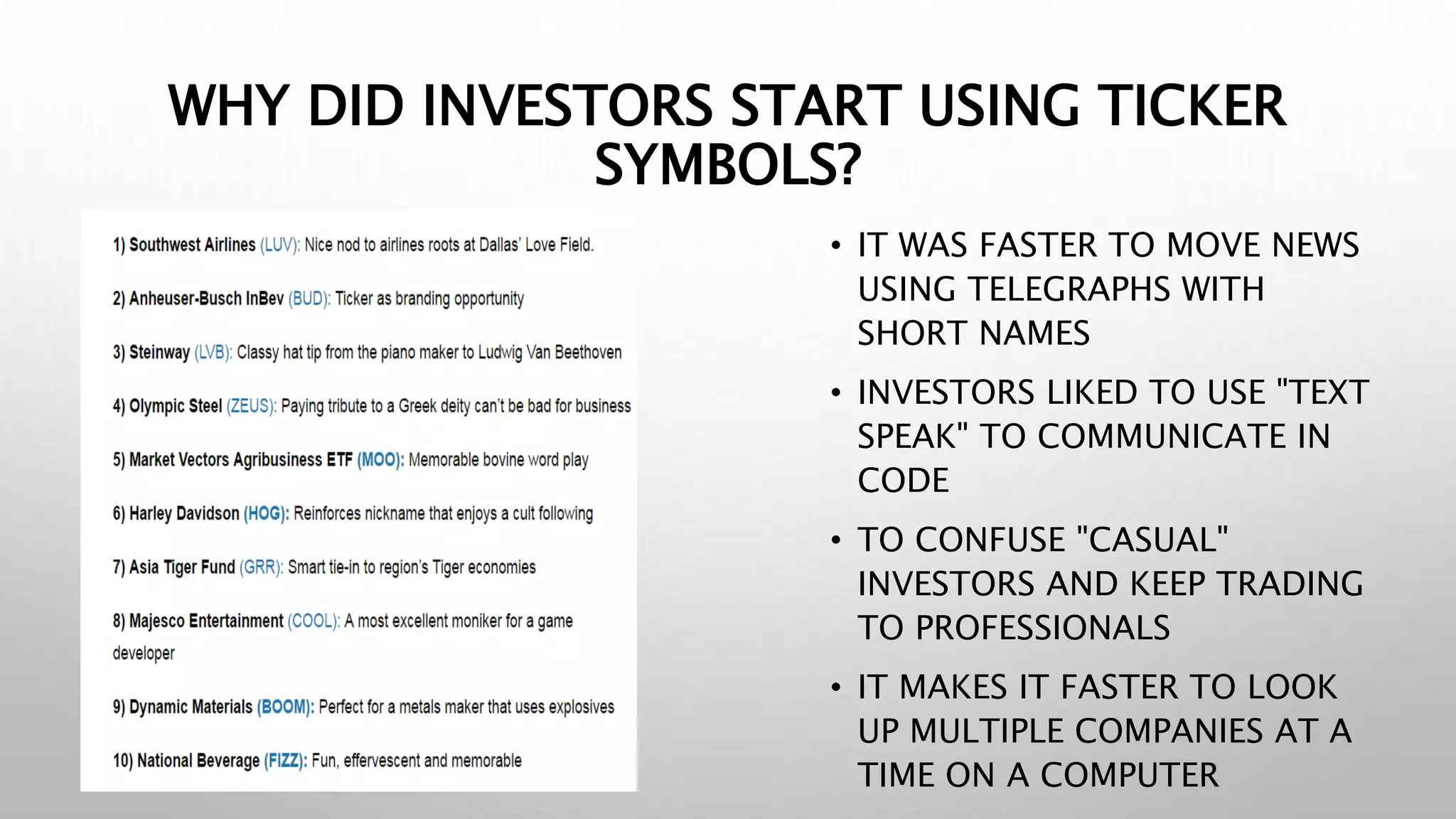
The question of “why did investors start using ticker symbols” delves deep into the evolution of financial markets, revealing a fascinating confluence of technological innovation, the relentless pursuit of efficiency, and the sheer necessity of bringing order to an increasingly complex system. From the pre-telegraphic chaos to the sophisticated algorithmic trading of the 21st century, ticker symbols have been an indispensable tool, born out of a desperate need to streamline communication and identify securities unequivocally. Their story is not just one of convenience; it’s a narrative central to the very functioning and growth of modern investment.
The Dawn of Modern Financial Markets: A Pre-Ticker World
Before the advent of ticker symbols, the mechanisms for identifying and trading stocks were rudimentary, often cumbersome, and prone to significant human error. The financial landscape of the 19th century, particularly in rapidly industrializing nations like the United States and Great Britain, was characterized by burgeoning enterprise and a growing public appetite for investment. However, the tools to manage this expansion were severely lacking.
Early Trading Challenges
In the earliest days of formal stock exchanges, trading was largely a person-to-person affair, often conducted in coffee houses or under specific trees, eventually moving to dedicated trading floors. When an investor wished to buy or sell shares, they would refer to the company by its full name. While this might seem straightforward for a small number of well-known companies, the reality was far more complex. As the number of publicly traded companies grew, so did the potential for confusion.
Imagine a market where you have “General Manufacturing Company,” “General Electric Company,” and “General Mills Company.” Shouting these names across a noisy trading floor, or writing them repeatedly on order slips, introduced multiple points of failure. Mishearings were common, leading to incorrect trades, disputes, and significant financial losses. Furthermore, the sheer length of company names consumed valuable time and physical space on trading documents. This lack of a universally accepted, concise identifier slowed down transaction speeds considerably, a critical bottleneck in markets where speed often translates directly to profit or loss. Without a standardized shorthand, the market’s capacity to absorb increasing trade volumes was severely limited, impeding its growth and liquidity.
The Urgent Need for Efficiency and Clarity
As the industrial revolution gained momentum, so did the demand for capital, leading to an explosion in the number of publicly listed companies. Railroads, manufacturing giants, and nascent tech companies (of their era) all sought public investment. This expansion brought with it an unprecedented volume of trading activity. The manual, full-name system became increasingly unsustainable. Brokers and traders were overwhelmed, and the risk of error escalated with every additional company listed and every trade executed.
The market desperately needed a mechanism to accelerate communication, reduce ambiguity, and streamline record-keeping. Every second saved in confirming a trade, every character omitted from a written record, contributed to greater efficiency and accuracy. This pressing need for a simple, unambiguous way to identify securities laid the groundwork for the inevitable adoption of ticker symbols. They weren’t just a “nice-to-have”; they became a “must-have” for any market aspiring to scale beyond a rudimentary level.
The Telegraph’s Influence and the Birth of Brevity
The technological advancements of the 19th century played a pivotal role in not only accelerating market activity but also in shaping the very solutions required to manage that acceleration. The invention of the telegraph stands out as a particularly influential factor in the birth of ticker symbols.
Technology as a Catalyst for Conciseness
Samuel Morse’s invention of the telegraph in the 1830s, and its subsequent commercialization, revolutionized long-distance communication. For the first time, information could travel across vast distances almost instantaneously, connecting disparate markets and enabling far more sophisticated financial operations. However, this groundbreaking technology came with its own set of constraints that profoundly influenced the development of ticker symbols.
Telegraph messages were transmitted character by character, and sending a message was often charged by the word or character. This economic reality created an immediate and powerful incentive for brevity. Every unnecessary character represented wasted time and increased cost. Financial news, stock prices, and trade confirmations were among the most critical pieces of information transmitted via telegraph. Naturally, there was immense pressure to shorten company names to their absolute minimum without sacrificing clarity. This wasn’t merely a preference; it was an economic imperative. The inherent limitations of telegraphic communication thus fostered a culture of conciseness that directly paved the way for the adoption of short, standardized abbreviations for companies.
From Full Names to Acronyms
The transition from using full company names to short, often single-letter or three-letter symbols was a logical and practical evolution driven by the telegraph. Initially, these abbreviations might have been informal, used within specific brokerage houses or between regular trading partners. However, the need for universal understanding quickly pushed for standardization.
If “Pennsylvania Railroad Company” could be universally understood as “PRR,” or “United States Steel Corporation” as “X,” the savings in transmission time and cost were enormous. These early symbols were essentially acronyms or highly abbreviated versions of company names, chosen for their distinctiveness and ease of transmission. This practice laid the foundational principle of ticker symbols: to provide a unique, short, and universally recognizable identifier for a specific security. The telegraph didn’t just carry information; it shaped the very format in which that information was presented, compressing verbose company names into the concise symbols we recognize today.
Standardization and the Rise of the Ticker Tape

While the telegraph initiated the drive for brevity, it was the invention of a complementary technology – the stock ticker machine – that cemented the need for universally standardized ticker symbols and brought real-time market data to a wider audience.
The Innovation of the Ticker Tape Machine
In the mid-1860s, advancements in telegraph technology led to the development of the ticker tape machine. Pioneered by inventors like Edward Calahan and later significantly improved by Thomas Edison, this device revolutionized how market information was disseminated. The stock ticker machine automatically printed sequences of ticker symbols and their corresponding prices onto a continuous paper strip, known as “ticker tape.”
Before the ticker tape, price information was largely relayed verbally or through handwritten notes, leading to delays and potential inaccuracies. The ticker tape machine provided unprecedented access to near real-time market data, making it possible for brokers, investors, and eventually the public to follow price movements with a speed previously unimaginable. However, for this machine to be effective, it absolutely demanded standardized, short identifiers. Imagine trying to print “The New York Central and Hudson River Railroad Company” repeatedly on a paper tape; it would consume excessive tape, time, and make the information unreadable at a glance. The machine’s mechanical limitations and the need for rapid, clear output solidified the requirement for compact, unique symbols.
Establishing Order and Preventing Confusion
The proliferation of ticker tape machines across brokerage offices and public spaces underscored the critical need for a centralized system of assigning and managing these symbols. Without standardization, different symbols might be used for the same company, or, worse, the same symbol for different companies, leading to chaos. Exchanges like the New York Stock Exchange (NYSE) took on the role of assigning and maintaining official ticker symbols.
This standardization served several vital purposes:
-
Uniqueness: Each listed company was assigned a unique symbol, eliminating any ambiguity, especially between companies with similar names. For instance, in an era before clear corporate naming conventions, “General Motors” and “General Electric” might have been easily confused. Distinct ticker symbols (GM and GE) eliminated this risk.
-
Clarity: The symbols were designed to be easily recognizable and memorable, often using an abbreviation or a key letter from the company name, enhancing quick identification.
-
Efficiency: Their brevity meant they could be printed quickly on the ticker tape, transmitted rapidly over telegraph lines, and easily referenced in ledgers and reports, saving invaluable time and resources.
-
Accessibility: By standardizing symbols, market information became universally comprehensible across different firms and locations, fostering a more transparent and orderly market environment.
The ticker tape machine not only democratized access to financial information but also cemented ticker symbols as the indispensable shorthand for identifying securities, laying the infrastructural bedrock for modern financial markets.
The Enduring Legacy: Ticker Symbols in the Digital Age
From their origins as a necessity born of telegraphic constraints and mechanical printing, ticker symbols have proven remarkably adaptable, seamlessly transitioning into every subsequent technological revolution in finance. Today, they remain as vital as ever, underpinning the global financial system.
From Physical Tape to Digital Screens
The ticker tape machine eventually faded into obsolescence, replaced first by electronic display boards and then, most profoundly, by computers and the internet. Yet, the core concept of the ticker symbol endured. Its inherent conciseness and uniqueness made it perfectly suited for the digital realm. On a computer screen, a few letters or numbers instantly call up vast amounts of data – current price, historical performance, company news, analyst reports, and more.
In the digital age, ticker symbols are the primary keys used in databases that store financial information. They are the search terms investors type into their brokerage platforms, the identifiers used in financial news feeds, and the foundational elements of complex trading algorithms. Their brevity, which was once crucial for telegraph transmission and mechanical printing, is now equally valuable for efficient data processing, rapid user input, and compact display on diverse digital interfaces, from smartphones to multi-monitor trading desks.
More Than Just an Identifier: Branding and Information Hub
Beyond mere identification, ticker symbols have evolved to carry additional weight. For many companies, their ticker symbol becomes an integral part of their public identity, almost a mini-brand in itself. Iconic symbols like “AAPL” for Apple, “GOOGL” for Alphabet (Google), or “MSFT” for Microsoft are instantly recognizable globally, even by non-investors. They represent not just a company’s stock but often the company’s entire legacy and market perception.
Furthermore, a ticker symbol serves as a direct portal to an immense reservoir of information. It’s the unique address that connects an investor to all publicly available data about a company. This makes them central to financial education, analysis, and communication, allowing investors to quickly pinpoint the information they need to make informed decisions. In a world saturated with information, the ticker symbol acts as an efficient filter, guiding users directly to relevant data streams.

The Foundation of Modern Market Infrastructure
Ultimately, ticker symbols are far more than just convenient abbreviations; they are a fundamental component of the global financial infrastructure. They facilitate:
-
Algorithmic Trading: High-frequency trading systems rely on ticker symbols to rapidly execute orders across multiple exchanges, often in fractions of a second.
-
Data Aggregation: Financial data providers use ticker symbols to organize and distribute real-time and historical market data to millions of users worldwide.
-
Indexing and ETFs: Market indices (like the S&P 500) and Exchange Traded Funds (ETFs) are built upon a defined basket of securities identified by their ticker symbols.
-
Global Interoperability: Despite geographical and regulatory differences, a company’s ticker symbol often remains consistent across various exchanges where its shares are cross-listed, enabling seamless global trading.
-
Regulatory Compliance: Regulators use ticker symbols to monitor trading activity, detect market manipulation, and enforce rules, ensuring fair and orderly markets.
In essence, ticker symbols provide the unique language that allows disparate systems, traders, and markets to communicate effectively and efficiently.
The journey of ticker symbols is a powerful testament to how practical necessities, often driven by technological limitations, can evolve into indispensable elements of a complex system. What began as a means to overcome the physical constraints of early communication and trading floors has become the backbone of a digitally interconnected global financial market. Investors started using ticker symbols not merely out of convenience, but out of an urgent, absolute necessity to bring order, efficiency, and clarity to an ever-expanding universe of financial assets, a necessity that continues to define their enduring relevance today.
aViewFromTheCave is a participant in the Amazon Services LLC Associates Program, an affiliate advertising program designed to provide a means for sites to earn advertising fees by advertising and linking to Amazon.com. Amazon, the Amazon logo, AmazonSupply, and the AmazonSupply logo are trademarks of Amazon.com, Inc. or its affiliates. As an Amazon Associate we earn affiliate commissions from qualifying purchases.