
The question “who was president when the stock market crashed?” is often asked with a specific historical event in mind: the infamous Wall Street Crash of 1929. However, while that particular downturn is indelibly linked to President Herbert Hoover, it represents just one of several significant market crashes throughout history, each occurring under different presidential administrations and unique economic circumstances. Understanding these moments, the leadership at the helm, and the subsequent economic repercussions offers invaluable insights into the complex interplay between politics, policy, and market dynamics, crucial knowledge for any investor or student of finance.

This exploration delves beyond the simple answer, dissecting the historical context of major stock market crashes, examining the presidents in office during these tumultuous times, and considering the broader economic forces at play. We will analyze the extent of presidential influence, the role of fiscal and monetary policy, and most importantly, draw lessons that remain profoundly relevant for modern investors seeking to navigate the inherent volatility of financial markets.
The Iconic Crash of 1929: Herbert Hoover’s Crucible
The most direct and widely recognized answer to the titular question points to Herbert Hoover, who was the 31st President of the United States when the stock market spectacularly collapsed in October 1929. This event, often referred to as Black Tuesday, marked the beginning of the most severe economic downturn in modern history: the Great Depression.
Black Tuesday and Its Aftermath
By the late 1920s, the American stock market had experienced an unprecedented bull run, fueled by speculative fervor, easy credit, and a widespread belief in perpetual prosperity. Individuals and institutions alike borrowed heavily to invest in stocks, driving valuations to unsustainable levels. The bubble began to burst on October 24, 1929, “Black Thursday,” with a sudden drop in prices. A brief recovery attempt failed, and on Tuesday, October 29, the market experienced its most devastating single-day decline, losing billions in value. Panic selling ensued, wiping out fortunes and shattering confidence.
The immediate aftermath was catastrophic for many. Margin calls forced investors to liquidate assets, compounding the downward spiral. Banks, which had themselves invested heavily in the market or lent money to speculators, faced runs as depositors rushed to withdraw their funds. Thousands of banks failed, taking with them the life savings of millions of Americans. The wealth destruction was immense, directly impacting consumer spending and business investment, setting off a chain reaction that would ripple through the entire economy for a decade.
Hoover’s Economic Philosophy and Response
Herbert Hoover, a Republican, had only been in office for seven months when the crash occurred. His economic philosophy was deeply rooted in individualism, self-reliance, and a belief in limited government intervention. Initially, he viewed the crash as a market correction that would naturally resolve itself, urging business leaders to maintain wages and production, and calling for voluntary cooperation rather than legislative action.
His administration’s initial responses were largely insufficient to stem the tide of the rapidly deteriorating economy. Hoover enacted some public works programs, such as the construction of the Hoover Dam, and established the Reconstruction Finance Corporation (RFC) in 1932 to provide emergency loans to banks, railroads, and other large businesses. However, these measures were often too late, too small in scale, or too conservative in their approach to combat the systemic issues at hand. Hoover’s reluctance to provide direct federal relief to individuals, fearing it would foster dependency, further alienated a suffering populace. Critics often argue that while the seeds of the Depression were sown before his presidency, Hoover’s adherence to a largely laissez-faire approach in the face of an unprecedented crisis exacerbated its severity and duration.
The Road to the Great Depression
The stock market crash of 1929 was a significant trigger, but not the sole cause, of the Great Depression. It exposed deep structural weaknesses in the U.S. and global economies. These included vast income inequality, a fragile banking system, agricultural overproduction, protectionist trade policies (like the Smoot-Hawley Tariff Act of 1930, which worsened global trade), and the flawed gold standard. The crash decimated confidence, tightened credit, and sent shockwaves across the globe, leading to a decade of mass unemployment, widespread poverty, and profound social upheaval, fundamentally reshaping the role of government in economic life and setting the stage for Franklin D. Roosevelt’s New Deal.
Presidents and Panics: A Look at Other Significant Market Downturns
While the 1929 crash is unique in its severity and lasting impact, history is replete with other significant market downturns that occurred under various presidential administrations. Each presented distinct challenges and elicited different responses.
The Nixon Shock (1970s)
The 1970s were a turbulent decade marked by “stagflation” – high inflation coupled with stagnant economic growth and high unemployment. While not a single, sharp crash like 1929, the period saw significant market volatility and a prolonged bear market. President Richard Nixon took a dramatic step in August 1971, unilaterally ending the convertibility of the U.S. dollar to gold, effectively dismantling the Bretton Woods system. This “Nixon Shock” was an attempt to combat inflation and trade deficits, but it ushered in an era of floating exchange rates and increased currency instability. Subsequent oil embargoes by OPEC in 1973 and 1979 further exacerbated economic woes, sending energy prices soaring and battering corporate profits and consumer confidence. The stock market, as measured by the S&P 500, lost nearly 50% of its value between January 1973 and October 1974.
Black Monday (1987) under Ronald Reagan
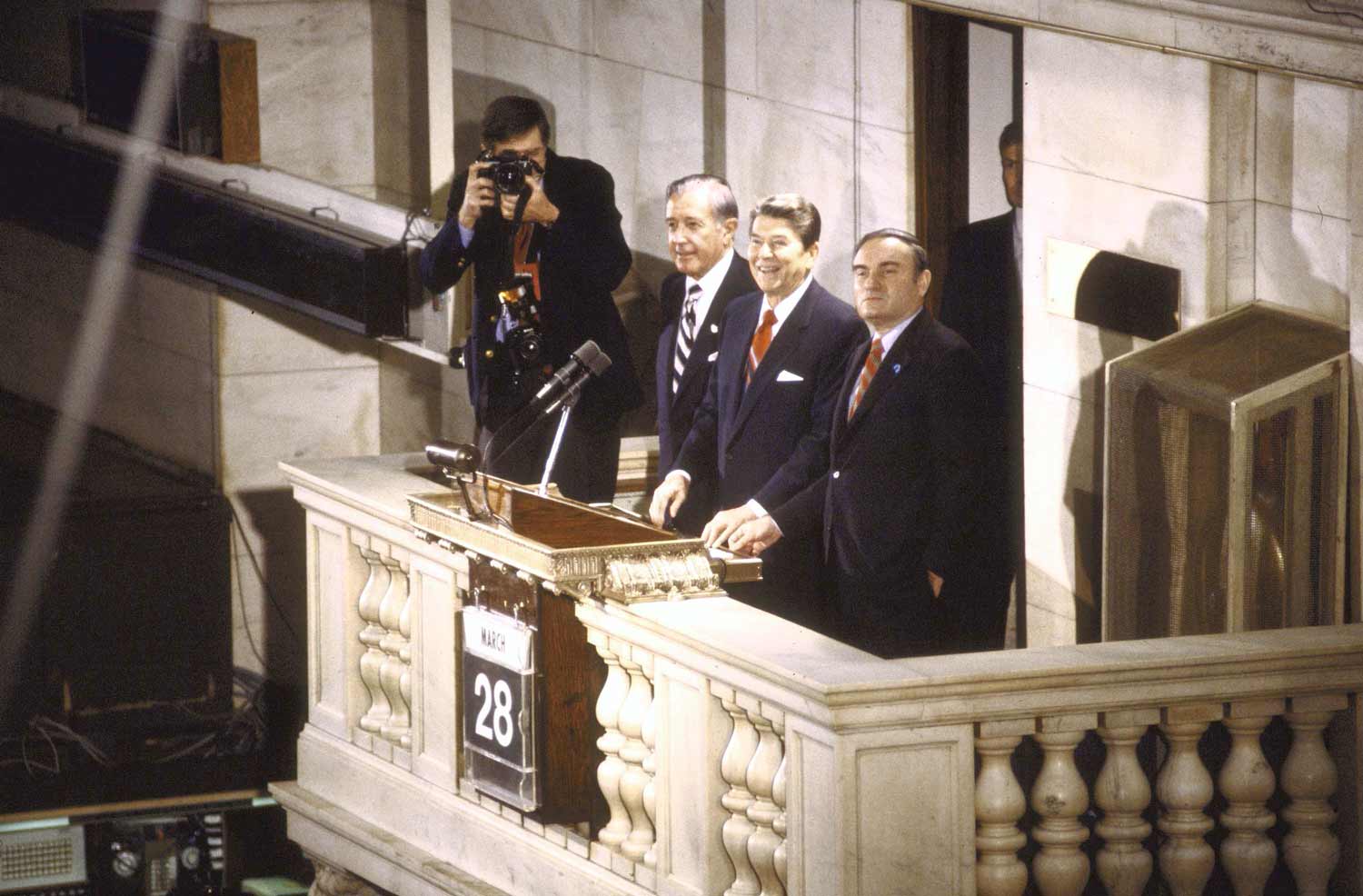
On October 19, 1987, “Black Monday,” the Dow Jones Industrial Average plunged by 22.6% in a single day – still the largest one-day percentage drop in stock market history. This astonishing event occurred under President Ronald Reagan. Unlike 1929, the crash was not precipitated by an obvious economic crisis, though concerns existed about rising interest rates, trade deficits, and the dollar’s value. The rapid sell-off was largely attributed to new automated program trading systems that accelerated selling pressure, combined with investor panic.
Crucially, the U.S. economy was fundamentally stronger than in 1929, and the Federal Reserve, under Alan Greenspan, responded swiftly by injecting liquidity into the financial system to prevent a credit crunch. This decisive action, coupled with relatively sound underlying economic conditions, prevented a deeper recession. The market recovered much of its losses within months, and the broader economy continued its expansion.
The Dot-Com Bubble Burst (Early 2000s) under Bill Clinton and George W. Bush
The late 1990s saw an explosion of internet-based companies, driving stock valuations of technology firms to unprecedented heights, creating the “dot-com bubble.” Many of these companies had little or no profits, operating on speculative future growth. The bubble began to deflate in early 2000, under President Bill Clinton‘s final year, and continued well into President George W. Bush‘s first term. From March 2000 to October 2002, the Nasdaq Composite, heavily weighted towards tech stocks, lost nearly 78% of its value.
This period also coincided with a mild recession following the September 11, 2001, terrorist attacks, further dampening investor sentiment. While painful for tech investors, the broader economy proved more resilient than in 1929. The Federal Reserve again cut interest rates to stimulate the economy, and while some prominent tech companies folded, the underlying technology continued to advance, laying the groundwork for future innovation.
The Great Financial Crisis (2008) under George W. Bush

The most severe financial crisis since the Great Depression occurred under President George W. Bush in 2008. This crisis stemmed from a combination of factors, primarily the collapse of the subprime mortgage market, where risky loans had been made to borrowers with poor credit. These loans were packaged into complex financial instruments and widely distributed, creating systemic risk. When the housing bubble burst, mortgage defaults surged, leading to massive losses for financial institutions holding these assets.
The crisis peaked with the failure of major investment banks like Lehman Brothers, triggering a freezing of credit markets and a widespread panic. Governments worldwide, including the Bush administration, responded with unprecedented interventions, including bailouts of critical financial institutions (like AIG and Fannie Mae/Freddie Mac), the Troubled Asset Relief Program (TARP), and massive monetary easing by the Federal Reserve. While averting a complete collapse of the financial system, the crisis led to the deepest recession since the 1930s, significant job losses, and a prolonged period of economic stagnation.
The COVID-19 Market Plunge (2020) under Donald Trump
In early 2020, as the COVID-19 pandemic swept across the globe, the U.S. stock market experienced an incredibly rapid and steep decline, often dubbed a “flash bear market.” Under President Donald Trump, fears about the economic impact of widespread lockdowns and business closures led to a sharp sell-off. The S&P 500 fell by approximately 34% in just over a month (February 19 to March 23, 2020).
However, the response was equally swift and massive. The Federal Reserve unleashed an unprecedented wave of monetary stimulus, slashing interest rates to near zero and implementing large-scale asset purchases. Simultaneously, Congress passed enormous fiscal relief packages, including the CARES Act, injecting trillions of dollars into the economy through direct payments, unemployment benefits, and business loans. This aggressive fiscal and monetary response, coupled with hopes for vaccine development, led to an equally remarkable market recovery, with indices reaching new highs within months.
The Complex Interplay: Presidential Leadership vs. Economic Realities
The narrative of “the president during the crash” often implies direct causation, but the reality is far more nuanced. While presidential decisions and policies certainly impact the economy, market crashes are rarely attributable to a single individual or administration.
The Limits of Presidential Power
Presidents operate within a complex web of economic forces, many of which are beyond their direct control. Global economic conditions, actions by foreign governments, technological advancements, natural disasters, and geopolitical events can all significantly influence financial markets. The Federal Reserve, an independent body, holds immense power over monetary policy (interest rates, money supply), which often has a more immediate and direct impact on market liquidity and sentiment than many presidential actions. Market psychology, driven by fear and greed, can also take on a life of its own, leading to irrational exuberance or panic selling that defies rational economic fundamentals.
Fiscal and Monetary Policy as Tools
Where presidents do exert influence is primarily through fiscal policy – government spending and taxation. A president can propose budgets, initiate infrastructure projects, or advocate for tax reforms that can stimulate or cool the economy. For instance, the stimulus packages under Trump during COVID-19 were a direct fiscal response. However, these policies require Congressional approval, introducing political complexities and delays.
Monetary policy, controlled by the Federal Reserve, is often the first line of defense against economic downturns or inflation. The Fed’s ability to adjust interest rates and manage the money supply profoundly impacts borrowing costs, business investment, and consumer spending, which in turn affect corporate earnings and stock market valuations. The coordinated actions of fiscal and monetary authorities, as seen during the 2008 and 2020 crises, are often critical in mitigating severe economic damage.
Public Perception vs. Economic Causality
There is often a significant disconnect between public perception and actual economic causality. Presidents frequently receive disproportionate credit for economic booms and disproportionate blame for busts. While their leadership, rhetoric, and policy choices matter, the vastness and interconnectedness of modern economies mean that blaming or crediting a single person for complex market movements is an oversimplification. A thoughtful analysis requires looking at a broader range of factors, including global trends, technological shifts, central bank actions, and the cumulative effects of decades of prior policy decisions.
Navigating Market Volatility: Lessons for the Modern Investor
Understanding the history of market crashes and the presidential context offers crucial lessons for personal finance and investing. While presidents change, certain economic principles and investor behaviors remain consistent.
The Importance of Diversification
One of the most enduring lessons from every market downturn is the peril of putting all your eggs in one basket. The dot-com crash devastated tech-heavy portfolios, just as the 2008 crisis hammered those overexposed to real estate or financial stocks. Diversification across different asset classes (stocks, bonds, real estate), industries, geographies, and investment styles is paramount. It helps to cushion the blow when one sector or asset class experiences a significant downturn, reducing overall portfolio risk.
Long-Term Perspective and Dollar-Cost Averaging
Market crashes, while painful in the short term, have historically proven to be temporary setbacks within a long-term upward trend for well-diversified equity markets. Investors who panic and sell during a downturn often lock in losses and miss the subsequent recovery. Adopting a long-term perspective – focusing on multi-decade goals rather than day-to-day fluctuations – is crucial. Coupled with dollar-cost averaging, where one invests a fixed amount regularly regardless of market movements, investors can buy more shares when prices are low and fewer when prices are high, potentially lowering their average cost over time.
Understanding Market Cycles and Emotional Discipline
Markets move in cycles – periods of expansion followed by contraction. Recessions and bear markets are a normal, albeit uncomfortable, part of this cycle. Developing emotional discipline is vital. Resisting the urge to make rash decisions driven by fear during downturns or excessive greed during booms is a hallmark of successful investing. Sticking to a well-thought-out financial plan, even when headlines are dire, can prevent costly mistakes. Automated investing, or using a financial advisor, can help remove emotion from the equation.
Financial Preparedness and Emergency Funds
Beyond investments, personal financial preparedness is critical. An emergency fund – typically 3-6 months’ worth of living expenses saved in an easily accessible, liquid account – provides a crucial buffer during economic uncertainty, unexpected job loss, or significant market corrections. It prevents the need to sell investments at depressed prices to cover immediate expenses, allowing your long-term portfolio to ride out the storm. Managing debt wisely, especially high-interest consumer debt, also reduces vulnerability during tough times.
In conclusion, while Herbert Hoover’s name is inextricably linked with the iconic 1929 stock market crash, history reveals that market downturns are complex phenomena that have occurred under various presidential administrations. These events highlight the limits of presidential power, the critical role of fiscal and monetary policy, and the enduring importance of sound financial principles for individuals. For investors, the takeaway is clear: market volatility is inevitable, but with diversification, a long-term perspective, emotional discipline, and robust financial preparedness, it can be navigated successfully, safeguarding and growing wealth over time.
aViewFromTheCave is a participant in the Amazon Services LLC Associates Program, an affiliate advertising program designed to provide a means for sites to earn advertising fees by advertising and linking to Amazon.com. Amazon, the Amazon logo, AmazonSupply, and the AmazonSupply logo are trademarks of Amazon.com, Inc. or its affiliates. As an Amazon Associate we earn affiliate commissions from qualifying purchases.