
The allure of the stock market is undeniable. It represents a potent engine for wealth creation, offering individuals the chance to grow their capital significantly over time. However, for many aspiring investors, the question “When can I buy stocks?” is not simply about a chronological age. It encompasses a broader spectrum of readiness – legal, financial, and educational – that is crucial for a successful and sustainable investment journey. This guide will demystify the process, helping you understand all the facets of market entry, from legal requirements to strategic considerations, ensuring you’re well-equipped to make informed decisions.

The Legal Age and Other Essential Entry Requirements
While the “when” in your question often implies a minimum age, understanding the legal framework is just the starting point. There are specific requirements and avenues designed to ensure investor protection and financial oversight.
Minimum Age for Investing
In most countries, including the United States, United Kingdom, Canada, and Australia, the legal age to open an individual brokerage account and directly trade stocks is 18 years old. This aligns with the age of majority, where individuals are legally recognized as adults capable of entering into contracts and making their own financial decisions. Below this age, minors cannot directly own or trade stocks in their own name due to legal capacity restrictions.
However, this doesn’t mean younger individuals are entirely shut out from the market. Custodial accounts, such as the Uniform Gifts to Minors Act (UGMA) or Uniform Transfers to Minors Act (UTMA) accounts in the U.S., allow an adult (the custodian, typically a parent or guardian) to open and manage an investment account on behalf of a minor. The assets in these accounts legally belong to the minor but are controlled by the custodian until the child reaches the age of majority (18 or 21, depending on the state). This provides an excellent opportunity for parents to start investing early for their children’s future, teaching them about financial markets along the way.
Essential Documents and Information
Before you can even think about selecting your first stock, you’ll need to satisfy your chosen brokerage firm’s Know Your Customer (KYC) and Anti-Money Laundering (AML) regulations. This typically involves providing:
-
Proof of Identity: A government-issued ID such as a driver’s license, passport, or state ID card.
-
Proof of Address: A utility bill, bank statement, or other official document showing your current residential address.
-
Taxpayer Identification: Your Social Security Number (SSN) in the U.S., National Insurance Number (NIN) in the UK, or equivalent Tax Identification Number (TIN) in your country. This is crucial for tax reporting on any investment gains.
-
Bank Account Information: Details of your checking or savings account for funding your brokerage account and withdrawing funds.
Having these documents ready will streamline the account opening process, which can often be completed online in a matter of minutes.
Opening a Brokerage Account
Once you meet the age requirement and have your documents in order, the next practical step is to open a brokerage account. A brokerage account is essentially an investment account that holds your cash and securities (like stocks, bonds, and mutual funds) and allows you to buy and sell them.
You’ll need to choose a brokerage firm, and there are several types:
-
Full-Service Brokers: Offer comprehensive financial advice, portfolio management, and a wide range of products. They come with higher fees but are suitable for investors who prefer hands-off management and personalized guidance.
-
Discount Brokers: Provide a platform for self-directed investors to buy and sell securities at a much lower cost. They offer tools and research but typically no personalized advice. This is the most common choice for new individual investors.
-
Robo-Advisors: Automated investment platforms that use algorithms to manage your portfolio based on your financial goals and risk tolerance. They are very low-cost and ideal for those who want a diversified portfolio without active management.
When selecting a broker, consider factors such as fees (commissions, account maintenance fees), platform usability, available investment products, research tools, customer support quality, and minimum deposit requirements. Many brokers now offer commission-free trading for stocks and ETFs, making it easier than ever to start with smaller amounts.
Are You Financially Ready to Buy Stocks?
Beyond the legalities, a more critical “when” concerns your personal financial health. Jumping into the stock market without a stable financial foundation can turn a promising venture into a stressful burden.
Establishing a Solid Financial Foundation
Before allocating funds to the potentially volatile stock market, prioritize these foundational steps:
-
Build an Emergency Fund: This is paramount. An emergency fund should ideally cover 3 to 6 months of essential living expenses, stored in an easily accessible, liquid account like a high-yield savings account. This fund acts as a financial safety net, ensuring you don’t have to sell investments at an inopportune time to cover unexpected costs like medical emergencies or job loss.
-
Pay Off High-Interest Debt: Credit card debt, personal loans, or payday loans often carry exorbitant interest rates (15-25% or more). The guaranteed return you get from eliminating this debt often far outstrips any potential (and uncertain) stock market gains. Focusing on debt repayment is a smart “investment” in itself.
-
Define Your Financial Goals: What are you investing for? Retirement? A down payment on a house? Your child’s education? Your investment goals will dictate your time horizon, risk tolerance, and ultimately, your investment strategy. Clear goals provide direction and motivation.
Understanding Risk Tolerance
Every investment carries some degree of risk, and stocks are no exception. Understanding your personal risk tolerance is crucial. This refers to your willingness and ability to take on financial risk in pursuit of investment returns.
Factors influencing your risk tolerance include:
-
Age: Younger investors often have a longer time horizon, allowing them to recover from market downturns, and thus may tolerate more risk.
-
Income Stability: A stable job and income provide a cushion, potentially allowing for greater risk-taking.
-
Time Horizon: If you need the money in the short term (e.g., within 1-3 years), you should generally take less risk. For long-term goals (10+ years), you can typically afford more volatility.
-
Personality: Some people are naturally more comfortable with uncertainty and volatility than others.
Be honest with yourself about how you would react to a significant market correction. Would you panic and sell at a loss, or would you see it as an opportunity to buy more? Your answer will help determine the appropriate allocation of your portfolio to different asset classes.
Starting Small and Diversifying
You don’t need to be wealthy to start investing. Many brokerage firms allow you to open accounts with modest initial deposits, and the advent of fractional shares means you can buy a portion of a high-priced stock with as little as $5 or $10. This democratizes investing, making it accessible to virtually anyone.
Equally important is diversification – spreading your investments across various assets to reduce risk. Instead of putting all your money into a single company, consider investing in:
-
Exchange-Traded Funds (ETFs) or Mutual Funds: These are baskets of many stocks (or other assets) that automatically provide diversification.
-
Different Sectors: Don’t put all your eggs in the tech basket; consider healthcare, consumer staples, financials, etc.
-
Dollar-Cost Averaging: This strategy involves investing a fixed amount of money at regular intervals (e.g., $100 every month), regardless of market fluctuations. This averages out your purchase price over time, reducing the risk of buying all your shares at a market peak.
The “When” Beyond Age – Market Timing and Personal Readiness
While the legal age and financial health lay the groundwork, the “when” of buying stocks also delves into market dynamics and your personal understanding of how markets work.
Is There a “Right Time” to Enter the Market?
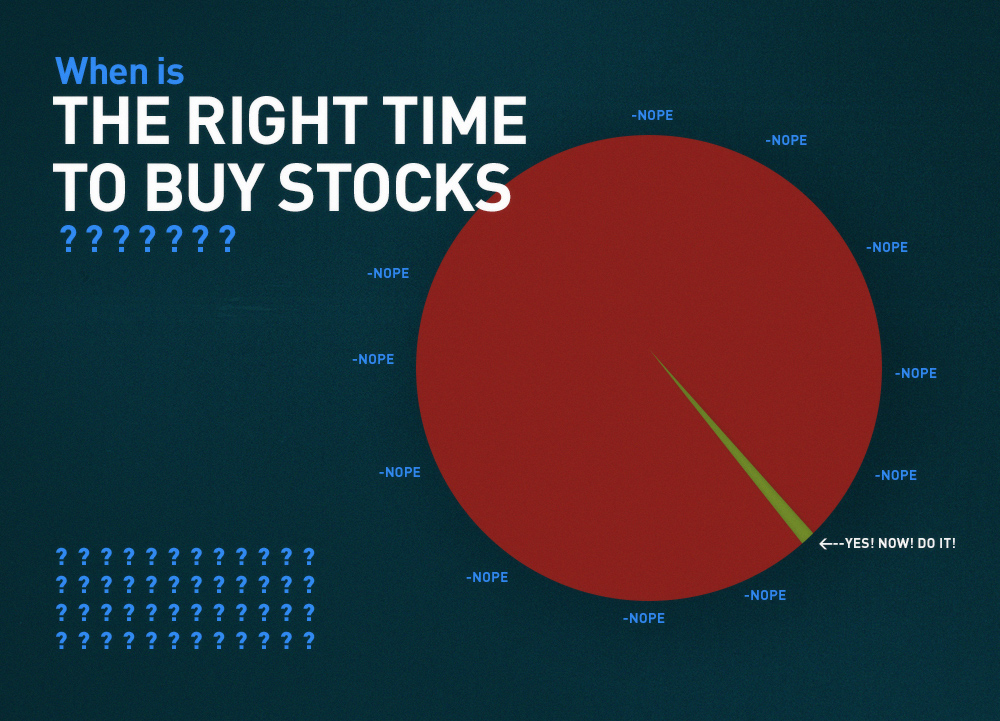
One of the oldest adages in investing is: “Time in the market beats timing the market.” This wisdom suggests that consistently investing over the long term, rather than attempting to predict market peaks and valleys, is the more reliable path to wealth. Market timing – trying to buy at the bottom and sell at the top – is notoriously difficult, even for professional investors. Studies consistently show that investors who attempt to time the market often underperform those who simply stay invested.
For most individual investors, the “right time” to enter the market is as soon as you are financially ready and have a long-term perspective. Missing even a few of the market’s best days can significantly impair your overall returns. The power of compounding works best when given ample time.
Economic Conditions and Their Impact
While market timing is ill-advised, it’s beneficial to understand how broader economic conditions can influence the stock market. Economic cycles, characterized by periods of growth (expansion) and contraction (recession), directly impact corporate earnings and investor sentiment.

-
During expansions, strong economic growth, low unemployment, and rising corporate profits often lead to bull markets (rising stock prices).
-
During recessions, economic contraction, job losses, and declining profits typically result in bear markets (falling stock prices).
However, it’s crucial to remember that the stock market is often a forward-looking indicator, sometimes anticipating economic shifts months in advance. Trying to react to current economic news can lead to chasing past performance or selling low. A long-term investor typically understands that these cycles are a natural part of the economy and rides them out, focusing on robust companies rather than short-term market fluctuations.
Personal Knowledge and Education
Perhaps the most underestimated aspect of “when” you can buy stocks is when you are educated enough to do so responsibly. Investing blindly based on tips or hype is a recipe for disaster. Before committing your capital, strive to understand:
-
Basic Investment Principles: Concepts like compounding, diversification, inflation, and risk-reward tradeoffs.
-
Types of Investments: Differentiate between stocks, bonds, mutual funds, ETFs, and other assets.
-
Company Fundamentals: Learn how to read basic financial statements (income statement, balance sheet) and understand key metrics like P/E ratio, earnings per share (EPS), and dividend yield.
-
Your Investment Philosophy: Are you a growth investor, a value investor, or do you prefer income-generating assets?
Continuous learning is vital. Read reputable financial news, investment books, take online courses, and follow respected financial experts. Never invest in something you don’t understand, and always do your own due diligence.
What to Buy: Navigating Investment Choices
Once you’ve decided you’re ready to enter the market, the next logical question is: what should you actually buy? The array of choices can be daunting, but understanding the core categories will simplify your decision-making.
Individual Stocks vs. Funds
This is often the first significant choice for new investors:
-
Individual Stocks: When you buy an individual stock, you’re purchasing a small piece of a specific company.
-
Pros: Potential for higher returns if the company performs exceptionally well; direct ownership in a business you believe in.
-
Cons: Higher risk as your investment is tied to one company’s performance; requires significant research and ongoing monitoring; lack of inherent diversification.
-
Best for: Investors who enjoy researching companies, have a high-risk tolerance, and understand fundamental analysis.
-
-
Exchange-Traded Funds (ETFs) & Mutual Funds: These are professionally managed or systematically constructed portfolios that hold a collection of many different stocks (or other securities).
-
Pros: Instant diversification, lower risk than individual stocks, often lower fees (especially for passively managed ETFs), good for beginners.
-
Cons: Generally lower potential for extraordinary returns compared to picking a single “home run” stock; may have management fees.
-
Best for: Most beginners, investors seeking broad market exposure, diversification, and a hands-off approach.
-
For most new investors, starting with broadly diversified, low-cost ETFs (e.g., those tracking the S&P 500 or total stock market) is an excellent strategy.
Growth vs. Value Investing
These are two primary investment philosophies:
-
Growth Investing: Focuses on companies expected to grow their earnings and revenue at a faster rate than the overall market. These companies often reinvest profits back into the business, may not pay dividends, and can trade at higher valuations (e.g., tech startups, innovative biotech companies).
-
Value Investing: Involves finding companies that are currently trading below their intrinsic value. These are often established companies with solid fundamentals but may be out of favor with the market for various reasons (e.g., older industrial companies, consumer staples during a market downturn). Value investors seek a “margin of safety.”
Both strategies can be successful, and a diversified portfolio might include elements of both. Your personal conviction and analysis will guide your preference.
Dividend Stocks
Dividend stocks are shares of companies that regularly distribute a portion of their earnings to shareholders in the form of dividends.
-
Pros: Provide a regular income stream, can be reinvested to compound returns, often come from stable, mature companies, which can offer some downside protection.
-
Cons: Growth potential might be lower than non-dividend-paying growth stocks, dividends are not guaranteed and can be cut.
-
Best for: Income-focused investors, retirees, or those looking to reinvest dividends for long-term growth.
Actionable Steps for Your First Stock Purchase
You’ve prepared, learned, and considered your options. Now, it’s time to take action.
Set Up and Fund Your Brokerage Account
-
Choose a Broker: Select a reputable brokerage firm that aligns with your needs (discount broker for self-directed, robo-advisor for automated).
-
Open an Account: Complete the online application, providing your personal details and documents.
-
Fund Your Account: Link your bank account and transfer funds. This can take a few business days depending on the method (e.g., ACH transfer, wire transfer).
Define Your Investment Goals and Strategy
Revisit your financial goals. Are you saving for retirement in 30 years, or a down payment in 5? This will influence your risk tolerance and what you buy. Decide on your strategy: will you invest a lump sum, or use dollar-cost averaging? What percentage of your portfolio will be in stocks vs. other assets?
Research and Selection
This is where your education pays off.
-
Utilize Brokerage Tools: Most platforms offer research reports, stock screeners, and analyst ratings.
-
Read Financial News: Stay informed about companies and market trends from reputable sources.
-
Focus on Fundamentals: Understand the company’s business model, financial health, management team, and competitive landscape.
-
Diversify: Don’t put all your eggs in one basket. Consider ETFs for broad market exposure.
Place Your Order
When you’re ready to buy, you’ll typically have a choice between:
-
Market Order: You instruct your broker to buy or sell shares immediately at the best available current market price. This guarantees execution but not a specific price.
-
Limit Order: You set a specific price at which you are willing to buy or sell. The order will only be executed if the stock reaches that price. This guarantees price but not execution.
For most beginners, especially for highly liquid stocks, a market order is sufficient. For less liquid stocks or when you want to buy at a specific price point, a limit order is prudent.
Continuous Monitoring and Rebalancing
Investing is not a one-time event. It requires ongoing attention:
-
Monitor Your Portfolio: Regularly check the performance of your investments.
-
Stay Informed: Keep abreast of company news and broader market developments.
-
Rebalance: Over time, some assets in your portfolio may grow faster than others, shifting your desired allocation. Periodically, you might need to sell some of your winners and buy more of your underperformers to bring your portfolio back to your target asset allocation.
-
Review Goals: As life changes, so might your financial goals. Adjust your investment strategy accordingly.
Conclusion
The question “When can I buy stocks?” is a gateway to a rewarding financial journey. It’s not merely about reaching the age of 18; it’s about aligning legal readiness with a robust financial foundation, continuous education, and a well-defined investment strategy. By building an emergency fund, tackling high-interest debt, understanding your risk tolerance, and committing to ongoing learning, you establish the optimal time to enter the market.
Remember the power of time in the market, the wisdom of diversification, and the importance of investing in what you understand. The stock market is a marathon, not a sprint. By taking these comprehensive steps, you not only answer “when” but also equip yourself with the knowledge and discipline to embark on a confident and successful path toward financial growth. Your future self will thank you for starting today, prudently and purposefully.
aViewFromTheCave is a participant in the Amazon Services LLC Associates Program, an affiliate advertising program designed to provide a means for sites to earn advertising fees by advertising and linking to Amazon.com. Amazon, the Amazon logo, AmazonSupply, and the AmazonSupply logo are trademarks of Amazon.com, Inc. or its affiliates. As an Amazon Associate we earn affiliate commissions from qualifying purchases.