
The stock exchange was once a restricted domain, accessible only to suit-clad professionals shouting orders on a chaotic trading floor. Today, that landscape has been completely transformed. With the tap of a smartphone screen or the click of a mouse, anyone with a modest amount of capital and an internet connection can participate in the global financial markets. However, the ease of access does not diminish the complexity of the endeavor. Trading on the stock exchange is a sophisticated discipline that blends mathematics, psychology, strategy, and risk management. To transition from a curious spectator to a proficient trader, one must understand the mechanics of the market, the tools of the trade, and the temperament required to survive its inherent volatility.
Understanding the Fundamentals of the Stock Market
Before placing your first trade, it is essential to grasp what a stock exchange actually is and why prices fluctuate the way they do. At its core, a stock exchange is a centralized marketplace where shares of publicly held companies are bought and sold. It serves as a platform that provides liquidity, ensuring that sellers can find buyers and vice versa at transparent prices.
The Role of the Exchange and Market Participants
The world’s major exchanges, such as the New York Stock Exchange (NYSE) and the NASDAQ, act as the infrastructure for global commerce. When you “trade,” you are participating in a secondary market. The primary market is where companies first issue shares to the public via an Initial Public Offering (IPO). Once those shares are in the hands of investors, they circulate on the secondary market—the exchange.
Participants in this ecosystem include retail traders (individuals), institutional investors (hedge funds, pension funds, and banks), and market makers. Market makers are crucial entities that provide liquidity by constantly quoting buy and sell prices, ensuring that the market remains “fluid” and that trades can be executed almost instantaneously.
How Stock Prices Move: The Law of Supply and Demand
The price of a stock is not a random number; it is the point at which a buyer and a seller agree to transact. This is governed by the fundamental law of supply and demand. If a company announces record-breaking earnings, demand for its stock increases. As more buyers compete for a limited number of shares, the price rises. Conversely, if a company faces a legal scandal or declining sales, shareholders may rush to sell, increasing supply while demand craters, leading to a price drop.
Modern trading also incorporates “market sentiment.” This refers to the collective psychology of traders. Even if a company’s fundamentals are strong, a general pessimistic outlook on the economy can drag its stock price down. Understanding that price action is a reflection of both hard data and human emotion is the first step toward becoming an insightful trader.
Setting the Foundation: Brokerage and Capital
The digital age has democratized trading through online brokerage platforms. Choosing where to house your capital and how much to allocate are the most critical administrative decisions you will make.
Choosing the Right Online Broker
Your broker is your gateway to the exchange. In the current market, most reputable brokers have moved toward a zero-commission model for stocks and ETFs, but they differ significantly in their tools and execution quality. When selecting a broker, consider the following:
-
Platform Functionality: Does the broker provide real-time data, advanced charting tools, and a stable mobile app?
-
Research and Education: High-quality brokers offer proprietary research, analyst ratings, and educational webinars that can help sharpen your edge.
-
Regulatory Standing: Ensure the broker is regulated by major authorities, such as the SEC and FINRA in the United States, and that your funds are protected by SIPC insurance.
-
Execution Speed: For active traders, the speed at which an order is filled can mean the difference between a profit and a loss.
Determining Your Risk Tolerance and Capital
A common mistake for beginners is trading with money they cannot afford to lose. Trading capital should be “risk capital”—funds that are separate from your emergency savings, rent, or grocery budget.
Beyond the amount of money, you must assess your risk tolerance. Are you comfortable seeing your account balance fluctuate by 5% in a single day? If the thought of a temporary loss causes significant stress, your strategy should lean toward more conservative, long-term investments. If you have a high risk-appetite and the time to monitor markets closely, active trading might be suitable.
Developing Your Trading Strategy
Entering the market without a strategy is akin to gambling. A strategy provides a set of rules that governs when to enter a trade, how much to buy, and, most importantly, when to exit.
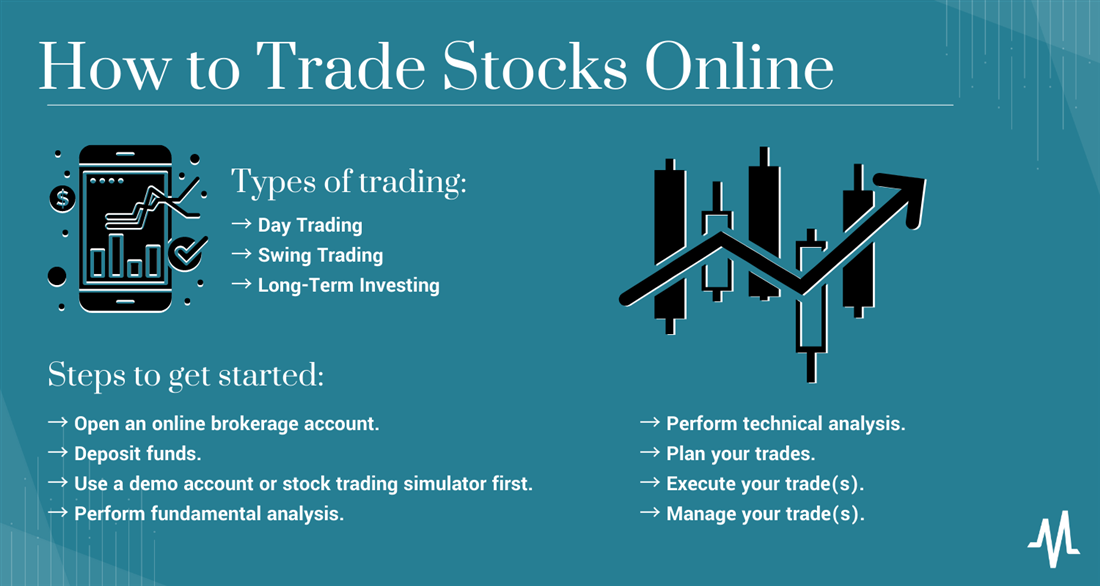
Day Trading vs. Swing Trading vs. Long-term Investing
The timeframe you choose will define your daily routine.
-
Day Trading: This involves buying and selling shares within the same trading day. Day traders capitalize on small price movements and rarely hold positions overnight to avoid “gap” risks. This requires intense focus and a deep understanding of intraday technical patterns.
-
Swing Trading: Swing traders hold positions for several days or weeks. They look for “swings” in price momentum. This is often more manageable for those with full-time jobs, as it requires less constant monitoring than day trading.
-
Long-term Investing: Often called “Buy and Hold,” this strategy focuses on the multi-year growth of a company. Investors ignore short-term volatility, betting on the long-term success of the business.
Technical vs. Fundamental Analysis
To decide which stocks to trade, you need an analytical framework.
Fundamental Analysis involves looking at the “health” of a company. You examine balance sheets, income statements, cash flow, and macroeconomic factors. Key metrics include the Price-to-Earnings (P/E) ratio, Dividend Yield, and Earnings Per Share (EPS). This method is favored by those looking for undervalued companies with strong growth potential.
Technical Analysis is the study of historical price action and volume. Technical traders believe that all known information is already “priced in” to the stock, so they look for patterns on charts. Tools like Moving Averages, the Relative Strength Index (RSI), and Bollinger Bands help traders identify trends and potential reversal points. While some traders use only one method, the most successful often combine both—using fundamental analysis to find what to buy and technical analysis to determine when to buy it.
Executing Your First Trade
Once you have identified an opportunity, the execution phase begins. This is where precision and an understanding of order types become paramount.
Mastering Order Types
When you click the “trade” button, you aren’t just buying; you are choosing how to buy.
-
Market Order: This instructs the broker to buy or sell immediately at the best available current price. While it guarantees execution, it does not guarantee the price, which can be risky in fast-moving markets.
-
Limit Order: This allows you to set a specific price at which you are willing to buy or sell. The trade will only execute if the stock reaches that price. This gives you control over your entry but carries the risk that the trade may never trigger if the price moves away from you.
-
Stop-Loss Order: This is a vital risk management tool. It automatically sells your position if the price drops to a certain level, preventing a small loss from turning into a catastrophic one.
The Importance of a Trading Journal
Execution doesn’t end when the trade is closed. Professional traders maintain a trading journal. They record the rationale for the trade, the entry and exit points, the emotions felt during the process, and the final outcome. Over time, this journal becomes a data-driven map of your strengths and weaknesses, allowing you to refine your strategy and eliminate repetitive mistakes.
Risk Management and Emotional Discipline
The difference between those who thrive on the stock exchange and those who lose their capital is rarely a matter of “intelligence” or “tips.” It is almost always a matter of discipline and risk management.
The Power of Diversification and Position Sizing
Never put all your capital into a single stock. Diversification involves spreading your investments across different sectors (e.g., technology, healthcare, energy) and asset classes. If one sector suffers a downturn, your other holdings can provide a buffer.
Furthermore, proper “position sizing” ensures that no single trade can wipe out your account. A common rule of thumb is the 1% rule: never risk more than 1% of your total account value on a single trade. If you have $10,000, you should structure your stop-loss so that if the trade goes against you, you only lose $100. This approach allows you to survive a string of losses—which is an inevitable part of trading—and stay in the game long enough for your winners to compound.
Managing the Psychology of Trading
The stock market is a mirror of human emotion, primarily fear and greed.
-
Greed causes traders to hold onto winning positions for too long, hoping for “one more dollar,” only to see the profits evaporate.
-
Fear causes traders to panic-sell during a minor dip or to avoid entering a perfectly valid trade because of a previous loss.
The most successful traders approach the exchange with a “probabilistic mindset.” They understand that they cannot control the market; they can only control their reaction to it. They follow their plan with mechanical precision, detaching their self-worth from the outcome of any single trade.
By mastering the technical mechanics of the exchange, maintaining a rigorous analytical framework, and exercising unwavering emotional control, you can navigate the complexities of the stock market. Trading is not a path to overnight riches, but rather a lifelong journey of financial education and strategic growth.
aViewFromTheCave is a participant in the Amazon Services LLC Associates Program, an affiliate advertising program designed to provide a means for sites to earn advertising fees by advertising and linking to Amazon.com. Amazon, the Amazon logo, AmazonSupply, and the AmazonSupply logo are trademarks of Amazon.com, Inc. or its affiliates. As an Amazon Associate we earn affiliate commissions from qualifying purchases.