
In the dynamic world of entrepreneurship, where innovation battles against uncertainty and limited resources, the concept of a “lean startup business plan” has emerged as a cornerstone for financial prudence and sustainable growth. Far from being a traditional, static document, a lean startup business plan is a living, agile framework designed to minimize financial waste, validate assumptions rapidly, and optimize resource allocation in pursuit of a viable and scalable business model. It shifts the focus from extensive upfront planning and large capital expenditure to iterative development, customer feedback, and continuous financial validation, making it an indispensable tool for managing business finance effectively.

The Financial Imperative Behind the Lean Startup Philosophy
At its heart, the lean startup methodology, popularized by Eric Ries, is a financial strategy disguised as an innovation framework. It recognizes that capital, whether self-funded or externally invested, is a finite and precious resource. The traditional business plan often necessitates significant upfront investment based on untested assumptions, a high-risk gamble that many startups cannot afford. The lean approach, conversely, aims to de-risk the entrepreneurial journey by integrating financial prudence into every stage of development.
Minimizing Risk and Maximizing Capital Efficiency
The primary financial driver of a lean startup business plan is risk mitigation. Every new product or service carries inherent market risk, technical risk, and financial risk. A lean plan seeks to identify and mitigate these risks systematically. Instead of spending substantial capital developing a full-featured product based on a hunch, the lean methodology advocates for developing a Minimum Viable Product (MVP) – the simplest version of a product that can deliver core value to early customers. This dramatically reduces the initial investment required and allows for real-world testing without draining significant financial reserves. By proving market demand and product viability with minimal capital, startups maximize their capital efficiency, ensuring that every dollar spent contributes directly to validated learning and progress. This iterative approach means investment is incremental, only increasing as the business demonstrates tangible progress and market traction, significantly lowering the financial burn rate.
Validated Learning as a Financial Strategy
Validated learning is a core tenet of the lean startup, and it has profound financial implications. Rather than operating on assumptions, a lean startup plan prioritizes testing hypotheses about customer needs, product features, and business models. Each experiment, whether it’s a landing page test, an A/B test, or a user interview, is a low-cost method to gather data and learn what truly resonates with the market. Financially, this means avoiding expensive development cycles for features that customers don’t want or need. Every piece of validated learning – whether confirming a hypothesis or proving it false – represents a financial saving, preventing wasted development costs, marketing spend, and operational overhead. It allows founders to “fail fast” and “pivot” without catastrophic financial consequences, redirecting resources towards more promising avenues identified through data.
Avoiding Premature Scaling and Financial Burnout
One of the most common pitfalls for startups is premature scaling – investing heavily in marketing, sales, and infrastructure before truly validating the product-market fit. This often leads to rapid financial burnout, as expenses quickly outpace revenue, even if some initial traction is achieved. A lean startup business plan explicitly guards against this. It advocates for controlled, measured growth, scaling operations only after a repeatable and profitable business model has been discovered and validated. This approach protects the startup’s financial runway, extending its lifespan and increasing its chances of reaching profitability. By focusing on sustainable unit economics from the outset, a lean plan ensures that growth, when it comes happens, is built on a solid financial foundation, not on speculative investment.
Key Components of a Lean Startup Business Plan from a Financial Lens
While a traditional business plan can span dozens of pages, a lean startup business plan is typically more concise, often encapsulated in a single document like the Lean Canvas. Its financial components are not just appendices but integrated into the core strategy.
The Lean Canvas: A Financial Blueprint
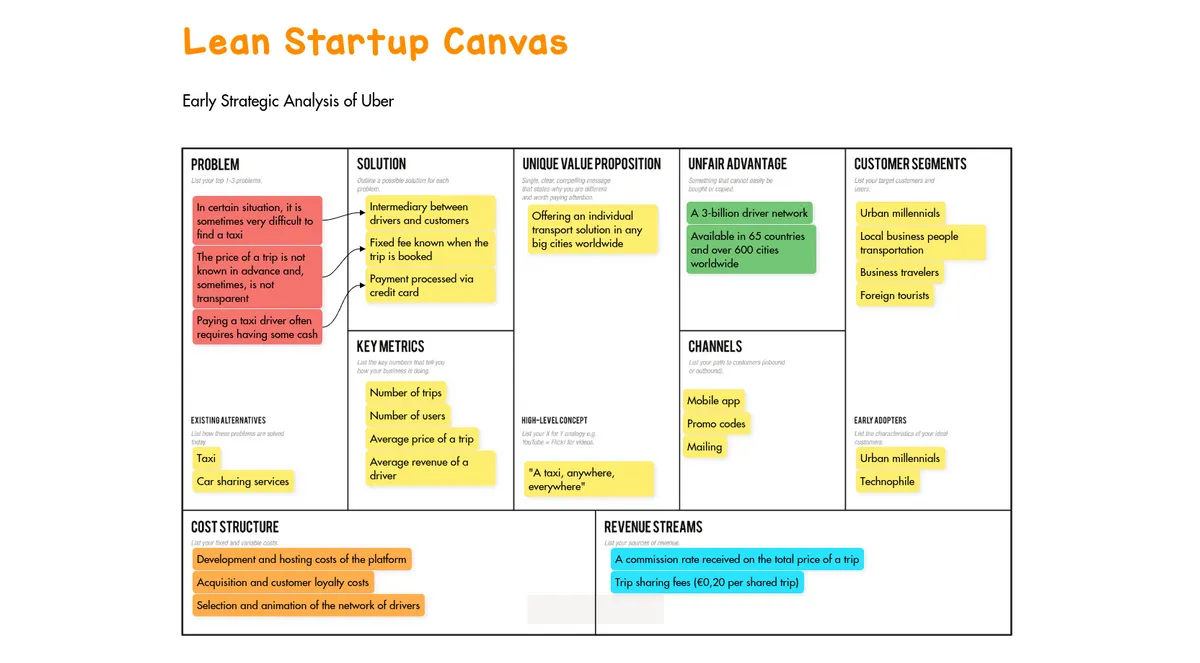
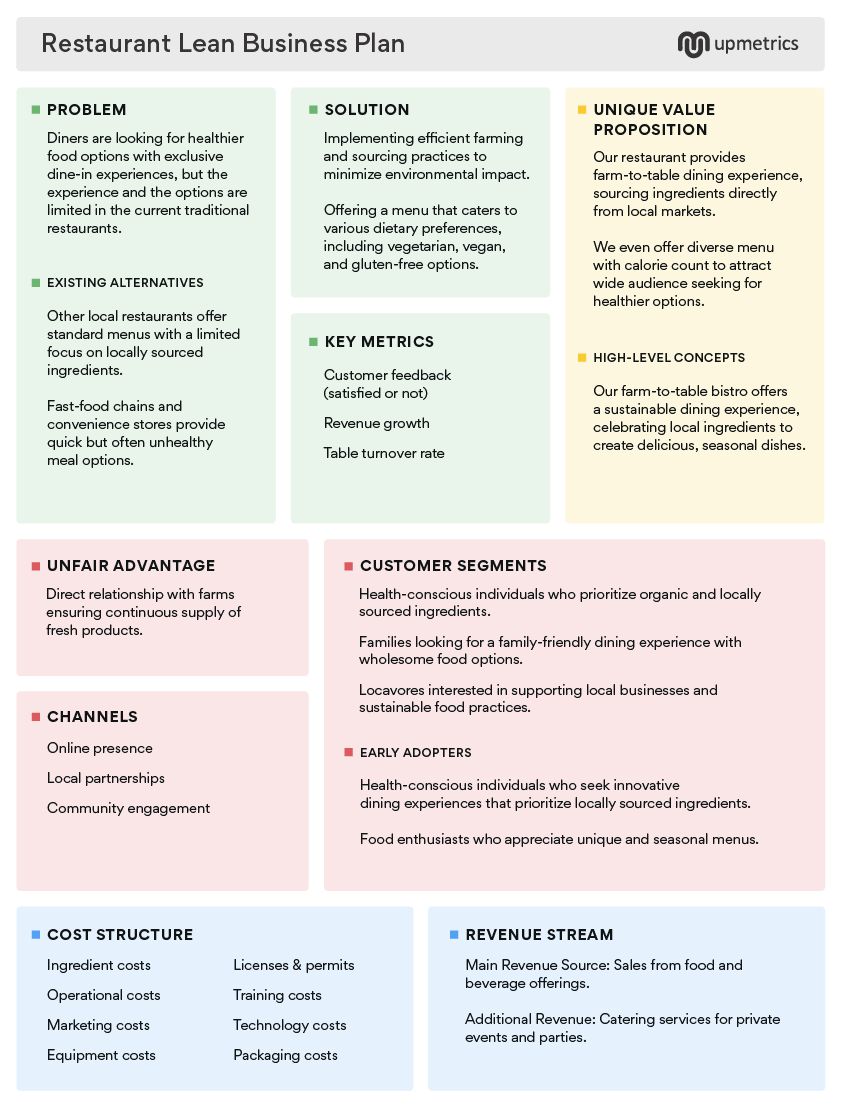
The Lean Canvas, a one-page adaptation of the Business Model Canvas, is an ideal tool for a lean startup business plan because it forces founders to think critically about the financial implications of each business component. It includes sections like:
-
Customer Segments & Problem: Who are you serving, and what pain point are you solving? (Directly impacts revenue potential and market size).
-
Solution & Unique Value Proposition: What are you offering, and why is it better? (Influences pricing power and customer willingness to pay).
-
Channels: How do you reach your customers? (Determines customer acquisition costs).
-
Revenue Streams: How will you make money? (Defines the financial model).
-
Cost Structure: What are your major expenses? (Crucial for profitability analysis and budgeting).
-
Key Metrics: What metrics will you track? (Essential for measuring financial health and progress, e.g., CAC, LTV, conversion rates).
By visually mapping these elements, founders gain a holistic financial overview, quickly identifying potential cost centers, revenue opportunities, and areas needing further validation.
Minimum Viable Product (MVP) and Iterative Funding
The MVP isn’t just a technical concept; it’s a financial one. It represents the smallest financial investment required to test core hypotheses and deliver initial value. The lean plan dictates that funding should be secured for the MVP phase, with subsequent rounds tied to achieving specific validation milestones (e.g., X number of users, Y conversion rate, Z revenue generated). This iterative funding approach aligns investor expectations with the lean methodology, demonstrating responsible capital deployment and risk management. It’s about securing “just enough” funding to prove the next critical assumption, rather than over-investing in an unproven concept.
Customer Acquisition Costs (CAC) and Lifetime Value (LTV)
For a lean startup, understanding CAC and LTV is paramount to financial viability. The plan explicitly outlines how these metrics will be measured, monitored, and optimized. A lean approach means finding the most cost-effective channels to acquire customers initially, often leveraging organic growth, viral loops, or targeted, low-cost experiments. The goal is to ensure that LTV significantly outweighs CAC, indicating a sustainable and profitable business model. If early validation reveals an unfavorable CAC:LTV ratio, the lean plan dictates a pivot in either product offering, pricing, or acquisition strategy to rectify the financial imbalance before scaling.
Financial Projections for Lean Models
Traditional business plans often feature extensive, multi-year financial projections based on speculative growth rates. A lean startup business plan takes a more pragmatic approach. It focuses on short-term, data-driven projections, often tied to specific validation milestones. These projections are dynamic, designed to be updated frequently as new data emerges from experiments. Key financial metrics include:
-
Burn Rate: How quickly is the company spending its cash reserves?
-
Runway: How much time does the company have left before running out of money, given its current burn rate?
-
Unit Economics: The revenue and costs associated with a single unit of your product/service.
-
Break-Even Analysis: When will the company’s revenues cover its costs?
These lean financial projections are not about predicting the future but about understanding the current financial health, identifying funding needs, and setting realistic, measurable targets for the next iteration.
Funding a Lean Startup: Smart Money and Strategic Investment
Securing capital is a critical hurdle for any startup, but a lean approach fundamentally changes the funding conversation. Investors in lean startups are often looking for different signals than those backing traditional models.
Bootstrapping and Self-Sufficiency
Many lean startups initially bootstrap, funding their operations through personal savings, pre-sales, or early revenue. This approach forces extreme financial discipline, driving founders to find the absolute minimum viable solution and validate it with scarce resources. Bootstrapping extends the financial runway, delays equity dilution, and often leads to a more robust, customer-funded business model, as the need for immediate revenue instills a strong focus on value delivery.
Angel Investors and Seed Funding: Focused Capital
When external funding becomes necessary, lean startups often seek angel investors or seed funding. These early-stage investors are typically more aligned with the lean philosophy, understanding the need for iterative development and validated learning. They are often less concerned with grand, multi-year revenue forecasts and more interested in the team’s ability to execute experiments, demonstrate customer traction with an MVP, and articulate a clear path to product-market fit with minimal capital. The lean plan serves as a roadmap to demonstrate prudent financial management and a clear strategy for using their investment to achieve specific, measurable milestones.
Understanding Investor Expectations for Lean Models
Investors in lean startups want to see a clear understanding of financial risk and a strategy for mitigating it. They expect detailed metrics on customer acquisition, retention, and engagement, alongside transparent reporting on burn rate and runway. The lean business plan should clearly articulate:
-
The hypotheses being tested.
-
The metrics being used to measure success.
-
The financial resources required for each stage of validation.
-
The potential financial returns upon achieving product-market fit.
This clarity on how capital will be deployed for validated learning builds investor confidence, signaling that the startup is financially responsible and strategically sound.
Operationalizing Financial Leanness: Tools and Practices
Implementing a lean startup business plan requires embedding financial discipline into daily operations, leveraging modern tools and a data-driven mindset.
Agile Budgeting and Expense Management
Traditional annual budgeting is often too rigid for a lean startup. Agile budgeting involves shorter cycles, often quarterly or even monthly, allowing for rapid adjustments based on new data and validated learning. Expense management is rigorous, with a constant focus on eliminating non-essential costs and ensuring every expenditure directly contributes to learning or revenue generation. Cloud services, open-source software, and flexible workforce models (freelancers, contractors) are common tactics to keep fixed costs low and maintain financial agility.
Data-Driven Financial Decision Making
Lean startups rely heavily on data, not just for product development but for financial decisions. Tools for analytics, cohort analysis, and A/B testing provide crucial insights into pricing strategies, marketing channel effectiveness, and customer lifetime value. Financial models are dynamic, constantly updated with real-world data to refine projections, assess the impact of pivots, and make informed choices about where to allocate scarce financial resources for maximum impact. This prevents costly decisions based on intuition alone.
Exit Strategy and Financial Scalability
Even at the early stages, a lean startup business plan considers potential exit strategies from a financial perspective. Understanding whether the business is built for acquisition or long-term independent growth influences early financial decisions, such as intellectual property strategy, defensibility, and potential valuation drivers. The lean methodology’s emphasis on building a validated, profitable business model inherently makes it more attractive to potential acquirers or future investors, as it demonstrates a proven track record of financial efficiency and market success.
Beyond the Plan: Sustaining Financial Health in a Lean Startup
A lean startup business plan is not a one-time exercise; it’s a continuous commitment to financial health and adaptability.
Continuous Financial Validation and Pivoting
The market is constantly evolving, and customer needs shift. A lean startup’s financial success hinges on its ability to continuously validate its business model, even after achieving initial traction. This means ongoing monitoring of key financial metrics, regular customer engagement, and a willingness to pivot the business model, pricing strategy, or operational approach if financial indicators suggest a change is necessary. This iterative financial validation ensures the startup remains relevant and profitable in the long run.
Building a Culture of Financial Prudence
A lean mindset permeates the entire organization, fostering a culture where every team member understands their role in financial stewardship. This means encouraging resourcefulness, questioning assumptions, and focusing on delivering maximum value with minimum expenditure. Employees are empowered to experiment, learn, and contribute to the collective effort of building a financially sustainable enterprise, where waste is minimized, and capital is revered.
Long-term Financial Planning for Growth
As a lean startup evolves and finds its product-market fit, the focus shifts from pure validation to scalable growth. The lean business plan adapts to this new phase, incorporating more robust long-term financial planning. This includes strategic financial modeling for future funding rounds, managing cash flow for expansion, exploring new revenue streams, and preparing for eventual profitability and sustained market leadership. The foundational principles of leanness – efficiency, validation, and adaptability – continue to guide these long-term financial strategies, ensuring that growth is not just rapid but also sustainable and financially sound.
In conclusion, a lean startup business plan is a powerful tool for financial navigation in the turbulent waters of entrepreneurship. It prioritizes financial efficiency, risk mitigation, and data-driven decision-making, allowing startups to conserve capital, validate their models with real-world evidence, and build a resilient foundation for sustainable growth. For any entrepreneur seeking to make every dollar count and maximize their chances of success, embracing the lean approach to business planning is not just an option, but a financial imperative.
aViewFromTheCave is a participant in the Amazon Services LLC Associates Program, an affiliate advertising program designed to provide a means for sites to earn advertising fees by advertising and linking to Amazon.com. Amazon, the Amazon logo, AmazonSupply, and the AmazonSupply logo are trademarks of Amazon.com, Inc. or its affiliates. As an Amazon Associate we earn affiliate commissions from qualifying purchases.