
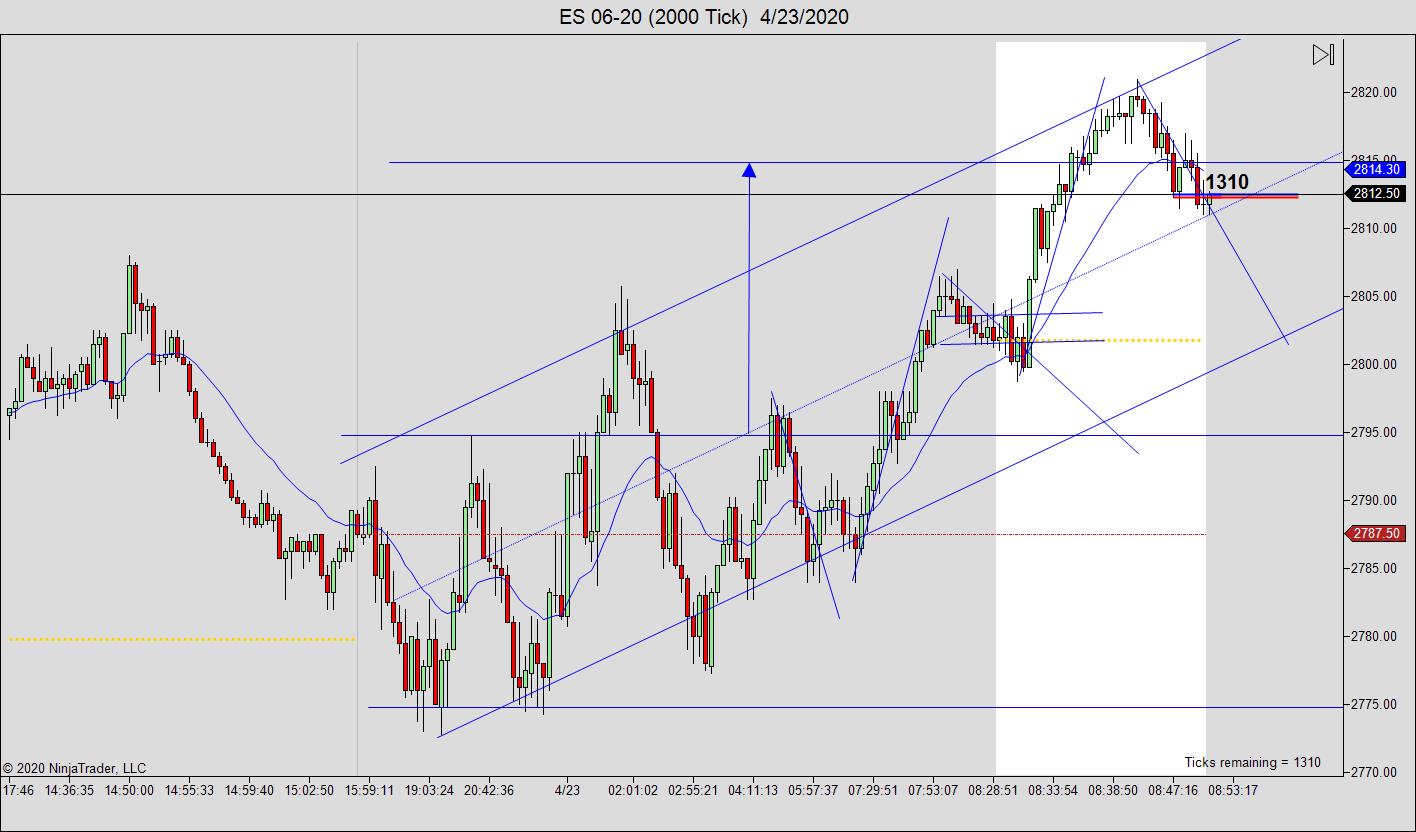
In the dynamic and often complex world of financial markets, understanding the terminology and instruments is paramount for anyone looking to navigate its currents successfully. Among the myriad of trading vehicles, “ES” stands out as one of the most popular and actively traded futures contracts. For newcomers, the acronym might seem cryptic, but for seasoned traders, it represents a cornerstone of their daily operations. ES is the ticker symbol for the E-mini S&P 500 futures contract, a derivative product that allows traders to speculate on the future price movements of the underlying S&P 500 stock market index.

Understanding ES is more than just knowing its name; it’s about grasping its significance within the broader financial landscape. It offers a unique blend of liquidity, leverage, and accessibility that appeals to a diverse range of participants, from institutional investors managing vast portfolios to individual day traders seeking short-term opportunities. This article will delve deep into what ES is, why it’s so widely traded, its operational mechanics, common trading strategies, and the critical risks and considerations associated with it. By the end, you’ll have a comprehensive understanding of this pivotal financial instrument and its role in modern trading.
Decoding ES: The E-mini S&P 500 Futures Contract
To fully appreciate ES, we must break down its components: the S&P 500 Index, futures contracts, and the “E-mini” designation itself. Each element plays a crucial role in defining this powerful trading instrument.
The S&P 500 Index: Underlying Asset
The S&P 500, or Standard & Poor’s 500, is a stock market index that represents the performance of 500 of the largest publicly traded companies in the United States. It is a market-capitalization-weighted index, meaning companies with larger market values have a greater impact on the index’s movement. Widely considered one of the best gauges of large-cap U.S. equities and a bellwether for the overall U.S. economy, the S&P 500’s movements are closely watched by investors and economists worldwide. When you hear financial news outlets report on “the market,” they often refer to the S&P 500’s performance. ES, therefore, provides a direct way to trade the aggregate sentiment and performance of this critical benchmark without needing to buy or sell all 500 individual stocks.
Futures Contracts: A Brief Overview
A futures contract is a legal agreement to buy or sell a particular commodity or financial instrument at a predetermined price at a specified time in the future. These contracts are standardized, meaning their specifications (e.g., quantity, quality, delivery month) are identical for all participants, facilitating ease of trading on exchanges. Unlike stocks, which represent ownership in a company, futures contracts are derivative instruments, deriving their value from an underlying asset. For ES, the underlying asset is the S&P 500 index. Futures contracts are primarily used for hedging against price risk or for speculation on future price movements. Traders don’t typically take physical delivery of the S&P 500; instead, they offset their positions before expiration, profiting or losing from the difference in contract prices.
The “E-mini” Distinction: Accessibility and Size
The “E-mini” prefix is crucial to understanding ES’s popularity. Historically, standard S&P 500 futures contracts were very large, requiring significant capital and making them inaccessible to many individual traders. In 1997, the Chicago Mercantile Exchange (CME) Group introduced the E-mini S&P 500 futures contract. The “E” stands for electronic (referring to its electronic trading nature), and “mini” signifies that it is a smaller, fraction-sized version of the standard S&P 500 futures contract. Specifically, one E-mini S&P 500 contract is valued at $50 multiplied by the S&P 500 index level, compared to the standard contract’s $250 multiplier. This reduction in contract size dramatically lowered the barrier to entry, making it more affordable and accessible for a broader range of traders, including retail investors, to participate in S&P 500 index futures trading.
Why Trade ES? Advantages and Appeal
ES has become a favorite among traders for several compelling reasons, offering a unique set of advantages that cater to different trading styles and objectives.
High Liquidity and Tight Spreads
One of the most significant benefits of trading ES is its unparalleled liquidity. Being one of the most heavily traded futures contracts globally, ES sees billions of dollars in volume every day. High liquidity ensures that traders can enter and exit positions quickly and efficiently, minimizing slippage (the difference between the expected price of a trade and the price at which the trade is actually executed). This also leads to tight bid-ask spreads, meaning the difference between the highest price a buyer is willing to pay and the lowest price a seller is willing to accept is minimal, reducing transaction costs for traders.
Leverage Potential
Futures trading inherently involves leverage, and ES is no exception. With a relatively small amount of margin capital, traders can control a large notional value of the S&P 500 index. For example, controlling a contract worth over $250,000 (S&P 500 at 5000 x $50) with only a few thousand dollars in margin can significantly amplify potential profits from even small market movements. However, this leverage is a double-edged sword, as it can equally magnify losses, a critical consideration we will explore later.
24/5 Market Access
The ES futures market operates nearly 24 hours a day, five days a week, from Sunday evening to Friday afternoon, with short breaks. This extended trading window allows traders to react to global news and events in real-time, even outside traditional U.S. stock market hours. It also provides flexibility for traders in different time zones, enabling them to align their trading activities with their personal schedules.
Hedging Capabilities
For investors holding diversified portfolios of U.S. large-cap stocks or S&P 500 index funds, ES futures offer an efficient tool for hedging. If an investor anticipates a short-term market downturn but doesn’t want to liquidate their long-term holdings, they can sell ES futures contracts. A decline in the S&P 500 would lead to profits on their short ES position, offsetting some of the losses in their cash equity portfolio. This allows investors to manage risk without disrupting their long-term investment strategy.
Market Transparency and Price Discovery
Futures markets, including ES, are highly centralized and regulated, leading to significant transparency. All trades are executed on an exchange, and real-time pricing data, volume, and open interest are readily available. This transparency facilitates efficient price discovery, as market participants collectively determine the fair value of the S&P 500’s future price based on all available information.
Understanding ES Contract Specifications and Mechanics
Trading ES requires a clear understanding of its specific contract details and how transactions are executed. These specifications dictate the value of trades and the capital required.
Contract Size and Tick Value
As mentioned, one ES contract has a multiplier of $50 per index point. If the S&P 500 index is trading at 5,000, one ES contract has a notional value of $250,000. The minimum price fluctuation for ES, known as a “tick,” is 0.25 index points. Therefore, one tick movement in ES is equivalent to $12.50 ($50 x 0.25). Understanding this value is crucial for calculating potential profits and losses on a per-contract basis. For instance, if you buy ES at 5000.00 and sell it at 5001.00, you’ve made a gain of 1.00 index point, or 4 ticks, totaling $50 ($12.50 x 4).
Expiration Cycles
ES contracts expire quarterly, in March, June, September, and December. Each contract is identified by a specific letter code (H for March, M for June, U for September, Z for December) followed by the year. For example, ESZ24 refers to the December 2024 E-mini S&P 500 futures contract. Traders typically focus on the “front-month” contract (the one closest to expiration) due to its superior liquidity. As the expiration date approaches, liquidity shifts to the next quarterly contract.
Margin Requirements
To trade ES, traders must deposit a certain amount of capital, known as margin, with their broker. There are two primary types of margin:
-
Initial Margin: The amount required to open a new ES position. This is typically set by the exchange (CME) and can vary. It’s a performance bond, not a down payment.
-
Maintenance Margin: A lower threshold than the initial margin. If the account equity falls below the maintenance margin level due to losses, the trader will receive a margin call, requiring them to deposit additional funds to bring their account back up to the initial margin level or close their position.
Margin requirements can vary between brokers and are subject to change based on market volatility and exchange policy. They are also often lower for day traders who close all positions before the market close (intraday margin).
Trading Platforms and Brokers
To trade ES, individuals need an account with a futures broker that provides access to the CME Group exchanges. These brokers offer specialized trading platforms equipped with real-time data, charting tools, order entry interfaces, and risk management features. Popular platforms include NinjaTrader, TradeStation, and Interactive Brokers’ Trader Workstation, among others. Choosing a reliable broker with competitive commissions, robust technology, and excellent customer support is essential for an optimal trading experience.
Strategies for Trading ES
The high liquidity and leverage of ES make it suitable for a wide array of trading strategies, catering to different time horizons and risk appetites.
Day Trading and Scalping
Day trading involves opening and closing positions within the same trading day, never holding positions overnight. Scalping is an even shorter-term variant, aiming to profit from very small price movements, often holding positions for only seconds or minutes. Both strategies are popular with ES due to its high liquidity, which allows for quick entry and exit, and its volatility, which creates frequent price fluctuations. Day traders and scalpers often rely on technical analysis, using indicators, chart patterns, and order flow analysis to identify short-term opportunities.
Swing Trading
Swing trading involves holding positions for several days to a few weeks, aiming to capture larger price “swings” in the market. Swing traders look for momentum shifts, breakouts, or reversals based on technical analysis and sometimes fundamental analysis (e.g., economic data releases). ES is well-suited for swing trading as it reflects broad market sentiment, and its movements can provide significant profit potential over a longer timeframe than day trading.
Trend Following
Trend following is a strategy where traders attempt to identify and ride established market trends. If ES is consistently making higher highs and higher lows, a trend follower might go long, holding the position as long as the uptrend persists. Conversely, they would go short during a downtrend. This strategy often utilizes technical indicators like moving averages, MACD, or ADX to identify and confirm trends.
Volatility Trading
Some traders specifically seek to profit from periods of high market volatility. During times of economic uncertainty or major news events, ES can experience significant price swings, presenting opportunities for skilled volatility traders. These strategies might involve options on futures or simply trading the futures contract directly, using stop-loss orders to manage the amplified risk.
Spreading Strategies
Spreading involves simultaneously buying one ES contract and selling another related contract to profit from the difference in their prices (the “spread”). Examples include inter-delivery spreads (trading different expiration months of ES) or inter-market spreads (trading ES against another index future like Nasdaq 100 futures). Spreading strategies are generally considered lower risk than outright directional trading, as they aim to profit from relative value rather than absolute price movement, and they often require less margin.
Risks and Considerations in ES Trading
While ES offers substantial opportunities, it’s crucial to acknowledge the inherent risks. Ignorance of these risks can lead to significant financial losses.
The Double-Edged Sword of Leverage
As highlighted, leverage can amplify profits, but it can equally magnify losses. A small adverse price movement, when leveraged, can wipe out a substantial portion of a trading account quickly. It’s not uncommon for inexperienced traders to be caught off guard by margin calls or even account liquidation if they fail to manage their leveraged positions effectively. Understanding margin requirements and maintaining sufficient capital is paramount.
Volatility and Gap Risk
The S&P 500, and therefore ES, can experience significant volatility, particularly during periods of economic uncertainty, geopolitical events, or major earnings reports. This volatility can lead to rapid price changes and “gap” openings, where the market opens at a significantly different price than its previous close, often due to overnight news. These gaps can cause stop-loss orders to be executed at much worse prices than intended, leading to larger-than-expected losses.
Psychological Demands
Trading ES, especially day trading, is incredibly demanding psychologically. The fast-paced environment, the potential for rapid gains and losses, and the constant need for decision-making can lead to stress, anxiety, and emotional trading errors. Discipline, emotional control, and a well-defined trading plan are critical for sustained success. Overcoming fear, greed, and impulsive decisions is often as challenging as mastering technical analysis.
Capital Requirements and Risk Management
Despite the “E-mini” designation making it more accessible, trading ES still requires adequate capital. Beyond the initial margin, traders need additional funds to absorb potential drawdowns and avoid margin calls. Effective risk management is non-negotiable. This includes:
-
Position Sizing: Determining the appropriate number of contracts to trade based on account size and risk tolerance.
-
Stop-Loss Orders: Predetermined price levels at which a losing trade is automatically closed to limit potential losses.
-
Risk-Reward Ratios: Ensuring that potential profits outweigh potential losses for each trade.
-
Diversification: While ES itself is a single instrument, understanding its role in a broader portfolio context helps manage overall investment risk.
Without a robust risk management strategy, even a string of winning trades can be undone by a single, poorly managed losing trade.

Conclusion
The E-mini S&P 500 futures contract, or ES, is a cornerstone of modern financial trading, offering a highly liquid, leveraged, and accessible way to participate in the movements of the broader U.S. stock market. Its advantages, from 24/5 market access to effective hedging capabilities, make it attractive to a diverse range of market participants. However, the power of ES comes with significant responsibilities. The leverage it provides, coupled with market volatility, demands a rigorous approach to risk management, capital allocation, and psychological discipline.
For those willing to invest the time in education, practice, and careful risk control, ES can be an incredibly potent tool for speculation, hedging, and portfolio management. By understanding its mechanics, exploring various strategies, and critically assessing the inherent risks, traders can position themselves to navigate the exciting and challenging world of ES futures trading with greater confidence and potential for success.
aViewFromTheCave is a participant in the Amazon Services LLC Associates Program, an affiliate advertising program designed to provide a means for sites to earn advertising fees by advertising and linking to Amazon.com. Amazon, the Amazon logo, AmazonSupply, and the AmazonSupply logo are trademarks of Amazon.com, Inc. or its affiliates. As an Amazon Associate we earn affiliate commissions from qualifying purchases.