
In the vast and often complex world of finance, few benchmarks command as much attention and understanding as the S&P 500. Far more than just a simple list of companies, it serves as a critical barometer for the health of the U.S. economy, a cornerstone for countless investment portfolios, and a subject of daily discussion among financial professionals and casual investors alike. Understanding what the S&P 500 is, how it functions, and its significance is fundamental for anyone looking to navigate the investment landscape with confidence and insight.
At its core, the S&P 500, officially known as the Standard & Poor’s 500, is a stock market index that represents the performance of 500 of the largest publicly traded companies in the United States. Compiled and maintained by S&P Dow Jones Indices, it is widely regarded as the best gauge of large-cap U.S. equities and a leading indicator of the overall stock market. Unlike some other indices that might be price-weighted, the S&P 500 is market-capitalization weighted, meaning companies with larger market values have a greater impact on the index’s performance. This weighting reflects the real-world influence of these corporate giants on the broader economy. For investors, the S&P 500 isn’t just a number; it’s a proxy for American corporate strength, innovation, and long-term economic growth, offering a diversified exposure to a significant portion of the U.S. equity market through a single, easily trackable benchmark. Its pervasive influence extends beyond merely tracking stock prices, shaping investor sentiment, informing economic policy, and serving as a critical component in the construction of diversified investment portfolios globally.

The S&P 500: A Core Benchmark of the U.S. Economy
The S&P 500’s prominence stems from its meticulous construction and its ability to offer a highly representative snapshot of the U.S. large-cap equity market. It’s not just a random collection of 500 companies; rather, each constituent is selected through a rigorous process designed to ensure that the index truly reflects the broader economic landscape. This systematic approach differentiates it from simpler indices and elevates its status as a premier benchmark.
More Than Just an Average: Understanding Market Capitalization Weighting
One of the most crucial aspects that defines the S&P 500’s methodology is its market capitalization weighting. This means that a company’s influence on the index’s performance is proportional to its total market value (share price multiplied by the number of outstanding shares). For instance, if Apple, with its multi-trillion-dollar market cap, experiences a significant price movement, it will have a far greater impact on the S&P 500’s overall value than a smaller company within the index, even if both companies experience the same percentage change in their stock price. This weighting methodology ensures that the index accurately reflects the actual economic footprint of its constituent companies, providing a more realistic representation of the market’s aggregate wealth. This contrasts with price-weighted indices, where higher-priced stocks have more influence, regardless of their total market value. The market-cap weighting aligns the index’s movements more closely with the actual investment capital deployed across the market.
Who are the “500” Companies?
The selection process for companies included in the S&P 500 is far from arbitrary. A committee at S&P Dow Jones Indices makes the decisions, adhering to specific criteria that go beyond just size. Key requirements include:
-
Market Capitalization: Companies must meet a minimum market cap threshold, which is periodically adjusted.
-
Liquidity: The company’s stock must be highly liquid, meaning it’s actively traded, allowing for efficient buying and selling without significantly affecting the price.
-
Public Float: A significant portion of the company’s shares must be available for public trading (not held by insiders or restricted).
-
U.S. Company: The company must be domiciled in the U.S.
-
Sector Representation: The committee also considers the company’s sector to ensure the index remains diversified and representative of the various industries contributing to the U.S. economy. This avoids over-concentration in any single sector.
Companies are added and removed as they grow, shrink, merge, or acquire others, ensuring that the index remains dynamic and relevant. This regular rebalancing and selection process is vital for the S&P 500 to maintain its status as a robust indicator of the current market leaders and the broader economic landscape. For example, a company like General Electric, once a dominant force, has seen its weight in the index diminish over time, while tech giants like NVIDIA have seen their influence soar.
Why it Matters: A Bellwether for Economic Health
The S&P 500 is more than just a measure of stock prices; it’s a critical bellwether for the U.S. economy. Because its constituent companies are large, publicly traded entities operating across virtually all sectors, their collective performance reflects broader economic trends. When these companies are performing well—reporting strong earnings, expanding, and innovating—it often signals a healthy economy with robust consumer spending, business investment, and overall confidence. Conversely, a sustained decline in the S&P 500 can indicate economic headwinds, such as recessions, decreased consumer demand, or geopolitical instability. Policymakers, economists, and business leaders closely monitor the S&P 500 as an indicator of financial stability and economic momentum. Its movements influence everything from interest rate decisions by the Federal Reserve to corporate investment strategies and even public sentiment about the future.
How Investors Access the S&P 500
For most individual investors, directly buying shares of all 500 companies in the S&P 500 would be an impractical, expensive, and logistically challenging endeavor. Fortunately, the financial industry has developed highly efficient and accessible mechanisms that allow anyone to invest in the S&P 500 with ease, offering immediate diversification and exposure to this critical benchmark. These investment vehicles have democratized access to broad market participation, making the S&P 500 a staple in many long-term financial plans.
ETFs and Mutual Funds: The Easiest Entry Points
The most popular and practical ways for investors to gain exposure to the S&P 500 are through Exchange-Traded Funds (ETFs) and Mutual Funds that specifically track the index.
-
S&P 500 ETFs: These are funds that hold the underlying stocks in the S&P 500 in the same proportion as the index itself. They trade on stock exchanges throughout the day, just like individual stocks, offering flexibility for buying and selling. Popular examples include SPDR S&P 500 ETF Trust (SPY), iShares Core S&P 500 (IVV), and Vanguard S&P 500 ETF (VOO). ETFs typically have very low expense ratios, making them cost-effective.
-
S&P 500 Index Mutual Funds: These funds also aim to replicate the performance of the S&P 500 by owning all the constituent stocks. Unlike ETFs, mutual funds are typically bought and sold once per day at their Net Asset Value (NAV) after the market closes. They are often available directly from fund providers or through brokerage platforms. Many retirement plans, like 401(k)s, offer S&P 500 index mutual funds as investment options.
Both ETFs and index mutual funds provide instant diversification, as a single purchase gives an investor a proportional stake in all 500 companies. This dramatically reduces individual company risk and allows investors to participate in the broader market’s growth without the need for extensive research into individual stocks.
Index Funds vs. Actively Managed Funds
The S&P 500 plays a crucial role in the ongoing debate between passive (index) investing and active investing.
-
Index Funds (Passive Investing): S&P 500 ETFs and index mutual funds are prime examples of passive investment vehicles. Their objective is simply to mirror the performance of the underlying index, not to outperform it. This strategy typically involves minimal trading (only when the index components change) and therefore incurs very low management fees. The premise is that over the long term, the market itself (as represented by the S&P 500) tends to outperform the majority of actively managed funds after fees.
-
Actively Managed Funds: These funds employ professional fund managers who try to pick individual stocks, time the market, or use other strategies to beat the S&P 500’s performance. While some active managers succeed in the short term, historical data consistently shows that a significant majority fail to outperform the S&P 500 over extended periods, especially after accounting for their often much higher fees. This consistent underperformance has made S&P 500 index funds an increasingly popular choice for investors seeking reliable, low-cost long-term growth.
Direct Investment: A Less Common Path for Retail Investors

While less common for individual retail investors, it is technically possible to gain exposure to the S&P 500 through more sophisticated financial instruments:
-
Futures Contracts: These are agreements to buy or sell the S&P 500 index at a predetermined price on a future date. They are typically used by institutional investors or very experienced traders for hedging or speculation, involving significant leverage and risk.
-
Options: Options contracts on S&P 500 ETFs (like SPY) or the index itself (SPX) allow investors to speculate on the future direction of the index or to hedge existing portfolios. These are also advanced instruments and not generally recommended for novice investors due to their complexity and potential for rapid loss.
For the vast majority of investors, S&P 500 index ETFs and mutual funds remain the most accessible, cost-effective, and prudent way to integrate this powerful benchmark into their financial strategy.
The Historical Performance and Long-Term Value Proposition
The enduring appeal of the S&P 500 as an investment vehicle is rooted in its compelling historical performance and its inherent design for long-term wealth creation. Over decades, it has consistently demonstrated its capacity to grow, rewarding patient investors who maintain a diversified approach. Understanding this historical context is crucial for appreciating its role in a sound financial strategy.
A History of Resilience and Growth
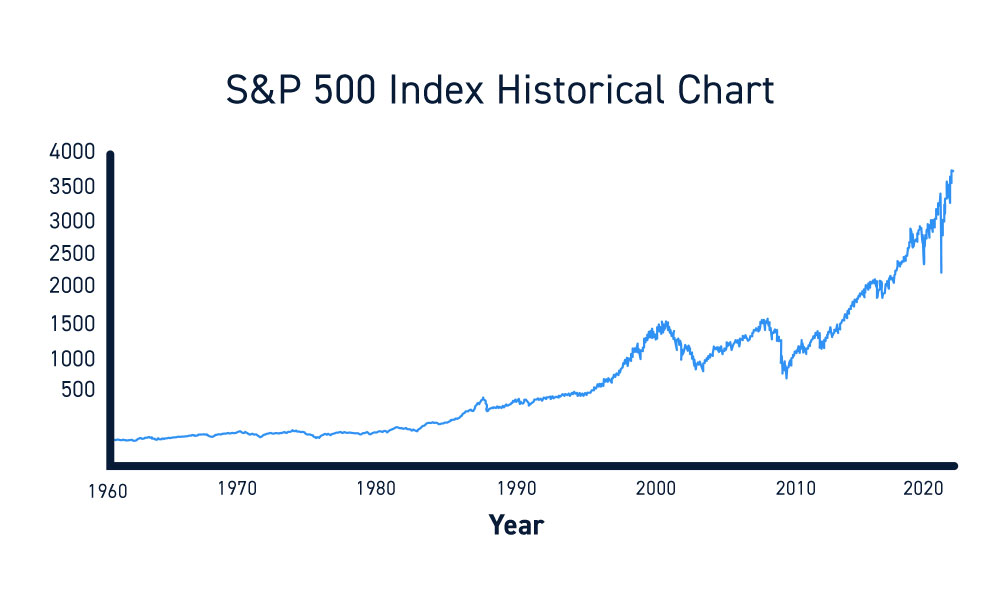
Looking back over many decades, the S&P 500 has exhibited a remarkable upward trajectory, despite numerous short-term crises, recessions, and market corrections. While the journey is rarely a straight line—punctuated by significant downturns like the dot-com bust, the 2008 financial crisis, or the COVID-19 pandemic—the long-term trend has been decisively positive. On average, the S&P 500 has historically returned around 10-12% annually, including reinvested dividends, though past performance is not indicative of future results. This average masks significant year-to-year volatility, but it highlights the powerful effect of compounding returns over extended periods. This resilience is a testament to the adaptive capacity of American corporations, their ability to innovate, and the underlying growth of the U.S. economy. For long-term investors, periods of market decline are often viewed not as reasons to panic, but as opportunities to acquire assets at lower prices.
Diversification and Risk Mitigation
One of the S&P 500’s greatest strengths, particularly for individual investors, is the inherent diversification it provides. By investing in an S&P 500 index fund or ETF, you are essentially investing in 500 different companies across eleven distinct sectors: Information Technology, Health Care, Financials, Consumer Discretionary, Communication Services, Industrials, Consumer Staples, Energy, Utilities, Real Estate, and Materials. This broad exposure significantly mitigates “single stock risk.” If one company in the index performs poorly or even goes bankrupt, its impact on the overall index is diluted by the performance of the other 499 companies. This level of diversification is difficult and expensive to achieve by buying individual stocks, making the S&P 500 an efficient tool for spreading risk across a vast segment of the market. This broad diversification, coupled with the rigorous selection process, ensures that the index reflects the collective health and growth of the U.S. corporate landscape rather than being overly reliant on any one company or industry.
Understanding Volatility and Market Cycles
While the long-term trend of the S&P 500 is upward, it is crucial for investors to understand that market volatility is a natural and unavoidable part of investing. Stock markets operate in cycles, experiencing periods of bull markets (sustained growth) and bear markets (sustained declines), as well as shorter, often sharp corrections. Factors such as economic data, corporate earnings, interest rate changes, geopolitical events, and investor sentiment can all cause daily or weekly fluctuations. It is important for investors to remain disciplined during these periods, resisting the urge to sell during downturns or chase fads during euphoric highs. The S&P 500’s history teaches that patience and a long-term perspective are richly rewarded. Investors who panic and sell during market drops often lock in losses, missing the subsequent recoveries that are a hallmark of market cycles. Embracing volatility as a normal part of the investment journey, rather than an anomaly, is key to successful long-term investing in the S&P 500.
The S&P 500 in Your Financial Strategy
Integrating the S&P 500 into a personal financial strategy is a well-established and often recommended approach for achieving various long-term financial goals. Its characteristics—diversification, historical growth, and low cost of access—make it a versatile and powerful component of a well-rounded investment portfolio.
Core Holding for Retirement Portfolios
For many individuals, the S&P 500, through an index fund or ETF, forms the bedrock of their retirement savings. Given its long-term growth potential and diversification, it is an ideal candidate for accounts like 401(k)s, IRAs, and other retirement vehicles where the investment horizon is typically decades long. Investing in the S&P 500 for retirement aligns with the principle of “time in the market, not timing the market,” allowing investors to benefit from compounding returns over many years, weathering short-term market fluctuations. It provides a straightforward way to participate in the growth of the overall U.S. economy, which historically has been a reliable path to wealth accumulation for retirement planning.
Dollar-Cost Averaging into the S&P 500
A highly effective strategy for investing in the S&P 500, particularly for consistent savers, is dollar-cost averaging. This involves investing a fixed amount of money at regular intervals (e.g., monthly or bi-weekly), regardless of the market’s current performance. When prices are high, your fixed dollar amount buys fewer shares; when prices are low, it buys more shares. Over time, this strategy helps to average out your purchase price, reducing the risk associated with trying to time the market’s peaks and troughs. For long-term S&P 500 investors, dollar-cost averaging simplifies the investment process, removes emotional decision-making, and systematically builds wealth through consistent contributions. It’s especially powerful when combined with automated investments, making the process effortless and disciplined.
Complementing Your Investment Portfolio
While the S&P 500 offers broad exposure to U.S. large-cap equities, it typically serves as one component of a truly diversified investment portfolio. Depending on an investor’s age, risk tolerance, and financial goals, the S&P 500 might be complemented by other asset classes to further diversify and optimize returns. These could include:
-
International Stocks: To gain exposure to global economic growth and reduce reliance on a single country.
-
Small-Cap and Mid-Cap Stocks: To capture growth opportunities in smaller, potentially higher-growth companies (though with higher risk).
-
Bonds: To provide stability, income, and act as a ballast during stock market downturns.
-
Real Estate (e.g., REITs): For additional diversification and income potential.
-
Alternative Investments: For very sophisticated investors seeking uncorrelated returns.
The proportion of S&P 500 exposure within a portfolio will vary significantly from person to person. A younger investor with a higher risk tolerance might have a larger percentage allocated to S&P 500 funds, while an older investor nearing retirement might have a more conservative allocation, shifting more towards bonds. The S&P 500 is not a standalone solution for all financial needs but rather a highly effective, central pillar around which a comprehensive and diversified financial strategy can be built.
In conclusion, the S&P 500 is more than just an index; it is a profound representation of American enterprise, a vital economic indicator, and an accessible pathway for investors to participate in the long-term growth of the U.S. economy. By understanding its construction, its historical performance, and the simple ways to access it, investors can confidently integrate this powerful tool into their financial plans, leveraging its inherent diversification and proven track record to build wealth over the long haul.
aViewFromTheCave is a participant in the Amazon Services LLC Associates Program, an affiliate advertising program designed to provide a means for sites to earn advertising fees by advertising and linking to Amazon.com. Amazon, the Amazon logo, AmazonSupply, and the AmazonSupply logo are trademarks of Amazon.com, Inc. or its affiliates. As an Amazon Associate we earn affiliate commissions from qualifying purchases.