
Options trading, once a realm primarily for institutional investors and seasoned professionals, has become increasingly accessible to the everyday individual. Platforms like Robinhood have democratized access to complex financial instruments, including options, through intuitive interfaces and commission-free trading. However, accessibility doesn’t equate to simplicity. Options are powerful, versatile, and, if misunderstood, can lead to substantial financial losses. This comprehensive guide will walk you through the fundamentals of options trading, how to navigate the process on Robinhood, and crucial considerations for responsible and potentially profitable engagement.
Understanding Options Trading Fundamentals
Before you place your first trade, it’s paramount to grasp what options are, how they work, and the unique risks they entail. Options are not shares of a company; they are contracts that give the buyer the right, but not the obligation, to buy or sell an underlying asset (like a stock) at a predetermined price on or before a specific date.

What Are Options? Calls vs. Puts
At their core, there are two primary types of options: calls and puts.
-
Call Options: A call option gives the holder the right to buy an underlying asset at a specified price (the strike price) before or on a specific date (the expiration date). Investors typically buy call options when they anticipate the price of the underlying asset will increase. If the stock price rises above the strike price before expiration, the call option becomes profitable.
-
Put Options: A put option gives the holder the right to sell an underlying asset at a specified price (the strike price) before or on a specific date (the expiration date). Investors typically buy put options when they anticipate the price of the underlying asset will decrease. If the stock price falls below the strike price before expiration, the put option becomes profitable.
It’s also important to remember that for every buyer of an option, there is a seller (or “writer”). The seller of a call option believes the stock will stay below the strike price, while the seller of a put option believes it will stay above. Sellers receive a premium upfront but take on significant risk if the market moves against them. Robinhood generally allows for both buying and selling of options, but selling options (especially uncovered calls or puts) carries unlimited risk and requires higher approval levels.
Key Options Terminology: Strike Price, Expiration, Premium
To effectively trade options, you need to be familiar with the following essential terms:
-
Underlying Asset: The security (usually a stock or ETF) that the option contract is based on. One options contract typically represents 100 shares of the underlying asset.
-
Strike Price: The predetermined price at which the underlying asset can be bought (for a call) or sold (for a put) if the option is exercised.
-
Expiration Date: The last day the option contract is valid. After this date, the option expires worthless if not exercised or sold. Options are often available with weekly, monthly, or even yearly expiration cycles.
-
Premium: The price an option buyer pays to the seller for the contract. This is the cost of the option and is determined by several factors, including the underlying asset’s price, strike price, time until expiration, and volatility.
-
In-the-Money (ITM), At-the-Money (ATM), Out-of-the-Money (OTM):
-
Call Option: ITM if stock price > strike price; ATM if stock price = strike price; OTM if stock price < strike price.
-
Put Option: ITM if stock price < strike price; ATM if stock price = strike price; OTM if stock price > strike price.
OTM options are generally cheaper but have a higher probability of expiring worthless.
-
The Risks and Rewards of Options Trading
Options trading offers significant leverage, meaning a small price movement in the underlying asset can lead to a large percentage gain or loss in the option’s value. This leverage is the source of both its allure and its danger.
Potential Rewards:
-
High Percentage Returns: A relatively small capital outlay (the premium) can control a large number of shares, leading to substantial returns if the market moves favorably.
-
Hedging: Options can be used to protect existing stock portfolios against downturns (e.g., buying puts on stocks you own).
-
Income Generation: Selling covered calls against shares you own can generate income (though it caps your upside potential).
Significant Risks:
-
Time Decay (Theta): Options lose value as they approach expiration, a phenomenon known as time decay. This is a constant drag on the option’s value.
-
Total Loss of Investment: A substantial majority of options contracts expire worthless. If the underlying asset does not move in your favor enough by expiration, you can lose 100% of your premium.
-
Complexity: Options strategies can be intricate, and misjudging market direction, volatility, or time decay can lead to rapid losses.
-
Unlimited Risk (for sellers): While buying options has limited risk (to the premium paid), selling uncovered options can expose you to potentially unlimited losses.
It cannot be stressed enough: options trading is not suitable for everyone. It requires a deep understanding of market dynamics, disciplined risk management, and a willingness to accept substantial losses.
Setting Up for Options Trading on Robinhood
Robinhood has simplified the interface for options trading, but there are still several steps and requirements you must meet before you can start.
Meeting Eligibility Requirements
Robinhood, like other brokers, requires users to apply for and be approved for options trading. This is a regulatory requirement designed to ensure investors understand the risks involved. The approval process typically involves:
-
Updating your investment profile: You’ll need to provide information about your investment experience, risk tolerance, financial sophistication, and financial situation (income, net worth).
-
Acknowledging risks: Robinhood will require you to confirm that you understand the substantial risks associated with options trading.
-
Tiered Approval: Robinhood uses a tiered system for options trading, ranging from Level 1 (covered calls, protective puts) to Level 3 (uncovered calls, spreads). Most beginners will start at Level 2, which allows for buying calls and puts. Higher tiers require more experience and financial resources. Ensure you apply for the level that matches your current knowledge and comfort.
Be honest in your application. Providing inaccurate information can lead to rejection or issues later on. Robinhood reviews applications quickly, often within a few business days.
Navigating the Robinhood App for Options
Once approved, options trading functionality will be enabled in your Robinhood app. The interface is designed for simplicity:
-
Search for a Stock: Use the search bar to find the stock you’re interested in trading options on (e.g., “AAPL”).
-
Access Options Chain: On the stock’s detail page, look for the “Trade” button, and then select “Trade Options.” This will bring you to the options chain.
-
Select Expiration Date: At the top of the options chain, you’ll see a list of available expiration dates. Tap on the date that aligns with your market outlook. Shorter-term options are generally more volatile and experience faster time decay.
-
Choose Calls or Puts: The options chain will display both call and put options. You can toggle between them. Calls are typically on one side (e.g., left) and puts on the other (e.g., right), with strike prices listed in the middle.
-
View Strike Prices and Premiums: For each expiration date, you’ll see a list of strike prices with their corresponding bid and ask prices (premiums). The bid is the price you can sell the option for, and the ask is the price you can buy it for.
Funding Your Account and Setting Up Security
Before placing a trade, ensure your Robinhood account is adequately funded. You can link your bank account for instant deposits, though larger amounts might take a few business days to clear. Remember that options contracts can be expensive, and you need sufficient funds to cover the premium of your desired trade.
Security is paramount. Enable two-factor authentication (2FA) for your Robinhood account. This adds an extra layer of protection, requiring a code from your mobile device in addition to your password, safeguarding your investments from unauthorized access.
Placing Your First Options Trade on Robinhood
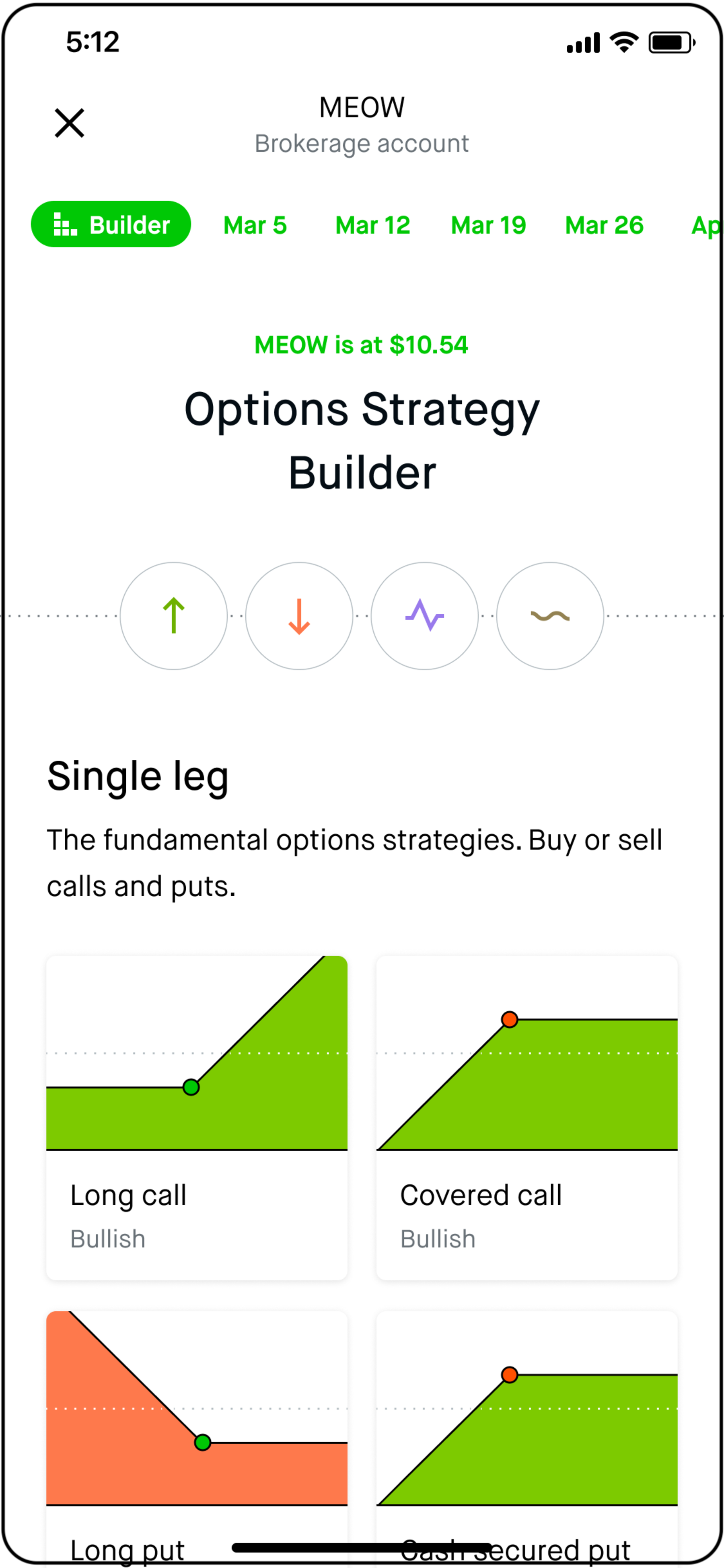
With your account set up and an understanding of the basics, you’re ready to consider your first trade. This process should always begin with thorough research, not speculation.
Researching Underlying Assets and Strategies
Never trade options on a whim. Research is critical:
-
Company Fundamentals: Understand the business of the underlying company. What are its earnings, growth prospects, competitive landscape, and news catalysts?
-
Technical Analysis: Look at the stock’s chart patterns, support and resistance levels, and indicators to gauge potential price movements.
-
Implied Volatility (IV): This indicates how much the market expects the stock price to move. High IV makes options more expensive but also implies potential for larger swings.
-
Market Sentiment: Are there upcoming earnings reports, product launches, or macroeconomic events that could significantly impact the stock?
-
Define Your Strategy: Are you bullish (expecting price to rise) or bearish (expecting price to fall)? Are you aiming for a short-term gain, or are you looking to hedge an existing position? For beginners, buying simple calls or puts is the starting point.
Executing a Call or Put Option Trade
Let’s assume you’ve identified a stock you believe will rise (bullish) and want to buy a call option:
-
Navigate to the Options Chain: As described above, find the stock and go to its options chain.
-
Select Expiration and Strike: Choose an expiration date that gives your thesis enough time to play out (but avoid excessively long-dated options initially due to higher premiums) and a strike price. OTM calls are cheaper but riskier; ITM calls are more expensive but have intrinsic value.
-
Tap on the Desired Option: Tap the ask price of the call option you wish to buy.
-
Review Order Details: A “Buy Call” screen will appear.
-
Number of Contracts: Enter the number of contracts you want to buy (remember, 1 contract = 100 shares).
-
Order Type: Start with a “Limit Order” to ensure you pay your desired price. A “Market Order” executes immediately at the prevailing market price but can be subject to slippage.
-
Limit Price: Enter the maximum premium you are willing to pay per share (e.g., if the ask is $1.50, you might enter $1.50).
-
Review Estimated Cost: Robinhood will show you the estimated total cost (number of contracts * limit price * 100).
-
-
Swipe to Submit: Carefully review all details and then swipe up to submit your order.
Your order will then be sent to the market. If it’s a limit order, it will execute if the price falls to or below your specified limit.
Monitoring and Managing Your Options Positions
Once your order is filled, your options position will appear in your Robinhood portfolio.
-
Track Performance: Regularly monitor the performance of your options. The “Cost Basis” shows your initial investment, and “Current Value” shows its real-time worth.
-
Time is Your Enemy: Remember time decay. If the stock isn’t moving in your favor, the option’s value will erode with each passing day.
-
Profit Taking: If your option becomes profitable, you can choose to sell it to realize gains. To sell, tap on the option in your portfolio, then tap “Trade” and “Sell to Close.”
-
Cutting Losses: Just as important as taking profits is cutting losses. Don’t let a losing trade wipe out too much of your capital. If your thesis is proving wrong, consider selling the option before it expires worthless.
-
Expiration: As the expiration date approaches, you have three choices:
-
Sell to Close: Sell the option to another trader for its current market value. This is the most common action.
-
Exercise: If the option is ITM and you want to buy (call) or sell (put) the underlying shares, you can exercise it. This requires sufficient capital to buy the shares (for calls) or owning the shares to sell (for puts). Robinhood often automatically exercises ITM options at expiration, but be aware of the capital implications.
-
Let Expire Worthless: If the option is OTM at expiration, it will expire worthless, and you will lose your entire premium.
-
Advanced Options Strategies and Risk Management
As you gain experience, you might explore more complex options strategies. However, always ensure you fully understand the mechanics and risks before diving in.
Beyond Simple Buys: Spreads and Covered Calls
-
Option Spreads: These involve simultaneously buying and selling different options contracts on the same underlying asset, often with different strike prices or expiration dates. Examples include vertical spreads (bull call spread, bear put spread) or iron condors. Spreads can define both maximum profit and maximum loss, making them popular for experienced traders. Robinhood offers certain spread strategies, usually at Level 3 approval.
-
Covered Calls: A popular strategy for income generation. You sell a call option on shares of stock that you already own. If the stock price stays below the strike price, you keep the premium. If it rises above, your shares may be “called away” (sold) at the strike price, capping your upside but generating income. This strategy is typically available at Level 1 or 2 on Robinhood.
Understanding Margin and Leverage
While Robinhood offers margin accounts for stock trading, using margin for options is a different beast and is primarily for selling advanced options strategies. For beginners, it’s strongly advised to trade options only with cash. Using margin for options can amplify losses exponentially and lead to margin calls, where you’re forced to deposit more money or have positions liquidated. Understand Robinhood’s margin policies thoroughly before considering it for any advanced trading.
Essential Risk Mitigation Techniques
Effective risk management is the cornerstone of successful options trading.
-
Only Trade What You Can Afford to Lose: This is the golden rule. Options are speculative. Assume every options trade you make could result in a 100% loss of premium.
-
Position Sizing: Don’t allocate a disproportionately large portion of your portfolio to a single options trade. A common guideline is to risk no more than 1-2% of your total trading capital on any single trade.
-
Diversification: Don’t put all your options capital into one stock or one market sector.
-
Stop-Loss Orders: While not always perfect for options (due to liquidity and volatility), consider setting a mental or actual stop-loss point. If an option loses a certain percentage of its value, exit the trade to prevent further losses.
-
Stay Informed: Keep abreast of market news, economic indicators, and company-specific events. Unexpected news can drastically impact option values.
-
Avoid Overtrading: Don’t feel compelled to always be in a trade. Sometimes, the best trade is no trade at all.
-
Start Small: Begin with small position sizes and less expensive options to gain experience without risking substantial capital.
Maximizing Your Options Experience with Robinhood’s Features
Robinhood continues to evolve its platform, offering tools that can enhance your options trading experience.
Utilizing Real-Time Data and Analytics
Robinhood provides real-time options data, including bid/ask spreads, implied volatility, and options “Greeks” (Delta, Gamma, Theta, Vega). While basic users might primarily focus on premium and strike price, understanding the Greeks can provide deeper insight into how an option’s price will react to changes in the underlying stock price, time, and volatility. For instance:
-
Delta: Measures how much an option’s price is expected to move for every $1 change in the underlying stock price.
-
Theta: Measures the rate at which an option’s premium decays over time.
-
Vega: Measures an option’s sensitivity to changes in the underlying asset’s implied volatility.
Familiarizing yourself with these metrics, even if you don’t use them for complex modeling, can lead to more informed decisions.
Understanding Fees and Commissions
One of Robinhood’s main appeals is commission-free trading. This generally applies to options contracts as well, meaning you don’t pay a per-contract fee to Robinhood. However, there are still regulatory fees involved, such as:
-
FINRA Trading Activity Fee: A small fee per contract (e.g., $0.00244 per contract).
-
Options Regulatory Fee (ORF): Also a small per-contract fee.
-
Exchange Fees: Fees charged by the options exchange.
These fees are typically very small and often negligible for individual traders, but they are worth being aware of. Always review the detailed execution statement for your trades to see any applicable fees. The “commission-free” aspect is a significant advantage for active options traders compared to platforms that charge per-contract fees.

Educational Resources and Community Support
Robinhood offers a robust “Learn” section within its app and on its website, providing articles and guides on various investing topics, including options. Take advantage of these resources to deepen your understanding. Beyond Robinhood, there are countless reputable financial education websites, books, and online communities dedicated to options trading. Engage with these to learn from others, but always exercise caution and critically evaluate advice, especially from unverified sources. The journey of becoming a proficient options trader is ongoing; continuous learning is essential.
In conclusion, options trading on Robinhood offers an accessible gateway to a powerful financial instrument. With its intuitive design and commission-free structure, it lowers the barrier to entry. However, this accessibility necessitates a greater commitment to education, diligent research, and rigorous risk management. Approach options with a clear strategy, a deep understanding of their mechanics, and a healthy respect for their inherent risks, and you’ll be better positioned for a more informed and potentially successful trading journey.
aViewFromTheCave is a participant in the Amazon Services LLC Associates Program, an affiliate advertising program designed to provide a means for sites to earn advertising fees by advertising and linking to Amazon.com. Amazon, the Amazon logo, AmazonSupply, and the AmazonSupply logo are trademarks of Amazon.com, Inc. or its affiliates. As an Amazon Associate we earn affiliate commissions from qualifying purchases.