
Tesla Inc. has long transcended its identity as merely an automaker, morphing into a sprawling technology conglomerate that continually pushes the boundaries of innovation across multiple sectors. From revolutionizing the electric vehicle (EV) market to spearheading advancements in artificial intelligence, battery technology, and manufacturing processes, Tesla has cemented its position as a disruptive force. Yet, in an increasingly competitive and rapidly evolving technological landscape, the question “Where is Tesla?” invites a deeper exploration into its current standing, its strategic direction, and the challenges it faces in maintaining its cutting-edge advantage. This article delves into Tesla’s technological footprint, examining its pioneering efforts in autonomous driving, its foundational work in energy storage, its audacious ventures into AI and robotics, and how these define its dynamic position in the global tech ecosystem.
Navigating the Autonomous Frontier: The State of FSD
Perhaps no technological pursuit defines Tesla’s ambition and controversy quite like its Full Self-Driving (FSD) system. Envisioned as a paradigm shift in personal transportation, FSD aims to deliver true Level 5 autonomy, where vehicles operate entirely without human intervention under all conditions. Tesla’s approach stands apart from many competitors, relying primarily on a vision-only system that uses an array of cameras and sophisticated neural networks to perceive its environment, eschewing lidar and most radar sensors. This strategy, championed by Elon Musk, posits that a human-like visual processing system is ultimately superior and scalable.
The Promise vs. Reality of Full Self-Driving
The journey towards FSD has been marked by both exhilarating progress and significant hurdles. Currently available as a beta software package to eligible owners, FSD capabilities have evolved dramatically, demonstrating impressive feats of navigation through complex city streets, highway interchanges, and unpredictable traffic scenarios. Drivers enrolled in the beta program regularly share videos showcasing the system’s ability to execute turns, navigate roundabouts, respond to traffic lights, and handle diverse road conditions. This real-world deployment on millions of vehicles provides Tesla with an unparalleled volume of data, a crucial ingredient for training and refining its neural networks.
However, the “full” in Full Self-Driving remains a future aspiration rather than a present reality. The system still requires active driver supervision, hands on the wheel, and readiness to intervene at any moment. While it handles a vast majority of driving tasks, it frequently encounters “edge cases” – unusual situations or unexpected obstacles – that necessitate human intervention. The gap between what FSD can do today and what Level 5 autonomy truly entails is substantial, encompassing not just technical perfection but also robust performance in extreme weather, construction zones, and against unpredictable human and environmental factors. Critics often point to the slow pace of achieving full autonomy relative to initial timelines, highlighting the immense complexity of the task.
Data-Driven Development and Neural Networks
Tesla’s strength lies in its closed-loop data feedback system. Every mile driven by a Tesla vehicle, particularly those with FSD engaged, contributes to a vast ocean of real-world driving data. This data is fed into Tesla’s powerful AI training clusters, including its custom Dojo supercomputer, to continuously improve its neural networks. The iterative process involves identifying scenarios where the system made errors or required intervention, retraining the AI with corrected data, and then pushing over-the-air (OTA) software updates to the fleet. This rapid, continuous learning cycle is a significant technological advantage, allowing Tesla to refine its autonomous capabilities at a pace unmatched by many competitors.
The company’s investment in custom AI hardware (like the D1 chip in Dojo) and software infrastructure demonstrates a deep commitment to its vision-first approach. Tesla’s AI team focuses on end-to-end learning, aiming to develop a generalized intelligence that can perceive, predict, and plan more effectively than rule-based systems. This foundational work in AI perception and prediction is not only critical for FSD but also serves as a crucial building block for other AI applications within the company, hinting at a broader play in generalized artificial intelligence.
Regulatory Hurdles and Ethical Considerations
Beyond the technical challenges, Tesla’s FSD faces significant regulatory scrutiny and ethical dilemmas. Governments worldwide are grappling with how to regulate autonomous vehicle technology, often adopting a cautious stance due to safety concerns. The U.S., in particular, lacks a unified federal framework, leading to a patchwork of state-level regulations. Incidents involving Tesla’s FSD or Autopilot, while statistically rare compared to human-driven accidents, often attract intense public and media attention, fueling debates about the safety and readiness of such systems.
Ethical questions surrounding autonomous decision-making – particularly in unavoidable accident scenarios – also persist. Who is liable? How should an autonomous vehicle prioritize outcomes? These complex issues intertwine with public trust, which is paramount for widespread adoption. “Where is Tesla” in this context reflects its position at the vanguard of a technological revolution that demands not just engineering brilliance but also careful navigation of societal, legal, and ethical frameworks. Its success in FSD will ultimately hinge on demonstrating a level of safety and reliability that instills widespread confidence, moving beyond its early adopter base to mainstream acceptance.
Powering the Future: Battery Technology and Energy Storage
At the core of Tesla’s transformative impact lies its profound expertise in battery technology and energy management. Far from being merely a component of its electric vehicles, batteries represent a foundational pillar of Tesla’s vision for a sustainable energy future, positioning the company as a leader in both automotive electrification and grid-scale energy solutions.
Innovations in Cell Chemistry and Manufacturing
Tesla has consistently pushed the envelope in battery cell design, chemistry, and manufacturing processes. Early on, it pioneered the use of readily available cylindrical lithium-ion cells (18650, then 2170) in its vehicles, optimizing them for power density, range, and cost. However, a significant leap was revealed with the introduction of the 4680 cell, a larger, tabless cylindrical cell designed for improved power delivery, reduced internal resistance, and enhanced thermal management. The “tabless” design aims to reduce manufacturing complexity and cost while enabling a more robust structural battery pack.
The structural battery pack concept, integrated with the vehicle’s chassis, promises to reduce overall vehicle weight, increase stiffness, and simplify assembly. This innovation is not just about the battery itself, but about a holistic vehicle architecture that leverages the battery pack as a core structural element, akin to an aircraft wing. This integration is a testament to Tesla’s vertically integrated approach, where hardware and software innovations are conceived in tandem, rather than as isolated components. Tesla’s continuous R&D into new chemistries, including higher nickel cathodes and potentially cobalt-free alternatives, aims to improve energy density, extend cycle life, and, critically, reduce the cost per kilowatt-hour, making EVs more affordable and accessible.
Scaling Up Production: The Gigafactory Network
The promise of advanced battery technology is moot without the ability to produce it at scale. Tesla’s Gigafactory network — sprawling manufacturing complexes in Nevada, Texas, Berlin, and Shanghai — represents a monumental investment in industrial scaling. These facilities are designed not just to assemble vehicles but to produce batteries, electric motors, and other critical components under one roof, integrating automation and innovative manufacturing techniques. The vertical integration strategy minimizes supply chain dependencies, allows for rapid iteration on production processes, and ultimately drives down costs.
The Gigafactories are more than just factories; they are testbeds for advanced robotics, sophisticated logistics, and AI-driven process optimization. The focus is on increasing throughput, reducing waste, and improving efficiency at every stage of production. The sheer scale and ambition of these operations underscore Tesla’s commitment to industrializing clean energy technology, ensuring that its innovations can reach a mass market. “Where is Tesla” in this context signifies its role as a global manufacturing powerhouse, redefining what it means to build complex technology products efficiently and at scale.
Expanding Beyond Vehicles: Megapacks and Virtual Power Plants
Tesla’s battery technology extends far beyond powering its automotive fleet. The Tesla Energy division has emerged as a significant player in the stationary energy storage market with products like the Powerwall for residential use and the Megapack for utility-scale applications. The Powerwall enables homeowners to store solar energy, provide backup power during outages, and reduce reliance on the grid. Megapacks, meanwhile, are large-scale battery storage systems deployed by utilities and independent power producers to stabilize grids, integrate intermittent renewable energy sources like solar and wind, and provide ancillary services.

These stationary storage solutions are crucial for the global transition to renewable energy. They address the inherent intermittency of solar and wind power, ensuring a reliable supply of electricity even when the sun isn’t shining or the wind isn’t blowing. Tesla is also pioneering “Virtual Power Plants” (VPPs) where networks of Powerwalls in homes are aggregated to act as a single, large power source that can dispatch energy back to the grid during peak demand or emergencies. This innovative use of distributed energy resources represents a significant technological leap in grid management and decentralization. Tesla’s energy storage solutions not only provide a powerful revenue stream but also solidify its position as a holistic clean energy company, driving fundamental changes in how electricity is generated, stored, and consumed worldwide.
Beyond the Wheel: AI, Robotics, and Manufacturing Innovation
Tesla’s technological footprint extends beyond electric vehicles and battery storage, venturing into cutting-edge domains like artificial intelligence, humanoid robotics, and revolutionary manufacturing processes. These initiatives underscore the company’s broader vision to leverage AI and automation to solve some of humanity’s most pressing challenges, from labor shortages to industrial efficiency.
The Vision for Optimus: Humanoid Robotics
Building on its deep expertise in AI developed for Full Self-Driving, Tesla has embarked on an ambitious project to create a general-purpose humanoid robot called Optimus (formerly Tesla Bot). Unveiled with the long-term goal of replacing repetitive, dangerous, or tedious human labor, Optimus is designed to operate autonomously in various environments, from factory floors to homes. The robot is intended to use the same neural network architecture and AI software developed for Tesla’s vehicles, leveraging the company’s extensive experience in real-world AI perception, planning, and control.
The vision is for Optimus to be an agile, dexterous robot capable of understanding and executing complex tasks through imitation learning and real-world interaction. While still in early developmental stages, the project signifies Tesla’s intention to apply its AI prowess to the broader field of robotics, potentially disrupting industries far beyond automotive. The challenges are immense, encompassing hardware design, motor control, perception, and complex AI reasoning in dynamic, unstructured environments. “Where is Tesla” in this context reflects its bold entry into a nascent but potentially transformative technological frontier, betting on its generalized AI capabilities to lead the charge.
Advanced Manufacturing: The Giga Press and Production Efficiency
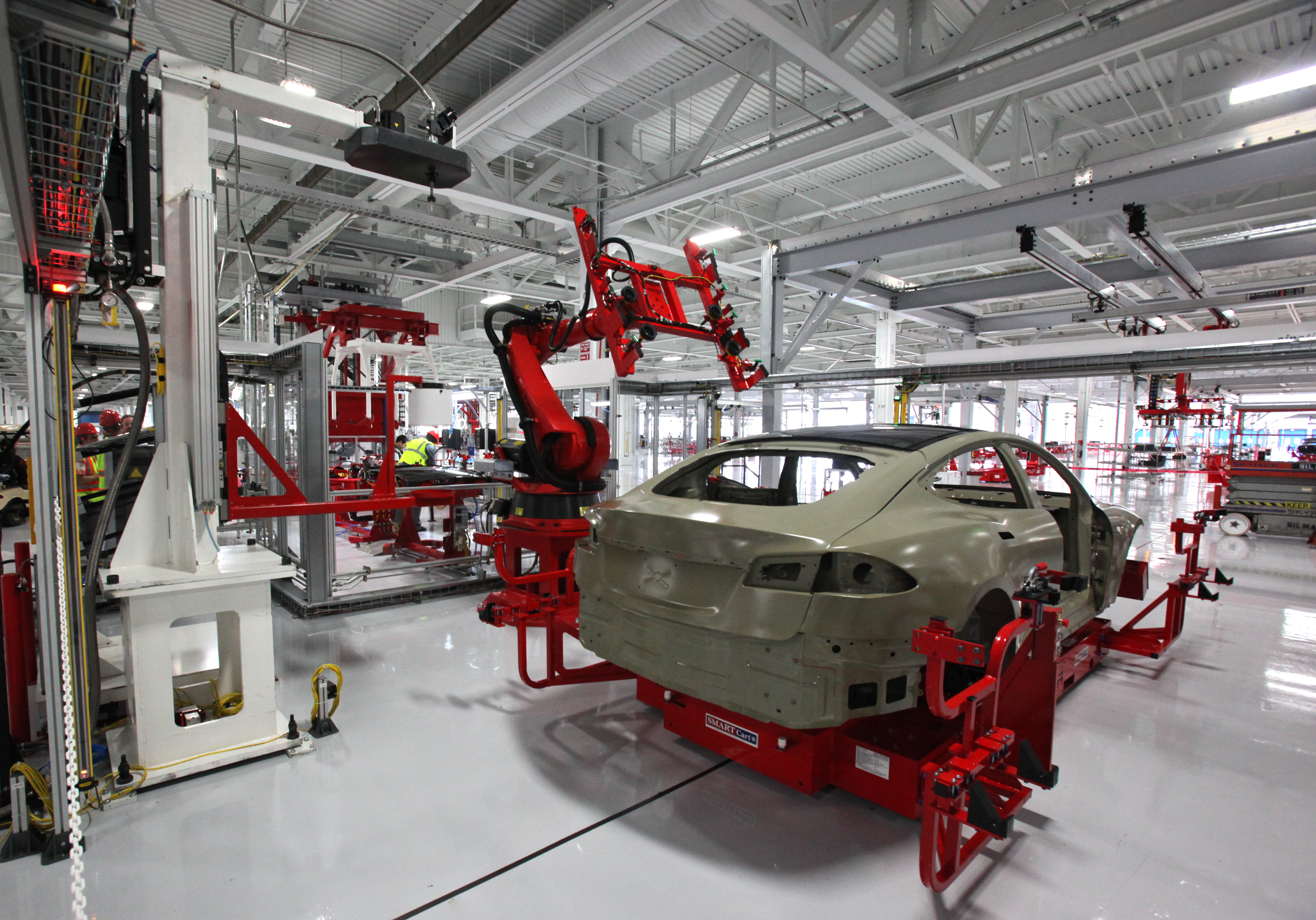
Tesla’s approach to manufacturing is as revolutionary as its product designs. Traditional automotive manufacturing involves hundreds of stamping, welding, and assembly steps for vehicle body parts. Tesla has sought to drastically simplify this through innovations like the Giga Press. This colossal die-casting machine, the largest in the world, can cast large sections of a vehicle’s underbody as a single piece, replacing dozens of smaller components and thousands of welds. This significantly reduces manufacturing complexity, weight, cost, and the physical footprint of the factory.
The Giga Press is a testament to Tesla’s commitment to viewing the factory itself as a product, continuously optimizing production lines and processes for maximum efficiency. Its Gigafactories are designed with vertical integration in mind, aiming to produce everything from battery cells to entire vehicles on highly automated lines. This manufacturing philosophy, often dubbed “the machine that builds the machine,” distinguishes Tesla from legacy automakers and even many tech companies, emphasizing a holistic approach to engineering not just the product, but its entire production system. This drive for industrial innovation is critical for scaling production and achieving economies of scale necessary for widespread adoption of its technologies.
Software-Defined Vehicles and Over-the-Air Updates
A cornerstone of Tesla’s technological advantage is its pioneering of the “software-defined vehicle.” Unlike traditional cars that are largely hardware-centric with static software, Teslas are more akin to computers on wheels. Their deep integration of hardware and software allows for unprecedented levels of customization, feature additions, and performance improvements through over-the-air (OTA) software updates. This capability differentiates Tesla, allowing it to rapidly deploy new features, enhance existing ones, improve safety, and even boost performance (e.g., increased range or power) long after the vehicle has left the factory.
This continuous improvement model, borrowed from the consumer electronics and software industries, transforms the ownership experience. It means a Tesla vehicle can evolve and get better over time, rather than depreciating in technological relevance. From infotainment system enhancements to significant FSD beta updates, OTA capabilities keep Tesla at the forefront of automotive innovation. This deep software integration also extends to diagnostics and predictive maintenance, allowing the company to proactively address potential issues and gather valuable data for future vehicle development. “Where is Tesla” in this regard firmly places it as a leading exponent of the automotive industry’s digital transformation, blurring the lines between vehicle manufacturing and high-tech software development.
Market Dynamics and the Evolving Tech Landscape
Tesla’s meteoric rise was fueled by its early lead in electric vehicle technology, battery innovation, and advanced software integration. However, the technological landscape is rapidly evolving, with a surging tide of competition from both established automotive giants and ambitious new startups. This dynamic environment poses new questions about “where is Tesla” in terms of its sustained competitive advantage and its future trajectory as a technology leader.
The Rise of EV Competitors and Tech Duplication
Tesla’s initial dominance in the EV market provided a significant head start, allowing it to build scale and refine its technologies without direct, widespread competition. Today, that landscape has dramatically shifted. Nearly every major automaker, from Volkswagen and Hyundai to Mercedes-Benz and Ford, has committed billions to electrifying their fleets, often launching compelling EV models that compete directly with Tesla in terms of range, performance, and features. These legacy players bring decades of manufacturing expertise, established supply chains, and vast dealer networks to the EV race.
Furthermore, new EV startups, particularly from China (e.g., NIO, XPeng, Li Auto), are rapidly advancing, offering sophisticated vehicles with impressive battery technology, advanced infotainment systems, and their own nascent autonomous driving solutions. Many of these competitors are now prioritizing software-defined vehicle architectures and OTA updates, effectively duplicating or aspiring to match key aspects of Tesla’s tech stack. This widespread adoption of EV technology signifies the success of Tesla’s initial disruption but also presents a formidable challenge to maintaining its technological supremacy. The question “where is Tesla” now includes its position in a crowded field, no longer a solitary innovator.
Maintaining the Software and AI Edge
While hardware innovations like efficient motors and battery cells are increasingly becoming commoditized, Tesla’s core differentiator has arguably always been its software and AI capabilities. The vast data flywheel for FSD, its in-house developed AI chips (like Dojo and FSD chip), and its integrated software platform for vehicle control and user experience represent a substantial, though not insurmountable, lead. However, competitors are rapidly catching up. Automotive software development is now a critical battleground, with many companies investing heavily in their own AI divisions and partnering with tech giants to develop advanced driver-assistance systems (ADAS) and intelligent cockpit experiences.
Maintaining this edge requires continuous, rapid innovation. Tesla must not only continue to improve FSD but also to develop new AI applications, refine its user interface, and expand the functionality of its vehicles through software. Its ability to attract and retain top AI and software engineering talent will be crucial. The “where is Tesla” inquiry now centers on its capacity to stay several steps ahead in the AI and software arms race, demonstrating truly revolutionary capabilities that cannot be easily replicated.
Diversification and New Tech Horizons
Recognizing the intensifying competition in the automotive sector, Tesla’s future trajectory is increasingly defined by its diversification into broader technological horizons. Its expansion into stationary energy storage with Powerwall and Megapack is already a significant diversification that leverages its battery expertise. The ambitious Optimus humanoid robot project signals an even bolder move into general-purpose AI and robotics, potentially opening up entirely new markets for automation and labor solutions.
This diversification strategy is not just about new revenue streams; it’s about leveraging its core technological competencies – AI, battery science, and advanced manufacturing – across multiple, interconnected industries. Tesla aims to be a leader in sustainable energy generation and storage, intelligent automation, and transformative AI, not just EV manufacturing. This broader technological play suggests that “where is Tesla” is no longer just about its place in the automotive industry, but its evolving role as a central pillar in the global tech economy. Its success will depend on its ability to execute these ambitious projects while fending off growing competition in its established markets.
In conclusion, “where is Tesla?” is a dynamic question with an evolving answer. It is a company that has redefined multiple industries through relentless technological innovation, from the widespread adoption of electric vehicles to advancements in battery storage and the audacious pursuit of generalized artificial intelligence. While it faces an increasingly competitive landscape, with rivals rapidly adopting its pioneering tech, Tesla’s strategic focus on vertical integration, data-driven AI development, and audacious ventures into new frontiers like humanoid robotics continues to position it as a formidable force in the global technology ecosystem. Its future trajectory will be defined not just by its next product launch, but by its continued capacity to innovate at scale and effectively navigate the complex challenges inherent in pushing the boundaries of what’s technologically possible.
aViewFromTheCave is a participant in the Amazon Services LLC Associates Program, an affiliate advertising program designed to provide a means for sites to earn advertising fees by advertising and linking to Amazon.com. Amazon, the Amazon logo, AmazonSupply, and the AmazonSupply logo are trademarks of Amazon.com, Inc. or its affiliates. As an Amazon Associate we earn affiliate commissions from qualifying purchases.