
Discovering you owe the IRS a significant amount of money can be a daunting experience. Whether it’s due to an unexpected tax bill, miscalculated estimated taxes, or an oversight, the immediate reaction is often one of panic and stress. However, ignoring the problem is the worst possible course of action. The IRS is a powerful federal agency with a comprehensive collection apparatus, and outstanding tax debt will not simply disappear. The good news is that the IRS understands that taxpayers sometimes face financial hardships, and they offer a variety of programs designed to help individuals and businesses resolve their tax liabilities over time. Establishing a payment plan is not only a viable solution but often the most prudent financial decision, preventing the accumulation of penalties, interest, and more severe collection actions.

This guide will demystify the process of setting up a payment plan with the IRS, outlining the different options available, the steps involved in applying, and critical considerations for maintaining compliance and achieving long-term financial stability. By understanding your options and acting proactively, you can navigate tax debt with confidence and regain control of your financial future.
Understanding Your Tax Debt and IRS Options
Before diving into the specifics of setting up a payment plan, it’s crucial to understand the nature of your tax debt and the overarching philosophy of the IRS when it comes to collections. The IRS prefers to work with taxpayers to resolve debt rather than resort to aggressive collection tactics, but only if taxpayers engage with them.
Why You Might Need a Payment Plan
Tax debt can arise from numerous situations. Perhaps you were self-employed for the first time and underestimated your quarterly tax payments, or you received a large unexpected bonus at work and didn’t adjust your withholding. Life events, such as a job loss, medical emergency, or divorce, can also impact your ability to pay your taxes on time. Regardless of the cause, falling behind on your tax obligations can lead to significant financial strain. The IRS charges both penalties for failure to pay and interest on underpayments, which can quickly compound the original debt. A payment plan is designed to halt the escalation of these charges and provide a structured path to full repayment.
Overview of IRS Payment Solutions
The IRS offers several distinct programs for taxpayers struggling with unmanageable tax debt. Understanding these options is the first step toward selecting the most appropriate solution for your circumstances:
-
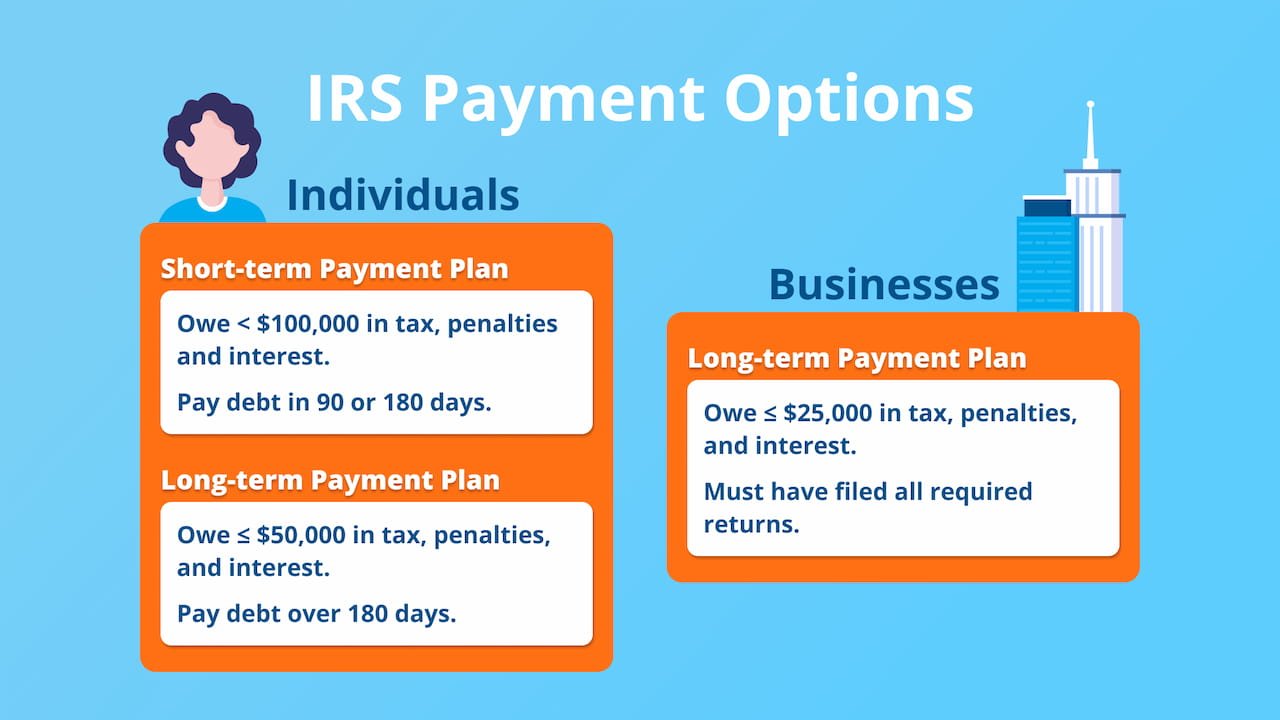
Installment Agreement (IA): This is the most common and straightforward payment plan. It allows taxpayers to make monthly payments for up to 72 months (six years). It can be a short-term plan (up to 180 days) or a long-term plan (up to 72 months).
-
Offer in Compromise (OIC): An OIC allows certain taxpayers to resolve their tax liability with the IRS for a lower amount than they originally owe. This option is typically considered when a taxpayer demonstrates an inability to pay the full amount due to economic hardship. It’s not for everyone and requires a thorough financial analysis.
-
Currently Not Collectible (CNC) Status: If the IRS determines that you cannot pay any of your tax debt due to extreme financial hardship, they may place your account in CNC status. This is a temporary measure, and the IRS will periodically review your financial situation to see if it has improved. While in CNC status, the IRS will not actively pursue collections, but penalties and interest will continue to accrue, and the statute of limitations for collection continues to run.
The Importance of Proactive Communication with the IRS
The single most important piece of advice when facing tax debt is to communicate with the IRS. Ignoring notices or hoping the problem will go away only leads to more severe consequences, such as tax liens, wage garnishments, or bank levies. The IRS is more likely to work with taxpayers who initiate contact and demonstrate a willingness to resolve their debt. Proactive engagement can prevent escalation and open the door to negotiation and resolution options tailored to your situation.
Navigating the Installment Agreement Process
The Installment Agreement (IA) is the most frequently utilized payment plan because it’s accessible to a broad range of taxpayers. It allows you to make manageable monthly payments over time, providing a structured approach to eliminating your tax debt.
Eligibility Requirements for an Installment Agreement
Generally, to qualify for a streamlined Installment Agreement, individuals and businesses must meet specific criteria:
-
Individuals: You must owe a combined total of tax, penalties, and interest of $50,000 or less. You must also have filed all required tax returns.
-
Businesses (sole proprietors, partnerships, corporations): Businesses must owe a combined total of tax, penalties, and interest of $25,000 or less, and have filed all required tax returns.
-
Payment History: You must be up-to-date with your estimated tax payments or withholding for the current tax year to avoid accumulating new tax debt.
If you owe more than these amounts, you might still qualify for a non-streamlined IA, but it will involve a more detailed financial review by the IRS.
Steps to Apply for a Short-Term Payment Plan
A short-term payment plan gives you up to 180 additional days to pay your tax liability in full, though interest and penalties still apply. This is a good option if you know you’ll have the funds soon but need a brief extension.
-
Online: For balances up to $100,000, you can request a short-term payment plan through the IRS Online Payment Agreement application.
-
Phone/Mail: You can also call the IRS directly or include a request with your tax return.
Steps to Apply for a Long-Term Payment Plan (Streamlined vs. Non-Streamlined)
A long-term payment plan, also known as a monthly installment agreement, allows you up to 72 months to pay your debt.
-
Streamlined Installment Agreement (Online Payment Agreement): This is the easiest and quickest way to set up a long-term plan if you meet the eligibility thresholds ($50,000 for individuals, $25,000 for businesses). You can apply online via the IRS’s Online Payment Agreement application. Approval is often immediate.
-
Non-Streamlined Installment Agreement: If you owe more than the streamlined thresholds, or if the IRS rejected your online application, you’ll need to apply using Form 9465, Installment Agreement Request. This often requires a more detailed financial disclosure, potentially including Form 433-F (Collection Information Statement) for individuals or Form 433-B (Collection Information Statement for Businesses). The IRS will review your income, expenses, assets, and ability to pay to determine a suitable monthly payment amount. This process can take several weeks or months.
What Information You’ll Need to Provide
Regardless of the specific application method, having accurate information readily available will expedite the process. You’ll typically need:
-
Your Social Security Number (or EIN for businesses)
-
Your date of birth
-
Your current address
-
The tax years for which you owe
-
The total amount you owe
-
Your proposed monthly payment amount and the date you can make payments
-
Bank account information for direct debit (optional but recommended for reliability)
-
For non-streamlined agreements, detailed financial information including income sources, monthly living expenses (housing, utilities, food, transportation, medical, etc.), and asset information.
Exploring Alternative IRS Debt Resolution Strategies

While an Installment Agreement is the most common solution, it’s not the only one. For those facing severe financial hardship or who believe the amount they owe is incorrect, other powerful options exist.
Offer in Compromise (OIC): When “Less Than You Owe” is Possible
An Offer in Compromise (OIC) is an agreement between a taxpayer and the IRS that resolves a tax liability for less than the full amount owed. The IRS will generally agree to an OIC when there’s doubt as to collectibility (you can’t pay the full amount), doubt as to liability (you believe you don’t owe the tax), or effective tax administration (collecting the full amount would cause economic hardship).
-
Eligibility: To qualify for an OIC, you must have filed all required tax returns, made all required estimated tax payments for the current year, and not be in an open bankruptcy proceeding. The IRS looks at your ability to pay, income, expenses, and asset equity.
-
Application Process: The OIC process is more complex than an IA. It requires completing Form 656, Offer in Compromise, along with Form 433-A (OIC), Collection Information Statement for Wage Earners and Self-Employed Individuals, or Form 433-B (OIC), Collection Information Statement for Businesses. You’ll also need to include a non-refundable application fee (unless you meet low-income guidelines) and your initial offer payment. The IRS reviews these forms meticulously to determine your “reasonable collection potential” – the most they can expect to collect from you.
-
Considerations: OICs are not easily granted and often take 6-12 months for the IRS to process. It’s crucial to present a compelling case with detailed financial documentation.
Currently Not Collectible (CNC) Status: A Temporary Reprieve
If your current financial situation is so dire that paying even a minimal amount would leave you unable to meet basic living expenses, the IRS might place your account in Currently Not Collectible (CNC) status.
-
Eligibility: To qualify, you must demonstrate significant financial hardship, typically requiring a detailed financial disclosure via Form 433-F or Form 433-A (Collection Information Statement). The IRS will review your income and expenses, ensuring that your expenses do not exceed your income and that you have no disposable income to apply towards the tax debt.
-
Implications: While in CNC status, the IRS will temporarily stop collection efforts. However, interest and penalties continue to accrue, and a federal tax lien may still be filed. The IRS will periodically review your financial situation, and if it improves, they will resume collection efforts. The statute of limitations for collection (usually 10 years) continues to run during this period.
-
Purpose: CNC status is a lifeline for those facing extreme, temporary financial distress, offering a temporary pause from collection pressure.
The Role of Tax Professionals (CPAs, Enrolled Agents, Tax Attorneys)
Navigating the complexities of IRS payment plans and debt resolution can be overwhelming. A qualified tax professional – such as a Certified Public Accountant (CPA), an Enrolled Agent (EA), or a tax attorney – can be invaluable.
-
Expert Guidance: They understand tax law, IRS procedures, and negotiation tactics.
-
Representation: They can communicate directly with the IRS on your behalf, often alleviating significant stress.
-
Strategic Advice: They can help you determine the best course of action, prepare necessary documentation, and ensure you comply with all requirements, increasing your chances of a favorable outcome. For complex cases like OICs or significant debt, professional assistance is highly recommended.
Maintaining Compliance and Avoiding Future Issues
Securing a payment plan with the IRS is a significant step towards resolving your tax debt, but it’s not the final one. Successfully completing your payment plan and preventing future tax issues requires ongoing diligence and smart financial habits.
Understanding Payment Plan Terms and Conditions
Once your payment plan is approved, it’s critical to understand and adhere to its terms. Key aspects include:
-
Monthly Payment Amount: Know the exact amount due each month.
-
Due Date: Mark your calendar for the monthly due date. Setting up direct debit (DDIA) is often the most reliable way to ensure payments are made on time and can sometimes reduce the user fee for the installment agreement.
-
New Tax Filings: You must continue to file all future tax returns on time.
-
Current Tax Payments: You must pay all future tax liabilities on time. This often means adjusting your withholding or making accurate estimated tax payments to avoid accruing new debt while you’re still paying off old debt.
-
Penalties and Interest: While an installment agreement prevents further collection actions, interest and failure-to-pay penalties generally continue to accrue on the outstanding balance until the debt is paid in full.
Consequences of Defaulting on a Payment Plan
Failing to meet the terms of your payment plan can have serious repercussions:
-
Default: The IRS will consider your agreement to be in default.
-
Accelerated Debt: The full amount of your remaining tax debt may become immediately due.
-
Renewed Collection Actions: The IRS can restart or intensify collection efforts, including issuing levies on bank accounts or wages, or filing a federal tax lien, which can severely damage your credit.
-
Loss of Future Options: You may find it more difficult to secure another payment plan or other resolution options in the future.
If you anticipate difficulty making a payment, contact the IRS immediately to discuss your situation. They may be willing to temporarily adjust your plan or offer other solutions.
Strategies for Preventing Future Tax Debt
The best way to avoid the stress of tax debt is to prevent it in the first place.
-
Adjust Withholding: If you’re an employee, review your Form W-4 annually or when your financial situation changes (marriage, new job, children). Use the IRS Tax Withholding Estimator tool on their website.
-
Make Estimated Payments: If you are self-employed, have significant investment income, or income not subject to withholding, make quarterly estimated tax payments (Form 1040-ES) to cover your tax liability throughout the year.
-
Maintain Accurate Records: Keep meticulous records of all income and expenses to ensure accurate tax preparation.
-
Budget for Taxes: Incorporate taxes into your regular budget, especially if you’re self-employed. Set aside a percentage of your income specifically for taxes.
-
Seek Professional Advice: Consult a tax professional for complex financial situations or business structures to ensure optimal tax planning and compliance.
Financial Planning Beyond Tax Debt Resolution
Successfully resolving tax debt is a significant financial accomplishment, but it should also be a catalyst for broader financial planning and stability. Once the burden of past tax debt is lifted, focus on building a resilient financial future.
Rebuilding Your Financial Foundation
After a period of financial strain due to tax debt, it’s essential to pivot towards rebuilding. This involves reviewing your overall financial health, assessing where you can improve, and setting new financial goals. A paid-off tax debt frees up cash flow that can now be directed towards savings, investments, or other priorities.
Budgeting and Savings Strategies
The discipline learned through adhering to an IRS payment plan can be reapplied to your everyday finances.
-
Create a Realistic Budget: Understand your income and expenses. Identify areas where you can cut back and areas where you can save.
-
Build an Emergency Fund: Aim for 3-6 months of living expenses in a readily accessible savings account. This fund is critical for absorbing unexpected costs without incurring new debt, including potential future tax shortfalls.
-
Automate Savings: Set up automatic transfers from your checking to your savings account each payday. Treat savings as a non-negotiable expense.
Long-Term Financial Security
With tax debt behind you, consider long-term financial goals:
-
Debt Reduction: Tackle other high-interest debts, such as credit card balances.
-
Retirement Planning: Contribute regularly to retirement accounts like a 401(k) or IRA.
-
Investment: Explore investment opportunities to grow your wealth over time.
-
Insurance Review: Ensure you have adequate health, life, disability, and property insurance to protect your assets and income.
-
Estate Planning: Even if you’re young, consider basic estate planning documents like a will and powers of attorney.
Making a payment plan with the IRS is more than just addressing a past obligation; it’s an opportunity to establish better financial habits and pave the way for a more secure and prosperous future. By taking proactive steps, leveraging available resources, and committing to ongoing financial vigilance, you can successfully navigate tax challenges and emerge stronger.
aViewFromTheCave is a participant in the Amazon Services LLC Associates Program, an affiliate advertising program designed to provide a means for sites to earn advertising fees by advertising and linking to Amazon.com. Amazon, the Amazon logo, AmazonSupply, and the AmazonSupply logo are trademarks of Amazon.com, Inc. or its affiliates. As an Amazon Associate we earn affiliate commissions from qualifying purchases.