
Navigating the complexities of the Internal Revenue Service (IRS) can be a daunting task for even the most financially literate individuals. While digital payment methods have become the standard for modern personal finance, a significant number of taxpayers still prefer or require the use of physical mail to settle their tax obligations. Whether you are paying a balance due on a 1040 return, making an estimated tax payment for your side hustle, or settling an assessment from a prior year, sending your money to the correct location is paramount. A misdirected payment can lead to processing delays, unnecessary late fees, and the stressful arrival of automated collection notices.
In the realm of personal finance and business management, understanding the logistics of tax compliance is just as critical as the strategy behind your investments. This guide provides a detailed breakdown of where to mail IRS payments, how to ensure your payment is processed accurately, and the strategic considerations of choosing physical mail over digital alternatives.
Navigating the Logistics of Physical Tax Payments
Sending a check or money order to the federal government is more than just putting an envelope in a mailbox. It requires a specific set of administrative steps to ensure that the funds are credited to the correct account and tax year. The IRS processes millions of payments annually; without the proper documentation, your payment could sit in a “suspense account” for months while the agency attempts to identify its purpose.
The Critical Role of Form 1040-V
If you are mailing a payment along with your tax return, or even if you are mailing it separately after e-filing, you should utilize Form 1040-V, the Payment Voucher. This small, one-page document is arguably the most important piece of paper in your envelope. It contains a scan-line that allows IRS high-speed processing equipment to automatically read your Social Security Number (SSN), the tax year, and the amount being paid.
Using a voucher significantly reduces the margin for human error during the data entry phase at the IRS service center. If you do not have a pre-printed voucher from your tax software, you can download a blank Form 1040-V from the IRS website. When filling it out, ensure that your SSN is clearly legible and matches the number on your tax return. For those filing a joint return, use the SSN that appears first on the 1040 form.
Check Formatting and Identification
Beyond the voucher, the check itself must be formatted correctly. The IRS has strict guidelines for how payments should be drafted. First, make the check or money order payable to the “United States Treasury,” not “IRS” or “Internal Revenue Service.” While the agency will often process checks made out to the latter, using the official “United States Treasury” designation is the professional standard and ensures there are no issues with bank clearance.
On the memo line of your check, you must include four vital pieces of information:
-
Your name and address.
-
Your daytime phone number.
-
Your Social Security Number (or Employer Identification Number if it is a business payment).
-
The tax year and the form number (e.g., “2023 Form 1040”).
This redundancy is a safeguard. If your check and voucher become separated during processing, the information on the check allows the IRS agent to manually track the payment back to your account.
Determining Your Correct Mailing Address
The most common question taxpayers ask is, “Where exactly does the envelope go?” The answer depends on two primary factors: your state of residence and whether or not you are enclosing your tax return with the payment. The IRS utilizes several processing centers across the country, including hubs in Cincinnati, Hartford, Charlotte, and San Francisco. These locations are strategically distributed to manage the massive volume of paper mail received during peak tax season.
Payments Accompanying a Paper Return
If you are filing a paper tax return and including a payment in the same envelope, the address is often different than if you were just sending a check. The IRS divides the country into regions. For example, taxpayers living in Florida, Louisiana, Mississippi, or Texas typically mail their returns and payments to a service center in Charlotte, North Carolina. Conversely, those in California or New York may be directed to centers in Philadelphia or Kansas City.
It is vital to consult the specific instructions for Form 1040 for the current tax year. The IRS occasionally shifts its processing workloads between centers to balance the administrative burden, meaning the address you used last year might not be the correct one for this year.
Payments Sent Without a Return
Many taxpayers choose to e-file their returns for speed and accuracy but prefer to mail a physical check for the balance due. In this scenario, you are sending a “stand-alone” payment. The addresses for these payments are generally different from the filing addresses.
For instance, a taxpayer in the Midwest might mail their return to Kansas City, but if they are only mailing a payment voucher (Form 1040-V), the destination might be a lockbox address in Cincinnati. These lockboxes are high-security financial processing centers operated by banks on behalf of the U.S. Treasury, designed specifically for rapid check deposit.
Special Cases: Estimated Taxes and Extensions
For entrepreneurs, freelancers, and investors, tax season happens four times a year. Estimated tax payments (Form 1040-ES) follow a similar regional logic but have their own dedicated mailing lists. Similarly, if you are filing for an extension (Form 4868) and making a payment to avoid interest and penalties, you must use the address designated for extension payments.
Misrouting an estimated tax payment is a common error for side hustlers. Because these payments are credited toward the current year rather than the previous year’s filing, an address error can lead to a “missing” payment when you eventually file your annual return, potentially triggering a penalty for underpayment of estimated tax.
Best Practices for Secure and Timely Mailing
In the world of business finance, documentation is everything. When you mail a payment to the IRS, you are entrusting the postal service with a sensitive financial document. Taking extra precautions is not just about paranoia; it is about creating a “paper trail” that can protect you in the event of an audit or a lost package.
The Importance of Certified Mail and Tracking
The “Postmark Rule” is a fundamental principle of tax law. According to the IRS, a payment is considered “on time” if the envelope is postmarked by the due date, even if the IRS does not receive or process it until days later. However, a standard postage stamp does not provide proof of when the envelope was mailed.
To protect yourself, always use USPS Certified Mail with a Return Receipt Requested. This provides you with a mailing receipt that bears a postmark and a tracking number. If the IRS later claims your payment was late, this receipt is your “get out of jail free” card. It serves as legal proof of timely filing and payment. For high-value payments, some taxpayers prefer using private delivery services like FedEx or UPS. The IRS maintains a list of “Approved Private Delivery Services” that qualify for the postmark rule, which includes specific services like FedEx Priority Overnight and UPS Next Day Air.
Common Pitfalls to Avoid
One of the most frequent mistakes is the use of staples. Never staple your check or Form 1040-V to your tax return. The IRS uses high-speed scanners that can be damaged by staples, and stapled documents must be manually separated, which slows down the processing of your payment. Instead, use a paperclip or simply leave the documents loose inside the envelope.
Additionally, ensure that you are using a sufficiently sized envelope. Folding a tax return and multiple schedules into a small letter envelope can make the documents difficult to scan. A large 9×12 manila envelope allows the documents to remain flat, ensuring the scan-line on your voucher remains readable.
Evaluating the Alternatives: Digital vs. Physical Payments
While mailing a payment is a traditional and reliable method, it is important for the modern taxpayer to weigh this against digital tools. Financial efficiency often dictates choosing the method that offers the most security and the least administrative friction.
IRS Direct Pay and EFTPS
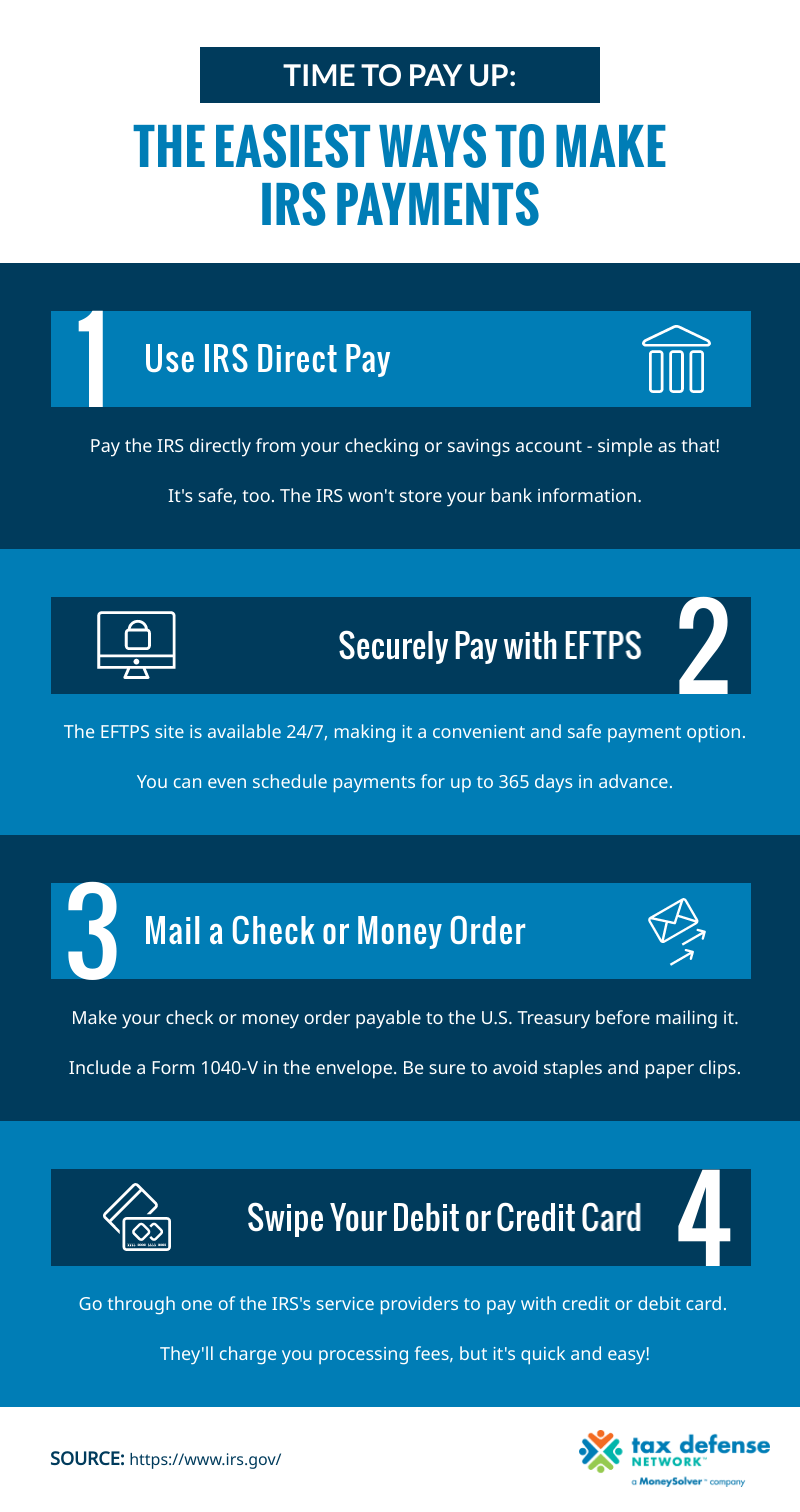
For personal finance management, IRS Direct Pay is often the superior choice. This free service allows you to pay directly from your checking or savings account without the need for a voucher or a stamp. The primary advantage is the instant confirmation number. Unlike a mailed check, which may take weeks to clear, a Direct Pay transaction provides immediate peace of mind that the obligation has been met.
For business owners or those with complex side hustles, the Electronic Federal Tax Payment System (EFTPS) is a more robust tool. While it requires a separate registration process and a mailed PIN, it allows you to schedule payments in advance and maintain a detailed history of all federal tax deposits. From a business finance perspective, the ability to schedule estimated payments months in advance is an excellent way to manage cash flow and ensure compliance without the risk of forgetting a mailing deadline.
Debit and Credit Card Options
The IRS also allows payments via debit and credit cards through third-party processors. While this can be a tempting way to “earn points” or “cash back,” it is rarely a sound financial decision. These processors charge a convenience fee, typically ranging from 1.8% to 2%. Unless your credit card’s rewards rate significantly exceeds this fee, you are effectively losing money. However, in a cash-flow emergency, using a credit card to pay the IRS can be a strategic move to avoid the 0.5% per month “Failure to Pay” penalty, provided you have a plan to pay off the balance quickly.
Strategic Financial Management for Effective Tax Seasons
Ultimately, knowing where to mail your IRS payment is only one piece of the broader financial puzzle. Effective tax management is a year-round endeavor that involves proactive planning and the use of the right financial tools.
Building a Tax Reserve
One of the most effective personal finance habits is the creation of a dedicated tax reserve account. For freelancers and those with significant non-wage income, setting aside 25% to 30% of every dollar earned into a high-yield savings account ensures that the funds are available when the payment deadline arrives. When you eventually mail that check to the IRS, the interest earned in the interim belongs to you, not the government. This approach turns tax compliance from a source of stress into a structured administrative task.

The Impact of Payment Timing on Cash Flow
In business finance, the timing of payments is a critical component of liquidity management. While the IRS requires timely payments, there is no financial benefit to paying earlier than necessary, unless you are attempting to mitigate interest on a past-due balance. By keeping your tax funds in your own accounts until the deadline—and then mailing the check using the postmark rule—you maximize your own “float.”
However, this strategy requires discipline. If you choose to mail your payment on the very last day, the importance of using certified mail cannot be overstated. You are essentially trading the convenience of an early payment for the marginal gain of keeping your cash for a few extra weeks; you must ensure that this trade-off does not result in a late-filing penalty due to a postal error.
In conclusion, while the world moves toward an increasingly paperless financial system, the ability to navigate the physical mailing of IRS payments remains a vital skill. By identifying the correct service center, formatting your documents with precision, and utilizing secure mailing methods, you can ensure that your financial obligations are met with professional rigor. Whether you are a seasoned investor or a first-time side hustler, mastering these logistical details is an essential step in maintaining your overall financial health and peace of mind.
aViewFromTheCave is a participant in the Amazon Services LLC Associates Program, an affiliate advertising program designed to provide a means for sites to earn advertising fees by advertising and linking to Amazon.com. Amazon, the Amazon logo, AmazonSupply, and the AmazonSupply logo are trademarks of Amazon.com, Inc. or its affiliates. As an Amazon Associate we earn affiliate commissions from qualifying purchases.