
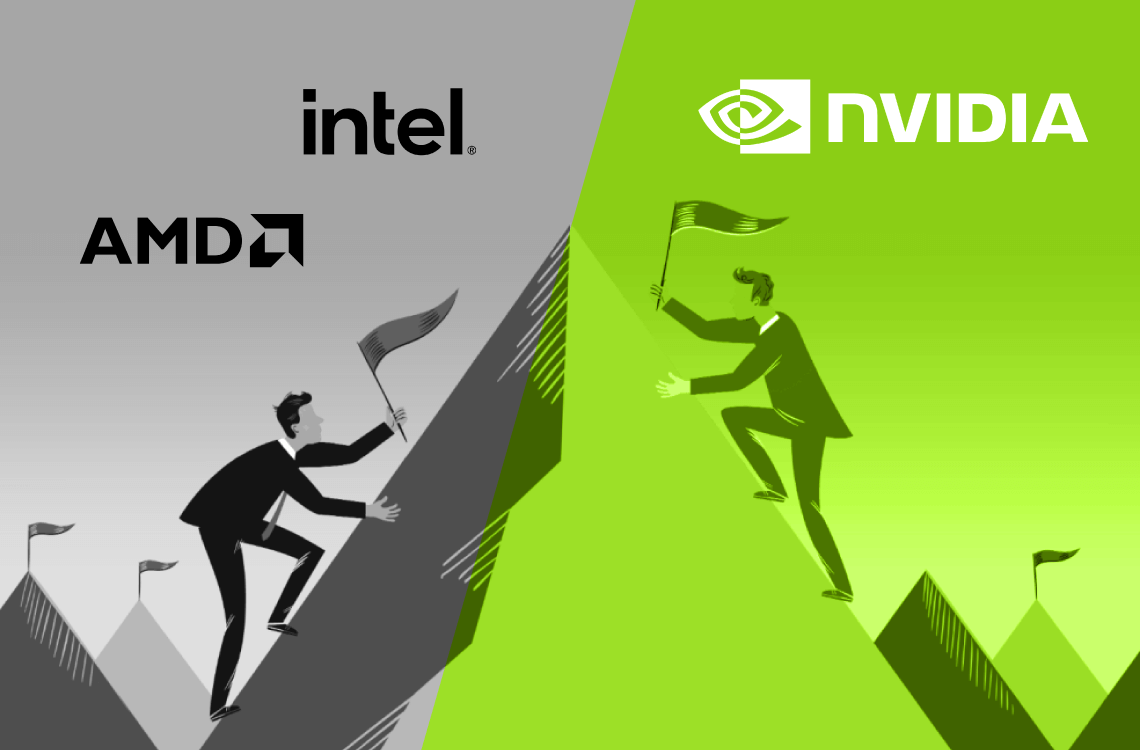
NVIDIA has transcended its origins as a graphics card manufacturer to become a pivotal force in the technological revolution, particularly in artificial intelligence, high-performance computing, and autonomous systems. Its ubiquitous GPUs power everything from immersive gaming experiences to the most advanced data centers driving global AI models. However, despite its seemingly unshakeable dominance in several key sectors, NVIDIA operates within a fiercely competitive landscape. Understanding “who is NVIDIA’s competition” requires a nuanced look at various segments, from traditional hardware rivals to emerging software platforms and specialized chip developers. This article will delve into the multifaceted challenges NVIDIA faces, dissecting its competitors across its core business areas and exploring the evolving dynamics of the technology industry.

The Core Battlefield: Graphics Processing Units (GPUs)
At its heart, NVIDIA’s legacy and current prowess are built upon the Graphics Processing Unit. While initially designed for rendering sophisticated visuals in video games, the parallel processing capabilities of GPUs proved uniquely suited for a broader range of computational tasks, fundamentally reshaping computing paradigms. This segment remains a primary arena for intense competition.
Gaming GPUs: A Duopoly Under Pressure
For decades, the discrete graphics card market for PC gaming has largely been a duopoly between NVIDIA and Advanced Micro Devices (AMD). This rivalry is one of the most visible and hotly contested.
-
Advanced Micro Devices (AMD): AMD’s Radeon division is NVIDIA’s most direct and enduring competitor in the consumer gaming space. While often trailing NVIDIA in raw performance at the very high-end, AMD consistently offers competitive price-to-performance ratios and frequently innovates with features like its FidelityFX Super Resolution (FSR) upscaling technology, which offers broader hardware compatibility compared to NVIDIA’s proprietary DLSS (Deep Learning Super Sampling). AMD’s strategy often involves leveraging its CPU division (Ryzen) to create integrated platforms that offer synergy benefits, attracting users seeking an all-AMD ecosystem. The competition is a continuous seesaw of architectural advancements, memory bandwidth wars, and software optimizations, with both companies vying for market share and developer mindshare through exclusive game bundles and technology partnerships.
-
Intel (Arc series): A significant new entrant in this traditional duopoly is Intel, which launched its Arc series of discrete GPUs in 2022. While initially facing challenges in driver maturity and performance consistency, Intel’s foray signals a long-term commitment to becoming a third player. With its immense financial resources, semiconductor manufacturing capabilities, and vast reach in the PC market through its CPUs, Intel represents a formidable potential threat. Should Intel successfully refine its Arc architecture and software stack, it could disrupt pricing structures and offer consumers more choice, directly impacting NVIDIA’s long-held market leadership. Their focus on media encoding capabilities and AI acceleration also hints at broader ambitions beyond pure gaming.
Data Center and AI Accelerators: The New Frontier
The data center market, particularly for AI training and inference, has become NVIDIA’s most lucrative and strategically vital segment. Here, the competition is arguably even more intense and diverse, encompassing traditional rivals, hyperscale cloud providers, and specialized AI chip startups.
-
Advanced Micro Devices (AMD Instinct series): AMD has aggressively pursued the data center and AI market with its Instinct series accelerators. Products like the MI250X and the more recent MI300X are directly positioned against NVIDIA’s H100 and A100 GPUs. AMD’s strategy involves leveraging its modular chiplet designs, providing competitive performance, and fostering an open-source software ecosystem (ROCm) as an alternative to NVIDIA’s proprietary CUDA platform. The company aims to break NVIDIA’s software lock-in, which many see as its primary competitive advantage in AI. Growing adoption by national supercomputing centers and cloud providers indicates AMD is gaining traction.
-
Intel (Gaudi, Xeon Max, and more): Intel’s data center AI strategy is multi-pronged. Through its acquisition of Habana Labs, Intel offers the Gaudi AI accelerators, specifically designed for deep learning training and inference. Additionally, Intel’s Xeon Max CPUs integrate High Bandwidth Memory (HBM) and offer specialized vector extensions that can perform AI tasks, blurring the lines between CPU and accelerator. Intel’s broader vision, embodied by its oneAPI initiative, seeks to provide a unified software stack across CPUs, GPUs, FPGAs, and AI accelerators, aiming to simplify development and reduce reliance on proprietary ecosystems.
-
Hyperscale Cloud Providers (Custom AI Chips): Perhaps the most significant “indirect” competition comes from NVIDIA’s own customers: the hyperscale cloud providers. Google developed its Tensor Processing Units (TPUs), Amazon has its Inferentia and Trainium chips, and Microsoft is investing heavily in its custom Maia and Athena AI accelerators. These companies are designing their own specialized silicon to power their internal AI workloads, reduce dependency on external vendors, optimize for their specific infrastructure, and potentially offer more cost-effective solutions to their cloud customers. While they still heavily use NVIDIA GPUs, the existence and continuous improvement of these custom chips represent a long-term strategic threat to NVIDIA’s market share in the AI acceleration space.
-
Specialized AI Startups: The AI boom has also spawned numerous startups developing highly specialized AI processors. Companies like Cerebras Systems (with its massive Wafer-Scale Engine), Graphcore (IPUs), SambaNova Systems, and many others are exploring novel architectures tailored for specific AI workloads. While their market share is currently small compared to NVIDIA, they push the boundaries of innovation and could capture niche markets or develop breakthrough technologies that eventually scale.
Expanding Horizons: Beyond Discrete GPUs
NVIDIA’s ambition extends far beyond discrete GPUs, with significant investments in professional visualization, automotive, and enterprise solutions. Each of these areas presents its own set of competitors.
Professional Visualization & Workstations
In professional markets, such as design, engineering, scientific visualization, and content creation, NVIDIA’s Quadro (now RTX A-series) GPUs have traditionally been dominant, known for their certified drivers and reliability.
-
Advanced Micro Devices (Radeon Pro): AMD directly competes with its Radeon Pro line of professional graphics cards. These GPUs offer certified drivers, workstation-grade performance, and often provide strong value propositions, especially in open-source software environments or applications optimized for AMD hardware.
-
Intel: While not a primary player in high-end professional discrete graphics, Intel’s integrated graphics solutions power a vast array of entry-level workstations and laptops, catering to less demanding professional tasks. As Intel’s discrete Arc GPUs mature, they may also aim for a share of the professional segment.
Automotive & Autonomous Driving
NVIDIA’s Drive platform for autonomous vehicles and in-car infotainment systems is a rapidly growing segment, but it faces formidable competition from established automotive suppliers and other tech giants.
-
Qualcomm: Qualcomm is a major competitor with its Snapdragon Ride platform, offering a comprehensive solution for ADAS (Advanced Driver-Assistance Systems) and autonomous driving, leveraging its vast experience in mobile processors and connectivity. Many major automakers have partnered with Qualcomm for their next-generation vehicle architectures.
-
Mobileye (an Intel subsidiary): Mobileye is a global leader in ADAS and vision-based self-driving technology, with deep relationships with virtually every major automaker. Its highly integrated hardware and software solutions pose a direct challenge to NVIDIA’s end-to-end platform approach.
-
Tesla (In-house Development): Tesla famously developed its own custom Full Self-Driving (FSD) chip, moving away from NVIDIA’s hardware. This move highlights the trend of large companies bringing critical technology development in-house, effectively becoming their own competitors.
-
NXP, Renesas, Infineon, Texas Instruments (TI): These traditional automotive semiconductor suppliers provide a wide range of microcontrollers, system-on-chips (SoCs), and power management ICs that are fundamental to modern vehicles. While not direct competitors to NVIDIA’s high-performance AI processors, they form the backbone of automotive electronics and influence the broader ecosystem.

Software Ecosystem and Platform Lock-in
Perhaps NVIDIA’s most powerful, yet often underestimated, competitive advantage lies not just in its hardware but in its deeply entrenched software ecosystem. This creates a significant barrier to entry and a challenge for rivals.
CUDA’s Dominance
NVIDIA’s Compute Unified Device Architecture (CUDA) is a parallel computing platform and programming model that allows developers to use NVIDIA GPUs for general-purpose processing.
-
The Power of CUDA: CUDA’s maturity, extensive libraries, developer tools, and massive community support make it the de facto standard for GPU-accelerated computing, especially in AI and scientific computing. It’s a key reason why researchers and developers often prioritize NVIDIA hardware.
-
Competitors’ Efforts: AMD’s ROCm (Radeon Open Compute platform) and Intel’s oneAPI are direct responses to CUDA. Both aim to provide open, performant alternatives for GPU programming. While these platforms have made significant strides, they face an uphill battle against CUDA’s decade-plus lead in developer adoption, optimized frameworks, and vast library support. The challenge for competitors isn’t just matching hardware performance, but creating an equally robust and attractive software environment that can pull developers away from NVIDIA’s sticky ecosystem.
Cloud Partnerships and AI Frameworks
NVIDIA has cultivated strong relationships with all major cloud providers, ensuring its GPUs are central to their AI infrastructure offerings.
-
Strategic Alliances: NVIDIA’s close collaboration with AWS, Azure, Google Cloud, and Oracle Cloud ensures its hardware is optimized and readily available for AI workloads, reinforcing its position.
-
Framework Integration: Popular AI frameworks like TensorFlow and PyTorch are heavily optimized for NVIDIA’s CUDA platform. While efforts are underway to ensure better compatibility with AMD and Intel hardware, the performance and ease of use on NVIDIA GPUs often remain superior, maintaining its advantage.
Emerging Threats and Future Landscapes
The technology landscape is constantly evolving, and new paradigms and architectures could shift the competitive balance in the long term.
Chiplet Designs and Heterogeneous Computing
-
Modular Architectures: AMD pioneered the widespread use of chiplet designs in CPUs and is now extending this to GPUs and data center accelerators. This modular approach allows for greater flexibility, better yields, and potentially more cost-effective manufacturing of complex processors. NVIDIA has traditionally relied on monolithic dies for its high-end GPUs, but the industry trend towards chiplets could influence future designs and manufacturing strategies.
-
Heterogeneous Integration: The push for heterogeneous computing – combining different types of processing units (CPUs, GPUs, FPGAs, specialized AI accelerators) within a single system or package – is a key trend. Intel’s oneAPI and its broader integration strategy are direct examples of this, aiming to offer seamless development across diverse hardware, which could diminish the exclusive reliance on a single type of accelerator.
RISC-V and Open Standards
- Alternative Architectures: The rise of open-source instruction set architectures like RISC-V presents a long-term, foundational shift. While not a direct competitor to NVIDIA’s current products, RISC-V offers an alternative to proprietary architectures like ARM and x86. Its flexibility and open nature could foster a new wave of highly customized, domain-specific accelerators that could eventually compete with NVIDIA in various niche applications or even broader markets if adopted widely. Companies like SiFive and various startups are building RISC-V-based CPUs and accelerators.
Quantum Computing (Long-term)
- Paradigm Shift: Although still in its nascent stages, quantum computing represents a fundamental shift in how certain complex problems are solved. If quantum computers reach a point of practical supremacy for specific computational challenges currently tackled by supercomputers reliant on GPUs, it could reshape the high-performance computing landscape. NVIDIA is already investing in quantum research and simulation tools, recognizing the potential long-term impact.
Conclusion
NVIDIA’s competitive landscape is a complex tapestry woven from traditional hardware rivalries, strategic software ecosystem battles, and the emergence of new architectural paradigms. While NVIDIA holds a commanding lead in several critical areas, particularly in AI and data center acceleration due to its superior hardware and the pervasive influence of its CUDA platform, it is far from unchallenged. AMD continues to be a formidable adversary across gaming and data center GPUs, offering compelling alternatives and pushing for open standards. Intel, with its vast resources and multi-pronged strategy, is a long-term threat in both consumer and enterprise segments. Furthermore, the rise of hyperscale cloud providers developing their own custom AI silicon and a plethora of specialized AI startups underscores a future where computation is increasingly diversified and optimized for specific workloads.
NVIDIA’s continued success will depend not only on its ability to maintain hardware performance leadership but also on evolving its software ecosystem, fostering strategic partnerships, and adapting to new architectural trends like chiplets and the potential impact of open standards and quantum computing. The relentless competition in the technology sector ensures that innovation will continue at a breakneck pace, benefiting consumers, developers, and the advancement of artificial intelligence itself.
aViewFromTheCave is a participant in the Amazon Services LLC Associates Program, an affiliate advertising program designed to provide a means for sites to earn advertising fees by advertising and linking to Amazon.com. Amazon, the Amazon logo, AmazonSupply, and the AmazonSupply logo are trademarks of Amazon.com, Inc. or its affiliates. As an Amazon Associate we earn affiliate commissions from qualifying purchases.