
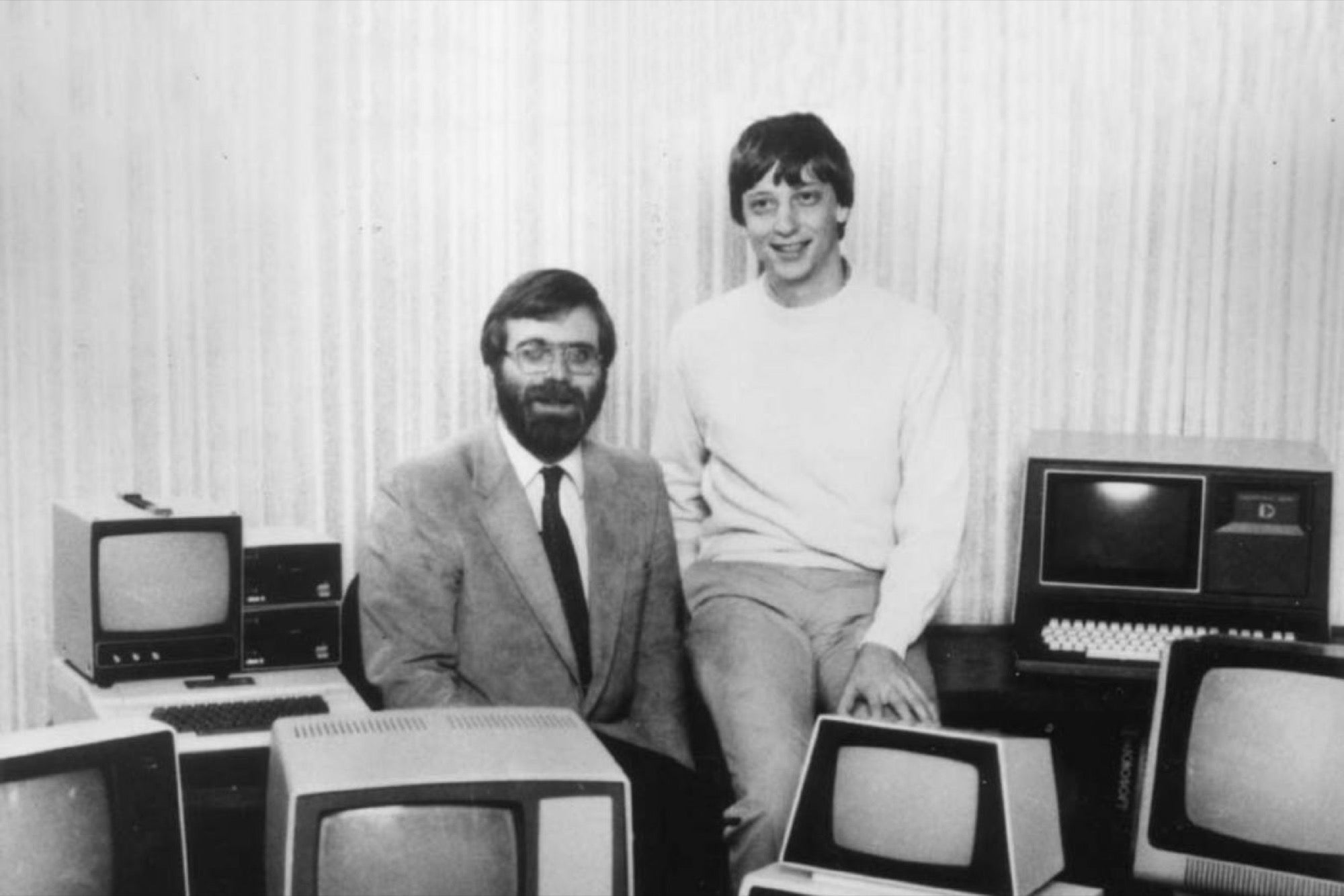
Microsoft was officially founded on April 4, 1975. While today the company is a global behemoth dominating everything from cloud computing to artificial intelligence, its origins were rooted in a small, rented office in Albuquerque, New Mexico. The creation of Microsoft was not just the birth of a corporation; it was the catalyst for the software industry as we know it. By shifting the focus of the technology world from hardware to software, founders Bill Gates and Paul Allen set the stage for a digital transformation that would eventually place a computer on every desk and in every home.
The Genesis of a Giant: April 4, 1975
The story of Microsoft’s creation begins with a single piece of hardware: the MITS Altair 8800. In early 1975, Paul Allen showed Bill Gates a cover of Popular Electronics magazine featuring the Altair, the world’s first commercially successful microcomputer. At the time, computers were massive, expensive machines reserved for large corporations and academic institutions. The Altair represented a shift toward accessibility, but it lacked one critical component: a user-friendly way to communicate with its hardware.
The Altair BASIC Breakthrough
Gates and Allen saw an opportunity to bridge the gap between human logic and machine code. They contacted Ed Roberts, the creator of the Altair, claiming they had developed a BASIC (Beginner’s All-purpose Symbolic Instruction Code) interpreter for the machine. In reality, they hadn’t written a single line of code for the Altair yet. After Roberts expressed interest, the duo spent eight weeks of intense coding at Harvard, using a PDP-10 simulator to mimic the Altair’s Intel 8080 processor.
When Allen flew to Albuquerque to demonstrate the software, it worked perfectly on the first try. This success led to the formal formation of “Micro-Soft” (a portmanteau of microcomputer and software) on April 4, 1975. The hyphen was eventually dropped, but the mission remained clear: to develop and sell software that made hardware useful.
Moving to Washington and the IBM Deal
By 1979, Microsoft moved its headquarters to Bellevue, Washington. The defining moment for the young company came in 1980 when IBM approached them to provide an operating system for their upcoming Personal Computer (PC). Since Microsoft did not yet have an operating system of its own, they purchased QDOS (Quick and Dirty Operating System) from Seattle Computer Products, refined it, and rebranded it as MS-DOS. Crucially, Gates insisted on a non-exclusive license, allowing Microsoft to sell MS-DOS to other hardware manufacturers. This move decoupled software from hardware, effectively creating the modern software market.
From BASIC to Windows: The Evolution of Software Engineering
As the 1980s progressed, Microsoft transitioned from a languages-and-tools company into a platform powerhouse. While MS-DOS was the backbone of the PC industry, its command-line interface was a barrier to entry for the general public. The tech industry was beginning to look toward Graphical User Interfaces (GUIs), pioneered by Xerox PARC and popularized by Apple.
The Launch of Windows 1.0
In November 1985, Microsoft released Windows 1.0. Rather than being a full operating system, it was a graphical shell that ran on top of MS-DOS. It introduced features that are now foundational to computing, such as scroll bars, “drop-down” menus, and icons. While initial reception was lukewarm due to hardware limitations of the era, it established the architectural blueprint for the future of the company’s software ecosystem.
The NT Kernel and 32-Bit Computing
The true technological leap occurred in the early 1990s with the development of Windows NT (New Technology). Unlike the consumer-grade Windows 95 and 98, which were still tethered to the aging architecture of MS-DOS, Windows NT was built from the ground up as a stable, 32-bit multi-tasking operating system for workstations and servers. This architectural shift was critical because it allowed Microsoft to enter the enterprise market, providing the stability and security required for corporate networks. Eventually, the consumer and professional lines merged with Windows XP in 2001, bringing the robust NT kernel to the masses.

The Productivity Suite: Microsoft Office
Parallel to the operating system’s growth was the development of application software. In 1989, Microsoft bundled its flagship applications—Word, Excel, and PowerPoint—into a single package known as Microsoft Office. This wasn’t just a marketing move; it was a technical integration. By ensuring that data could be easily moved between a spreadsheet and a word processor, Microsoft solidified its dominance in the workplace, making its software the universal language of global business.
Shaping the Modern Digital Ecosystem: Internet and Cloud Infrastructure
The mid-1990s brought a new challenge that nearly caught Microsoft off guard: the rise of the World Wide Web. In 1995, Bill Gates issued his famous “Internet Tidal Wave” memo, reorienting the entire company toward the web. This led to the “browser wars” of the late 90s, where Internet Explorer was integrated directly into Windows to compete with Netscape Navigator.
The Shift to Software as a Service (SaaS)
For decades, Microsoft’s business model relied on “shrink-wrapped” software—physical disks sold in boxes. However, the 2010s saw a massive shift in how technology was consumed. Under the leadership of Satya Nadella, who took the helm in 2014, Microsoft underwent a “mobile-first, cloud-first” transformation.
This resulted in the transition of Microsoft Office into Office 365 (now Microsoft 365). Instead of a one-time purchase, software became a subscription service, constantly updated via the cloud. This ensured that users always had the latest security patches and features, reflecting a broader trend in tech where software is treated as a living entity rather than a static product.
The Azure Backbone
Perhaps the most significant tech achievement of the modern era for Microsoft is Azure. Launched in 2010, Azure is a comprehensive cloud computing platform that provides infrastructure as a service (IaaS), platform as a service (PaaS), and software as a service (SaaS). It powers everything from global web applications to complex data analytics for Fortune 500 companies. The sheer scale of Azure’s data centers across the globe represents the physical manifestation of the “software-first” philosophy born in 1975.
The Future of Microsoft: AI and the Next Frontier of Technology
As we look beyond the anniversary of its 1975 founding, Microsoft has positioned itself at the forefront of the next great technological epoch: Artificial Intelligence. The company’s strategic partnership with OpenAI and the subsequent integration of Large Language Models (LLMs) into its product stack represent the most significant shift in computing since the invention of the graphical user interface.
Copilot and the AI-Infused OS
Microsoft is currently redesigning the computing experience through “Copilot,” an AI assistant integrated across Windows, Office, and GitHub. This is not merely a chatbot; it is a fundamental change in how humans interact with software. Instead of navigating menus or writing complex formulas, users can use natural language to command their devices. This brings Microsoft full circle—from creating a BASIC interpreter that made the Altair 8800 usable, to creating AI that makes the complexities of modern data management accessible to everyone.
Quantum Computing and Beyond
The engineering labs at Microsoft are also deep into the development of topological qubits for quantum computing. While still in the experimental phase, quantum computing promises to solve problems that would take classical supercomputers thousands of years to crack. By investing in the hardware and software requirements of the quantum era, Microsoft is ensuring that its 1975 founding principles—empowering people through technology—will continue to apply to the most advanced physics known to man.
The year 1975 was a pivot point in human history. By recognizing that the value of technology lay in the lines of code rather than the solder on a circuit board, Microsoft didn’t just build a successful company; it built the framework for the modern digital age. From the first line of BASIC on a paper tape to the billions of parameters in a neural network, Microsoft’s journey is a testament to the enduring power of software innovation.
aViewFromTheCave is a participant in the Amazon Services LLC Associates Program, an affiliate advertising program designed to provide a means for sites to earn advertising fees by advertising and linking to Amazon.com. Amazon, the Amazon logo, AmazonSupply, and the AmazonSupply logo are trademarks of Amazon.com, Inc. or its affiliates. As an Amazon Associate we earn affiliate commissions from qualifying purchases.