
The 30-year fixed-rate mortgage is the cornerstone of the American dream. For decades, it has served as the primary vehicle for homeownership, offering a level of predictability and stability that few other financial products can match. However, the question of what constitutes an “average” rate is far more complex than a single percentage point. Mortgage rates are dynamic, fluctuating daily based on a complex interplay of macroeconomic indicators, central bank policies, and individual borrower profiles.
Understanding the average rate for a 30-year fixed mortgage requires more than just looking at a headline; it requires an analysis of the economic engine that drives these numbers and an understanding of how personal financial health dictates the specific offer a borrower receives. In the current economic climate, where volatility has become the new baseline, staying informed on these trends is essential for any prospective homeowner or real estate investor.

The Macroeconomic Drivers of Mortgage Rates
To understand why the average 30-year fixed mortgage rate sits where it does today, one must look at the broader financial landscape. Mortgage rates are not set in a vacuum; they are influenced by several high-level economic factors that signal to lenders how much risk they are taking by locking in a rate for three decades.
The Influence of the Federal Reserve
One of the most common misconceptions in personal finance is that the Federal Reserve directly sets mortgage rates. In reality, the Fed sets the federal funds rate—the interest rate at which commercial banks borrow and lend to each other overnight. While this does not dictate mortgage rates, it sets the “floor” for the cost of capital. When the Fed raises rates to combat inflation, the cost of borrowing increases across the board. Mortgage lenders respond by raising their rates to maintain profit margins and account for the increased cost of obtaining the money they lend to consumers.
The 10-Year Treasury Yield
Perhaps the most accurate daily barometer for the 30-year fixed mortgage rate is the 10-year Treasury yield. Investors often view mortgage-backed securities (MBS) and Treasury bonds as competing investment vehicles. When the yield on the 10-year Treasury rises, mortgage rates almost always follow suit. This relationship exists because lenders must offer a higher interest rate on mortgages to attract investors who might otherwise put their money into the “risk-free” alternative of government bonds. Typically, there is a “spread” of about 150 to 300 basis points between the 10-year Treasury and the average 30-year mortgage.
Inflation and the Consumer Price Index (CPI)
Inflation is the natural enemy of fixed-income investments. Because a 30-year mortgage pays back a fixed amount of interest over a long period, the purchasing power of those future payments is eroded by inflation. When the Consumer Price Index shows that inflation is rising faster than expected, lenders increase mortgage rates to compensate for the loss of value over time. Conversely, when inflation cools, rates often stabilize or begin a downward trend.
Historical Perspective: From the 1980s to the Present
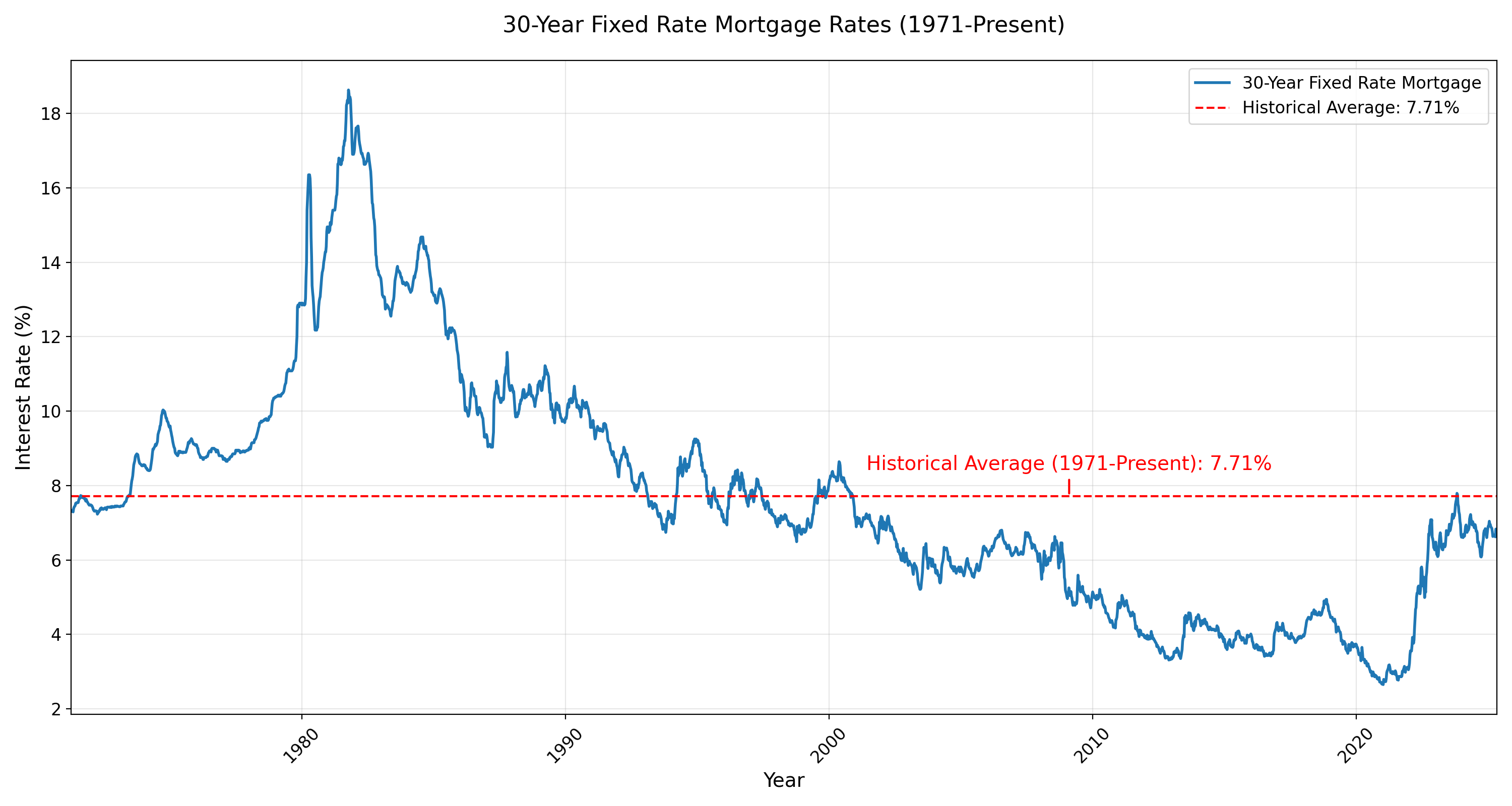
The definition of a “good” or “average” rate is entirely dependent on the historical context in which it is viewed. Borrowers today often feel the sting of rates that have doubled since the historic lows of the early 2020s, but a look at the long-term data provides much-needed perspective.
The Era of Double-Digit Rates
In the early 1980s, the United States faced rampant stagflation. To curb this, the Federal Reserve pushed interest rates to unprecedented heights. In 1981, the average 30-year fixed mortgage rate peaked at over 18%. For nearly a decade, rates remained in the double digits. For homeowners of that era, an 8% or 9% interest rate was considered a bargain.
The Great Moderation and the 2008 Crash
Following the 1980s, rates entered a multi-decade decline. By the early 2000s, rates hovered between 5% and 7%. After the 2008 financial crisis, the Federal Reserve engaged in quantitative easing, buying massive amounts of mortgage-backed securities to keep borrowing costs low and stimulate the housing market. This ushered in a decade of “cheap money,” where rates rarely climbed above 5%.
The Pandemic Anomaly
The COVID-19 pandemic created a unique economic vacuum. In late 2020 and throughout 2021, the average 30-year fixed mortgage rate dropped below 3% for the first time in history, bottoming out around 2.65%. This fueled a massive housing boom but also set an unrealistic expectation for future borrowers. As the economy reopened and inflation surged, the correction was swift and significant, leading to the higher-rate environment we see today.
How Individual Profiles Influence the “Personal” Average
While national averages are reported weekly by institutions like Freddie Mac, very few borrowers actually receive that exact rate. Your personal financial profile acts as a modifier to the national average, either granting you a “prime” discount or saddling you with a “subprime” premium.
The Power of the Credit Score
Your FICO score is the single most influential factor in determining your specific mortgage rate. Lenders categorize borrowers into tiers. Those with scores above 760 or 800 are often eligible for the lowest advertised rates. Conversely, a borrower with a score in the low 600s might face a rate that is 1% to 2% higher than the national average. Over the life of a 30-year loan, this seemingly small difference can result in over $100,000 in additional interest payments.
Debt-to-Income (DTI) and Loan-to-Value (LTV) Ratios
Lenders use these ratios to assess risk. A lower DTI (the percentage of your gross monthly income that goes toward debt) indicates that you are less likely to default. Similarly, the LTV ratio—determined by your down payment—impacts the rate. A borrower putting 20% down represents less risk to the lender than one putting 3% down. While low-down-payment programs exist, they often come with higher interest rates or the added cost of Private Mortgage Insurance (PMI), which effectively increases the monthly cost of borrowing.
Loan Type and Property Use
The 30-year fixed rate for a primary residence is generally lower than the rate for an investment property or a second home. Furthermore, “conforming” loans—those that fit the criteria set by Fannie Mae and Freddie Mac—usually offer better rates than “Jumbo” loans, which exceed local loan limits. Borrowers should also distinguish between conventional loans and government-backed options like FHA or VA loans, which may have lower base rates but different fee structures.
Strategies for Navigating High-Rate Environments
When the average mortgage rate is higher than desired, savvy borrowers employ specific strategies to mitigate the cost of borrowing. Finding the right rate is not just about timing; it is about active financial management.
Buying Down the Rate with Points
Discount points allow a borrower to pay upfront interest at closing in exchange for a lower permanent interest rate. One point typically costs 1% of the total loan amount and reduces the interest rate by approximately 0.25%. This is a “math problem” for the borrower: they must calculate the break-even point—how many months it will take for the monthly savings to exceed the initial cost of the points. If the borrower plans to stay in the home for a long time, buying points can be an excellent long-term investment.
The Importance of Comparison Shopping
Data suggests that borrowers who get at least three to five quotes can save thousands of dollars over the life of their loan. Different lenders have different “appetites” for risk and different overhead costs. A local credit union might offer a more competitive rate than a large national bank, or an online-only lender might have lower fees. Shopping around is the most effective way to ensure you aren’t paying more than the market requires.
Rate Locks and Timing
Because mortgage rates can change multiple times in a single day, “locking” a rate is a crucial step in the home-buying process. A rate lock guarantees the interest rate for a specific period (usually 30 to 60 days) while the loan is processed. If rates rise during that window, the borrower is protected. Some lenders also offer a “float-down” option, which allows the borrower to take advantage of a lower rate if market conditions improve before closing.
The Long-Term Financial Impact of the 30-Year Fixed Rate
The 30-year fixed-rate mortgage is a powerful tool for building wealth, but it requires a long-term perspective. Even when average rates feel high, the fixed nature of the loan provides a hedge against future inflation.
Inflation Hedge and Wealth Building
One of the greatest advantages of the 30-year fixed rate is that while your income and the cost of living are likely to rise over three decades, your principal and interest payment remains identical. This “freezes” a significant portion of your housing costs. In an inflationary environment, you are essentially paying back the bank with dollars that are worth less than the ones you originally borrowed. This is a primary reason why real estate is considered a classic hedge against inflation.
The Option to Refinance
A 30-year mortgage is not necessarily a 30-year commitment to a specific rate. The “average” rate today does not dictate what you will pay forever. If market rates drop significantly in the future, homeowners have the option to refinance into a new loan at a lower rate. This flexibility allows borrowers to “marry the house and date the rate.” While refinancing involves closing costs, the long-term savings can be substantial if rates drop by 1% or more.

Amortization and Equity Growth
In the early years of a 30-year fixed mortgage, the majority of the monthly payment goes toward interest. However, as the loan matures, a larger portion is applied to the principal balance. Understanding the amortization schedule is key for anyone looking to build home equity. Making even one extra payment per year toward the principal can shave years off the loan term and save tens of thousands of dollars in interest, effectively lowering the “real” rate paid over the life of the mortgage.
In summary, the average mortgage rate for a 30-year fixed loan is a moving target, influenced by global economics, national policy, and personal financial health. By understanding the mechanics behind these rates and the strategies available to manage them, borrowers can make informed decisions that align with their long-term financial goals. Whether rates are at historic lows or returning to historical norms, the 30-year fixed mortgage remains a vital instrument for financial stability and personal wealth.
aViewFromTheCave is a participant in the Amazon Services LLC Associates Program, an affiliate advertising program designed to provide a means for sites to earn advertising fees by advertising and linking to Amazon.com. Amazon, the Amazon logo, AmazonSupply, and the AmazonSupply logo are trademarks of Amazon.com, Inc. or its affiliates. As an Amazon Associate we earn affiliate commissions from qualifying purchases.