
When asking “where is American Airlines HQ,” the literal answer is 1 Skyview Way, Fort Worth, Texas. However, for those interested in the intersections of corporate identity and brand strategy, the answer is far more complex than a simple GPS coordinate. The American Airlines headquarters, known as the Skyview campus, is a 300-acre physical manifestation of a multi-billion dollar brand strategy. It is a site where architecture, history, and corporate culture converge to signal the future of the world’s largest airline.
In the competitive landscape of the aviation industry, a corporate headquarters is not merely an office space; it is a primary touchpoint for the brand’s internal culture and its external reputation. By consolidating its operations into a centralized, state-of-the-art campus in the heart of the Dallas-Fort Worth (DFW) metroplex, American Airlines has made a definitive statement about its brand values: unity, innovation, and a deep-rooted connection to its Texan heritage.

A Physical Manifestation of the American Spirit
The decision to anchor the American Airlines headquarters in Fort Worth was a strategic move to reinforce the brand’s identity as a cornerstone of the American economy. The Skyview campus is situated on the same grounds where the company has operated for decades, but the transition from a fragmented collection of older buildings to a unified “mega-campus” marks a significant evolution in its corporate identity.
The Power of Place in Brand Strategy
Brands are often defined by their origins. For American Airlines, the “American” moniker is more than a name; it is a brand promise of reliability and national pride. By investing $350 million into the Skyview 8 building—the centerpiece of the campus—the company signaled that its brand is grounded in stability and long-term vision. The location, nestled between Dallas and Fort Worth and adjacent to DFW International Airport, places the brand at the literal center of its own logistical universe. This proximity creates a seamless link between the corporate decision-makers and the frontline operations, a vital component of a brand that prides itself on operational excellence.
Symbolism in the Skyline
The campus itself is designed to be visible from the air, a “brand greeting” to passengers flying into DFW. This visibility is a deliberate branding tactic. Large-scale corporate campuses serve as a landmark, reinforcing the brand’s dominance in the region. When travelers see the sprawling, modern glass structures of Skyview, they are witnessing the physical scale of the American Airlines brand. It transforms the company from a service provider into a permanent, towering institution.
The Architecture of Connectivity: Designing a Brand Experience
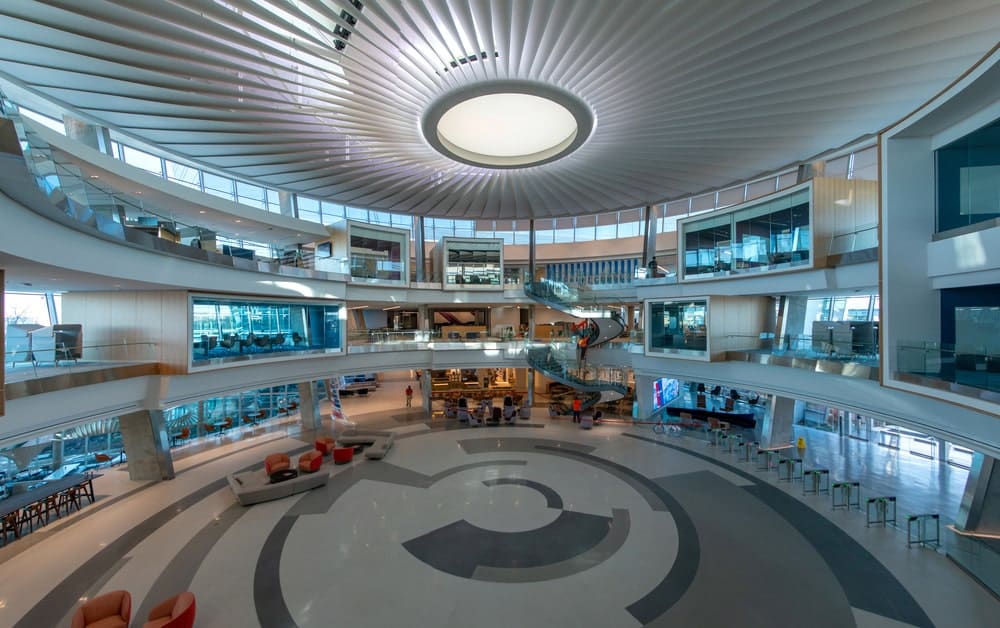
The Skyview campus was designed by the architectural firm Pelli Clarke Pelli, with a specific focus on “transparency” and “connectivity.” These are not just architectural buzzwords; they are core tenets of the modern American Airlines brand strategy. Following the merger with US Airways, the company faced the monumental task of blending two distinct corporate cultures. The architecture of the new HQ was the primary tool used to achieve this brand alignment.
Fostering “Planned Spontaneity”
One of the most innovative aspects of the Skyview campus is the layout, which encourages “collision” among employees. In brand management, internal alignment is just as important as external marketing. By creating wide-open common areas, shared dining facilities, and interconnected walkways, the design forces employees from different departments—finance, marketing, flight operations, and tech—to interact.
This “planned spontaneity” breaks down the silos that often plague legacy brands. From a brand strategy perspective, this ensures that every employee, regardless of their role, feels part of the “One Team” identity. When the internal brand is unified, the external service becomes more consistent, directly impacting customer perception and brand loyalty.
Environmental Stewardship as a Brand Pillar
In the modern era, a brand’s commitment to sustainability is a major component of its corporate identity. The Skyview campus was built with LEED Gold certification standards in mind. It features high-efficiency lighting, recycled building materials, and a design that maximizes natural light.
For American Airlines, this is a crucial brand pivot. The aviation industry is often criticized for its environmental impact. By housing its leadership in a sustainable, eco-friendly environment, American Airlines is visually and physically communicating its commitment to a greener future. It allows the brand to tell a story of modernization—moving away from the “old guard” of fossil-fuel-heavy perceptions and toward a more conscious, forward-thinking corporate identity.

Consolidation and the “One Team” Philosophy
Before the completion of the Skyview campus, American Airlines employees were scattered across multiple buildings in the DFW area, some of which were aging and disconnected. This fragmentation was a liability for the brand. A disjointed workforce leads to a disjointed brand experience for the customer.
Integrating Legacy Cultures
The “One Team” philosophy is the heartbeat of American’s internal branding. When the company merged with US Airways, there was a significant risk of a “we vs. them” mentality. The HQ served as the neutral ground where a new, unified identity could be forged. By moving everyone—from the CEO to the scheduling coordinators—into the same complex, the brand effectively hit the “reset” button.
The campus includes amenities like a massive fitness center, social hubs, and even a company museum. These features are not just perks; they are brand-building tools. They create a “campus life” that mirrors the environments of Silicon Valley tech giants, helping American Airlines reposition its brand as an innovative tech-forward company rather than a legacy industrial giant.
The CR Smith Museum: Preserving Brand Heritage
A key element of brand strategy is the balance between innovation and heritage. On the outskirts of the HQ campus sits the CR Smith Museum. Named after a former legendary CEO of the airline, the museum serves as the “brand archives.”
By maintaining this museum on its headquarters grounds, American Airlines anchors its modern brand in its storied past. It tells the story of the DC-3, the birth of the Flagship service, and the evolution of the iconic silver livery. For new employees and visiting partners, the museum acts as an induction into the brand’s legacy. It reinforces the idea that while the company is looking toward the future with Skyview, it remains deeply proud of the history that built the “American” name.
The HQ as a Tool for Talent Acquisition and Retention
In the war for talent, a brand’s physical workspace is one of its strongest recruiting tools. American Airlines competes not just with other carriers, but with global tech firms for top-tier data scientists, marketers, and engineers.
Modernizing the Corporate Persona
The “where” of American Airlines—a lush, amenity-rich campus—is a far cry from the drab, grey cubicles of 20th-century aviation offices. The brand strategy here is to appeal to the modern worker who values wellness, collaboration, and environment. The presence of walking trails, outdoor meeting spaces, and “grab-and-go” healthy food options rebranded American Airlines as an “employer of choice.”
When a company’s headquarters looks like a high-end tech campus, it changes the perception of what it’s like to work there. This, in turn, elevates the brand’s prestige. High-quality talent produces high-quality work, which ultimately strengthens the brand’s position in the global market. The HQ is the physical evidence of the brand’s investment in its most valuable asset: its people.
Regional Brand Dominance
Furthermore, the location in Fort Worth cements American Airlines as a regional titan. Being the largest employer in Tarrant County gives the brand significant political and social capital. This “community branding” is vital. By being a “good neighbor” and a massive economic engine for North Texas, American Airlines builds a brand of reliability and indispensable value to the region. This local strength provides a stable foundation from which the brand can project its global influence.
Conclusion: A Brand Built on Texas Soil
Ultimately, the answer to “where is American Airlines HQ” is that it is located at the intersection of heritage and the future. The Skyview campus is much more than a collection of office buildings; it is a strategic asset designed to unify a global workforce, modernize a legacy brand, and communicate a commitment to innovation and sustainability.
Through the Skyview campus, American Airlines has successfully utilized architecture and geography to reinforce its brand identity. It has moved away from the fragmented, siloed operations of the past and into a unified, transparent, and collaborative future. For a brand that is tasked with carrying the name of a nation, its headquarters stands as a bold statement of intent: American Airlines is not just flying toward the future; it has built a permanent, innovative home from which to lead it. The campus is the physical proof that the American brand is integrated, resilient, and ready for the next century of flight.
aViewFromTheCave is a participant in the Amazon Services LLC Associates Program, an affiliate advertising program designed to provide a means for sites to earn advertising fees by advertising and linking to Amazon.com. Amazon, the Amazon logo, AmazonSupply, and the AmazonSupply logo are trademarks of Amazon.com, Inc. or its affiliates. As an Amazon Associate we earn affiliate commissions from qualifying purchases.