
Crypto.com has solidified its position as a behemoth in the cryptocurrency landscape, offering a broad spectrum of services from exchange functionalities and debit cards to DeFi solutions and an NFT marketplace. As a company deeply embedded in the world of digital assets, understanding its “on-chain” presence is crucial for grasping its operational mechanics and the underlying technology that powers its ecosystem.
To truly comprehend Crypto.com’s on-chain activities, we must first define what “on-chain” means within the context of blockchain technology. Simply put, “on-chain” refers to any transaction, data, or activity that is recorded directly, immutably, and publicly on a blockchain’s distributed ledger. These records are verified by the network’s participants and become a permanent part of the blockchain’s history. For a centralized entity like Crypto.com, navigating the decentralized world of blockchain presents a fascinating interplay of leveraging core technological tenets while providing accessible services to millions. This exploration delves into how Crypto.com integrates with, contributes to, and facilitates interaction with various blockchain networks, underscoring its pivotal role as a bridge between the traditional financial world and the burgeoning decentralized web.
Demystifying “On-Chain” in the Crypto Ecosystem
The concept of “on-chain” is fundamental to understanding cryptocurrencies and blockchain technology. It represents the very essence of decentralization, transparency, and security that blockchains promise.
The Fundamentals of Blockchain Technology
At its core, a blockchain is a decentralized, distributed ledger that records transactions across many computers, known as nodes. Each “block” in the chain contains a set of transactions, and once validated, it is added to the previous block, creating an immutable, chronological chain. Key characteristics include:
-
Decentralization: No single entity controls the network; power is distributed among its participants.
-
Immutability: Once a transaction is recorded on the blockchain, it cannot be altered or deleted. This ensures data integrity and trust.
-
Transparency: All validated transactions are publicly viewable by anyone on the network, though personal identities might be pseudonymous.
-
Security: Cryptographic principles protect the network from tampering and fraud, making it highly secure.
Blockchains can be public (like Bitcoin or Ethereum, open to anyone to participate) or private (permissioned networks typically used by organizations for specific purposes). The vast majority of cryptocurrencies operate on public blockchains, leveraging their inherent properties to establish trustless systems.
What “On-Chain” Truly Means
“On-chain” specifically refers to data and transactions that have been broadcast to and processed by a blockchain network, becoming a permanent part of its public ledger. When you send Bitcoin, execute a smart contract on Ethereum, or mint an NFT, these actions are “on-chain.” They are verifiable by anyone, secured by the network’s consensus mechanism, and immutable once confirmed.
This contrasts sharply with “off-chain” activities. Off-chain transactions typically occur internally within a centralized platform’s database, such as trades executed within Crypto.com’s exchange or transfers between users of the same platform. While these are faster and cheaper because they don’t incur blockchain network fees (gas fees), they lack the decentralization and immutability of on-chain records. For instance, when you buy or sell crypto on Crypto.com, the actual exchange of assets often happens off-chain within their internal systems. Only when you deposit crypto from an external wallet to Crypto.com or withdraw crypto from Crypto.com to an external wallet does an “on-chain” transaction occur. Understanding this distinction is crucial for discerning where true blockchain decentralization applies versus where centralized infrastructure facilitates user experience. The importance of on-chain activity lies in its promise of verifiable truth, censorship resistance, and global accessibility without reliance on intermediaries.
Crypto.com’s Multi-Faceted On-Chain Presence
Crypto.com is not merely a platform that supports blockchain assets; it is deeply interwoven with various blockchain networks, including its own native chain, contributing significantly to its on-chain footprint.
The Cronos Chain: Crypto.com’s Native Blockchain
A cornerstone of Crypto.com’s on-chain strategy is the Cronos Chain. Launched in late 2021, Cronos (built on Cosmos SDK and EVM-compatible) is a decentralized, open-source blockchain network designed to scale the Web3 ecosystem. It aims to significantly increase transaction speed and reduce costs compared to older blockchains like Ethereum, while maintaining compatibility with the vast array of Ethereum-based decentralized applications (dApps).
The purpose of Cronos is manifold:
-
Facilitating DeFi and NFTs: It provides a robust infrastructure for developers to build decentralized finance (DeFi) protocols, non-fungible token (NFT) marketplaces, and gaming applications, fostering a vibrant dApp ecosystem.
-
Interoperability: Being built on Cosmos SDK, Cronos is designed for interoperability with other Cosmos-based blockchains via the Inter-Blockchain Communication (IBC) protocol, allowing seamless asset transfers across different networks.
-
CRO Token Utility: The native cryptocurrency of the Crypto.com ecosystem, CRO, plays a crucial role on Cronos. It is used for transaction fees (gas), staking by validators to secure the network, and as a governance token, giving holders a say in the chain’s future development.
When users interact with dApps on Cronos, transfer CRO tokens, or stake CRO on the Cronos network, they are engaging in direct on-chain activity, leveraging the security and transparency of this blockchain. Cronos represents Crypto.com’s direct contribution to, and participation in, the decentralized on-chain world, moving beyond just being an exchange to becoming a core infrastructure provider.
Supporting Diverse On-Chain Assets and Networks
Beyond its own Cronos Chain, Crypto.com acts as a critical gateway to a multitude of other blockchain networks. The platform allows users to buy, sell, and manage cryptocurrencies that reside on various independent blockchains, including but not limited to:
-
Bitcoin (BTC): Operating on its own independent blockchain.
-
Ethereum (ETH): The leading smart contract platform, hosting thousands of tokens (ERC-20) and NFTs (ERC-721, ERC-1155).
-
Solana (SOL), Avalanche (AVAX), Polygon (MATIC), BNB Chain (BNB): Other prominent Layer 1 and Layer 2 blockchains supporting a wide range of decentralized applications.
When a user initiates a withdrawal of, say, Bitcoin from their Crypto.com account to an external Bitcoin wallet, Crypto.com’s system processes an actual on-chain transaction on the Bitcoin network. This involves signing the transaction with Crypto.com’s wallet keys and broadcasting it to the Bitcoin network for validation by its miners. The same applies to withdrawals of Ethereum, Solana, or any other native blockchain asset to their respective external wallets. This function is vital as it allows Crypto.com users to move their assets from the centralized exchange environment into self-custodied wallets, enabling them to directly interact with the broader decentralized ecosystem and participate in activities like DeFi, staking, or dApp usage on the underlying networks. By supporting a vast number of networks and their native assets, Crypto.com facilitates broad on-chain access for its global user base.

On-Chain Operations for Security and Transparency
While the majority of internal trading on Crypto.com happens off-chain for efficiency, the platform still leverages blockchain technology for crucial aspects of security, auditing, and enabling user transparency.
For instance, Crypto.com, like many centralized exchanges, holds significant user funds. While the specific holdings of individual users are managed in an internal database, the underlying cryptocurrencies are stored on various blockchains. The industry has seen a growing trend towards “Proof of Reserves,” where exchanges publish cryptographic proofs (often using Merkle trees) that demonstrate they hold the assets they claim. These proofs often involve referencing on-chain wallet addresses and their balances, which can be independently verified on the respective blockchains. This on-chain verification provides a layer of transparency and reassurance to users that their funds are indeed backed by real assets on the blockchain, even if their individual trading balances are managed internally. While not a constant real-time audit, it showcases how centralized entities can use on-chain data for accountability and trust-building in a technologically advanced manner.
Bridging Centralization and Decentralization
Crypto.com exemplifies the complex and often necessary bridge between the centralized services that many users prefer for ease of use and the decentralized ethos of blockchain technology.
The Centralized Exchange as a Gateway
The core Crypto.com app and exchange operate as a centralized service. This means that while it facilitates access to a decentralized world, many transactions within the platform occur off-chain. When you buy crypto, sell it, or transfer it to another Crypto.com user, these actions are typically recorded in Crypto.com’s internal database. This off-chain processing allows for instantaneous trades, zero internal transfer fees, and high liquidity, providing a user experience akin to traditional online banking or stock trading platforms.
However, the “on-chain” aspect comes into play at the entry and exit points. When you deposit assets into your Crypto.com account from an external wallet, an on-chain transaction occurs from your wallet to Crypto.com’s designated deposit address on the blockchain. Conversely, when you withdraw assets from Crypto.com to an external wallet, Crypto.com initiates an on-chain transaction from its custody wallets to your specified external address. In this role, Crypto.com acts as a crucial on-ramp and off-ramp, converting fiat currency into crypto assets and vice-versa, and allowing users to move their assets between the centralized platform and the broader decentralized ecosystem. Without this gateway function, directly interacting with complex on-chain protocols would be significantly more challenging for the average user.
Empowering Users with On-Chain Access
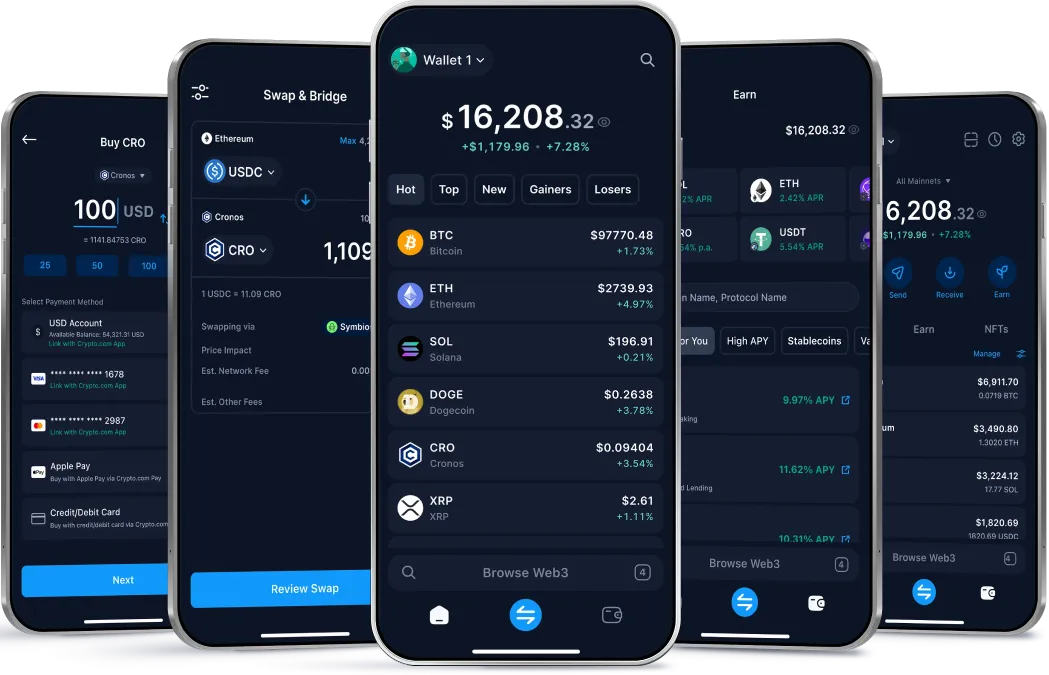
Recognizing the growing demand for true decentralized interaction, Crypto.com has also developed tools that empower users with direct on-chain access, thereby bypassing the centralized intermediary when desired. The most prominent example is the Crypto.com DeFi Wallet.
Unlike the main Crypto.com app, the DeFi Wallet is a non-custodial wallet. This means users hold their private keys and thus have sole control over their funds. When a user uses the Crypto.com DeFi Wallet, they are directly interacting with blockchain networks, not through Crypto.com’s servers. This enables them to:
-
Participate in DeFi: Connect to decentralized exchanges (DEXs), lending protocols, and yield farming opportunities directly on various blockchains (e.g., Ethereum, Cronos, Polygon).
-
Manage NFTs: Store, send, and receive non-fungible tokens, and interact with NFT marketplaces.
-
Stake and Earn: Directly stake their cryptocurrencies on proof-of-stake networks to earn rewards.
-
Engage with dApps: Explore and utilize a vast array of decentralized applications without needing Crypto.com as a middleman.
The DeFi Wallet represents Crypto.com’s commitment to enabling full on-chain participation, providing a secure and user-friendly interface for interacting with the decentralized web. By offering both centralized services and non-custodial tools, Crypto.com caters to a spectrum of user preferences, from those seeking simplicity and convenience to those desiring full sovereignty over their digital assets and direct engagement with decentralized protocols. This dual approach solidifies its position as a comprehensive ecosystem player, bridging both worlds.
The Future of Crypto.com On-Chain
As the blockchain landscape continues to evolve at a rapid pace, Crypto.com’s on-chain strategy will undoubtedly adapt and expand, deepening its integration with decentralized technologies and user empowerment.
Continued Expansion of the Cronos Ecosystem
The Cronos Chain is poised for significant growth and development. We can anticipate:
-
Enhanced Developer Support: More tools, grants, and resources to attract developers, leading to a proliferation of dApps across various sectors like gaming, metaverse, and enterprise solutions.
-
Scalability and Interoperability Improvements: Ongoing technological upgrades to increase transaction throughput, reduce latency, and improve seamless asset transfer with other blockchain networks, particularly within the broader Cosmos ecosystem.
-
Strategic Partnerships: Collaborations with other projects, protocols, and traditional businesses to expand Cronos’s reach and utility. The success of Cronos directly contributes to Crypto.com’s on-chain presence as a builder and facilitator of decentralized technology.
Innovations in On-Chain Integration and User Experience
Crypto.com is likely to focus on making on-chain interactions even more accessible and secure for its vast user base. This could involve:
-
Seamless Fiat-to-On-Chain Ramps: Making it easier for users to directly fund their DeFi Wallets or interact with dApps using fiat currencies, bypassing the traditional exchange middleman to some extent.
-
Advanced Security Features: Implementing cutting-edge security measures for on-chain transactions, such as multi-party computation (MPC) wallets or enhanced recovery options for non-custodial assets, reducing the risk of human error or sophisticated attacks.
-
Personalized On-Chain Insights: Providing users with more detailed and digestible information about their on-chain activities, including transaction histories, gas fee analyses, and risk assessments for dApp interactions, directly within their platforms.

The Evolving Role of Centralized Entities in a Decentralized World
Crypto.com’s journey reflects the dynamic tension and symbiotic relationship between centralized platforms and the decentralized ethos of Web3. As the industry matures, centralized entities like Crypto.com will likely continue to play a crucial role as:
-
Primary On-Ramps and Off-Ramps: Bridging the gap between traditional finance and the crypto economy.
-
Liquidity Providers: Facilitating efficient trading and market depth across various digital assets.
-
Innovation Catalysts: Investing in blockchain infrastructure, fostering developer communities, and driving the adoption of new technologies.
-
Guardians of User Experience: Simplifying complex on-chain processes to make them accessible to a mainstream audience.
The future will likely see Crypto.com further blurring the lines between centralized convenience and decentralized control, offering a hybrid model that provides the best of both worlds. Its continued commitment to developing platforms like Cronos and integrating direct on-chain tools ensures its relevance in a world increasingly moving towards decentralization, while retaining the accessibility and support that many users still value.
In conclusion, Crypto.com’s “on-chain” identity is multifaceted. It manifests through its native Cronos Chain, its role in facilitating on-chain transactions across numerous blockchains, and its provision of non-custodial tools like the DeFi Wallet that empower users with direct control. While its core exchange provides the convenience of off-chain operations, its strategic use and development of on-chain technologies firmly establish Crypto.com as a critical player in the ongoing evolution of the decentralized web. Its trajectory will be defined by how effectively it continues to bridge these two worlds, driving innovation and adoption within the tech-driven crypto ecosystem.
aViewFromTheCave is a participant in the Amazon Services LLC Associates Program, an affiliate advertising program designed to provide a means for sites to earn advertising fees by advertising and linking to Amazon.com. Amazon, the Amazon logo, AmazonSupply, and the AmazonSupply logo are trademarks of Amazon.com, Inc. or its affiliates. As an Amazon Associate we earn affiliate commissions from qualifying purchases.