
Bitcoin, since its inception in 2009, has revolutionized our understanding of money and digital trust. At the heart of its innovation lies a process often misunderstood: mining. Far from the traditional image of pickaxes and gold pans, Bitcoin mining is a sophisticated, energy-intensive computational endeavor that serves two critical functions: introducing new bitcoins into circulation and validating transactions on the network. This intricate process forms the bedrock of Bitcoin’s security, decentralization, and immutability, making it a cornerstone of modern digital security and distributed ledger technology. To truly grasp Bitcoin’s genius, one must first understand the technical marvel that is its mining operation.

The Foundational Role of Bitcoin Mining in Blockchain Security
Bitcoin mining is not merely about creating new digital currency; it is fundamentally about maintaining the integrity and security of the Bitcoin blockchain. Without miners, the network would cease to function, transactions would not be confirmed, and the entire decentralized system would collapse. Miners are the distributed accountants, auditors, and record-keepers of the Bitcoin network, performing their duties without a central authority or trusted intermediary.
What is Bitcoin Mining? Beyond the Pickaxe Analogy
At its core, Bitcoin mining is the process by which new blocks of transactions are added to the Bitcoin blockchain. This process involves solving a complex computational puzzle, which in turn secures the network and verifies the legitimacy of transactions. When a miner successfully solves this puzzle, they are granted the right to add the next block of transactions to the blockchain and are rewarded with newly minted bitcoins and transaction fees.
The term “mining” is an apt analogy because, much like excavating precious metals, it requires significant effort and resources (computational power and electricity) to uncover something valuable (new bitcoins). However, unlike physical mining, the output is digital, and the “extraction” process is a form of cryptographic proof that ensures consensus across a global network. It’s a system designed to be difficult, making it economically unfeasible for any single entity to maliciously control the network.
The Decentralized Ledger: Blockchain’s Immutable Record
The Bitcoin blockchain is a distributed public ledger that records all confirmed Bitcoin transactions. Each “block” in the chain contains a list of transactions, a timestamp, and a reference to the previous block, forming a chronological and immutable chain. This structure is critical for maintaining a single, agreed-upon history of all transactions, preventing fraud such as double-spending – where a user attempts to spend the same bitcoins twice.
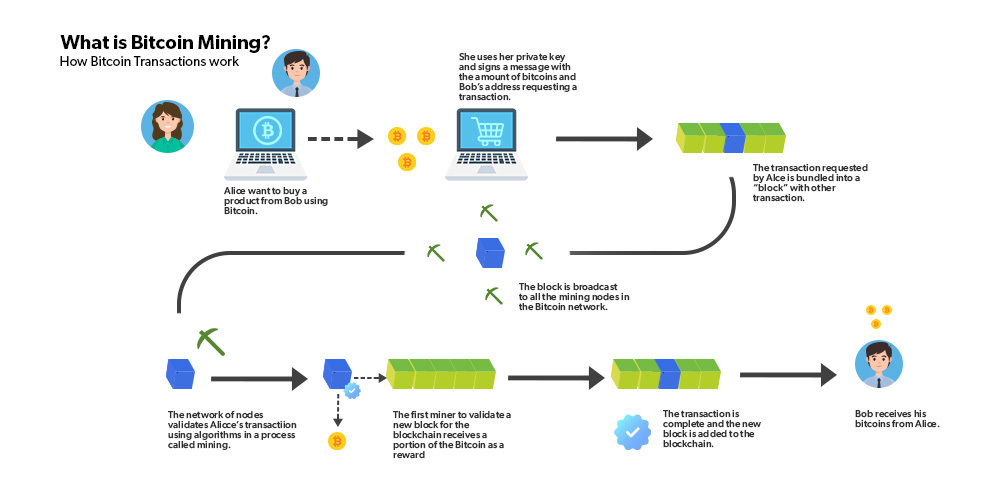
Miners play a crucial role in maintaining this ledger. They gather unconfirmed transactions, bundle them into a new block, and then attempt to solve the cryptographic puzzle. Once a miner finds a valid solution, they broadcast their newly formed block to the rest of the network. Other nodes (computers running Bitcoin software) then verify the legitimacy of this block and, if valid, add it to their copy of the blockchain. This distributed verification process ensures that no single point of failure exists and that the ledger remains consistent across all participants. The longer the chain of blocks, the more secure and resilient the network becomes, as altering past transactions would require re-mining every subsequent block, an exponentially difficult task.
The Cryptographic Puzzle: Proof-of-Work Explained
The heart of Bitcoin mining lies in its “Proof-of-Work” (PoW) mechanism. This ingenious system, first described by Cynthia Dwork and Moni Naor in 1993 and later popularized by Bitcoin’s creator Satoshi Nakamoto, is what makes the network secure and resistant to attack. PoW is a form of cryptographic puzzle that is difficult to solve but easy to verify, ensuring that miners expend significant computational effort to validate transactions and add new blocks.
Hashing and the Target Difficulty
The puzzle itself involves finding a specific numerical value, known as a “nonce” (number only used once), which, when combined with the data in a block (including transactions, the previous block’s hash, and a timestamp) and run through a cryptographic hash function (specifically SHA-256 for Bitcoin), produces an output hash that meets a certain condition. This condition is typically that the hash must start with a certain number of leading zeros.
The “target difficulty” is a dynamic parameter that adjusts every 2016 blocks (roughly every two weeks) to ensure that, on average, a new block is found approximately every ten minutes. If blocks are being found too quickly, the difficulty increases, requiring more leading zeros in the target hash. If they are found too slowly, the difficulty decreases. This self-regulating mechanism ensures a consistent rate of block generation, regardless of the total computational power (hash rate) on the network. The difficulty adjustment is a critical technical feature that maintains the predictable issuance schedule of Bitcoin.
The Race to Find the Nonce
Miners essentially engage in a massive, distributed guessing game. They repeatedly hash the block header (which contains the current nonce value) with different nonces until they find one that produces an output hash meeting the current target difficulty. Because cryptographic hash functions are one-way (meaning you can’t reverse-engineer the input from the output) and deterministic (the same input always produces the same output), the only way to find a valid nonce is through brute-force trial and error.
Thousands of miners worldwide compete simultaneously to be the first to find this golden nonce. The first miner to succeed broadcasts their solution (the valid block, including the nonce) to the network. The other nodes verify the proof of work quickly by simply running the hash function once. If it’s valid, they accept the block, discard their current work on the previous block, and immediately start mining on top of the newly found block, racing to find the next one. This constant race ensures that the network is always working towards extending the longest, most secure chain.
Verifying Transactions and Creating Blocks
Before a miner even starts searching for a nonce, they perform an essential validation step: verifying all pending transactions. Miners aggregate valid transactions from the network’s memory pool (mempool), where unconfirmed transactions reside. They check that each transaction is correctly formatted, has valid digital signatures, and that the sender has sufficient funds. Invalid transactions are discarded. This verification process prevents fraudulent transactions from ever entering the blockchain. Once a bundle of verified transactions is ready, along with the previous block’s hash, a timestamp, and a Merkle root (a cryptographic summary of all transactions in the block), the miner incorporates these into a new block header and begins the nonce-guessing process. Upon finding a valid nonce and broadcasting the block, these transactions are considered “confirmed” once added to the blockchain, providing finality to the transfer of value.
The Anatomy of a Bitcoin Miner: Hardware and Software
Bitcoin mining, especially in its current state, is not a casual endeavor. It requires specialized hardware and software working in concert to compete effectively on the global network. The evolution of mining technology reflects the increasing difficulty and professionalization of the industry.
From CPUs/GPUs to ASICs: The Evolution of Mining Hardware
In Bitcoin’s early days, mining could be performed using standard central processing units (CPUs) found in most personal computers. As the network’s hash rate grew and difficulty increased, miners quickly transitioned to graphics processing units (GPUs), which are far more efficient at parallel computation and thus better at hashing.
However, the relentless competition led to the development of Application-Specific Integrated Circuits (ASICs). These are microchips designed solely for one purpose: Bitcoin mining. ASICs are orders of magnitude more powerful and energy-efficient for SHA-256 hashing than even the most advanced GPUs. Today, professional Bitcoin mining is almost exclusively done using powerful ASIC miners, often housed in large-scale data centers specifically designed to optimize their operation. This hardware specialization represents a significant technological barrier to entry for individual miners but also ensures the immense computational power securing the Bitcoin network.

Mining Software and Pools: Collaborative Computation
Beyond the hardware, miners utilize specialized software to connect their ASICs to the Bitcoin network. This software facilitates communication with the blockchain, fetches transaction data, manages the hashing process, and submits completed blocks. Given the intense competition and the sheer difficulty of finding a block as an individual miner (the odds are astronomically low), most miners join “mining pools.”
A mining pool is a group of miners who combine their computational power (hash rate) and agree to share the block rewards proportionally to the amount of work each member contributes. When the pool collectively finds a block, the reward is distributed among its members. This collaborative approach stabilizes income for individual miners, making mining a more predictable, albeit still highly competitive, enterprise. Pool software manages the distribution of work, ensuring each miner contributes to the overall effort.
The Energy Equation: Powering the Network
The computational intensity of Bitcoin mining translates into significant energy consumption. The repetitive trial-and-error process of finding a nonce requires a vast amount of electricity to power the ASICs. This energy demand has become a prominent topic of discussion, with critics highlighting its environmental impact.
However, advocates argue that a significant portion of Bitcoin mining utilizes renewable energy sources, stranded energy (energy that would otherwise be wasted), or energy from remote locations. Furthermore, the energy expenditure is not arbitrary; it is the fundamental cost of securing a truly decentralized, censorship-resistant financial network. The energy expended is a direct measure of the network’s security, making it incredibly expensive for any malicious actor to mount a 51% attack. From a technological perspective, the challenge lies in optimizing energy efficiency for future mining hardware and exploring sustainable energy solutions to power the network’s growth.
Rewards, Risks, and the Future of Mining
Bitcoin mining is driven by economic incentives, but these incentives are carefully designed into the protocol to ensure network health and security. Understanding the reward structure is key to understanding the motivations of miners and the long-term stability of the Bitcoin network.
Block Rewards and Transaction Fees: The Miner’s Incentive
When a miner successfully adds a new block to the blockchain, they receive two forms of reward:
-
Block Reward: Newly minted bitcoins are generated and awarded to the successful miner. This is the primary mechanism for introducing new bitcoins into circulation. This reward halves approximately every four years, an event known as the “halving.”
-
Transaction Fees: Miners also collect the transaction fees attached to all the transactions included in the block they mine. Users include these fees to incentivize miners to prioritize their transactions, especially during periods of high network congestion.
These rewards provide a powerful incentive for miners to continue dedicating computational power to securing the network. Without these rewards, there would be no economic motivation to perform the intensive work required for PoW.
The Halving Events and Supply Economics
The Bitcoin protocol has a fixed supply limit of 21 million bitcoins. The halving events, where the block reward is cut in half, are crucial to managing this supply and ensuring its scarcity. Starting with a block reward of 50 BTC in 2009, it halved to 25 BTC in 2012, 12.5 BTC in 2016, and 6.25 BTC in 2020. The next halving is anticipated in 2024.
From a technical and economic perspective, the halving ensures a predictable and diminishing rate of new Bitcoin issuance, mimicking the scarcity of precious metals. This programmed scarcity is a core tenet of Bitcoin’s design and is enforced by the mining difficulty adjustments and the PoW mechanism. As block rewards decrease, transaction fees are expected to play an increasingly important role in compensating miners in the long term, cementing their incentive to process transactions efficiently.
Environmental Concerns and Shifting Paradigms
The energy consumption of Bitcoin mining remains a significant technical and societal concern. While solutions like using renewable energy and capturing waste heat are gaining traction, the fundamental energy cost of Proof-of-Work is inherent to its security model. This has spurred ongoing research into alternative consensus mechanisms, such as Proof-of-Stake (PoS), which consumes significantly less energy. However, Bitcoin remains committed to PoW, largely due to its proven security and resistance to centralization. The ongoing technological challenge is to make PoW mining more sustainable without compromising its core security principles. Innovations in hardware efficiency and geographical distribution of mining operations will continue to be crucial in addressing these concerns.
The Broader Implications for Digital Security and Innovation
Beyond its function as a monetary system, Bitcoin’s mining process has profound implications for digital security, cryptography, and distributed systems. It stands as a testament to what can be achieved with carefully designed incentive structures and robust cryptographic primitives.
Securing the Network: Defending Against Double-Spending
The immense computational power harnessed by Bitcoin miners provides an unparalleled level of digital security. A 51% attack, where a malicious entity gains control of more than half the network’s hash rate to manipulate transactions, is theoretically possible but prohibitively expensive and difficult to execute. The sheer cost of acquiring and operating the necessary hardware and electricity makes such an attack economically irrational, as it would likely destroy the value of the asset being attacked.
This robust security model, underpinned by Proof-of-Work, is a significant technological achievement. It provides the guarantee that once a transaction is sufficiently confirmed (usually after six blocks), it is practically irreversible, offering a level of finality that traditional digital payment systems often struggle to achieve without central intermediaries.
A Catalyst for Cryptographic Research and Development
Bitcoin’s success has undeniably spurred massive innovation in cryptography, distributed systems, and decentralized technologies. The challenges and solutions developed for Bitcoin mining have informed the design of other cryptocurrencies and blockchain platforms. Research into more efficient hashing algorithms, secure peer-to-peer networking, and novel consensus mechanisms has been directly influenced by the pioneering work of Bitcoin.
The very concept of a permissionless, trustless network secured by computational effort has opened new avenues for exploring decentralized applications, digital identity, and verifiable data integrity. Bitcoin mining, therefore, is not just a mechanism for value transfer; it is a continuously evolving technological frontier that pushes the boundaries of what is possible in the digital realm, shaping the future of secure, distributed systems.
In conclusion, Bitcoin mining is a complex, technologically sophisticated process that serves as the backbone of the Bitcoin network. It is a critical component that ensures the security, immutability, and decentralization of the blockchain, enabling a truly peer-to-peer digital cash system. While energy-intensive, its Proof-of-Work mechanism is the genius behind its resilience, safeguarding a revolutionary technology that continues to reshape our digital landscape. Understanding how it works is not just about comprehending a cryptocurrency; it’s about grasping a fundamental innovation in distributed computing and digital security.
aViewFromTheCave is a participant in the Amazon Services LLC Associates Program, an affiliate advertising program designed to provide a means for sites to earn advertising fees by advertising and linking to Amazon.com. Amazon, the Amazon logo, AmazonSupply, and the AmazonSupply logo are trademarks of Amazon.com, Inc. or its affiliates. As an Amazon Associate we earn affiliate commissions from qualifying purchases.