
Apple Inc., a titan of technology and one of the world’s most valuable companies, has a history of making headlines not just for its groundbreaking products, but also for its financial maneuvers. Among these, stock splits stand out as particularly impactful events for investors. With its share price often hovering at elevated levels, the question “When will Apple split its stock again?” frequently resurfaces in financial discussions, captivating both seasoned institutional investors and aspiring retail traders.
A stock split, while seemingly a simple mathematical adjustment, carries significant implications for market accessibility, liquidity, and even investor psychology. For a company like Apple, with its massive market capitalization and widespread ownership, the decision to split its shares is never taken lightly. It reflects a strategic move aimed at optimizing its presence in the market and ensuring its continued appeal to a diverse investor base. This article delves into the mechanics of stock splits, Apple’s historical precedents, and the factors that might influence its next move, all through the lens of finance and investing.
The Mechanics and Motivations Behind a Stock Split
Understanding a stock split requires dissecting its core definition and the strategic rationale that drives companies to undertake such actions. It’s more than just a numbers game; it’s a calculated financial decision with specific objectives.
What Exactly is a Stock Split?
At its heart, a stock split is a corporate action where a company increases the number of its outstanding shares by dividing existing shares into multiple new shares. For example, in a 2-for-1 stock split, a shareholder who previously owned one share will now own two shares. Crucially, while the number of shares doubles, the price per share is halved, meaning the total market value of the investment remains unchanged immediately after the split. The company’s overall market capitalization also stays constant.
The primary effect is that the individual share price becomes lower, making it ostensibly more affordable for new investors to purchase whole shares, or for existing investors to average down their positions with greater ease. It’s akin to exchanging a $100 bill for two $50 bills – you have more bills, but the total value is the same. The split does not fundamentally alter the company’s intrinsic value, its earnings power, or its underlying business performance. It is purely an accounting and market-oriented adjustment.
Why Companies Conduct Stock Splits
Companies engage in stock splits for several compelling financial and psychological reasons, often aiming to broaden their appeal and enhance market dynamics:
-
Increased Liquidity and Accessibility: A lower share price makes it easier for smaller retail investors to buy shares. This can lead to increased trading volume (liquidity), as more shares are available and actively traded. Higher liquidity can also make the stock more attractive to institutional investors who may value the ease of buying and selling large blocks of shares without significant price impact.
-
Psychological Appeal: There’s a widely acknowledged psychological effect. A stock priced at, say, $500 might seem “expensive” to some individual investors, even if its underlying value justifies it. After a 5-for-1 split, the price drops to $100, which can feel more “affordable” and within reach. This perceived affordability can attract a new wave of investors, contributing to demand.
-
Optimal Trading Range: Companies often prefer their stock to trade within a certain price range, believing it optimizes investor interest and trading activity. When a stock price climbs significantly above this preferred range, a split brings it back down to what management perceives as a more appropriate level.
-
Inclusion in Price-Weighted Indices: Historically, high share prices could hinder inclusion in price-weighted indices like the Dow Jones Industrial Average (DJIA). A split reduces the share price, making it a more suitable candidate for such indices, where a higher-priced stock has a disproportionately larger impact on the index’s movement. While Apple is already in the DJIA, maintaining a reasonable price can still be a subtle consideration for index weighting.
The Different Types of Stock Splits
While our focus is primarily on forward stock splits, it’s worth briefly noting the other types. A forward stock split (e.g., 2-for-1, 3-for-1, 4-for-1) is what we’ve described: more shares, lower price. Conversely, a reverse stock split (e.g., 1-for-2, 1-for-3) consolidates shares, reducing the number of outstanding shares and increasing the price per share. This is often done by companies facing delisting threats due to low stock prices or those wanting to project a more “serious” image. There are also stock dividends, which distribute additional shares to existing shareholders, similar to a split but often without changing the par value of the shares as directly. For Apple, the discussion almost exclusively revolves around forward splits.
Apple’s History with Stock Splits and Current Context
Apple’s journey as a publicly traded company is marked by phenomenal growth, which has periodically led its share price to levels that prompted management to initiate stock splits. Examining its past actions provides crucial insights into its potential future moves.
A Look Back: Apple’s Previous Splits
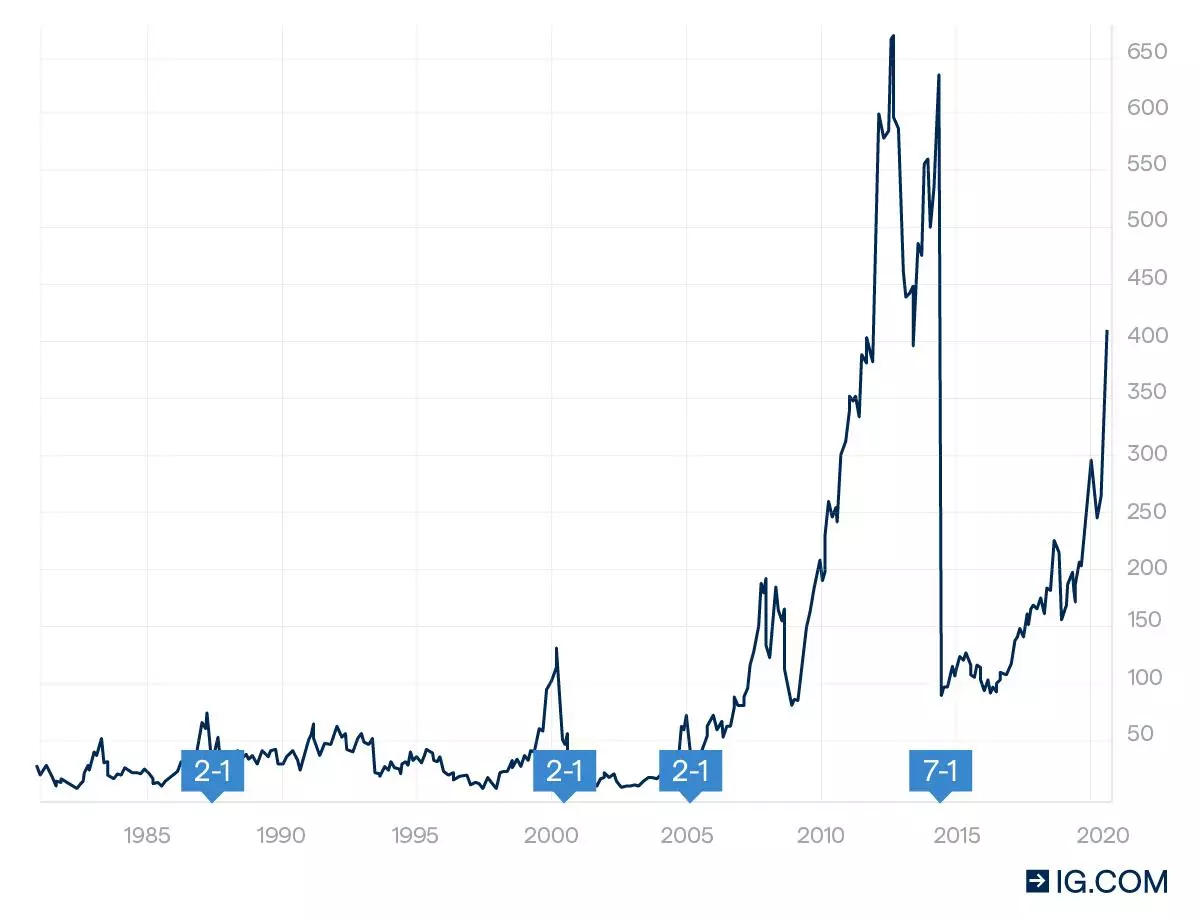
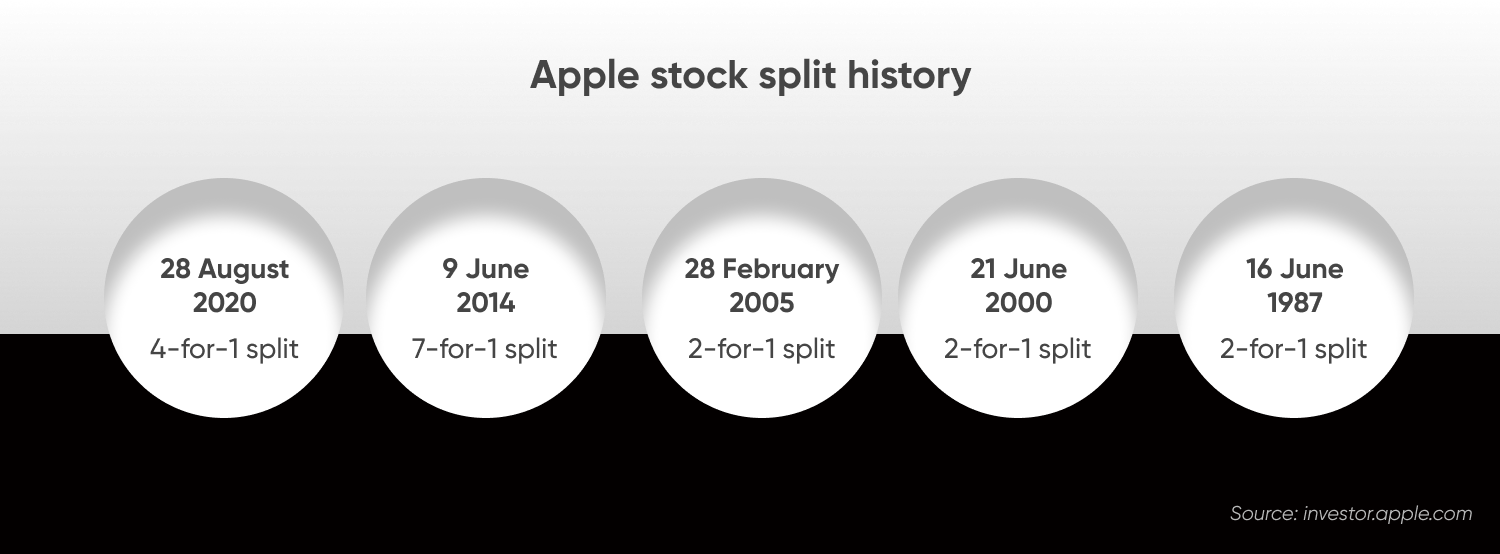
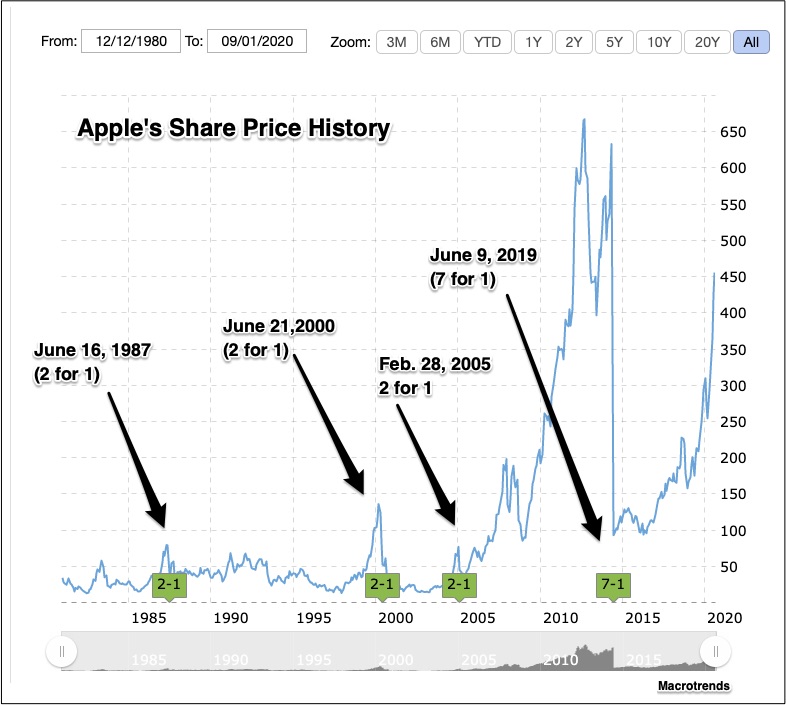
Apple has conducted five stock splits since its IPO in 1980, each occurring after periods of significant share price appreciation:
-
June 16, 1987: 2-for-1 split. This was Apple’s first split, reflecting its early success and growth.
-
June 21, 2000: 2-for-1 split. Occurring during the dot-com boom, this split came as Apple navigated a challenging but ultimately transformative period.
-
February 28, 2005: 2-for-1 split. This split preceded the launch of the iPhone and signaled the growing confidence in Apple’s resurgence under Steve Jobs.
-
June 9, 2014: 7-for-1 split. This was Apple’s most significant split by ratio and was explicitly aimed at making the stock more accessible and facilitating its inclusion in the Dow Jones Industrial Average. Before this split, Apple’s share price was hovering around $650.
-
August 31, 2020: 4-for-1 split. This most recent split occurred after Apple’s stock soared past the $400 mark (pre-split basis), driven by strong performance, the pandemic-fueled tech boom, and increased retail investor interest.
What Drove Apple’s Last Splits?
The motivations behind Apple’s splits have been consistent: managing a high share price to enhance accessibility and market dynamics. The 2014 split was particularly notable, as the company explicitly stated its intention to make the stock more attractive to a broader base of investors and facilitate its entry into the Dow Jones Industrial Average. A lower per-share price makes it easier for individual investors, especially those with smaller portfolios, to buy shares outright rather than through fractional shares. It also aids employee stock purchase plans and options. The 2020 split reiterated this theme, coming at a time when retail investing surged and Apple’s price once again became a psychological barrier for many. Management likely aimed to keep its stock broadly available and liquid.
The Current Landscape: Is Another Split Imminent?
As of early 2024, Apple’s stock price has once again seen significant appreciation, often trading in the high $100s to low $200s range. While this is not as stratospheric as the pre-split prices of 2014 ($650+) or 2020 ($400+ on a pre-split basis for the next day’s price), the trend of Apple’s price increasing means the question is ever-present.
The key factors that might trigger another split include:
-
Sustained High Price: If Apple’s stock continues its upward trajectory and consistently trades significantly above its current levels (e.g., crossing $250, $300, or even higher), the psychological and accessibility arguments for a split will gain strength.
-
Retail Investor Interest: The retail investor community often expresses a strong preference for lower-priced stocks, even if fractional share ownership is common. Apple’s management may monitor this sentiment.
-
Peer Comparisons: While not a direct driver, looking at other tech giants like Amazon or Alphabet, which have also executed splits when their prices soared into the thousands, provides context for what high-value tech companies often do.
-
Employee Stock Programs: A lower share price can make employee stock options and purchase plans more manageable and motivating.
There is no defined price threshold for a split, but a general observation is that Apple tends to consider splits when its share price significantly outpaces its historical trading range, making it a “big ticket” item for many.
Investor Implications and Market Sentiment
A stock split, while mathematically neutral in its immediate effect, often generates considerable buzz and can influence investor behavior and market sentiment in distinct ways.
For Retail Investors: Increased Accessibility or Just Psychological?
For the individual retail investor, a stock split can feel like a positive event, even if it doesn’t change the underlying value of their holdings. The lower per-share price makes it easier to buy full shares, which can be appealing for those who prefer not to deal with fractional shares or whose brokers do not offer them. It can also make reinvesting dividends into whole shares more feasible.
The psychological impact is undeniable. A $180 stock feels more “affordable” than a $720 stock (before a hypothetical 4-for-1 split), even though a $1,800 investment would buy 10 shares in the former scenario and 2.5 shares in the latter, representing the same total value. This perceived affordability can lead to increased demand from new investors, who might have previously been deterred by the high nominal price. While the fundamentals remain unchanged, increased retail participation can sometimes contribute to short-term upward price momentum.
For Institutional Investors and Fundamentals
Institutional investors, such as mutual funds, hedge funds, and pension funds, are typically less impacted by stock splits. Their investment decisions are based primarily on fundamental analysis: a company’s earnings, revenue growth, market position, competitive advantages, and long-term prospects. For them, whether Apple trades at $180 or $720 (pre-split equivalent) does not alter the underlying investment thesis. They can buy large blocks of shares regardless of the nominal price, and their valuations focus on market capitalization, enterprise value, and financial ratios, which are unaffected by a split.
However, institutional investors do recognize the increased liquidity and broader investor base that a split can create. These factors, while not directly tied to fundamentals, can contribute to a more efficient and robust trading environment for the stock, which is generally viewed positively.
The “Split Signal” Theory
Many investors view a stock split as a positive signal from management. This “split signal” theory suggests that companies typically split their stock when they are confident about future growth and believe the stock price will continue to rise. Management wouldn’t want to split the stock only for it to fall back below the preferred trading range. Therefore, a split is often interpreted as an indication of management’s bullish outlook on the company’s prospects.
While this perception often leads to a short-term boost in share price following a split announcement, it’s crucial to remember that correlation does not equal causation. The underlying reason for the stock’s high price (strong company performance) is what truly drives long-term gains, not the split itself. The split merely reflects management’s confidence in that performance.
Factors Influencing Apple’s Decision and Future Outlook
Predicting the exact timing of Apple’s next stock split is akin to predicting market movements – inherently speculative. However, by understanding the influencing factors, investors can better gauge the likelihood and context of such an event.
Share Price Thresholds and Historical Precedents
As observed from Apple’s history, splits tend to occur after significant and sustained share price appreciation. Before its 2014 split, Apple traded in the $650 range. Before the 2020 split, it was above $400. While the absolute dollar value threshold might shift with inflation and market growth, the underlying principle is a price point that management deems too high for optimal market accessibility.
Currently, Apple’s stock trades below these previous pre-split levels. This suggests that for another split to be considered, Apple’s share price would likely need to ascend considerably further, perhaps into the $250-$300+ range, and sustain that level for some time. The company is unlikely to split its stock only to see it quickly dip back below an optimal trading range. Management would want assurance that the growth trajectory is robust enough to justify the move.
Market Conditions and Macroeconomic Environment
The broader economic climate and prevailing market sentiment can also play a role. During periods of strong bull markets and high investor confidence, companies might be more inclined to split their stock, capitalizing on positive momentum and increased retail participation. Conversely, in volatile or bearish markets, companies might prioritize stability and cash preservation, making stock splits less of a priority.
Interest rates, inflation, and global economic growth forecasts influence investor behavior and company valuations. A strong economic outlook and robust consumer spending, which directly benefit Apple’s product sales and services revenue, could contribute to the sustained stock price appreciation that often precedes a split.
Strategic Considerations: Dow Jones and Other Indices
While Apple is already a prominent member of the Dow Jones Industrial Average, index inclusion and weighting remain subtle strategic considerations for many large-cap companies. The Dow Jones is a price-weighted index, meaning stocks with higher per-share prices have a greater influence on the index’s movements. A company might want to maintain its price within a certain band to avoid disproportionately affecting the index or being seen as an outlier. Although less of a primary driver for Apple now, given its established position, maintaining a certain trading range can still be part of broader market management strategy. Other institutional factors, like eligibility for certain investment funds or ETFs that have price-per-share criteria, could also influence a decision.
The Future of Apple’s Stock Performance
Ultimately, the prospect of another Apple stock split is tied directly to the company’s future financial performance and market valuation. Apple continues to innovate across its product lines (iPhone, Mac, iPad, Apple Watch) and rapidly expand its services segment (App Store, Apple Music, iCloud, Apple Pay, Apple TV+). New ventures, such as its foray into spatial computing with the Apple Vision Pro, represent potential new growth engines.
If Apple continues its historical trend of delivering strong earnings, expanding its ecosystem, and growing its market share in existing and new categories, its stock price is likely to continue its upward trajectory over the long term. This sustained growth is the fundamental prerequisite that would ultimately lead to a share price high enough to trigger another stock split.
Conclusion: The “When” Remains a Speculation, But the “Why” is Clear
The question of “when will Apple split its stock?” remains a subject of speculation rather than a definitive forecast. Apple’s management has not indicated any immediate plans for another split, and any such decision would be closely guarded until an official announcement.
However, the “why” behind such a decision is clear: to enhance accessibility, boost liquidity, appeal to a broader investor base, and maintain a perceived optimal trading range for one of the world’s most watched and owned stocks. Apple’s history demonstrates a pattern of using stock splits as a tool to manage its share price during periods of substantial growth, ensuring its market remains dynamic and inclusive.
For investors, while the allure of a stock split can be exciting, it’s crucial to remember that it is a cosmetic adjustment rather than a change in fundamental value. The true determinants of Apple’s investment appeal lie in its robust financials, innovative products, strong brand loyalty, and future growth prospects. When Apple does eventually announce its next split, it will likely be a testament to its continued success and a signal of management’s confidence in its enduring market leadership. Until then, investors should focus on the underlying business, understanding that a split is merely a reflection of, not a driver of, the company’s long-term value creation.
aViewFromTheCave is a participant in the Amazon Services LLC Associates Program, an affiliate advertising program designed to provide a means for sites to earn advertising fees by advertising and linking to Amazon.com. Amazon, the Amazon logo, AmazonSupply, and the AmazonSupply logo are trademarks of Amazon.com, Inc. or its affiliates. As an Amazon Associate we earn affiliate commissions from qualifying purchases.