
Apple Inc. (AAPL) stands as a titan in the global economy, a company whose every financial move reverberates across markets. For individual and institutional investors alike, understanding the trajectory of its stock performance, including its historical stock splits, is crucial for grasping its enduring appeal and financial strategy. A stock split, while seemingly a simple mathematical adjustment, carries significant implications for market psychology, liquidity, and investor accessibility. This article will unravel the complete history of Apple’s stock splits, exploring the financial rationale behind these decisions and their impact on shareholders, all through the lens of sound investment principles.
Understanding Stock Splits: The Mechanics and Motivation
Before diving into Apple’s specific history, it’s essential to first grasp the fundamental mechanics and motivations behind stock splits. Often misunderstood, a stock split is more than just a cosmetic change; it’s a strategic corporate action designed to influence a company’s share price and market perception.
What is a Stock Split?
At its core, a stock split is a corporate action in which a company divides its existing shares into multiple shares. The most common type is a “forward stock split,” where the number of shares increases, and the price per share decreases proportionally. For example, in a 2-for-1 split, a shareholder who previously owned one share at $100 would now own two shares at $50 each. Conversely, a “reverse stock split” consolidates shares, increasing the price per share while reducing the total number of shares outstanding. This analysis focuses exclusively on forward splits, which Apple has consistently employed.
Crucially, a stock split does not alter the total market capitalization of the company or the total value of an investor’s holdings. The pie remains the same size; it’s simply cut into more, smaller slices. The company’s underlying fundamentals—its revenue, earnings, assets, and liabilities—remain untouched by the split itself. It’s a re-proportioning of ownership rather than a creation of new value.
Why Companies Split Their Stock?
Companies undertake stock splits for several strategic financial reasons, primarily aimed at making their shares more attractive and accessible to a broader base of investors.
One primary motivation is to reduce the per-share price, making the stock more “affordable” for retail investors. A high stock price, say $500 or $1,000 per share, can deter smaller investors who might not be able to purchase a full share, even with the advent of fractional share trading. By lowering the price to a more conventional range (e.g., $100-$200), companies aim to increase trading volume and liquidity, as more investors are willing and able to participate.
Another reason is psychological. A lower share price can make a stock appear more “cheap” or “undervalued” to some investors, even though the underlying valuation hasn’t changed. This can generate renewed interest and positive sentiment around the stock. Furthermore, splits can also help companies maintain a desired trading range, which some believe contributes to market stability and attracts a wider array of institutional investors who might have specific price targets or trading algorithms. For companies whose shares have appreciated significantly over time, a split is a natural way to reset the price without changing the fundamental investment thesis.
The Impact on Share Price and Market Cap
As mentioned, a stock split does not inherently change a company’s market capitalization. Market cap is calculated by multiplying the number of outstanding shares by the current share price. If shares double and the price halves, the market cap remains constant. Similarly, the percentage ownership of each shareholder remains unchanged. If you owned 1% of the company before a 2-for-1 split, you still own 1% after, but now represented by twice as many shares at half the price.
However, the split can have an indirect, positive impact on share price over time due to increased liquidity and broader investor interest. A more accessible price point can lead to greater demand, which, in turn, can put upward pressure on the stock price. This effect is often amplified for high-growth, high-profile companies like Apple, where splits are seen as a vote of confidence in future growth and a move to democratize access to their rapidly appreciating stock. While not directly creating value, splits often precede periods of further stock appreciation, making them significant milestones for investors to track.
Apple’s Stock Split History: A Timeline of Growth
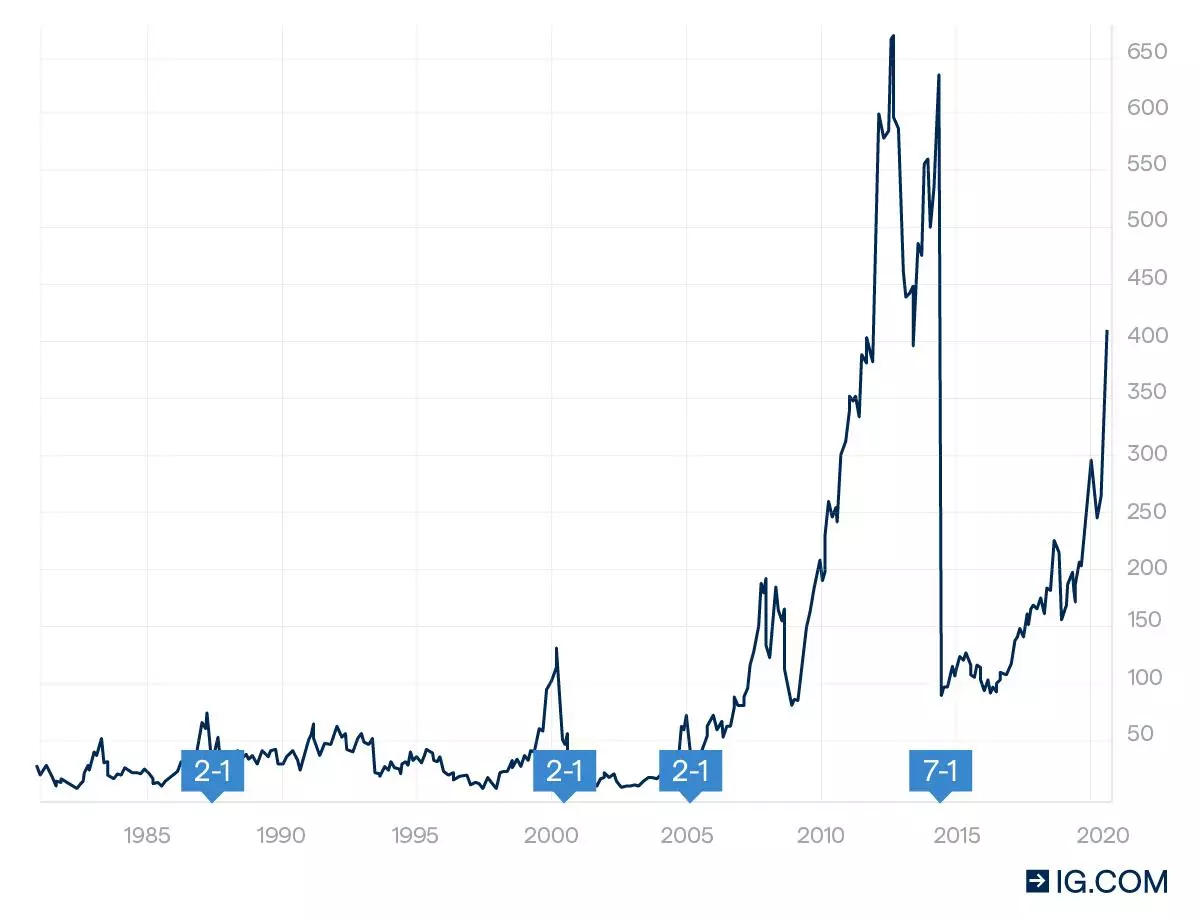
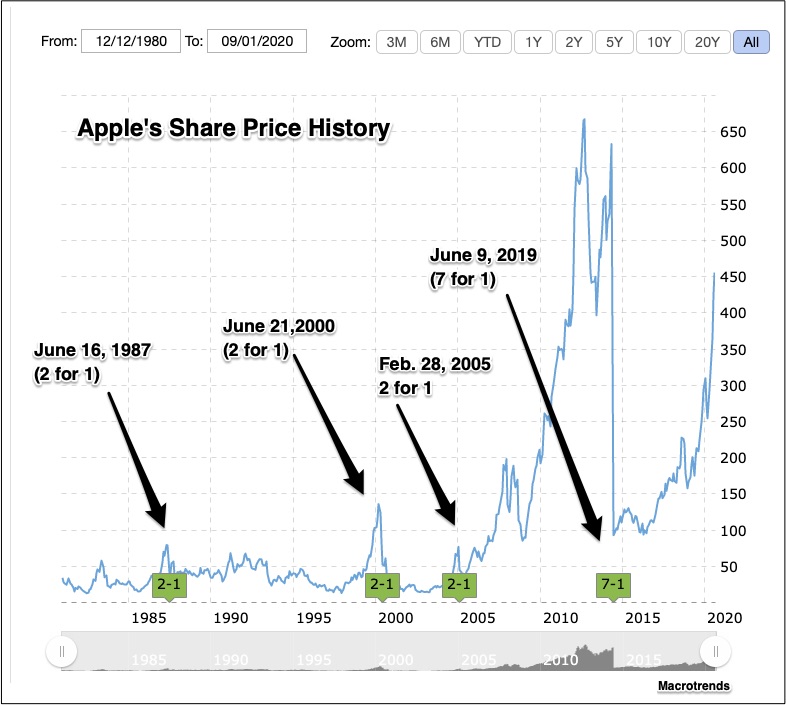
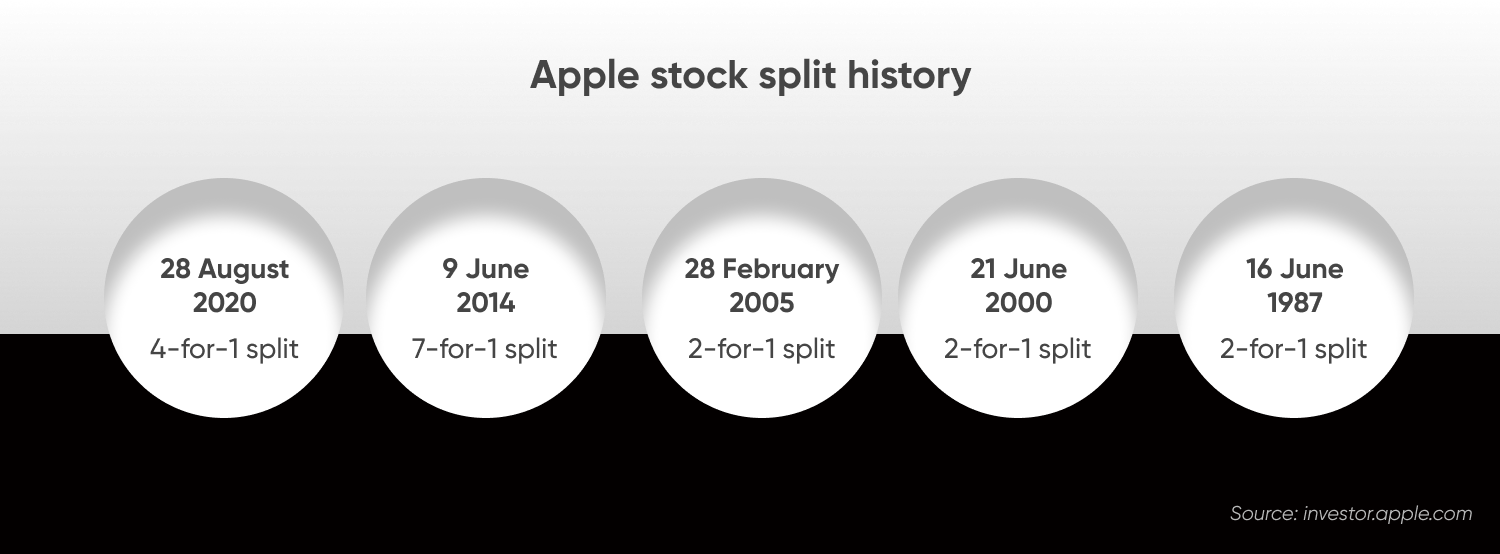
Apple’s journey from a garage startup to a trillion-dollar technology powerhouse is punctuated by five distinct stock splits, each marking a period of significant growth and market re-evaluation. These splits reflect not only the company’s escalating value but also its strategic financial planning to maintain investor appeal.
The Early Splits: Making Shares Accessible (1987, 2000, 2005)
Apple’s first stock split occurred on June 16, 1987, a 2-for-1 split. This came roughly seven years after its IPO in 1980, reflecting early success and investor enthusiasm for the Macintosh era. As the stock price climbed, making shares more accessible was a logical move to encourage broader participation.
The second split took place on June 21, 2000, another 2-for-1 split. This period coincided with the dot-com bubble, but also with Apple’s resurgence under Steve Jobs and the initial groundwork for its revolutionary product pipeline. The split aimed to keep the stock trading in an attractive range as the company geared up for its next phase of innovation.
The third split followed on February 28, 2005, once again a 2-for-1 split. This was a pivotal time for Apple, just two years before the launch of the iPhone and as the iPod dominated the music industry. The company was on the cusp of an explosive growth period, and this split ensured its shares remained affordable and liquid as its market value soared. These early splits established a pattern of leveraging corporate actions to manage stock price in tandem with fundamental business expansion.
The Tim Cook Era’s Major Split (2014)
Perhaps the most significant of Apple’s splits, and certainly the largest in terms of ratio, occurred on June 9, 2014. This was a 7-for-1 stock split, meaning for every one share an investor owned, they received six additional shares, totaling seven. This massive split took place under the leadership of Tim Cook, who had taken the helm after Steve Jobs’ passing.
By 2014, Apple’s stock had experienced phenomenal growth, with its share price exceeding $600. The 7-for-1 split dramatically reduced the per-share price to around $92, instantly making it far more accessible to retail investors and potentially paving the way for its inclusion in price-weighted indices like the Dow Jones Industrial Average (which it did join in 2015). This split was a clear signal of confidence in Apple’s sustained growth trajectory and a strategic move to broaden its investor base further. It also underscored the company’s commitment to returning value to shareholders, complementing its expanding dividend and share buyback programs.
The Most Recent Split: Adapting to New Market Dynamics (2020)
Apple’s fifth and most recent stock split happened on August 31, 2020. This was a 4-for-1 split, coming amidst a period of unprecedented market volatility driven by the global pandemic, but also exceptional performance for tech stocks. The stock had once again reached very high levels, trading well over $400 per share before the split.
The 2020 split aimed to reduce the share price to approximately $100, once again improving accessibility, especially for retail investors who were increasingly active in the market. This split also coincided with an increase in trading by fractional shares across various platforms, which somewhat mitigated the traditional need for splits, yet Apple chose to proceed. This decision highlighted the company’s ongoing strategy to maintain high liquidity and an attractive price point, ensuring its shares remained appealing to the widest possible range of investors in a rapidly evolving market landscape. It also underscored the robust financial health and continued growth story of Apple, even in challenging economic times.
The Financial Rationale Behind Apple’s Splits
Apple’s consistent use of stock splits is not arbitrary; it’s rooted in clear financial strategies designed to optimize its market presence and shareholder engagement. These rationales go beyond simple price adjustments, touching upon liquidity, investor psychology, and strategic positioning.
Enhancing Liquidity and Attracting Retail Investors
One of the foremost financial reasons for Apple’s stock splits has been to enhance liquidity. A lower share price generally translates to higher trading volumes because more individual investors can afford to buy shares. This increased activity leads to a tighter bid-ask spread and easier execution of trades, benefiting all market participants. For a company as widely held as Apple, maximizing liquidity is crucial for efficient price discovery and overall market health.
Furthermore, lower share prices are inherently more attractive to retail investors. While institutional investors often trade in large blocks and are less sensitive to per-share price, smaller individual investors often prefer to buy multiple shares rather than just a fraction of one expensive share. By making its stock more “affordable,” Apple effectively broadens its investor base, fostering a more diverse ownership structure and potentially increasing demand for its shares, particularly among its loyal customer base who may also wish to invest in the company.
Maintaining Affordability for Employees and ESOPs
Beyond external investors, stock splits also play a significant role in internal financial management, particularly concerning employee stock ownership plans (ESOPs) and executive compensation. Many companies grant stock options or restricted stock units (RSUs) to employees as part of their compensation packages. When the share price becomes exceedingly high, the number of shares that can be granted for a given compensation value decreases. This can make these benefits less tangible or attractive for employees.
By splitting the stock, Apple ensures that its employee stock purchase programs and equity compensation plans remain practical and motivating. It allows employees to acquire a more substantial number of shares, even with limited capital, enhancing their sense of ownership and alignment with the company’s long-term success. This is a critical aspect of talent retention and motivation, especially for a company that relies heavily on innovation driven by its workforce.
Signalling Confidence and Future Growth Potential
While a stock split doesn’t change fundamentals, it often serves as a powerful signal from management to the market. A company typically splits its stock when its share price has risen significantly, indicating strong performance and investor confidence. By splitting, management implicitly communicates its belief that the company’s growth trajectory is sustainable and that the stock is expected to continue appreciating in value.
For Apple, each split has coincided with, or immediately preceded, periods of immense innovation and market dominance. The splits in 2000 and 2005 predated the iPhone era, and the 2014 and 2020 splits followed sustained periods of record-breaking revenue and profit. These actions reinforce a narrative of success and future potential, often generating positive media attention and investor interest, which can contribute to a positive feedback loop for the stock’s performance.
The Investor’s Perspective: What Stock Splits Mean for You
From an individual investor’s standpoint, understanding the implications of a stock split is crucial for making informed financial decisions. While the immediate impact is purely cosmetic, the psychological and long-term effects can be notable.
Does a Stock Split Create Value?
The short answer is no; a stock split itself does not create intrinsic value. As established, your total investment value remains the same immediately after a split. If you owned $1,000 worth of Apple stock before a 2-for-1 split, you still own $1,000 worth afterward, just represented by more shares at a lower price. The company’s market capitalization, its earnings per share (on a split-adjusted basis), and its underlying business performance are unchanged by this corporate action.
However, where a stock split can create value is indirectly. By making the stock more accessible, a split can increase demand, leading to greater trading volume and potentially a higher market price over time. This uplift is not guaranteed, but historical data often shows that stocks tend to perform well after a split, particularly for growth companies. This positive performance is usually attributed to the company’s strong fundamentals that led to the split in the first place, rather than the split itself. Investors should always remember that the company’s financial health and future prospects are the true drivers of value, not merely the number of shares outstanding or the price per share.
Psychological Impact on Trading Behavior
The psychological impact of a stock split on investor behavior is significant. A lower share price often makes a stock feel more affordable and attractive. For many retail investors, buying 10 shares at $100 feels more substantial than buying 1 share at $1,000, even though the total investment amount is the same. This perception can lead to increased buying activity, especially from new investors or those with smaller capital.
Furthermore, a split can reset the “anchor price” in investors’ minds. If a stock has traded at $500 for a long time, $450 might feel like a discount. After a split, say to $100, a move to $110 feels like a significant gain, even if it represents the same percentage increase as a jump from $450 to $500 before the split. This psychological phenomenon can contribute to positive momentum in the stock’s trading after a split announcement. It’s a testament to how human emotion can intertwine with purely mathematical financial decisions.
Long-Term Implications for Shareholder Returns
For long-term investors in Apple, stock splits have historically been a positive indicator. Each split has coincided with periods of sustained growth for the company, and investors who held through these splits have seen tremendous returns. The splits made it easier for more people to buy in, fueling demand and helping to drive the stock’s overall appreciation.
The most important takeaway for long-term investors is to focus on the underlying fundamentals of Apple’s business: its innovation pipeline, revenue growth, profitability, market share, and competitive advantages. The splits are merely corporate tools that aid in the presentation and accessibility of ownership. While splits might offer a short-term psychological boost or liquidity bump, true long-term shareholder returns are generated by Apple’s consistent ability to deliver groundbreaking products and services that captivate consumers and generate robust financial performance. Therefore, a split should prompt an investor to re-evaluate the company’s fundamentals, rather than simply celebrate the split itself.
Beyond the Split: Apple’s Enduring Financial Strength
While stock splits offer valuable insights into a company’s financial strategy and market perception, they are ultimately just one facet of Apple’s comprehensive financial story. The true strength of Apple as an investment lies in its consistent ability to generate massive revenues, profit, and shareholder value, supported by prudent capital allocation.
Revenue Growth and Profitability
Apple’s financial might is primarily driven by its unparalleled ability to innovate and execute, leading to staggering revenue growth and industry-leading profitability. From its Mac computers to the iPod, iPhone, iPad, Apple Watch, and its rapidly expanding services segment (App Store, Apple Music, iCloud, Apple TV+), the company has consistently introduced products and services that redefine categories and capture massive market share. Its integrated ecosystem creates powerful network effects, locking in customers and fostering recurring revenue streams.
This translates into formidable financial results: multi-billion-dollar quarterly revenues, high-profit margins, and immense free cash flow. These fundamentals are what truly drive investor value and allow the company to pursue strategic actions like stock splits, knowing that the underlying business is robust. Analysts and investors closely monitor Apple’s quarterly earnings reports, sales figures for new products, and growth in its services division, as these are the real engines of its valuation.
Share Buybacks and Dividends
In addition to stock splits, Apple has a history of returning capital to shareholders through aggressive share buyback programs and consistent dividend payments. Share buybacks reduce the number of outstanding shares, which can boost earnings per share and support the stock price. Apple has consistently executed among the largest buyback programs in corporate history, reflecting its strong cash generation and commitment to enhancing shareholder value.
Furthermore, Apple initiated a dividend payment in 2012 and has consistently increased it since. Dividends provide direct income to shareholders, making the stock attractive to income-focused investors in addition to growth investors. These capital allocation strategies, combined with its stock splits, demonstrate Apple’s comprehensive approach to managing its financial structure to benefit its diverse shareholder base and reinforce its status as a financially sound, investor-friendly corporation.
Future Outlook and Investor Considerations
Looking ahead, Apple continues to be a central figure in the global economy and a key component of many investment portfolios. Its future outlook will hinge on its ability to continue innovating, expanding its services revenue, and navigating evolving geopolitical and regulatory landscapes. Areas like augmented reality, artificial intelligence, and new product categories (e.g., Apple Vision Pro, potential electric vehicle projects) represent avenues for continued growth.
For investors, understanding Apple’s history of stock splits provides valuable context for how the company manages its shares and interacts with the market. However, the decision to invest in Apple—or any company—should always be based on a thorough analysis of its financial health, competitive position, growth prospects, and valuation. Stock splits are a part of Apple’s rich financial narrative, reflecting its journey of unprecedented growth and its ongoing commitment to making its success accessible to investors worldwide.
aViewFromTheCave is a participant in the Amazon Services LLC Associates Program, an affiliate advertising program designed to provide a means for sites to earn advertising fees by advertising and linking to Amazon.com. Amazon, the Amazon logo, AmazonSupply, and the AmazonSupply logo are trademarks of Amazon.com, Inc. or its affiliates. As an Amazon Associate we earn affiliate commissions from qualifying purchases.