
Amazon, a name synonymous with e-commerce, cloud computing, and digital innovation, stands as one of the most recognized and influential brands worldwide. Its journey from an online bookstore to a sprawling global enterprise is a testament to astute brand strategy, relentless market expansion, and an unwavering focus on customer experience. The question “what countries have Amazon” isn’t merely a geographical query; it’s an inquiry into the strategic footprint of a corporate giant, revealing the deliberate choices made to embed its brand identity and operational excellence across diverse cultures and economies. This article delves into the brand strategy behind Amazon’s global reach, exploring where it operates and the underlying principles that guide its international corporate identity and market penetration.
The Genesis of a Global E-commerce Powerhouse
Amazon’s brand narrative began in the United States, meticulously building a reputation for convenience, selection, and competitive pricing. This initial success laid the groundwork for an ambitious global vision, transforming a national brand into a universal phenomenon. Understanding its origins is key to appreciating the scale and complexity of its international expansion.
From Bookstore to Everything Store: Early U.S. Dominance
Founded by Jeff Bezos in 1994, Amazon initially capitalized on the nascent internet’s potential to disrupt traditional retail, starting with books. The brand quickly established itself by offering an unparalleled selection, user-friendly interface, and efficient delivery. This period was crucial for refining Amazon’s core value proposition – a customer-centric approach that would later become a cornerstone of its global brand identity. As it diversified into music, movies, electronics, and eventually an “everything store,” Amazon honed its logistical capabilities and technological infrastructure, creating a scalable model ready for international deployment. The brand built trust and familiarity within its home market, gathering valuable insights into consumer behavior and e-commerce dynamics that would inform its later international ventures.
The First Forays: Pioneering International Markets
Amazon’s leap across borders began remarkably early, signaling its global ambitions from the late 1990s. Recognizing that the internet knew no geographical bounds, Amazon strategically targeted developed markets with strong internet penetration and consumer purchasing power.
-
United Kingdom (1998): Amazon’s first international expansion was into the UK, a culturally familiar market with a robust postal service and a large English-speaking population. This move was a strategic testbed, allowing Amazon to adapt its model to a new regulatory and consumer landscape while leveraging brand familiarity.
-
Germany (1998): Simultaneously, Amazon launched in Germany, a market known for its high purchasing power and logistical efficiency. This presented a greater challenge in terms of language and cultural adaptation but offered significant growth potential.
-
Canada (2002): Proximity and shared cultural elements with the US made Canada a natural next step, facilitating easier logistics and brand transfer.
-
Japan (2000): Japan represented a more significant cultural and logistical challenge, but its tech-savvy population and dense urban centers made it an attractive market for e-commerce, demonstrating Amazon’s willingness to invest heavily in localization.
These early expansions were not just about opening websites; they were about strategically embedding the Amazon brand in new territories, learning to localize its offerings, and building the logistical networks that would support its future global dominance.
Mapping Amazon’s Core E-commerce Markets
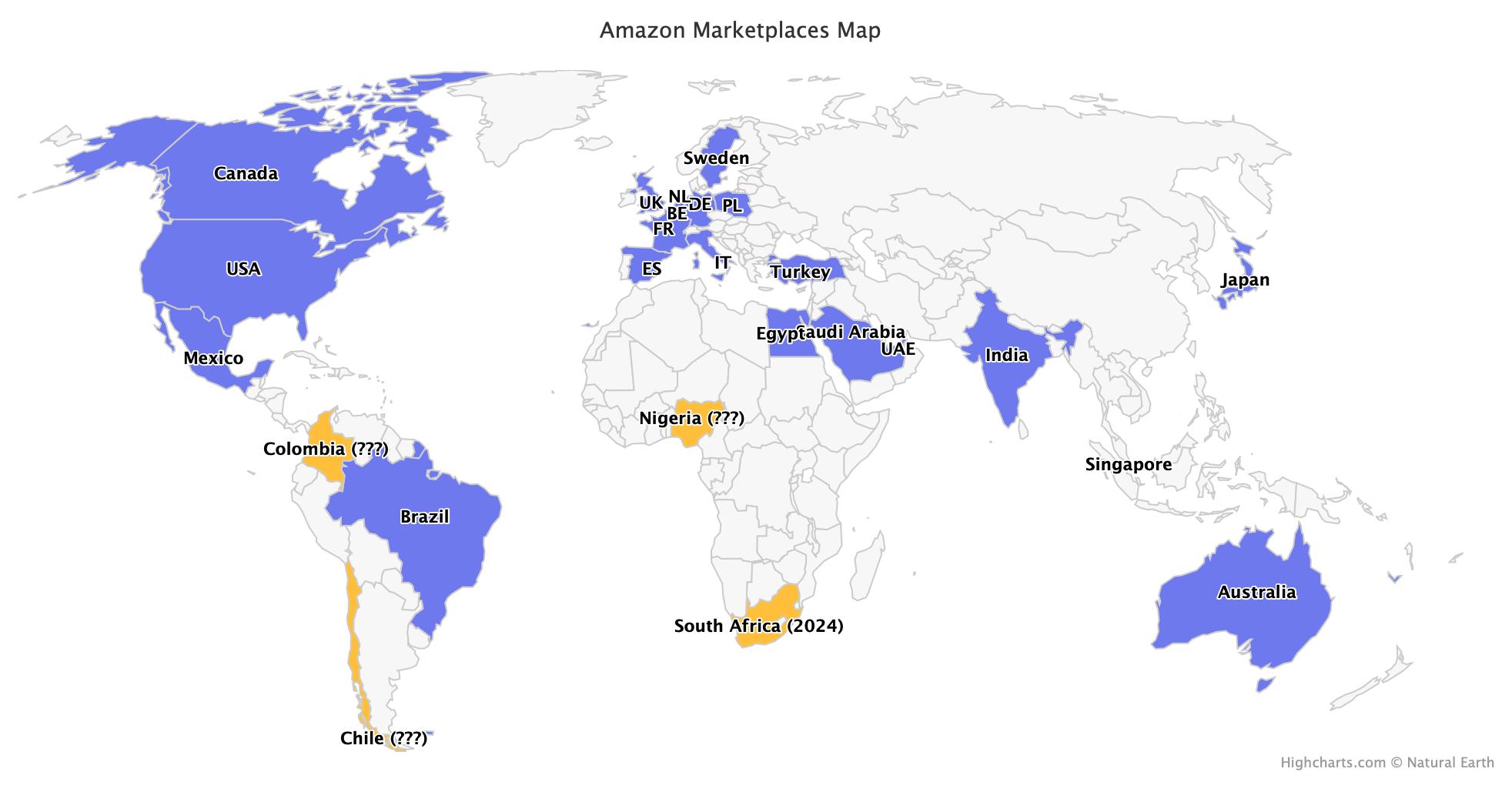
Today, Amazon’s e-commerce operations span numerous countries, each representing a deliberate strategic choice based on market potential, economic stability, and digital readiness. Its presence is categorized by the degree of brand integration, from full-fledged local websites with Prime services to more nascent operations.
Established Western Markets: Europe and North America
Amazon has cemented its brand as a household name across much of Western Europe and North America. These markets benefit from well-developed infrastructures and high internet penetration, allowing Amazon to offer its full suite of services, including rapid delivery, extensive product catalogs, and Prime memberships.
-
North America: Beyond the US and Canada, Mexico (2015) has seen significant investment, with Amazon tailoring its brand strategy to the unique purchasing habits and logistical challenges of Latin America’s second-largest economy.
-
Europe: Following the UK and Germany, Amazon expanded into France (2000), Italy (2010), Spain (2011), and the Netherlands (2014, with full e-commerce in 2020). These countries represent a sophisticated consumer base, where Amazon competes fiercely with local retailers, continuously refining its brand appeal through competitive pricing, convenience, and service. Sweden (2020), Poland (2021), and Belgium (2022) are among Amazon’s more recent European ventures, indicating a continued push to fill in geographical gaps and capture new consumer bases.
Asia-Pacific Expansion: India, Australia, Singapore, UAE/KSA (Middle East)
Amazon’s brand strategy in the Asia-Pacific and Middle East regions demonstrates a nuanced approach, recognizing the vast cultural, economic, and regulatory differences.
-
India (2013): India represents one of Amazon’s most significant and challenging brand investments. With a massive population, growing internet penetration, and a burgeoning middle class, India is a critical long-term growth market. Amazon has had to adapt significantly, navigating complex regulations, fierce local competition (e.g., Flipkart), and developing unique logistical solutions for a diverse geographical landscape. Its brand message here often emphasizes selection, trust, and accessibility.
-
Australia (2017): A developed economy with a dispersed population, Australia presented opportunities for Amazon to extend its brand of convenience, particularly in electronics and everyday goods.
-
Singapore (2017): As a dense, affluent city-state and a regional hub, Singapore serves as a strategic point for Amazon to test new services and expand its Prime Now (ultra-fast delivery) offerings, showcasing its brand of urban efficiency.
-
United Arab Emirates (UAE) and Saudi Arabia (KSA) (2017, through acquisition of Souq.com): Amazon’s entry into the Middle East through the acquisition of Souq.com was a smart brand integration strategy. It allowed Amazon to leverage an established local brand and customer base, gradually rebranding it to Amazon while adapting to regional preferences and payment methods. This demonstrated a flexible approach to global brand expansion.
Emerging Markets and Strategic Pockets
Amazon continues to explore and establish its brand in new territories, often starting with limited services and gradually expanding.
-
Brazil (2012, full e-commerce in 2017): Another large and complex Latin American market, Brazil offers immense potential despite logistical and economic hurdles. Amazon’s brand here focuses on expanding product categories and enhancing delivery speed.
-
Egypt (2021, rebranding Souq.com): Similar to the UAE/KSA, Egypt represents a key North African market where Amazon is building its brand presence on the foundation of a previously acquired local platform.
-
Other countries where Amazon has a presence, albeit sometimes limited to specific services like Amazon Web Services (AWS) or specific product lines, include Turkey (2018) and more recently Colombia (2020) and Chile (2023), primarily via AWS infrastructure but hinting at future retail ambitions.
It’s important to note that “having Amazon” can mean different things. For many countries, Amazon Web Services (AWS) has a strong presence, providing cloud infrastructure, even if a full Amazon.com retail website doesn’t exist. This highlights the multi-faceted nature of Amazon’s global brand strategy.
The Strategic Imperatives Behind Global Brand Expansion

Amazon’s widespread international presence is not accidental; it is the outcome of a deliberate and dynamic brand strategy, driven by a set of core imperatives that extend beyond mere geographical presence.
Market Opportunity and Customer Acquisition: Tapping into New Demand
At its heart, Amazon’s global expansion is about brand growth and market dominance. Each new country represents a pool of potential customers and an opportunity to capture market share. The brand meticulously assesses demographics, economic indicators, internet penetration, and e-commerce readiness before making a move. The goal is to onboard new customer segments into the Amazon ecosystem, expanding its reach and reinforcing its position as the default choice for online shopping. This also involves leveraging positive brand associations built in existing markets to accelerate adoption in new ones, using its global reputation for reliability and selection as a powerful marketing tool.
Supply Chain and Logistics Mastery: Building a Global Infrastructure
A critical component of Amazon’s global brand promise is its unparalleled logistical capability. Expanding into new countries necessitates replicating or adapting its intricate network of fulfillment centers, transportation routes, and last-mile delivery solutions. This operational excellence is integral to the Amazon brand, ensuring products reach customers efficiently and reliably, regardless of their location. Investing in local supply chains, integrating with regional carriers, and developing innovative delivery solutions (like Locker systems or specific local delivery partnerships) are crucial for maintaining the brand’s reputation for speed and convenience in diverse geographical contexts. This infrastructure not only supports e-commerce but also enables other Amazon ventures like AWS to provide localized services.
Localizing the Brand Experience: Adapting to Cultural Nuances
While Amazon maintains a consistent global brand identity around customer-centricity and convenience, its successful international expansion relies heavily on localization. This goes beyond mere language translation. It involves adapting payment methods to local preferences (e.g., cash on delivery in India), curating product selections that resonate with local tastes and cultural practices, and celebrating local festivals and shopping events (e.g., Diwali in India, Black Friday in Europe). The brand also adapts its marketing messages and advertising campaigns to reflect local idioms and values, ensuring that the Amazon brand feels relevant and accessible to local consumers. This strategic balance between global consistency and local relevance is a hallmark of Amazon’s successful brand strategy.
Beyond E-commerce: Expanding the Amazon Brand Ecosystem Globally
Amazon’s brand footprint extends far beyond its retail websites. Its diversified portfolio of services and products contributes significantly to its global brand recognition and value. These ventures often precede or parallel the e-commerce launch in new countries, establishing an ecosystem that locks in customers and creates multiple touchpoints with the Amazon brand.
Amazon Web Services (AWS): The Ubiquitous Cloud Foundation
AWS is arguably Amazon’s most globally pervasive brand. Operating in over 30 geographic regions with more than 100 availability zones, AWS provides cloud computing infrastructure to businesses, governments, and educational institutions worldwide. Its brand identity is built on reliability, scalability, security, and innovation. AWS’s global presence often precedes Amazon’s retail operations in a country, laying technological groundwork and building enterprise relationships that can indirectly support future e-commerce ventures. It’s a critical, albeit less consumer-facing, facet of Amazon’s global brand.
Prime’s Global Appeal: Loyalty, Convenience, and Entertainment
Amazon Prime is a powerful loyalty program that encapsulates the Amazon brand promise of premium service. Available in most countries with full Amazon e-commerce, Prime offers expedited shipping, exclusive deals, and access to a vast library of digital content (Prime Video, Prime Music, Prime Reading). The global rollout of Prime Video, in particular, has brought the Amazon brand to even more countries where a full retail presence might not yet exist, positioning Amazon as a major player in the global entertainment landscape. This strategy deepens customer engagement and strengthens brand loyalty across its diverse offerings.
Other Ventures: Alexa, Kindle, and More
Amazon’s hardware products like Kindle e-readers and Echo smart speakers (powered by Alexa) further extend its brand into homes worldwide. While their availability varies by country, these devices solidify Amazon’s presence in the digital lifestyle of consumers. Alexa’s multilingual capabilities and localized content ensure its relevance in diverse markets, while Kindle’s vast library breaks down geographical barriers for readers. These products not only generate revenue but also serve as brand ambassadors, integrating Amazon’s technology and services into daily life.
Challenges and Future Outlook for Amazon’s Global Brand
Despite its immense success, Amazon’s global brand expansion is not without its challenges. The journey into new markets is fraught with regulatory hurdles, intense competition, and the constant need to adapt.
Navigating Regulatory Landscapes and Competition
Each country presents its own unique set of regulations concerning e-commerce, data privacy, labor laws, and taxation. Amazon’s brand strategy must be agile enough to navigate these complexities, often requiring significant investment in legal and compliance teams. Moreover, Amazon faces formidable local competitors in almost every market—companies deeply entrenched in their respective cultures and often benefiting from strong local brand loyalty. Sustaining its competitive edge requires continuous innovation, aggressive pricing, and a consistent demonstration of its brand value. Issues of antitrust and market dominance are also global concerns that frequently challenge Amazon’s operations and brand perception.
Sustaining Brand Identity While Localizing
The delicate balance between maintaining a consistent global brand identity and effectively localizing its offerings is an ongoing challenge. While the core tenets of convenience, selection, and customer service remain universal, how these are manifested must evolve. Over-localization risks diluting the global brand, while under-localization can lead to brand alienation in specific markets. Amazon continually refines this balance, learning from its experiences in different regions to ensure its brand resonates authentically with a global audience.

The Uncharted Territories: Where Could Amazon Go Next?
Looking ahead, Amazon’s global brand strategy will likely continue its trajectory of strategic expansion. Countries with large, internet-savvy populations and growing middle classes, particularly in Southeast Asia, Africa, and parts of Eastern Europe, represent potential future frontiers. However, entry will be guided by careful consideration of infrastructure, regulatory environments, competitive landscapes, and the readiness of the market to embrace Amazon’s brand promise. The company might also deepen its presence in existing markets, expanding its physical footprint with more fulfillment centers, physical stores, or new service offerings.
In conclusion, the question “what countries have Amazon” unveils a saga of strategic brand building and relentless global expansion. Amazon’s presence across dozens of countries, from established markets to emerging economies, is a testament to a corporate identity rooted in innovation, customer-centricity, and logistical mastery. Its brand strategy is a masterclass in adapting a global vision to local realities, consistently reinforcing its position as a transformative force in commerce and technology worldwide. As Amazon continues to grow, its global brand footprint will undoubtedly continue to expand and evolve, shaping the future of how businesses and consumers interact across the globe.
aViewFromTheCave is a participant in the Amazon Services LLC Associates Program, an affiliate advertising program designed to provide a means for sites to earn advertising fees by advertising and linking to Amazon.com. Amazon, the Amazon logo, AmazonSupply, and the AmazonSupply logo are trademarks of Amazon.com, Inc. or its affiliates. As an Amazon Associate we earn affiliate commissions from qualifying purchases.