
In the annals of corporate history, few companies have commanded the financial might and sustained investor interest quite like Apple Inc. The simple question, “What is Apple company worth?” belies a complex tapestry of market dynamics, unparalleled brand loyalty, strategic innovation, and astute financial management that has propelled it to unprecedented heights. For investors, economists, and even casual observers, understanding Apple’s valuation is more than just appreciating a number; it’s comprehending the mechanisms of modern capitalism and the potential of a company that has redefined consumer technology.
This article delves into the intricate financial landscape of Apple, exploring the metrics that define its value, the core drivers of its immense market capitalization, and the future horizons that will shape its financial trajectory. We will navigate beyond the headlines of trillion-dollar valuations to uncover the underlying economic principles and investment considerations that make Apple one of the most scrutinized and valuable entities on the planet.
The Multi-Trillion Dollar Phenomenon: A Historic Financial Journey
Apple’s journey from a garage startup to a global powerhouse is legendary, but its financial ascent in the 21st century has been nothing short of phenomenal. Reaching and often surpassing the multi-trillion-dollar market capitalization mark, Apple has consistently broken records, setting new benchmarks for corporate valuation. This isn’t merely a testament to its product sales but a reflection of deep investor confidence and robust financial health.
Market Capitalization Explained: The Primary Metric
At its core, “what Apple is worth” primarily refers to its market capitalization. This figure is calculated by multiplying the current share price by the total number of outstanding shares. It represents the total dollar value of a company’s outstanding shares and is the most common metric used by the investment community to determine a company’s size. While a daily fluctuating number, Apple’s market cap provides a snapshot of how the market values its current and future earnings potential. Unlike book value, which looks at assets minus liabilities, market cap is a forward-looking valuation, reflecting investor expectations.
The Road to Unprecedented Milestones: From Billion to Trillion
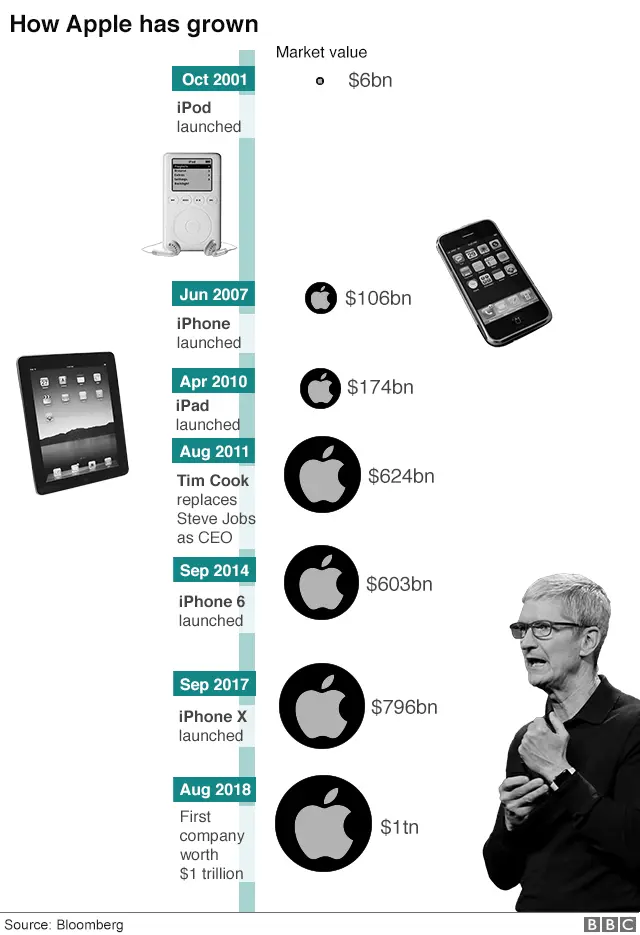
Apple’s path to a multi-trillion-dollar valuation has been marked by significant milestones. It first crossed the $1 trillion threshold in August 2018, becoming the first publicly traded U.S. company to do so. This was largely fueled by the consistent success of the iPhone, alongside the growing ecosystem of services. The leap to $2 trillion followed swiftly in August 2020, amidst a global pandemic that paradoxically boosted demand for personal technology and digital services. The $3 trillion mark was breached in January 2022, cementing its status as the world’s most valuable company for an extended period. These milestones aren’t just arbitrary numbers; they reflect periods of sustained growth, innovation, and strategic financial management that resonated powerfully with investors. Each new trillion-dollar valuation represented a period where the market believed Apple’s future earnings and growth vectors justified an even higher premium.
Comparing Apple’s Scale: Beyond Corporate Valuation
To truly grasp Apple’s scale, it’s insightful to compare its market capitalization not just to other companies, but to entire economies. At its peak, Apple’s valuation has surpassed the Gross Domestic Product (GDP) of numerous mid-sized countries. This comparison highlights its immense economic footprint, its ability to influence global supply chains, and its substantial contribution to the U.S. economy in terms of job creation, innovation, and capital flows. It underscores Apple’s role as a sovereign-like entity in the global economic landscape, wielding influence that extends far beyond typical corporate boundaries.
Decoding the Pillars of Apple’s Financial Powerhouse
Apple’s immense worth is not accidental; it is built upon a foundation of strategic product development, a thriving service ecosystem, and exceptionally strong financial discipline. Understanding these pillars is crucial to appreciating its enduring financial strength.
Product Dominance: iPhone, Mac, iPad, and Wearables
The enduring success of Apple’s hardware lineup remains a primary engine of its revenue and profitability. The iPhone, in particular, continues to be a cash cow, dominating the premium smartphone market with its brand appeal, user experience, and robust ecosystem integration. Macs, iPads, and the rapidly growing Wearables, Home, and Accessories segment (including Apple Watch, AirPods, and HomePod) diversify revenue streams and reinforce customer lock-in. Each product line isn’t just a standalone device; it’s a gateway into the Apple ecosystem, driving subsequent purchases and service subscriptions. This integrated approach amplifies the financial impact of each individual product sale.
The Services Ecosystem: A Growing Revenue Juggernaut
While hardware sales generate significant upfront revenue, Apple’s services segment has emerged as a critical growth engine and a key driver of its valuation. This segment includes the App Store, Apple Music, iCloud, Apple Pay, AppleCare, Apple TV+, Apple Arcade, and more. Services revenue is highly attractive to investors because it’s recurring, often has higher profit margins than hardware, and represents a sticky revenue stream that enhances customer lifetime value. The consistent growth in this segment demonstrates Apple’s successful transition into a more diversified revenue model, reducing its historical reliance solely on iPhone sales. This predictability and high margin nature of services revenue significantly contributes to a higher valuation multiple.
Robust Financials: Cash Reserves, Profit Margins, and Shareholder Returns
Beyond top-line revenue, Apple’s underlying financial health is exceptionally strong. It consistently maintains vast cash reserves, allowing for strategic investments, acquisitions, and resilience during economic downturns. Its profit margins, particularly for its services and high-end hardware, are industry-leading, translating directly into strong earnings per share (EPS). Furthermore, Apple is a major proponent of returning value to shareholders through substantial dividend payouts and aggressive share buyback programs. These buybacks reduce the number of outstanding shares, thereby increasing EPS and, theoretically, the share price, further enhancing shareholder value and contributing to a higher market capitalization. These financial disciplines underscore a mature, well-managed company focused on long-term value creation.
Brand Value and Customer Loyalty: An Intangible Asset with Tangible Returns

While “brand” might seem like a marketing concept, for financial analysts, Apple’s brand value and unparalleled customer loyalty are tangible assets with direct financial implications. A strong brand allows Apple to command premium pricing, reduces marketing costs due to word-of-mouth and inherent demand, and fosters an incredibly resilient customer base less prone to switching to competitors. This loyalty translates into repeat purchases, higher engagement with services, and a willingness to adopt new products. From a financial perspective, a powerful brand reduces business risk, stabilizes revenue streams, and commands a premium multiple in valuation models, making it a critical, albeit intangible, component of Apple’s immense worth.
Valuation Metrics and Investor Perspectives
Assessing Apple’s worth goes beyond simply looking at its market capitalization. Savvy investors and financial analysts employ a suite of valuation metrics to determine if the stock is overvalued, undervalued, or fairly priced, and to gauge its attractiveness as an investment.
Beyond Market Cap: Understanding P/E Ratios, EV/EBITDA, and DCF
While market capitalization tells us the total value of the company, other metrics provide deeper insights. The Price-to-Earnings (P/E) ratio compares the company’s share price to its earnings per share, indicating how much investors are willing to pay for each dollar of earnings. A higher P/E often suggests higher growth expectations. Enterprise Value to EBITDA (EV/EBITDA) is another crucial metric, especially for comparing companies across different industries, as it accounts for debt and cash, providing a more comprehensive view of the company’s total value relative to its operating profitability before non-cash expenses. Finally, Discounted Cash Flow (DCF) analysis is a fundamental valuation method that projects a company’s future free cash flows and discounts them back to their present value, providing an intrinsic value estimate against which the market price can be compared. These metrics, alongside revenue growth rates, profit margins, and return on invested capital (ROIC), help investors form a holistic view of Apple’s financial health and investment potential.
Dividend Policy and Share Buybacks: Returning Value to Shareholders
Apple’s commitment to returning capital to shareholders is a significant factor for many investors. The company maintains a consistent dividend policy, offering a steady income stream to its shareholders, particularly attractive to income-focused investors. More notably, Apple has executed some of the largest share buyback programs in corporate history. By repurchasing its own stock, Apple reduces the number of outstanding shares, which theoretically increases earnings per share (EPS) and often the stock price itself, thereby enhancing shareholder value. These actions signal financial strength and a management team confident in the company’s long-term prospects, further bolstering its appeal to the investment community.
Institutional Ownership and Analyst Consensus: A Look at Market Sentiment
A substantial portion of Apple’s stock is held by institutional investors – mutual funds, hedge funds, pension funds, and other large financial entities. High institutional ownership often indicates confidence in the company’s stability and growth prospects. Furthermore, Wall Street analysts frequently cover Apple, providing ratings (buy, hold, sell) and price targets. The consensus of these analysts offers a snapshot of current market sentiment and often influences short-term trading decisions. While not infallible, this collective expert opinion contributes to how the market perceives Apple’s worth and future trajectory, impacting its daily valuation.
Navigating Future Financial Horizons: Challenges and Growth Vectors
Despite its colossal valuation, Apple is not immune to challenges. Its future worth will be shaped by its ability to navigate a complex global landscape, continue innovating, and adapt to evolving market demands.
Regulatory Scrutiny and Geopolitical Risks
As a dominant global technology player, Apple faces increasing regulatory scrutiny worldwide. Concerns about anti-competitive practices, app store fees, privacy, and data security pose potential threats to its business model and, consequently, its valuation. Fines, forced changes to its ecosystem, or even breakups could impact its profitability and growth prospects. Geopolitical tensions, particularly regarding its extensive supply chain in China, also present significant risks, including disruptions to manufacturing, increased tariffs, and market access issues, all of which could negatively impact its financial performance.
Innovation Cycles and Market Saturation
The technology industry thrives on innovation. While Apple has a strong track record, the challenge of maintaining its pace of groundbreaking innovation in mature markets is ever-present. Smartphone markets, for instance, are becoming increasingly saturated, leading to longer upgrade cycles. Apple’s ability to introduce truly new and compelling product categories beyond its current core offerings – such as augmented reality (AR) or electric vehicles – will be crucial for sustained long-term growth and justifying its premium valuation. Stagnant innovation could lead to slower revenue growth, which would inevitably impact its market worth.
Emerging Markets and New Product Categories: Untapped Financial Potential
Despite its global reach, significant financial opportunities remain in emerging markets where smartphone penetration is still growing, and disposable incomes are rising. Tailoring products and services to these regions could unlock substantial new revenue streams. Furthermore, Apple’s ventures into new product categories, often hinted at but yet to be fully realized, represent colossal potential growth vectors. Areas like virtual/augmented reality headsets, autonomous driving technology, and health tech could fundamentally redefine Apple’s market opportunities and add trillions more to its valuation if successfully executed, providing new avenues for financial expansion.

Sustainable Practices and ESG Investing: Long-Term Value Creation
In today’s investment landscape, environmental, social, and governance (ESG) factors are increasingly important to institutional investors. Apple’s commitment to sustainable practices, ethical sourcing, labor standards, and robust corporate governance can significantly impact its long-term valuation. Companies with strong ESG performance are often viewed as more resilient, less risky, and better positioned for future regulatory environments, making them more attractive to a growing segment of investors focused on sustainable and responsible investing. This focus on long-term value creation through responsible business practices further solidifies Apple’s worth beyond immediate financial metrics.
In conclusion, “what Apple is worth” is a dynamic and multifaceted figure, currently measured in the trillions, reflecting its market capitalization. This colossal valuation is built on the robust pillars of iconic hardware, a booming services ecosystem, stringent financial management, and an unparalleled brand. While challenges persist in the form of regulatory scrutiny and the constant demand for innovation, Apple’s strategic foresight and financial prowess position it to potentially continue its impressive trajectory, making it a pivotal entity in the global financial landscape for years to come.
aViewFromTheCave is a participant in the Amazon Services LLC Associates Program, an affiliate advertising program designed to provide a means for sites to earn advertising fees by advertising and linking to Amazon.com. Amazon, the Amazon logo, AmazonSupply, and the AmazonSupply logo are trademarks of Amazon.com, Inc. or its affiliates. As an Amazon Associate we earn affiliate commissions from qualifying purchases.