
The advent of cryptocurrency has ushered in a paradigm shift in global finance, presenting unprecedented opportunities for individuals to generate wealth outside traditional financial systems. What began as a niche technological experiment with Bitcoin has blossomed into a multi-trillion-dollar industry, offering a diverse array of pathways to earn, invest, and build financial independence. While the allure of quick riches often dominates headlines, a nuanced understanding of the landscape, coupled with strategic planning and diligent execution, is essential for sustainable success. This article delves into the various methods for making money in cryptocurrency, providing insights into the strategies, risks, and best practices for navigating this dynamic frontier.

Understanding the Cryptocurrency Landscape and Its Potential
Before diving into specific income-generation strategies, it’s crucial to establish a foundational understanding of what cryptocurrency is, why it holds financial appeal, and the inherent challenges it presents. This context empowers individuals to make informed decisions and approach the market with realistic expectations.
What is Cryptocurrency? A Brief Overview
At its core, cryptocurrency is a digital or virtual currency secured by cryptography, making it nearly impossible to counterfeit or double-spend. Unlike traditional fiat currencies issued by central banks, most cryptocurrencies are decentralized, operating on a technology called blockchain—a distributed ledger enforced by a network of computers. This decentralization aims to provide transparency, immutability, and often, censorship resistance. Bitcoin, created in 2009, was the first cryptocurrency, followed by thousands of others, each with unique functionalities, use cases, and economic models. These digital assets can represent anything from a store of value (like digital gold) to utility tokens that power decentralized applications (dApps) or govern blockchain networks.
Why Consider Crypto for Income Generation?
The primary driver for cryptocurrency’s appeal in income generation is its potential for significant returns. The nascent stage of many projects, coupled with rapid technological adoption and speculative interest, can lead to exponential price appreciation, far surpassing traditional investment vehicles. Furthermore, the decentralized nature of many crypto projects enables novel ways to earn passive income, participate in governance, and contribute to the network, often without intermediaries. The global accessibility of crypto markets also means that individuals worldwide can participate, leveraging an internet connection to access financial opportunities previously restricted by geographical or institutional barriers. For many, it represents a chance to democratize finance and empower individual investors.
Inherent Risks and Volatility
While the potential for gains is high, it is equally important to acknowledge and understand the inherent risks. Cryptocurrency markets are notoriously volatile. Prices can fluctuate dramatically within short periods, driven by market sentiment, regulatory news, technological developments, and macroeconomic factors. This volatility means that investments can lose significant value just as quickly as they gained it. Regulatory uncertainty also poses a risk; governments globally are still grappling with how to classify and regulate digital assets, which can lead to sudden shifts in market conditions. Furthermore, the ecosystem is not immune to scams, hacks, and fraudulent schemes, necessitating a high degree of skepticism and due diligence from participants. Understanding these risks is not meant to deter but to equip potential investors with a realistic perspective.
Diverse Strategies for Earning in Crypto
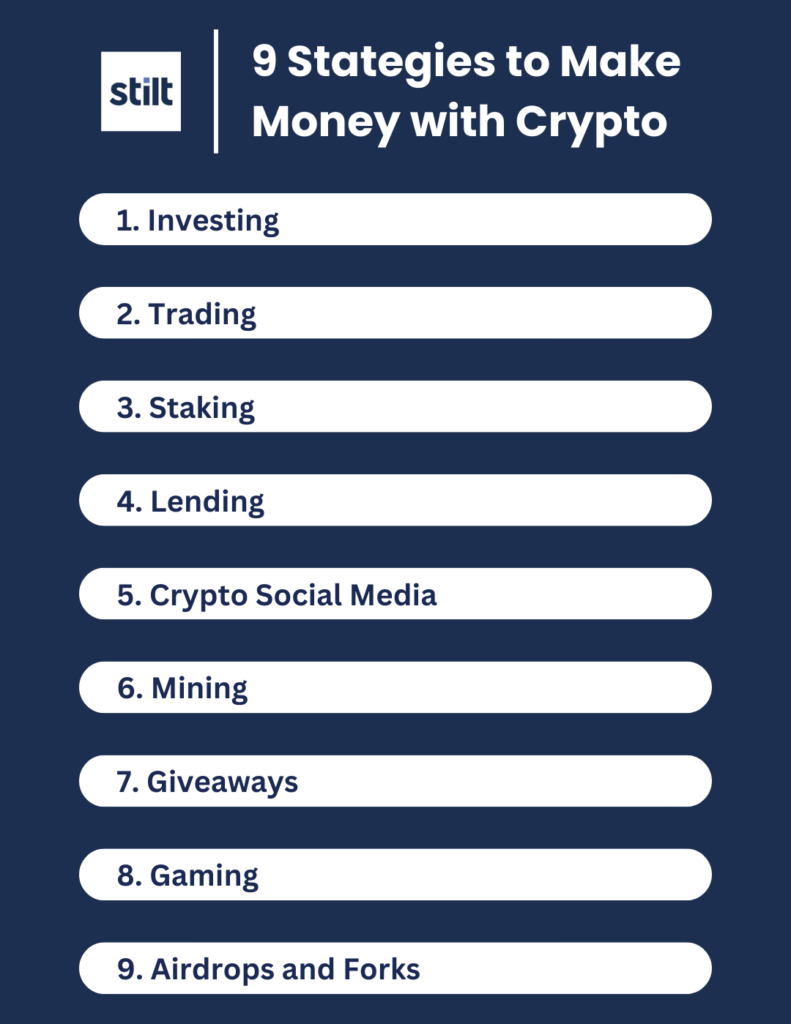
The methods for making money in cryptocurrency are multifaceted, ranging from active engagement in trading to more passive approaches that leverage network participation. A diversified strategy often proves most resilient, but understanding each avenue is key to choosing what aligns with one’s risk tolerance and financial goals.
Investing and Trading: The Core Approaches
The most common ways to make money in crypto involve buying and selling digital assets, aiming to profit from price movements.
Long-Term HODLing (Buy and Hold)
“HODL,” a popular term in the crypto community, originated from a misspelling of “hold” and refers to the strategy of buying cryptocurrencies and holding them for an extended period, often years, regardless of market fluctuations. The premise is that over time, the underlying value and adoption of robust projects will increase, leading to significant price appreciation. This strategy requires patience, conviction in the chosen assets, and the ability to withstand market downturns without panic selling. It’s often recommended for beginners due to its simplicity and lower demands on active market monitoring.
Active Trading (Day Trading, Swing Trading)
Active trading involves frequently buying and selling cryptocurrencies to capitalize on short-to-medium term price movements.
-
Day Trading: This involves executing multiple trades within a single trading day, aiming to profit from small price changes and closing all positions before the market closes (though crypto markets operate 24/7, the principle remains). Day trading requires deep market analysis, technical indicator proficiency, robust risk management, and significant time commitment.
-
Swing Trading: This strategy involves holding assets for a few days or weeks to profit from “swings” in price. Swing traders look for assets that are overbought or oversold and attempt to capture a portion of the subsequent reversal. It demands less intense monitoring than day trading but still requires a solid understanding of market trends and chart patterns. Both active trading styles carry higher risk due to transaction fees, potential for rapid losses, and the psychological demands of constant decision-making.
Dollar-Cost Averaging (DCA)
Dollar-Cost Averaging is a disciplined investment strategy where an investor divides the total amount to be invested across periodic purchases of a target asset over a certain period. For example, instead of investing $1,000 all at once, an investor might commit to buying $100 worth of Bitcoin every month for ten months. This strategy mitigates the risk of investing a large sum at an unfortunate peak price. By averaging out the purchase price over time, DCA can reduce the impact of volatility, making it a sound long-term accumulation strategy, especially in volatile markets like crypto.
Earning Passive Income Streams
Beyond actively trading, several methods allow individuals to earn cryptocurrency by contributing to or participating in blockchain networks, often with less direct market interaction.
Staking and Lending
-
Staking: Many modern cryptocurrencies operate on a Proof-of-Stake (PoS) consensus mechanism. Instead of miners, “stakers” validate transactions and secure the network by locking up (staking) a certain amount of their cryptocurrency. In return, they earn new coins as rewards, similar to earning interest in a savings account. Staking can be done directly or through staking pools and exchanges, offering a relatively low-effort way to generate passive income while supporting the network.
-
Lending: Decentralized Finance (DeFi) platforms allow users to lend out their crypto assets to borrowers, earning interest on their holdings. These loans are often overcollateralized or governed by smart contracts, reducing counterparty risk. Lending platforms vary in interest rates and terms, offering a flexible way to earn yield on idle assets.
Yield Farming and Liquidity Provision
Yield farming is a sophisticated DeFi strategy where investors lock up their crypto assets in liquidity pools to provide liquidity for decentralized exchanges (DEXs) or lending protocols. In return, they earn fees from trades that use their provided liquidity and sometimes receive additional “governance tokens” as rewards. These tokens can then be sold for profit or staked themselves. While offering potentially high returns, yield farming is complex, carries risks like “impermanent loss” (a temporary loss of funds due to volatility in a trading pair), and often requires substantial capital.
Mining (Proof-of-Work)
Mining is the original method for earning cryptocurrency, primarily associated with Bitcoin and other Proof-of-Work (PoW) blockchains. Miners use powerful computers to solve complex computational puzzles to validate transactions and add new blocks to the blockchain. The first miner to solve the puzzle earns newly minted coins and transaction fees. While profitable in the early days, PoW mining has become highly competitive, requiring significant investment in specialized hardware (ASICs), electricity, and cooling systems. For most individual investors, the barrier to entry is now prohibitively high.
Cloud Mining
Cloud mining offers an alternative to traditional mining where individuals rent computing power from large mining farms. Instead of owning and maintaining hardware, users pay a fee to subscribe to a portion of a data center’s mining capacity. While it lowers the technical hurdles, cloud mining contracts often come with opaque fee structures, lower profitability compared to direct mining, and a higher risk of scams. Due diligence on the provider is paramount.
Engaging with Web3 and Decentralized Finance (DeFi)
The broader Web3 ecosystem and DeFi are continually evolving, creating new avenues for earning.
Play-to-Earn (P2E) Gaming
P2E games integrate blockchain technology, allowing players to earn cryptocurrency and NFTs (Non-Fungible Tokens) through gameplay, completing quests, winning battles, or trading in-game assets. These digital assets have real-world value and can be sold on marketplaces. While still nascent, P2E games like Axie Infinity have demonstrated the potential for players to generate significant income, blurring the lines between gaming and finance.
Content Creation and NFTs
Artists, musicians, writers, and other creators can monetize their digital work by minting NFTs. An NFT is a unique digital asset that represents ownership of a specific item or piece of content, recorded on a blockchain. Selling NFTs allows creators to bypass traditional intermediaries, retain more control over their work, and earn royalties on secondary sales. This emerging market offers new financial opportunities for creators in the digital age.
Bounty Hunting and Airdrops
-
Bounty Hunting: Many new crypto projects offer “bounties” to individuals who perform specific tasks, such as bug testing their software, translating content, creating marketing materials, or promoting the project on social media. These bounties are paid in the project’s native cryptocurrency, offering a way to earn without direct investment.
-
Airdrops: An airdrop is a distribution of free cryptocurrency tokens to a large number of wallet addresses. Projects often conduct airdrops to raise awareness, reward early adopters, or decentralize token distribution. While largely passive and often requiring minimal effort (e.g., holding a certain token or performing a specific action), airdrops can result in unexpected financial gains.
Essential Considerations Before Diving In
Embarking on the journey of making money in cryptocurrency requires more than just knowing the strategies; it demands a disciplined approach to research, risk management, and security.
Due Diligence and Research
The cryptocurrency market is rife with projects, some legitimate and promising, others speculative and fraudulent. Thorough due diligence is non-negotiable. This involves researching the project’s whitepaper, team, technology, use case, market capitalization, trading volume, community sentiment, and competitive landscape. Understand the problem the project aims to solve and its viability. Never invest based on hype or recommendations without independent verification.
Risk Management and Portfolio Diversification
Given crypto’s volatility, robust risk management is paramount. Only invest what you can afford to lose. Avoid putting all your capital into a single asset; diversify your portfolio across different cryptocurrencies, and even consider diversifying between crypto and traditional assets. Setting stop-loss orders for active trading, and having a clear exit strategy for all investments, are crucial tools for limiting potential losses. Rebalance your portfolio periodically to maintain desired risk exposure.
Security Best Practices (Wallets, Exchanges)
The decentralized nature of crypto means you are your own bank, which comes with significant responsibility for security.
-
Wallets: Store your cryptocurrencies in secure wallets. Hardware wallets (e.g., Ledger, Trezor) offer the highest level of security for long-term storage (“cold storage”). Software wallets (e.g., MetaMask) are convenient for active use (“hot storage”).
-
Exchanges: Use reputable, regulated cryptocurrency exchanges with strong security features like two-factor authentication (2FA). Avoid keeping large amounts of cryptocurrency on exchanges for extended periods, as they are often targets for hackers.
-
Personal Security: Be wary of phishing scams, never share your private keys or seed phrases, and use strong, unique passwords for all crypto-related accounts.
Regulatory and Tax Implications
The regulatory landscape for cryptocurrency is still evolving globally. Understand the specific regulations in your jurisdiction regarding crypto trading, investment, and income. Crucially, be aware of your tax obligations. Most countries treat cryptocurrency as property or an asset for tax purposes, meaning capital gains from selling or trading, and income from staking, mining, or lending, may be subject to taxation. Consult with a qualified financial advisor or tax professional to ensure compliance.
Building a Sustainable Crypto Income Strategy
Making money in cryptocurrency is less about finding a get-rich-quick scheme and more about developing a sustainable, informed approach. This requires continuous learning, adaptability, and a clear financial framework.
Starting Small and Scaling Up
For beginners, it’s advisable to start with a small, manageable amount of capital. Experiment with simpler strategies like long-term HODLing or dollar-cost averaging before venturing into more complex or higher-risk activities like active trading or yield farming. As you gain experience, knowledge, and confidence, you can gradually scale up your investments and explore more diverse income streams.
Continuous Learning and Adaptation
The cryptocurrency space is one of the fastest-evolving industries. New technologies, projects, and market dynamics emerge constantly. To stay ahead and maintain a sustainable income strategy, continuous learning is essential. Follow reputable news sources, engage with knowledgeable communities, read whitepapers, and keep abreast of regulatory changes. Adapt your strategies as the market evolves and new opportunities or risks arise.

The Importance of a Clear Financial Plan
Ultimately, any successful venture into cryptocurrency for income generation must be integrated into a broader personal financial plan. Define your financial goals, risk tolerance, and time horizon. Cryptocurrency should ideally be a component of a diversified portfolio, rather than your sole investment. A clear plan helps to manage expectations, guide decision-making during volatile periods, and ensure that your crypto activities align with your overall financial well-being. By approaching cryptocurrency with a professional mindset, combining thorough research with disciplined execution and an awareness of risk, individuals can unlock significant potential for wealth creation in this revolutionary financial domain.
aViewFromTheCave is a participant in the Amazon Services LLC Associates Program, an affiliate advertising program designed to provide a means for sites to earn advertising fees by advertising and linking to Amazon.com. Amazon, the Amazon logo, AmazonSupply, and the AmazonSupply logo are trademarks of Amazon.com, Inc. or its affiliates. As an Amazon Associate we earn affiliate commissions from qualifying purchases.